


Roller skiing

Encyclopedia
Snow
Snow is a form of precipitation within the Earth's atmosphere in the form of crystalline water ice, consisting of a multitude of snowflakes that fall from clouds. Since snow is composed of small ice particles, it is a granular material. It has an open and therefore soft structure, unless packed by...
equivalent to cross-country skiing
Cross-country skiing
Cross-country skiing is a winter sport in which participants propel themselves across snow-covered terrain using skis and poles...
. Emulating ski
Ski
A ski is a long, flat device worn on the foot, usually attached through a boot, designed to help the wearer slide smoothly over snow. Originally intended as an aid to travel in snowy regions, they are now mainly used for recreational and sporting purposes...
s, elongated inline skates
Inline skates
In-line skates are a type of roller skate used for inline skating. Unlike quad skates, which have two front and two rear wheels, inline skates have two, three, four, or five wheels arranged in a single line...
, with wheel
Wheel
A wheel is a device that allows heavy objects to be moved easily through rotating on an axle through its center, facilitating movement or transportation while supporting a load, or performing labor in machines. Common examples found in transport applications. A wheel, together with an axle,...
s at the ends, are used on tarmac
Tarmac
Tarmac is a type of road surface. Tarmac refers to a material patented by Edgar Purnell Hooley in 1901...
. The skating/skiing action is very similar to actual cross-country skiing on snow.
First created as a summer training alternative, roller skiing has now grown into a competitive sport in its own right. Annual championships are held in various locations around the world. Most, if not all, national cross-country ski teams around the world roller ski during the off-season to simulate the ski motion.
The skiing technique applied on roller skis is very similar to the technique used on snow conditions. The back kick in classic technique is slightly different because roller skis do not slide backwards.
History
The first rollerskis were built in the mid ‘30s in Italy and North Europe.In the early 1950s, when cross-country skiing started to evolve to a serious competition sport, the necessity for good summer training grew. All around the world from 1950s to 1970s people experimented with skis on wheels.
In the 1970s something of a standard emerged and the first races took place. At this time all rollerskis had one wheel in front and two wheels at the back. The metal frame was between 70 and 100 centimetres (2'4" and 3'4") long.
Athletes felt they could start to engage themselves in competitions. In 1976, Giustino Del Vecchio, an air pilot, established a record in Monza
Monza
Monza is a city and comune on the river Lambro, a tributary of the Po, in the Lombardy region of Italy some 15 km north-northeast of Milan. It is the capital of the Province of Monza and Brianza. It is best known for its Grand Prix motor racing circuit, the Autodromo Nazionale Monza.On June...
by doing 240.5 km in 24 hours thanks to the skirolls he had designed, using material and technologies from the aircraft industry; narrow solid wheels with hard tread, reverse lock-up ball bearings to enable push forward.
In the beginning the skis were developed with one wheel in front and two wheels behind.The introduction of skating (free technique) in cross-country skiing implied some changes in the use of materials and training methods, which consequently produced an impact on rollerskis (maybe changes were started by rollerskis, with which skating is much easier). From 3 to 2 wheels, much lighter and easier to use, rollerskis could be used both for the classic style and skating.
Paolo Miorin, with his famous Skirollo, can be considered the inventor of the innovative 2-wheels rollerskis.
The World Record for the greatest number of roller skiers in one place was established in the Gatineau Park, Chelsea Quebec, Canada 2 October 2010.
The Races
The races became international and the need for serious supervising grew. Around 1985 the European Rollerski Federation was established and the first European Championships were organized in the Netherlands in 1988.The growth of the rollerski sport caused the FIS
International Ski Federation
The International Ski Federation, known by its name in French, Fédération Internationale de Ski is the main international organisation for ski sports...
(Federation Internationale de Ski) to notice the rollerski sport. In 1992 the congress decided to incorporate the rollerski sport.
After the first World Games
World Games
The World Games, first held in 1981, are an international multi-sport event, meant for sports, or disciplines or events within a sport, that are not contested in the Olympic Games...
in The Hague, in 1993, the first World Cup races where held in that same year. In 1998, in Prague
Prague
Prague is the capital and largest city of the Czech Republic. Situated in the north-west of the country on the Vltava river, the city is home to about 1.3 million people, while its metropolitan area is estimated to have a population of over 2.3 million...
, the congress decided to grant the rollerski sport the official FIS World Championships. On 30 August- 3 September 2000, these competitions where organized in the Netherlands
Netherlands
The Netherlands is a constituent country of the Kingdom of the Netherlands, located mainly in North-West Europe and with several islands in the Caribbean. Mainland Netherlands borders the North Sea to the north and west, Belgium to the south, and Germany to the east, and shares maritime borders...
.
The races are very well differentiated: from only uphill, to flat to undulating tracks. From relays, sprints (typical 200 metres) and team races to individual races and pursuit races. On flat tracks the speed can be as fast as 50 kilometres per hour (30 miles per hour). Average speed on flat tracks in World Cup races can easily be 30 kilometres per hour (almost 20 miles per hour). As in regular cross-country skiing, the rollers compete in classic and free style. Helmets and protective eyeglasses in competitions are mandatory.
World Cup and World Championships
The Italian, Russian, Norwegian, Swedish and German rollers, have been very strong in competitions compared to other Nations since the beginning in 1993. Note that World Roller Skiing championships are not an officially sanctioned races by FIS or recognized sports governing bodies.----
Men
So far, the World Cup and World Championships, have been dominated by a few very good rollers.The most successful skiroller are Italian Alfio di Gregorio, who has won the World Games three times and World Cup four times. Then include Russian Igor Glushkov who have won World Cup three times. One of the major cross-country skiers has noticed in the sport; It is the Frenchman Vincent Vittoz
Vincent Vittoz
Vincent Vittoz is a French cross-country skier. He grew up in the town of La Clusaz in the Northern French Alps and has been competing since 1982...
, which fetched World Championships in 2002. World Championships 2009 takes place in Piglio
Piglio
Piglio is a comune in the Province of Frosinone in the Italian region Lazio, located about 50 km east of Rome and about 30 km northwest of Frosinone, offering a panoramic view on the valleys of the Sacco and Aniene rivers....
, Italy.
----
Women
Mateja Bogatec from Italy has been one of the most successful female rollers since the beginning of the FISInternational Ski Federation
The International Ski Federation, known by its name in French, Fédération Internationale de Ski is the main international organisation for ski sports...
World Cup in 2000.
Equipment
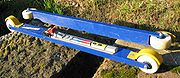
Roller skis for "classic" and "skate" style skiing are used. Also another type of roller ski is added called an off road roller ski. This type of roller ski is designed to take harsher conditions.For classic style roller skiing the skis usually have wider wheels, and a rachet mechanism on one of the wheels, normally the front. This front wheel only rolls in the forward direction and provides resistance on the "kick"—comparable to grip wax
Ski wax
Ski wax is a material applied to the bottom of skis or snowboards to improve the ski's performance on snow. It can also be applied to other devices that slide over snow and ice such as toboggans.- Types of ski wax :...
on snow.
For skate skiing, the roller skis usually have narrower wheels (similar to those used on inline skates), with both wheels rolling freely.
There are also types of roller skis that have both thin and thick wheels, with a thin one on the tip, a slightly thicker wheel in front of the binding, and two thick wheels at the very back.
Roller skis with pneumatic tires are also available for rough pavement and off-road use.
Normal cross-country ski binding
Ski binding
A ski binding is an attachment which anchors a ski boot to the ski. There are different types of bindings for different types of skiing.-Universal designs:...
s and ski boot
Ski boot
Ski boots are specialized footwear that are used in skiing to provide a way to attach the skier to skis using ski bindings. This ski-boot-binding combination is used to effectively transmit control inputs from the skier to the snow....
s are used with most roller skis. Cross-country ski pole
Ski pole
Ski poles are used by skiers to improve balance and timing. Early ski poles were simply sticks, then bamboo , then steel . In 1958, Ed Scott invented the aluminium ski pole...
s are also used, with the "basket" replaced by a tungsten carbide
Tungsten carbide
Tungsten carbide is an inorganic chemical compound containing equal parts of tungsten and carbon atoms. Colloquially, tungsten carbide is often simply called carbide. In its most basic form, it is a fine gray powder, but it can be pressed and formed into shapes for use in industrial machinery,...
spike.
Extra protective clothing is recommended (glove
Glove
A glove is a garment covering the hand. Gloves have separate sheaths or openings for each finger and the thumb; if there is an opening but no covering sheath for each finger they are called "fingerless gloves". Fingerless gloves with one large opening rather than individual openings for each...
s, helmet
Helmet
A helmet is a form of protective gear worn on the head to protect it from injuries.Ceremonial or symbolic helmets without protective function are sometimes used. The oldest known use of helmets was by Assyrian soldiers in 900BC, who wore thick leather or bronze helmets to protect the head from...
, knee and elbow pads). Many ski training programs require the use of helmets while roller skiing.
Most roller skis don't have bona fide brakes, except for a relatively new calf-activated brake pioneered by Len Johnson of V2 Jenex. Speed reducers, available on some models, work by providing different levels of friction against the wheels. There are also techniques for slowing down without the use of speed reducers. The most common of which is a motion similar to a snowplow on snow skis where pressure is applied to the outside edge of the roller ski and the skis pointed in an inward fashion.
Popular manufacturers of rollerskis are: Pursuit (US), Briko-Maplus (Italy), V2 Jenex (US), Marwe (Finland), Start (Finland), Pro Ski (Sweden), SkiSkett (Italy), Swenor(Norway) Eagle Sport (The Netherlands) and Oneway (US).
Roller skiing is most popular in Europe (France, Italy, Norway, Finland, Estonia, Sweden, Russia) where there are many serious races and even a World Cup Circuit. In North America, rollerskiing is popular in areas with many Nordic skiers such as Canmore
Canmore, Alberta
Canmore is a town in Alberta, Canada, located approximately west of the City of Calgary near the southeast boundary of Banff National Park. It is located in the Bow Valley within Alberta's Rockies. The town shares a border with Kananaskis Country to the west and south and the Municipal District of...
, Ottawa, Alberta
Alberta
Alberta is a province of Canada. It had an estimated population of 3.7 million in 2010 making it the most populous of Canada's three prairie provinces...
, Alaska
Alaska
Alaska is the largest state in the United States by area. It is situated in the northwest extremity of the North American continent, with Canada to the east, the Arctic Ocean to the north, and the Pacific Ocean to the west and south, with Russia further west across the Bering Strait...
, New York
New York
New York is a state in the Northeastern region of the United States. It is the nation's third most populous state. New York is bordered by New Jersey and Pennsylvania to the south, and by Connecticut, Massachusetts and Vermont to the east...
, Vermont
Vermont
Vermont is a state in the New England region of the northeastern United States of America. The state ranks 43rd in land area, , and 45th in total area. Its population according to the 2010 census, 630,337, is the second smallest in the country, larger only than Wyoming. It is the only New England...
, New Hampshire
New Hampshire
New Hampshire is a state in the New England region of the northeastern United States of America. The state was named after the southern English county of Hampshire. It is bordered by Massachusetts to the south, Vermont to the west, Maine and the Atlantic Ocean to the east, and the Canadian...
, Maine
Maine
Maine is a state in the New England region of the northeastern United States, bordered by the Atlantic Ocean to the east and south, New Hampshire to the west, and the Canadian provinces of Quebec to the northwest and New Brunswick to the northeast. Maine is both the northernmost and easternmost...
, Minnesota
Minnesota
Minnesota is a U.S. state located in the Midwestern United States. The twelfth largest state of the U.S., it is the twenty-first most populous, with 5.3 million residents. Minnesota was carved out of the eastern half of the Minnesota Territory and admitted to the Union as the thirty-second state...
, Wisconsin
Wisconsin
Wisconsin is a U.S. state located in the north-central United States and is part of the Midwest. It is bordered by Minnesota to the west, Iowa to the southwest, Illinois to the south, Lake Michigan to the east, Michigan to the northeast, and Lake Superior to the north. Wisconsin's capital is...
.
Safety
Roller skiing requires balance, flexibility, upper and lower body strength, good condition of lungs for breathing. As in other extreme sports, high coordination is required. Safety equipment should be worn always while roller skiing.It is recommended to wear reflective clothing and flashing red lights to increase visibility in dark areas. Safety equipment such as a helmet is recommended.
Nordic blading
Nordic blading is a sport which uses ski poles with special tips and inline skatesInline skates
In-line skates are a type of roller skate used for inline skating. Unlike quad skates, which have two front and two rear wheels, inline skates have two, three, four, or five wheels arranged in a single line...
or roller skis to train the total body for skiing. The sport has been practiced for over 80 years by elite cross-country skiers in the off season and is now being redescovered by the masses through blading. It is much like Nordic Ski walking, the only difference being that skates/roller skis are used. The benefits of Nordic blading are similar to that of cross-country skiing
Cross-country skiing
Cross-country skiing is a winter sport in which participants propel themselves across snow-covered terrain using skis and poles...
if performed correctly. Nordic Blading has also been proven more risky than inline skating as the poles constitute extra coordination challenges. By using the poles, the user can also expect to develop upper and core body strength.
Types of techniques used
- one-skate
- two-skate
- offset
- free skate
- double poling
- diagonal Stride
- Double pole-Kick (Step-Double pole)
- downhill (tuck, Slalom etc.)
Equipment needed
- Helmet
- Gloves
- Poles
- Inline skates / Roller skis
- Boots (If using actual roller skis)
- protective eyewear(mandatory in some competitions)