

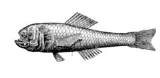
Ridgehead

Encyclopedia
Ridgeheads, also known as bigscales, are a family
(Melamphaidae, from the Greek
melanos [black] and amphi [by both sides]) of small, deep-sea stephanoberyciform fish
. The family contains approximately 37 species
in five genera
; their distribution is worldwide, but ridgeheads are absent from the Arctic Ocean
and Mediterranean Sea
. Although the family is one of the most widespread and plentiful of deep-sea families, none of its members are of interest to commercial fishery
.
These fish are named for their large scale
s and pronounced cranial ridges, as well as for their typically dark brown to black coloration. Ridgeheads are the largest and most diverse family of their order
.
. The head is also cavernous, being riddled by muciferous
canals—similar structures are found in the beryciform slimehead
(Trachichthyidae) and fangtooth
(Anoplogastridae) families. Sharp spines
and serrations may further adorn the head in some species. The mouth is large and oblique; the long jaw
s extend to or exceed the posterior margin of the eye
, and are lined with villiform (brushlike) teeth
. The vomer
, palatines
, endopterygiod, and ectopterygiods all lack teeth. The eye
s are usually fairly small, but in Poromitra megalops they may exceed 20 per cent of the head's length in diameter.
The large scales are cycloid and imbricate; they are arranged in a longitudinal series of 12–40. Usually deciduous, these scales are largest in Scopelogadus species; in these and some other species, the scales' circuli (concentric lines) are clearly visible to the unaided eye. The lateral line
(excluding the network of cranial canals) is largely absent; when present, it is reduced to 1–2 pored scales following the operculum
's upper edge. The caudal peduncle is relatively long; the caudal fin is forked to emarginate and possesses 3–4 procurrent spines. The single dorsal fin
originates behind the pectoral and pelvic fins and contains 1–3 weak spines and 9–18 soft rays; the pectoral fins are elongate and tapered (the superior rays being longer than the inferior rays) and contain 12–16 soft rays. The pelvic fins are thoracic to subthoracic with one spine and 6–8 soft rays; the anal fin is small and set far back, with one spine and 7–11 soft rays.
The branchiostegal rays number 7–8 and the vertebrae 24–31. The largest species recorded is the crested bigscale (Poromitra crassiceps) at up to 18 centimetres standard length (SL; a measurement excluding the caudal fin). Most ridgeheads are well under 10 centimetres SL.
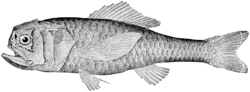 Ridgeheads are meso- to bathypelagic
; they have been trawled at depths as shallow as 150 metres (492.1 ft) to as deep as 3400 metres (11,154.9 ft). Some species undergo diel vertical migration
s of several hundred metres; that is, they remain at aphotic depths (below ca. 400 metres) during the day but rise to surface waters (10–100 metres) at night to feed and (presumably) to avoid predators. Ridgeheads feed primarily on zooplankton
, such as copepod
s, euphausiids, and other small pelagic crustacean
s. There is also a marked segregation of life stages: larva
l and juvenile ridgeheads are present within the upper 200 metres of the water column, whereas adults are typically found much farther down.
The family is sometimes termed pseudoceanic because, rather than having an even distribution in open water, ridgeheads occur in significantly higher abundances around structural oases, notably seamount
s and over continental slopes. This is also true of other deep-sea pelagic groups, such as the lanternfish
(Myctophidae), marine hatchetfish
(Sternoptychidae), and lightfish
(Phosichthyidae or Photichthyidae) families. The phenomenon is explained by the likewise abundance of prey species which are also attracted to the structures.
As oviparous pelagic spawners
, ridgeheads produce many tiny eggs
which are fertilized externally; the eggs and larvae (and early juveniles) are buoyant and plankton
ic, drifting with the currents near the surface until the juveniles have reached the point where they are strong enough to determine their own direction. Study of the spawning habits of twospine bigscales (Scopelogadus mizolepis bispinosus) indicates spawning occurs year-round, with no definite peaks.
Although their deep-living nature protects them from predation to some degree, ridgeheads are prey to large seabird
s such as albatross
es; large squid
such as the Jumbo Squid (Dosidicus gigas) and Sevenstar Flying Squid (Martialia hyadesii
); oceanic dolphin
s (family Delphinidae); and large pelagic fish
, such as tuna
and other scombrid
s.
Family (biology)
In biological classification, family is* a taxonomic rank. Other well-known ranks are life, domain, kingdom, phylum, class, order, genus, and species, with family fitting between order and genus. As for the other well-known ranks, there is the option of an immediately lower rank, indicated by the...
(Melamphaidae, from the Greek
Greek language
Greek is an independent branch of the Indo-European family of languages. Native to the southern Balkans, it has the longest documented history of any Indo-European language, spanning 34 centuries of written records. Its writing system has been the Greek alphabet for the majority of its history;...
melanos [black] and amphi [by both sides]) of small, deep-sea stephanoberyciform fish
Fish
Fish are a paraphyletic group of organisms that consist of all gill-bearing aquatic vertebrate animals that lack limbs with digits. Included in this definition are the living hagfish, lampreys, and cartilaginous and bony fish, as well as various extinct related groups...
. The family contains approximately 37 species
Species
In biology, a species is one of the basic units of biological classification and a taxonomic rank. A species is often defined as a group of organisms capable of interbreeding and producing fertile offspring. While in many cases this definition is adequate, more precise or differing measures are...
in five genera
Genus
In biology, a genus is a low-level taxonomic rank used in the biological classification of living and fossil organisms, which is an example of definition by genus and differentia...
; their distribution is worldwide, but ridgeheads are absent from the Arctic Ocean
Arctic Ocean
The Arctic Ocean, located in the Northern Hemisphere and mostly in the Arctic north polar region, is the smallest and shallowest of the world's five major oceanic divisions...
and Mediterranean Sea
Mediterranean Sea
The Mediterranean Sea is a sea connected to the Atlantic Ocean surrounded by the Mediterranean region and almost completely enclosed by land: on the north by Anatolia and Europe, on the south by North Africa, and on the east by the Levant...
. Although the family is one of the most widespread and plentiful of deep-sea families, none of its members are of interest to commercial fishery
Fishery
Generally, a fishery is an entity engaged in raising or harvesting fish which is determined by some authority to be a fishery. According to the FAO, a fishery is typically defined in terms of the "people involved, species or type of fish, area of water or seabed, method of fishing, class of boats,...
.
These fish are named for their large scale
Scale (zoology)
In most biological nomenclature, a scale is a small rigid plate that grows out of an animal's skin to provide protection. In lepidopteran species, scales are plates on the surface of the insect wing, and provide coloration...
s and pronounced cranial ridges, as well as for their typically dark brown to black coloration. Ridgeheads are the largest and most diverse family of their order
Order (biology)
In scientific classification used in biology, the order is# a taxonomic rank used in the classification of organisms. Other well-known ranks are life, domain, kingdom, phylum, class, family, genus, and species, with order fitting in between class and family...
.
Physical description
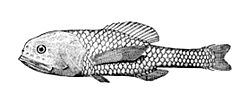
Typical of the Stephanoberyciformes, the melamphid body is robust, oblong, subcylindrical, and slightly compressed laterally. The head is large and scaleless, with its profile either bluntly rounded or with a sharp frontal angle; it is conspicuous for its prominent ridges, which are covered by thin skinSkin
-Dermis:The dermis is the layer of skin beneath the epidermis that consists of connective tissue and cushions the body from stress and strain. The dermis is tightly connected to the epidermis by a basement membrane. It also harbors many Mechanoreceptors that provide the sense of touch and heat...
. The head is also cavernous, being riddled by muciferous
Mucus
In vertebrates, mucus is a slippery secretion produced by, and covering, mucous membranes. Mucous fluid is typically produced from mucous cells found in mucous glands. Mucous cells secrete products that are rich in glycoproteins and water. Mucous fluid may also originate from mixed glands, which...
canals—similar structures are found in the beryciform slimehead
Slimehead
Slimeheads, also known as roughies and redfish, are mostly small, exceptionally long-lived, deep-sea beryciform fish constituting the family Trachichthyidae...
(Trachichthyidae) and fangtooth
Fangtooth
Fangtooths are beryciform fish of the family Anoplogastridae that live in the deep sea. The name is from Greek anoplo meaning "unarmed" and gaster meaning "stomach"...
(Anoplogastridae) families. Sharp spines
Spine (zoology)
A spine is a hard, thorny or needle-like structure which occurs on various animals. Animals such as porcupines and sea urchins grow spines as a self-defense mechanism. Spines are often formed of keratin...
and serrations may further adorn the head in some species. The mouth is large and oblique; the long jaw
Jaw
The jaw is any opposable articulated structure at the entrance of the mouth, typically used for grasping and manipulating food. The term jaws is also broadly applied to the whole of the structures constituting the vault of the mouth and serving to open and close it and is part of the body plan of...
s extend to or exceed the posterior margin of the eye
Eye
Eyes are organs that detect light and convert it into electro-chemical impulses in neurons. The simplest photoreceptors in conscious vision connect light to movement...
, and are lined with villiform (brushlike) teeth
Tooth
Teeth are small, calcified, whitish structures found in the jaws of many vertebrates that are used to break down food. Some animals, particularly carnivores, also use teeth for hunting or for defensive purposes. The roots of teeth are embedded in the Mandible bone or the Maxillary bone and are...
. The vomer
Vomer
The vomer is one of the unpaired facial bones of the skull. It is located in the midsagittal line, and articulates with the sphenoid, the ethmoid, the left and right palatine bones, and the left and right maxillary bones.-Biology:...
, palatines
Palatine bone
The palatine bone is a bone in many species of the animal kingdom, commonly termed the palatum .-Human anatomy:...
, endopterygiod, and ectopterygiods all lack teeth. The eye
Eye
Eyes are organs that detect light and convert it into electro-chemical impulses in neurons. The simplest photoreceptors in conscious vision connect light to movement...
s are usually fairly small, but in Poromitra megalops they may exceed 20 per cent of the head's length in diameter.
The large scales are cycloid and imbricate; they are arranged in a longitudinal series of 12–40. Usually deciduous, these scales are largest in Scopelogadus species; in these and some other species, the scales' circuli (concentric lines) are clearly visible to the unaided eye. The lateral line
Lateral line
The lateral line is a sense organ in aquatic organisms , used to detect movement and vibration in the surrounding water. Lateral lines are usually visible as faint lines running lengthwise down each side, from the vicinity of the gill covers to the base of the tail...
(excluding the network of cranial canals) is largely absent; when present, it is reduced to 1–2 pored scales following the operculum
Operculum (fish)
The operculum of a bony fish is the hard bony flap covering and protecting the gills. In most fish, the rear edge of the operculum roughly marks the division between the head and the body....
's upper edge. The caudal peduncle is relatively long; the caudal fin is forked to emarginate and possesses 3–4 procurrent spines. The single dorsal fin
Dorsal fin
A dorsal fin is a fin located on the backs of various unrelated marine and freshwater vertebrates, including most fishes, marine mammals , and the ichthyosaurs...
originates behind the pectoral and pelvic fins and contains 1–3 weak spines and 9–18 soft rays; the pectoral fins are elongate and tapered (the superior rays being longer than the inferior rays) and contain 12–16 soft rays. The pelvic fins are thoracic to subthoracic with one spine and 6–8 soft rays; the anal fin is small and set far back, with one spine and 7–11 soft rays.
The branchiostegal rays number 7–8 and the vertebrae 24–31. The largest species recorded is the crested bigscale (Poromitra crassiceps) at up to 18 centimetres standard length (SL; a measurement excluding the caudal fin). Most ridgeheads are well under 10 centimetres SL.
Life history
Pelagic zone
Any water in a sea or lake that is not close to the bottom or near to the shore can be said to be in the pelagic zone. The word pelagic comes from the Greek πέλαγος or pélagos, which means "open sea". The pelagic zone can be thought of in terms of an imaginary cylinder or water column that goes...
; they have been trawled at depths as shallow as 150 metres (492.1 ft) to as deep as 3400 metres (11,154.9 ft). Some species undergo diel vertical migration
Diel vertical migration
Diel vertical migration, also known as diurnal vertical migration, is a pattern of movement that some organisms living in the ocean and in lakes undertake each day. Usually organisms move up to the epipelagic zone at night and return to the mesopelagic zone of the oceans or to the hypolimnion zone...
s of several hundred metres; that is, they remain at aphotic depths (below ca. 400 metres) during the day but rise to surface waters (10–100 metres) at night to feed and (presumably) to avoid predators. Ridgeheads feed primarily on zooplankton
Zooplankton
Zooplankton are heterotrophic plankton. Plankton are organisms drifting in oceans, seas, and bodies of fresh water. The word "zooplankton" is derived from the Greek zoon , meaning "animal", and , meaning "wanderer" or "drifter"...
, such as copepod
Copepod
Copepods are a group of small crustaceans found in the sea and nearly every freshwater habitat. Some species are planktonic , some are benthic , and some continental species may live in limno-terrestrial habitats and other wet terrestrial places, such as swamps, under leaf fall in wet forests,...
s, euphausiids, and other small pelagic crustacean
Crustacean
Crustaceans form a very large group of arthropods, usually treated as a subphylum, which includes such familiar animals as crabs, lobsters, crayfish, shrimp, krill and barnacles. The 50,000 described species range in size from Stygotantulus stocki at , to the Japanese spider crab with a leg span...
s. There is also a marked segregation of life stages: larva
Larva
A larva is a distinct juvenile form many animals undergo before metamorphosis into adults. Animals with indirect development such as insects, amphibians, or cnidarians typically have a larval phase of their life cycle...
l and juvenile ridgeheads are present within the upper 200 metres of the water column, whereas adults are typically found much farther down.
The family is sometimes termed pseudoceanic because, rather than having an even distribution in open water, ridgeheads occur in significantly higher abundances around structural oases, notably seamount
Seamount
A seamount is a mountain rising from the ocean seafloor that does not reach to the water's surface , and thus is not an island. These are typically formed from extinct volcanoes, that rise abruptly and are usually found rising from a seafloor of depth. They are defined by oceanographers as...
s and over continental slopes. This is also true of other deep-sea pelagic groups, such as the lanternfish
Lanternfish
Cooper Lanternfishes are small mesopelagic fish of the large family Myctophidae. One of two families in the order Myctophiformes, the Myctophidae are represented by 246 species in 33 genera, and are found in oceans worldwide. They are aptly named after their conspicuous use of bioluminescence...
(Myctophidae), marine hatchetfish
Marine hatchetfish
Marine hatchetfishes or deep-sea hatchetfishes are small deep-sea mesopelagic ray-finned fish of the stomiiform subfamily Sternoptychinae...
(Sternoptychidae), and lightfish
Phosichthyidae
Lightfishes are small stomiiform fishes in the family PhosichthyidaeThey are very small fishes found in oceans throughout the world: most species grow no longer than 10 cm, while those in the genus Vinciguerria only reach 4 cm or so....
(Phosichthyidae or Photichthyidae) families. The phenomenon is explained by the likewise abundance of prey species which are also attracted to the structures.
As oviparous pelagic spawners
Spawn (biology)
Spawn refers to the eggs and sperm released or deposited, usually into water, by aquatic animals. As a verb, spawn refers to the process of releasing the eggs and sperm, also called spawning...
, ridgeheads produce many tiny eggs
Roe
Roe or hard roe is the fully ripe internal egg masses in the ovaries, or the released external egg masses of fish and certain marine animals, such as shrimp, scallop and sea urchins...
which are fertilized externally; the eggs and larvae (and early juveniles) are buoyant and plankton
Plankton
Plankton are any drifting organisms that inhabit the pelagic zone of oceans, seas, or bodies of fresh water. That is, plankton are defined by their ecological niche rather than phylogenetic or taxonomic classification...
ic, drifting with the currents near the surface until the juveniles have reached the point where they are strong enough to determine their own direction. Study of the spawning habits of twospine bigscales (Scopelogadus mizolepis bispinosus) indicates spawning occurs year-round, with no definite peaks.
Although their deep-living nature protects them from predation to some degree, ridgeheads are prey to large seabird
Seabird
Seabirds are birds that have adapted to life within the marine environment. While seabirds vary greatly in lifestyle, behaviour and physiology, they often exhibit striking convergent evolution, as the same environmental problems and feeding niches have resulted in similar adaptations...
s such as albatross
Albatross
Albatrosses, of the biological family Diomedeidae, are large seabirds allied to the procellariids, storm-petrels and diving-petrels in the order Procellariiformes . They range widely in the Southern Ocean and the North Pacific...
es; large squid
Squid
Squid are cephalopods of the order Teuthida, which comprises around 300 species. Like all other cephalopods, squid have a distinct head, bilateral symmetry, a mantle, and arms. Squid, like cuttlefish, have eight arms arranged in pairs and two, usually longer, tentacles...
such as the Jumbo Squid (Dosidicus gigas) and Sevenstar Flying Squid (Martialia hyadesii
Martialia hyadesii
Martialia hyadesii is a species of squid commonly known as the Sevenstar Flying Squid. These large squid are known to prey upon deep-sea Ridgeheads, and to be preyed upon in turn by King Penguins....
); oceanic dolphin
Oceanic dolphin
Oceanic dolphins are the members of the Delphinidae family of cetaceans. These marine mammals are related to whales and porpoises. They are found worldwide, mostly in the shallower seas of the continental shelves...
s (family Delphinidae); and large pelagic fish
Pelagic fish
Pelagic fish live near the surface or in the water column of coastal, ocean and lake waters, but not on the bottom of the sea or the lake. They can be contrasted with demersal fish, which do live on or near the bottom, and reef fish which are associated with coral reefs.The marine pelagic...
, such as tuna
Tuna
Tuna is a salt water fish from the family Scombridae, mostly in the genus Thunnus. Tuna are fast swimmers, and some species are capable of speeds of . Unlike most fish, which have white flesh, the muscle tissue of tuna ranges from pink to dark red. The red coloration derives from myoglobin, an...
and other scombrid
Scombridae
Scombridae is the family of the mackerels, tunas, and bonitos, and thus includes many of the most important and familiar food fishes. The family consists of about 55 species in 15 genera and two subfamilies...
s.
Species
There are 37 species in five genera:- Genus Melamphaes
- Slender bigscale, Melamphaes acanthomus Ebeling, 1962.
- Melamphaes danae Ebeling, 1962.
- Melamphaes ebelingi Keene, 1973.
- Melamphaes eulepis Ebeling, 1962.
- Melamphaes hubbsi Ebeling, 1962.
- Melamphaes indicus Ebeling, 1962.
- Melamphaes janae Ebeling, 1962.
- Melamphaes laeviceps Ebeling, 1962.
- Melamphaes leprus Ebeling, 1962.
- Melamphaes longivelis Parr, 1933.
- Highsnout melamphid, Melamphaes lugubris Gilbert, 1891.
- Melamphaes macrocephalus Parr, 1931.
- Melamphaes micropsMelamphaes micropsMelamphaes microps is a fish of the genus Melamphaes, found in the North Atlantic, South Atlantic, southern Indian Ocean, and the south west Pacific including New Zealand, at depths of from 1,000 to 3,000 m...
(Günther, 1878)..gif)
- Melamphaes parini Kotlyar, 1999.
- Little bigscale, Melamphaes parvus Ebeling, 1962.
- Melamphaes polylepis Ebeling, 1962.
- Melamphaes pumilus Ebeling, 1962.
- Ridgehead, Melamphaes simus Ebeling, 1962.
- Melamphaes spinifer Ebeling, 1962.
- Melamphaes suborbitalis (GillTheodore GillTheodore Nicholas Gill was an American ichthyologist, mammalogist, malacologist and librarian.Born and educated in New York City under private tutors, Gill early showed interest in natural history. He was associated with J...
, 1883). - Melamphaes typhlops (Lowe, 1843).
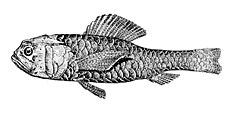
- Genus Poromitra
- Poromitra capito Goode & Bean, 1883.
- Poromitra crassa Parin & Ebeling, 1980.
- Crested bigscale, Poromitra crassiceps (Günther, 1878).
- Poromitra gibbsi Parin & Borodulina, 1989.
- Poromitra megalops (Lütken, 1877).
- YawningYawning (fish)The yawning, Poromitra oscitans, is a fish of the family Melamphaidae, found in tropical and subtropical waters of the indo-Pacific region.-References:...
, Poromitra oscitans Ebeling, 1975. - Poromitra unicornis (Gilbert, 1905).
- Poromitra capito Goode & Bean, 1883.
- Genus Scopeloberyx
- Scopeloberyx microlepis (Norman, 1937).
- Scopeloberyx opisthopterus (Parr, 1933).
- Longjaw bigscale, Scopeloberyx robustus (Günther, 1887).
- Scopeloberyx rubriventer (Koefoed, 1953).
- Genus Scopelogadus
- Scopelogadus beanii (Günther, 1887).
- Twospine bigscale, Scopelogadus mizolepis bispinosus (Gilbert, 1915).
- Scopelogadus mizolepis mizolepis Günther, 1878.
- Scopelogadus unispinis Ebeling & Weed, 1963.
- Scopelogadus beanii (Günther, 1887).
- Genus Sio
- Sio nordenskjoldii (Lönnberg, 1905).