

.gif)
Parton (particle physics)

Encyclopedia
In particle physics
, the parton model was proposed by Richard Feynman
in 1969 as a way to analyze high-energy hadron
collisions. It was later recognized that partons describe the same objects now more commonly referred to as quark
s and gluon
s. Therefore
a more detailed presentation of the properties and physical theories pertaining indirectly to partons can be found under quark
s.
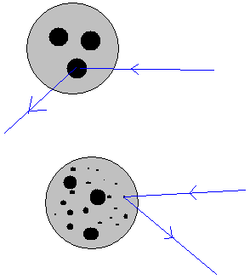 In this model, a hadron (for example, a proton
) is composed of a number of point-like constituents, termed "partons". Additionally, the hadron is in a reference frame
where it has infinite momentum — a valid approximation at high energies. Thus, parton motion is slowed by time dilation
, and the hadron charge distribution is Lorentz-contracted
, so incoming particles will be scattered "instantaneously and incoherently". The parton model was immediately applied to electron
-proton
deep inelastic scattering
by Bjorken
and Paschos. Later, with the experimental observation of Bjorken scaling, the validation of the quark model
, and the confirmation of asymptotic freedom
in quantum chromodynamics
, partons were matched to quarks and gluons. The parton model remains a justifiable approximation at high energies, and others have extended the theory over the years.
An interesting fact about partons is that they are defined with respect to a physical scale (as probed by the inverse of the momentum transfer). For instance, a quark parton at one length scale can turn out to be a superposition of a quark parton state with a quark parton and a gluon parton state together with other states with more partons at a smaller length scale. Similarly, a gluon parton at one scale can resolve into a superposition of a gluon parton state, a gluon parton and quark-antiquark partons state and other multiparton states. Because of this, the number of partons in a hadron actually goes up with momentum transfer. At low energies (i.e. large length scales), a baryon contains three valence partons (quarks) and a meson contains two valence partons (a quark and an antiquark parton). At higher energies, however, observations show sea partons (nonvalence partons) in addition to valence partons.
preferred the term parton to quark, whereas Gell-Mann
prefers quark. In modern parlance, the term parton is often used to mean "a quark or a gluon", in a broad sense similar to the way a "nucleon
" refers to a proton
or a neutron
. However, note that whereas a proton and a neutron are both hadrons, the gluon, unlike the quark, is the carrier of the color force.
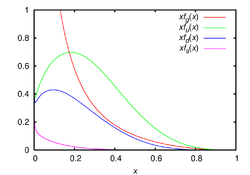 A parton distribution function is defined as the probability density
for finding a particle with a certain longitudinal momentum fraction x at momentum transfer Q2. Because of the inherent non-perturbative effect in a QCD
binding state, parton distribution functions cannot be obtained by perturbative QCD. Due to the limitations in present lattice QCD calculations, the known parton distribution functions are instead obtained by using experimental data.
Experimentally determined parton distribution functions are available from various groups worldwide. The major unpolarized data sets are:
Generalized parton distributions (GPDs) are a more recent approach to better understand hadron
structure by representing the parton distributions as functions of more variables, such as the transverse momentum and spin
of the parton. Early names included "non-forward", "non-diagonal" or "skewed" parton distributions. They are accessed through exclusive processes for which all particles are detected in the final state. Ordinary parton distribution functions are recovered by setting to zero (forward limit) the extra variables in the generalized parton distributions. Other rules show that the electric form factor
, the magnetic form factor
, or even the form factors associated to the energy-momentum tensor are also included in the GPDs. A full 3-dimensional image of partons inside hadrons can also be obtained from GPDs.
Particle physics
Particle physics is a branch of physics that studies the existence and interactions of particles that are the constituents of what is usually referred to as matter or radiation. In current understanding, particles are excitations of quantum fields and interact following their dynamics...
, the parton model was proposed by Richard Feynman
Richard Feynman
Richard Phillips Feynman was an American physicist known for his work in the path integral formulation of quantum mechanics, the theory of quantum electrodynamics and the physics of the superfluidity of supercooled liquid helium, as well as in particle physics...
in 1969 as a way to analyze high-energy hadron
Hadron
In particle physics, a hadron is a composite particle made of quarks held together by the strong force...
collisions. It was later recognized that partons describe the same objects now more commonly referred to as quark
Quark
A quark is an elementary particle and a fundamental constituent of matter. Quarks combine to form composite particles called hadrons, the most stable of which are protons and neutrons, the components of atomic nuclei. Due to a phenomenon known as color confinement, quarks are never directly...
s and gluon
Gluon
Gluons are elementary particles which act as the exchange particles for the color force between quarks, analogous to the exchange of photons in the electromagnetic force between two charged particles....
s. Therefore
a more detailed presentation of the properties and physical theories pertaining indirectly to partons can be found under quark
Quark
A quark is an elementary particle and a fundamental constituent of matter. Quarks combine to form composite particles called hadrons, the most stable of which are protons and neutrons, the components of atomic nuclei. Due to a phenomenon known as color confinement, quarks are never directly...
s.
Model
Proton
The proton is a subatomic particle with the symbol or and a positive electric charge of 1 elementary charge. One or more protons are present in the nucleus of each atom, along with neutrons. The number of protons in each atom is its atomic number....
) is composed of a number of point-like constituents, termed "partons". Additionally, the hadron is in a reference frame
Frame of reference
A frame of reference in physics, may refer to a coordinate system or set of axes within which to measure the position, orientation, and other properties of objects in it, or it may refer to an observational reference frame tied to the state of motion of an observer.It may also refer to both an...
where it has infinite momentum — a valid approximation at high energies. Thus, parton motion is slowed by time dilation
Time dilation
In the theory of relativity, time dilation is an observed difference of elapsed time between two events as measured by observers either moving relative to each other or differently situated from gravitational masses. An accurate clock at rest with respect to one observer may be measured to tick at...
, and the hadron charge distribution is Lorentz-contracted
Length contraction
In physics, length contraction – according to Hendrik Lorentz – is the physical phenomenon of a decrease in length detected by an observer of objects that travel at any non-zero velocity relative to that observer...
, so incoming particles will be scattered "instantaneously and incoherently". The parton model was immediately applied to electron
Electron
The electron is a subatomic particle with a negative elementary electric charge. It has no known components or substructure; in other words, it is generally thought to be an elementary particle. An electron has a mass that is approximately 1/1836 that of the proton...
-proton
Proton
The proton is a subatomic particle with the symbol or and a positive electric charge of 1 elementary charge. One or more protons are present in the nucleus of each atom, along with neutrons. The number of protons in each atom is its atomic number....
deep inelastic scattering
Deep Inelastic Scattering
Deep inelastic scattering is the name given to a process used to probe the insides of hadrons , using electrons, muons and neutrinos. It provided the first convincing evidence of the reality of quarks, which up until that point had been considered by many to be a purely mathematical phenomenon...
by Bjorken
James Bjorken
James Daniel "BJ" Bjorken is one of the world's foremost theoretical physicists. He was a Putnam Fellow in 1954, received a BS in physics from MIT in 1956, and obtained his PhD from Stanford University in 1959...
and Paschos. Later, with the experimental observation of Bjorken scaling, the validation of the quark model
Quark model
In physics, the quark model is a classification scheme for hadrons in terms of their valence quarks—the quarks and antiquarks which give rise to the quantum numbers of the hadrons....
, and the confirmation of asymptotic freedom
Asymptotic freedom
In physics, asymptotic freedom is a property of some gauge theories that causes interactions between particles to become arbitrarily weak at energy scales that become arbitrarily large, or, equivalently, at length scales that become arbitrarily small .Asymptotic freedom is a feature of quantum...
in quantum chromodynamics
Quantum chromodynamics
In theoretical physics, quantum chromodynamics is a theory of the strong interaction , a fundamental force describing the interactions of the quarks and gluons making up hadrons . It is the study of the SU Yang–Mills theory of color-charged fermions...
, partons were matched to quarks and gluons. The parton model remains a justifiable approximation at high energies, and others have extended the theory over the years.
An interesting fact about partons is that they are defined with respect to a physical scale (as probed by the inverse of the momentum transfer). For instance, a quark parton at one length scale can turn out to be a superposition of a quark parton state with a quark parton and a gluon parton state together with other states with more partons at a smaller length scale. Similarly, a gluon parton at one scale can resolve into a superposition of a gluon parton state, a gluon parton and quark-antiquark partons state and other multiparton states. Because of this, the number of partons in a hadron actually goes up with momentum transfer. At low energies (i.e. large length scales), a baryon contains three valence partons (quarks) and a meson contains two valence partons (a quark and an antiquark parton). At higher energies, however, observations show sea partons (nonvalence partons) in addition to valence partons.
Terminology
FeynmanRichard Feynman
Richard Phillips Feynman was an American physicist known for his work in the path integral formulation of quantum mechanics, the theory of quantum electrodynamics and the physics of the superfluidity of supercooled liquid helium, as well as in particle physics...
preferred the term parton to quark, whereas Gell-Mann
Murray Gell-Mann
Murray Gell-Mann is an American physicist and linguist who received the 1969 Nobel Prize in physics for his work on the theory of elementary particles...
prefers quark. In modern parlance, the term parton is often used to mean "a quark or a gluon", in a broad sense similar to the way a "nucleon
Nucleon
In physics, a nucleon is a collective name for two particles: the neutron and the proton. These are the two constituents of the atomic nucleus. Until the 1960s, the nucleons were thought to be elementary particles...
" refers to a proton
Proton
The proton is a subatomic particle with the symbol or and a positive electric charge of 1 elementary charge. One or more protons are present in the nucleus of each atom, along with neutrons. The number of protons in each atom is its atomic number....
or a neutron
Neutron
The neutron is a subatomic hadron particle which has the symbol or , no net electric charge and a mass slightly larger than that of a proton. With the exception of hydrogen, nuclei of atoms consist of protons and neutrons, which are therefore collectively referred to as nucleons. The number of...
. However, note that whereas a proton and a neutron are both hadrons, the gluon, unlike the quark, is the carrier of the color force.
Parton distribution functions
Probability amplitude
In quantum mechanics, a probability amplitude is a complex number whose modulus squared represents a probability or probability density.For example, if the probability amplitude of a quantum state is \alpha, the probability of measuring that state is |\alpha|^2...
for finding a particle with a certain longitudinal momentum fraction x at momentum transfer Q2. Because of the inherent non-perturbative effect in a QCD
Quantum chromodynamics
In theoretical physics, quantum chromodynamics is a theory of the strong interaction , a fundamental force describing the interactions of the quarks and gluons making up hadrons . It is the study of the SU Yang–Mills theory of color-charged fermions...
binding state, parton distribution functions cannot be obtained by perturbative QCD. Due to the limitations in present lattice QCD calculations, the known parton distribution functions are instead obtained by using experimental data.
Experimentally determined parton distribution functions are available from various groups worldwide. The major unpolarized data sets are:
- CTEQ, from the CTEQ Collaboration
- GRV, from M. Glück, E. Reya, and A. Vogt
- GJR, from M. Glück, P. Jimenez-Delgado, and E. Reya
- MRST, from A. D. Martin, R. G. Roberts, W. J. Stirling, and R. S. Thorne
- NNPDFNNPDFNNPDF is used to denote the parton distribution functions from the NNPDF Collaboration.The NNPDF approach can be divided into four main steps...
, from the NNPDF Collaboration
Generalized parton distributions (GPDs) are a more recent approach to better understand hadron
Hadron
In particle physics, a hadron is a composite particle made of quarks held together by the strong force...
structure by representing the parton distributions as functions of more variables, such as the transverse momentum and spin
Spin (physics)
In quantum mechanics and particle physics, spin is a fundamental characteristic property of elementary particles, composite particles , and atomic nuclei.It is worth noting that the intrinsic property of subatomic particles called spin and discussed in this article, is related in some small ways,...
of the parton. Early names included "non-forward", "non-diagonal" or "skewed" parton distributions. They are accessed through exclusive processes for which all particles are detected in the final state. Ordinary parton distribution functions are recovered by setting to zero (forward limit) the extra variables in the generalized parton distributions. Other rules show that the electric form factor
Electric form factor
The electric form factor is the Fourier transform of electric charge distribution in space.The idea originated from young William Thomson....
, the magnetic form factor
Magnetic form factor
In electromagnetism, a magnetic form factor is the Fourier transform of an electric current distribution in space.-See also:For the form factor relevant to magnetic diffraction of free neutrons by unpaired outer electrons of an atom see also: atomic form factor- External links :*, Andrey Zheludev,...
, or even the form factors associated to the energy-momentum tensor are also included in the GPDs. A full 3-dimensional image of partons inside hadrons can also be obtained from GPDs.