

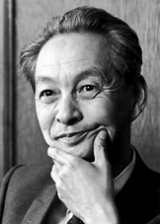
Sin-Itiro Tomonaga

Encyclopedia
was a Japan
ese physicist
, influential in the development of quantum electrodynamics
, work for which he was jointly awarded the Nobel Prize in Physics
in 1965 along with Richard Feynman
and Julian Schwinger
.
in 1906. He was the second child and eldest son of a Japanese philosopher, Sanjūrō Tomonaga. He entered the Kyoto Imperial University
in 1926. Hideki Yukawa
, also a Nobel Prize
winner, was one of his classmates during undergraduate school. During graduate school at the same university, he worked as an assistant in the university for three years. After graduate school, he joined Nishina
's group in Riken
. In 1937, while working in Leipzig, he collaborated with the research group of Werner Heisenberg
. Two years later, he returned to Japan due to the outbreak of the Second World War, but finished his doctoral degree on the study of nuclear
materials with his thesis on work he had done while in Leipzig.
In Japan, he was appointed to a professorship in the Tokyo University of Education (a forerunner of Tsukuba University). During the war he studied the magnetron, meson
theory, and his "super-many-time" theory. In 1948, he and his students re-examined a 1939 paper by Sidney Dancoff
that attempted, but failed, to show that the infinite quantities that arise in QED
can be canceled with each other. Tomonaga applied his super-many-time theory and a relativistic method based on the non-relativistic method of Wolfgang Pauli
and Fierz
to greatly speed up and clarify the calculations. Then he and his students found that Dancoff had overlooked one term in the perturbation series
. With this term, the theory gave finite results; thus Tomonaga discovered the renormalization
method independently of Julian Schwinger
and calculated physical quantities such as the Lamb shift at the same time.
In the next year, he was invited by Robert Oppenheimer
to work at the Institute for Advanced Study
in Princeton Township
. He studied a many-body problem
on the collective oscillations of a quantum-mechanical system. In the following year, he returned to Japan and proposed the Tomonaga-Luttinger liquid. In 1965, he was awarded the Nobel Prize in Physics
, with Julian Schwinger
and Richard P. Feynman, for the study of QED, specifically for the discovery of the renormalization
method. He died in Tokyo
in 1979.
Tomonaga was married in 1940 to Ryoko Sekigushi. They had two sons and one daughter.
Japan
Japan is an island nation in East Asia. Located in the Pacific Ocean, it lies to the east of the Sea of Japan, China, North Korea, South Korea and Russia, stretching from the Sea of Okhotsk in the north to the East China Sea and Taiwan in the south...
ese physicist
Physicist
A physicist is a scientist who studies or practices physics. Physicists study a wide range of physical phenomena in many branches of physics spanning all length scales: from sub-atomic particles of which all ordinary matter is made to the behavior of the material Universe as a whole...
, influential in the development of quantum electrodynamics
Quantum electrodynamics
Quantum electrodynamics is the relativistic quantum field theory of electrodynamics. In essence, it describes how light and matter interact and is the first theory where full agreement between quantum mechanics and special relativity is achieved...
, work for which he was jointly awarded the Nobel Prize in Physics
Nobel Prize in Physics
The Nobel Prize in Physics is awarded once a year by the Royal Swedish Academy of Sciences. It is one of the five Nobel Prizes established by the will of Alfred Nobel in 1895 and awarded since 1901; the others are the Nobel Prize in Chemistry, Nobel Prize in Literature, Nobel Peace Prize, and...
in 1965 along with Richard Feynman
Richard Feynman
Richard Phillips Feynman was an American physicist known for his work in the path integral formulation of quantum mechanics, the theory of quantum electrodynamics and the physics of the superfluidity of supercooled liquid helium, as well as in particle physics...
and Julian Schwinger
Julian Schwinger
Julian Seymour Schwinger was an American theoretical physicist. He is best known for his work on the theory of quantum electrodynamics, in particular for developing a relativistically invariant perturbation theory, and for renormalizing QED to one loop order.Schwinger is recognized as one of the...
.
Biography
Tomonaga was born in TokyoTokyo
, ; officially , is one of the 47 prefectures of Japan. Tokyo is the capital of Japan, the center of the Greater Tokyo Area, and the largest metropolitan area of Japan. It is the seat of the Japanese government and the Imperial Palace, and the home of the Japanese Imperial Family...
in 1906. He was the second child and eldest son of a Japanese philosopher, Sanjūrō Tomonaga. He entered the Kyoto Imperial University
Kyoto University
, or is a national university located in Kyoto, Japan. It is the second oldest Japanese university, and formerly one of Japan's Imperial Universities.- History :...
in 1926. Hideki Yukawa
Hideki Yukawa
né , was a Japanese theoretical physicist and the first Japanese Nobel laureate.-Biography:Yukawa was born in Tokyo and grew up in Kyoto. In 1929, after receiving his degree from Kyoto Imperial University, he stayed on as a lecturer for four years. After graduation, he was interested in...
, also a Nobel Prize
Nobel Prize
The Nobel Prizes are annual international awards bestowed by Scandinavian committees in recognition of cultural and scientific advances. The will of the Swedish chemist Alfred Nobel, the inventor of dynamite, established the prizes in 1895...
winner, was one of his classmates during undergraduate school. During graduate school at the same university, he worked as an assistant in the university for three years. After graduate school, he joined Nishina
Yoshio Nishina
was the founding father of modern physics research in Japan. He co-authored the well-known Klein–Nishina formula. He was a principal investigator of RIKEN and mentored generations...
's group in Riken
RIKEN
is a large natural sciences research institute in Japan. Founded in 1917, it now has approximately 3000 scientists on seven campuses across Japan, the main one in Wako, just outside Tokyo...
. In 1937, while working in Leipzig, he collaborated with the research group of Werner Heisenberg
Werner Heisenberg
Werner Karl Heisenberg was a German theoretical physicist who made foundational contributions to quantum mechanics and is best known for asserting the uncertainty principle of quantum theory...
. Two years later, he returned to Japan due to the outbreak of the Second World War, but finished his doctoral degree on the study of nuclear
Nuclear physics
Nuclear physics is the field of physics that studies the building blocks and interactions of atomic nuclei. The most commonly known applications of nuclear physics are nuclear power generation and nuclear weapons technology, but the research has provided application in many fields, including those...
materials with his thesis on work he had done while in Leipzig.
In Japan, he was appointed to a professorship in the Tokyo University of Education (a forerunner of Tsukuba University). During the war he studied the magnetron, meson
Meson
In particle physics, mesons are subatomic particles composed of one quark and one antiquark, bound together by the strong interaction. Because mesons are composed of sub-particles, they have a physical size, with a radius roughly one femtometer: 10−15 m, which is about the size of a proton...
theory, and his "super-many-time" theory. In 1948, he and his students re-examined a 1939 paper by Sidney Dancoff
Sidney Dancoff
Sidney Michael Dancoff was an American theoretical physicist best known for the Tamm–Dancoff approximation method and for nearly developing a renormalization method for solving quantum electrodynamics ....
that attempted, but failed, to show that the infinite quantities that arise in QED
Quantum electrodynamics
Quantum electrodynamics is the relativistic quantum field theory of electrodynamics. In essence, it describes how light and matter interact and is the first theory where full agreement between quantum mechanics and special relativity is achieved...
can be canceled with each other. Tomonaga applied his super-many-time theory and a relativistic method based on the non-relativistic method of Wolfgang Pauli
Wolfgang Pauli
Wolfgang Ernst Pauli was an Austrian theoretical physicist and one of the pioneers of quantum physics. In 1945, after being nominated by Albert Einstein, he received the Nobel Prize in Physics for his "decisive contribution through his discovery of a new law of Nature, the exclusion principle or...
and Fierz
Markus Fierz
Markus Eduard Fierz was a Swiss physicist, particularly remembered for his formulation of Spin-statistics theorem, and for his contributions to the development of quantum theory, particle physics, and statistical mechanics...
to greatly speed up and clarify the calculations. Then he and his students found that Dancoff had overlooked one term in the perturbation series
Perturbation theory (quantum mechanics)
In quantum mechanics, perturbation theory is a set of approximation schemes directly related to mathematical perturbation for describing a complicated quantum system in terms of a simpler one. The idea is to start with a simple system for which a mathematical solution is known, and add an...
. With this term, the theory gave finite results; thus Tomonaga discovered the renormalization
Renormalization
In quantum field theory, the statistical mechanics of fields, and the theory of self-similar geometric structures, renormalization is any of a collection of techniques used to treat infinities arising in calculated quantities....
method independently of Julian Schwinger
Julian Schwinger
Julian Seymour Schwinger was an American theoretical physicist. He is best known for his work on the theory of quantum electrodynamics, in particular for developing a relativistically invariant perturbation theory, and for renormalizing QED to one loop order.Schwinger is recognized as one of the...
and calculated physical quantities such as the Lamb shift at the same time.
In the next year, he was invited by Robert Oppenheimer
Robert Oppenheimer
Julius Robert Oppenheimer was an American theoretical physicist and professor of physics at the University of California, Berkeley. Along with Enrico Fermi, he is often called the "father of the atomic bomb" for his role in the Manhattan Project, the World War II project that developed the first...
to work at the Institute for Advanced Study
Institute for Advanced Study
The Institute for Advanced Study, located in Princeton, New Jersey, United States, is an independent postgraduate center for theoretical research and intellectual inquiry. It was founded in 1930 by Abraham Flexner...
in Princeton Township
Princeton Township, New Jersey
Also Princeton Borough is an independent municipality completely surrounded by the township.Princeton North is a census-designated place and unincorporated area located within Princeton Township....
. He studied a many-body problem
Many-body problem
The many-body problem is a general name for a vast category of physical problems pertaining to the properties of microscopic systems made of a large number of interacting particles. Microscopic here implies that quantum mechanics has to be used to provide an accurate description of the system...
on the collective oscillations of a quantum-mechanical system. In the following year, he returned to Japan and proposed the Tomonaga-Luttinger liquid. In 1965, he was awarded the Nobel Prize in Physics
Nobel Prize in Physics
The Nobel Prize in Physics is awarded once a year by the Royal Swedish Academy of Sciences. It is one of the five Nobel Prizes established by the will of Alfred Nobel in 1895 and awarded since 1901; the others are the Nobel Prize in Chemistry, Nobel Prize in Literature, Nobel Peace Prize, and...
, with Julian Schwinger
Julian Schwinger
Julian Seymour Schwinger was an American theoretical physicist. He is best known for his work on the theory of quantum electrodynamics, in particular for developing a relativistically invariant perturbation theory, and for renormalizing QED to one loop order.Schwinger is recognized as one of the...
and Richard P. Feynman, for the study of QED, specifically for the discovery of the renormalization
Renormalization
In quantum field theory, the statistical mechanics of fields, and the theory of self-similar geometric structures, renormalization is any of a collection of techniques used to treat infinities arising in calculated quantities....
method. He died in Tokyo
Tokyo
, ; officially , is one of the 47 prefectures of Japan. Tokyo is the capital of Japan, the center of the Greater Tokyo Area, and the largest metropolitan area of Japan. It is the seat of the Japanese government and the Imperial Palace, and the home of the Japanese Imperial Family...
in 1979.
Tomonaga was married in 1940 to Ryoko Sekigushi. They had two sons and one daughter.