

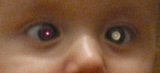
Retinoblastoma

Encyclopedia
Retinoblastoma is a rapidly developing cancer
that develops in the cells of retina
, the light-detecting tissue
of the eye. In the developed world, Rb has one of the best cure rates of all childhood cancers (95-98%), with more than nine out of every ten sufferers surviving into adulthood.
In about two thirds of cases, only one eye is affected (unilateral retinoblastoma); in the other third, tumours develop in both eyes (bilateral retinoblastoma). The number and size of tumours on each eye may vary. In certain cases, the pineal gland
is also affected (trilateral retinoblastoma). The position, size and quantity of tumours are considered when choosing the type of treatment for the disease.
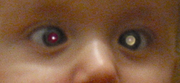
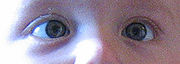 The most common and obvious sign
of retinoblastoma is an abnormal appearance of the pupil, leukocoria
, also known as amaurotic cat's eye reflex. Other less common and less specific signs and symptoms are: deterioration of vision, a red and irritated eye, faltering growth or delayed development. Some children with retinoblastoma can develop a squint, commonly referred to as "cross-eyed" or "wall-eyed" (strabismus
). Retinoblastoma presents with advanced disease in developing countries and eye enlargement is a common finding.
Depending on the position of the tumors, they may be visible during a simple eye exam using an ophthalmoscope to look through the pupil. A positive diagnosis is usually made only with an examination under anesthetic (EUA). A white eye reflection is not always a positive indication of retinoblastoma and can be caused by light being reflected badly or by other conditions such as Coats's Disease
.
In a photograph, the photographic fault red eye
may be a sign of retinoblastoma, if in the photograph it is in one eye and not in the other eye. A more clear sign is "white eye" or "cat's eye".
Most children are diagnosed before the age of five years old. In the UK, bilateral cases usually present within the first year with the average age at diagnosis being 9 months. Diagnosis of unilateral cases peaks between 24 and 30 months.
, called the RB1 gene.The genetic codes found in chromosomes control the way in which cells grow and develop within the body. If a portion of the code is missing or altered (mutation) a cancer may develop.
The defective RB1 gene can be inherited from either parent; in some children, however, the mutation occurs in the early stages of fetal development. It is unknown what causes the gene abnormality; it is most likely to be a random mistake during the copy process which occurs when a cell divides.
Inherited forms of retinoblastomas are more likely to be bilateral; in addition, they may be associated with pinealoblastoma
(also known as trilateral retinoblastoma) with a dismal outcome. The genetic codes found in chromosomes control the way in which cells grow and develop within the body.
Several methods have been developed to detect the RB1 gene mutations. Attempts to correlate gene mutations to the stage at presentation have not shown convincing evidence of a correlation.
Current research being joint funded by The Childhood Eye Cancer Trust in Birmingham, UK, is attempting to establish the different types of retinoblastoma children may have and subsequently determine a more successful treatment pathway.
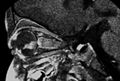 If the eye examination is abnormal, further testing may include imaging studies, such as Computerized Tomography (CT), Magnetic Resonance Imaging
(MRI), and Ultrasound
. CT and MRI can help define the structure abnormalities and reveal any calcium depositions. Ultrasound can help define the height and thickness of the tumor. Bone marrow
examination or lumbar puncture
may also be done to determine any metastases
to bones or the brain.
s, Homer-Wright rosette
s, and fluerettes from photoreceptor differentiation.
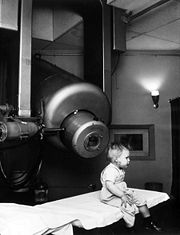 Treatment of retinoblastoma varies from country to country. The first priority is to preserve the life of the child, then to preserve the vision and thirdly to minimize any complications or side effects of the treatment. The exact course of treatment will depend on the individual case and will be decided by the ophthalmologist in discussion with the paediatric oncologist.
Many treatment options exist, including chemotherapy
(administered locally via a thin catheter threaded through the groin, through the aorta and the neck, into the optic vessels), cryotherapy
, radioactive plaques, laser therapy, external beam radiotherapy
and surgical removal of the eyeball. Any combinations of these treatments may be adopted.
In recent years, there has been an effort to find alternatives to enucleation and radiation therapy.
Cancer
Cancer , known medically as a malignant neoplasm, is a large group of different diseases, all involving unregulated cell growth. In cancer, cells divide and grow uncontrollably, forming malignant tumors, and invade nearby parts of the body. The cancer may also spread to more distant parts of the...
that develops in the cells of retina
Retina
The vertebrate retina is a light-sensitive tissue lining the inner surface of the eye. The optics of the eye create an image of the visual world on the retina, which serves much the same function as the film in a camera. Light striking the retina initiates a cascade of chemical and electrical...
, the light-detecting tissue
Tissue (biology)
Tissue is a cellular organizational level intermediate between cells and a complete organism. A tissue is an ensemble of cells, not necessarily identical, but from the same origin, that together carry out a specific function. These are called tissues because of their identical functioning...
of the eye. In the developed world, Rb has one of the best cure rates of all childhood cancers (95-98%), with more than nine out of every ten sufferers surviving into adulthood.
Classification
There are two forms of the disease; a heritable form and non-heritable form (all cancers are considered genetic in that mutations of the genome are required for their development, but this does not imply that they are heritable, or transmitted to offspring). Approximately 55% of children with Rb have the non-heritable form. If there is no history of the disease within the family, the disease is labeled "sporadic", but this does not necessarily indicate that it is the non-heritable form.In about two thirds of cases, only one eye is affected (unilateral retinoblastoma); in the other third, tumours develop in both eyes (bilateral retinoblastoma). The number and size of tumours on each eye may vary. In certain cases, the pineal gland
Pineal gland
The pineal gland is a small endocrine gland in the vertebrate brain. It produces the serotonin derivative melatonin, a hormone that affects the modulation of wake/sleep patterns and seasonal functions...
is also affected (trilateral retinoblastoma). The position, size and quantity of tumours are considered when choosing the type of treatment for the disease.
Signs and symptoms
Medical sign
A medical sign is an objective indication of some medical fact or characteristic that may be detected by a physician during a physical examination of a patient....
of retinoblastoma is an abnormal appearance of the pupil, leukocoria
Leukocoria
Leukocoria is an abnormal white reflection from the retina of the eye. Leukocoria resembles eyeshine, but leukocoria can occur in humans and other animals that lack eyeshine because their retina lacks a tapetum lucidum....
, also known as amaurotic cat's eye reflex. Other less common and less specific signs and symptoms are: deterioration of vision, a red and irritated eye, faltering growth or delayed development. Some children with retinoblastoma can develop a squint, commonly referred to as "cross-eyed" or "wall-eyed" (strabismus
Strabismus
Strabismus is a condition in which the eyes are not properly aligned with each other. It typically involves a lack of coordination between the extraocular muscles, which prevents bringing the gaze of each eye to the same point in space and preventing proper binocular vision, which may adversely...
). Retinoblastoma presents with advanced disease in developing countries and eye enlargement is a common finding.
Depending on the position of the tumors, they may be visible during a simple eye exam using an ophthalmoscope to look through the pupil. A positive diagnosis is usually made only with an examination under anesthetic (EUA). A white eye reflection is not always a positive indication of retinoblastoma and can be caused by light being reflected badly or by other conditions such as Coats's Disease
Coats disease
Coats’ disease, , is a very rare congenital, nonhereditary eye disorder, causing full or partial blindness, characterized by abnormal development of blood vessels behind the retina.It can have a similar presentation to that of retinoblastoma.-Presentation:Coats’ usually...
.
In a photograph, the photographic fault red eye
Red eye
Red eye or red-eye or redeye may refer to:-In humans and animals:*Red eye , is a symptom of eye disease.*Red-eye effect, the appearance of red eyes in photos due to the use of a flash*Red eye, an extremely rare eye color...
may be a sign of retinoblastoma, if in the photograph it is in one eye and not in the other eye. A more clear sign is "white eye" or "cat's eye".
Frequency of retinoblastoma
Retinoblastoma is rare and affects approximately 1 in 15,000 live births, but it is the most common inherited childhood malignancy. In the UK, around 40 to 50 new cases are diagnosed each year.Most children are diagnosed before the age of five years old. In the UK, bilateral cases usually present within the first year with the average age at diagnosis being 9 months. Diagnosis of unilateral cases peaks between 24 and 30 months.
Cause of retinoblastoma
In children with the heritable genetic form of retinoblastoma there is a mutation on chromosome 13Chromosome 13 (human)
Chromosome 13 is one of the 23 pairs of chromosomes in humans. People normally have two copies of this chromosome. Chromosome 13 spans about 114 million base pairs and represents between 3.5 and 4 % of the total DNA in cells....
, called the RB1 gene.The genetic codes found in chromosomes control the way in which cells grow and develop within the body. If a portion of the code is missing or altered (mutation) a cancer may develop.
The defective RB1 gene can be inherited from either parent; in some children, however, the mutation occurs in the early stages of fetal development. It is unknown what causes the gene abnormality; it is most likely to be a random mistake during the copy process which occurs when a cell divides.
Inherited forms of retinoblastomas are more likely to be bilateral; in addition, they may be associated with pinealoblastoma
Pinealoblastoma
Pinealoblastoma is a tumor of the pineal gland.Retinoblastoma can be characterized as "bilateral" when it presents on both sides. It can also be characterized as "trilateral" when it presents with pinealoblastoma....
(also known as trilateral retinoblastoma) with a dismal outcome. The genetic codes found in chromosomes control the way in which cells grow and develop within the body.
Several methods have been developed to detect the RB1 gene mutations. Attempts to correlate gene mutations to the stage at presentation have not shown convincing evidence of a correlation.
Current research being joint funded by The Childhood Eye Cancer Trust in Birmingham, UK, is attempting to establish the different types of retinoblastoma children may have and subsequently determine a more successful treatment pathway.
Diagnosis
Screening for retinoblastoma should be part of a "well baby" screening for newborns during the first three months of life, to include:- The red reflexRed reflexThe red reflex refers to the reddish-orange reflection from the eye's retina that is observed when using an ophthalmoscope or retinoscope from approximately 30 cm / 1 foot...
: checking for a normal reddish-orange reflection from the eye's retina with an ophthalmoscope or retinoscope from approximately 30 cm / 1 foot, usually done in a dimly lit or dark room. - The corneal light reflex/Hirchberg test: checking for symmetrical reflection of beam of light in the same spot on each eye when a light is shined into each cornea, to help determine whether the eyes are crossed.
- Eye examinationEye examinationAn eye examination is a battery of tests performed by an ophthalmologist, optometrist, or orthoptist assessing vision and ability to focus on and discern objects, as well as other tests and examinations pertaining to the eyes....
: checking for any structural abnormalities.
Differential diagnosis
- 1. Persistent hyperplastic primary vitreousPersistent hyperplastic primary vitreousPersistent hyperplastic primary vitreous is a rare congenital developmental anomaly of the eye that resultsfollowing failure of the embryological, primary vitreous and hyaloid vasculature to regress...
(PHPV): congenital developmental anomaly of the eye resulting from failure of the embryological, primary vitreous and hyaloid vasculature to regress, whereby the eye is shorter, develops a cataract, and may present with whitening of the pupil. - 2. Coat's disease: a typically unilateral disease characterised by abnormal development of blood vessels behind the retina, leading to blood vessel abnormalities in the retina and retinal detachment to mimic retinoblastoma.
- 3. Toxocara canisToxocara canisToxocara canis is worldwide distributed helminth parasite of dogs and other canids. T. canis are gonochorists, adult worms measure from 9 to 18 cm, are yellow-white in color, and occur in the intestine of the definitive host. In adult dogs, the infection is usually asymptomatic. By the...
: an infectious disease of the eye associated with exposure to infected puppies, which causes a retinal lesion leading to retinal detachment. - 4. Retinopathy of prematurityRetinopathy of prematurityRetinopathy of prematurity , previously known as retrolental fibroplasia , is an eye disease that affects prematurely-born babies. It is thought to be caused by disorganized growth of retinal blood vessels which may result in scarring and retinal detachment. ROP can be mild and may resolve...
(ROP): associated with low birth weight infants who receive supplemental oxygen in the period immediately after birth, it involves damage to the retinal tissue and may lead to retinal detachment.
Magnetic resonance imaging
Magnetic resonance imaging , nuclear magnetic resonance imaging , or magnetic resonance tomography is a medical imaging technique used in radiology to visualize detailed internal structures...
(MRI), and Ultrasound
Ultrasound
Ultrasound is cyclic sound pressure with a frequency greater than the upper limit of human hearing. Ultrasound is thus not separated from "normal" sound based on differences in physical properties, only the fact that humans cannot hear it. Although this limit varies from person to person, it is...
. CT and MRI can help define the structure abnormalities and reveal any calcium depositions. Ultrasound can help define the height and thickness of the tumor. Bone marrow
Bone marrow
Bone marrow is the flexible tissue found in the interior of bones. In humans, bone marrow in large bones produces new blood cells. On average, bone marrow constitutes 4% of the total body mass of humans; in adults weighing 65 kg , bone marrow accounts for approximately 2.6 kg...
examination or lumbar puncture
Lumbar puncture
A lumbar puncture is a diagnostic and at times therapeutic procedure that is performed in order to collect a sample of cerebrospinal fluid for biochemical, microbiological, and cytological analysis, or very rarely as a treatment to relieve increased intracranial pressure.-Indications:The...
may also be done to determine any metastases
Metastasis
Metastasis, or metastatic disease , is the spread of a disease from one organ or part to another non-adjacent organ or part. It was previously thought that only malignant tumor cells and infections have the capacity to metastasize; however, this is being reconsidered due to new research...
to bones or the brain.
Morphology
Gross and microscopic appearances of retinoblastoma are identical in both hereditary and sporadic types. Macroscopically, viable tumor cells are found near blood vessels, while zones of necrosis are found in relatively avascular areas. Microscopically, both undifferentiated and differentiated elements may be present. Undifferentiated elements appear as collections of small, round cells with hyperchromatic nuclei; differentiated elements include Flexner-Wintersteiner rosetteFlexner-Wintersteiner rosette
Flexner-Wintersteiner rosette is a spoke and wheel shaped cell formation seen in retinoblastoma and certain other ophthalmic tumors. A rosette is a structure or formation resembling a rose, such as the clusters of polymorphonuclear leukocytes around a globule of lipid nuclear material, as observed...
s, Homer-Wright rosette
Homer-Wright rosette
Homer-Wright rosettes are a type of rosette in which differentiated tumor cells surround the neuropil. Examples of tumors containing these are neuroblastoma, medulloblastoma, retinoblastoma, and pinealoblastoma. Homer-Wright rosettes are considered "pseudo" in the sense they are not the true...
s, and fluerettes from photoreceptor differentiation.
Genetic testing
Identifying the RB1 gene mutation that led to a child's retinoblastoma can be important in the clinical care of the affected individual and in the care of (future) siblings and offspring.- Bilaterally affected individuals and 13-15% of unilaterally affected individuals, are expected to show an RB1 mutation in blood. By identifying the RB1 mutation in the affected individual, (future) siblings, children, and other relatives can be tested for the mutation; if they do not carry the mutation, child relatives are not at risk of retinoblastoma so need not undergo the trauma and expense of examinations under anaesthetic. For the 85% of unilaterally affected patients found not to carry either of their eye tumor RB1 mutations in blood, neither molecular testing nor clinical surveillance of siblings is required.
- If the RB1 mutation of an affected individual is identified, amniotic cells in an at-risk pregnancy can be tested for the family mutation; any fetus that carries the mutation can be delivered early, allowing early treatment of any eye tumors, leading to better visual outcomes.
- For cases of unilateral retinoblastoma where no eye tumor is available for testing, if no RB1 mutation is detected in blood after high sensitivity molecular testing (i.e. >93% RB1 mutation detection sensitivity), the risk of a germline RB1 mutation is reduced to less than 1%, a level at which only clinic examination (and not examinations under anaesthetic) is recommended for the affected individual and their future offspring (National Retinoblastoma Strategy, Canadian Guidelines for Care).
Treatment
Many treatment options exist, including chemotherapy
Chemotherapy
Chemotherapy is the treatment of cancer with an antineoplastic drug or with a combination of such drugs into a standardized treatment regimen....
(administered locally via a thin catheter threaded through the groin, through the aorta and the neck, into the optic vessels), cryotherapy
Cryotherapy
Cryotherapy is the local or general use of low temperatures in medical therapy or the removal of heat from a body part. The term "cryotherapy" comes from the Greek cryo meaning cold and the word therapy meaning cure...
, radioactive plaques, laser therapy, external beam radiotherapy
External beam radiotherapy
External beam radiotherapy or teletherapy is the most common form of radiotherapy. The patient sits or lies on a couch and an external source of radiation is pointed at a particular part of the body...
and surgical removal of the eyeball. Any combinations of these treatments may be adopted.
In recent years, there has been an effort to find alternatives to enucleation and radiation therapy.
External links
- Retinoblastoma at National Cancer InstituteNational Cancer InstituteThe National Cancer Institute is part of the National Institutes of Health , which is one of 11 agencies that are part of the U.S. Department of Health and Human Services. The NCI coordinates the U.S...
- Retinoblastoma International
- Ocular Oncology Service, Wills Eye Institute, Philadelphia, Pennsylvania, USA
- Retinoblastoma information from MedlinePlusMedlinePlusMedlinePlus is a free Web site that provides consumer health information for patients, families, and Health care providers. The site brings together information from the United States National Library of Medicine, the National Institutes of Health , other U.S. government agencies, and...
- RB1 Mutation Database