

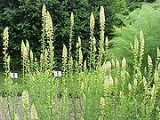
Resedaceae

Encyclopedia
Resedaceae is a family of generally herbaceous
dicotyledon
ous plants comprising some 70 species in six genera:
Recent molecular studies suggest that Oligomeris, Randonia and Ochradenus all arose from within the ranks of Reseda. This would imply that only three genera should be recognised, although as yet no nomenclatural changes have been made.
The family includes annuals
, biennials
and perennials
and is distributed in temperate
to sub-tropical regions of the Europe
, western Asia
, the Middle East
, North America
, and South Africa
.
Resedaceae was placed under the Cronquist system
in the order Capparales
. The APG II system
places it in the order Brassicales
.
Species include:
Herbaceous
A herbaceous plant is a plant that has leaves and stems that die down at the end of the growing season to the soil level. They have no persistent woody stem above ground...
dicotyledon
Dicotyledon
The dicotyledons, also known as dicots, are a group of flowering plants whose seed typically has two embryonic leaves or cotyledons. There are around 199,350 species within this group...
ous plants comprising some 70 species in six genera:
- CayluseaCayluseaThe plant genus Caylusea is a small group of plants found in parts of Africa and India.Caylusea abyssinica is eaten as a vegetable.-Selected species :* Caylusea abyssinica Fisch. & C.A.Mey.* Caylusea canescens Webb...
- OchradenusOchradenusOchradenus is a genus of plant in family Resedaceae. It contains the following species :* Ochradenus socotranus, A.G.Mill....
- Oligomeris
- Randonia
- Reseda
- Sesamoides
Recent molecular studies suggest that Oligomeris, Randonia and Ochradenus all arose from within the ranks of Reseda. This would imply that only three genera should be recognised, although as yet no nomenclatural changes have been made.
The family includes annuals
Annual plant
An annual plant is a plant that usually germinates, flowers, and dies in a year or season. True annuals will only live longer than a year if they are prevented from setting seed...
, biennials
Biennial plant
A biennial plant is a flowering plant that takes two years to complete its biological lifecycle. In the first year the plant grows leaves, stems, and roots , then it enters a period of dormancy over the colder months. Usually the stem remains very short and the leaves are low to the ground, forming...
and perennials
Perennial plant
A perennial plant or simply perennial is a plant that lives for more than two years. The term is often used to differentiate a plant from shorter lived annuals and biennials. The term is sometimes misused by commercial gardeners or horticulturalists to describe only herbaceous perennials...
and is distributed in temperate
Temperate
In geography, temperate or tepid latitudes of the globe lie between the tropics and the polar circles. The changes in these regions between summer and winter are generally relatively moderate, rather than extreme hot or cold...
to sub-tropical regions of the Europe
Europe
Europe is, by convention, one of the world's seven continents. Comprising the westernmost peninsula of Eurasia, Europe is generally 'divided' from Asia to its east by the watershed divides of the Ural and Caucasus Mountains, the Ural River, the Caspian and Black Seas, and the waterways connecting...
, western Asia
Asia
Asia is the world's largest and most populous continent, located primarily in the eastern and northern hemispheres. It covers 8.7% of the Earth's total surface area and with approximately 3.879 billion people, it hosts 60% of the world's current human population...
, the Middle East
Middle East
The Middle East is a region that encompasses Western Asia and Northern Africa. It is often used as a synonym for Near East, in opposition to Far East...
, North America
North America
North America is a continent wholly within the Northern Hemisphere and almost wholly within the Western Hemisphere. It is also considered a northern subcontinent of the Americas...
, and South Africa
South Africa
The Republic of South Africa is a country in southern Africa. Located at the southern tip of Africa, it is divided into nine provinces, with of coastline on the Atlantic and Indian oceans...
.
Resedaceae was placed under the Cronquist system
Cronquist system
The Cronquist system is a taxonomic classification system of flowering plants. It was developed by Arthur Cronquist in his texts An Integrated System of Classification of Flowering Plants and The Evolution and Classification of Flowering Plants .Cronquist's system places flowering plants into two...
in the order Capparales
Capparales
Capparales is a botanical name of an order of flowering plants. It was used in the Cronquist system for an order in subclass Dilleniidae and in the Kubitzki system, nowadays...
. The APG II system
Angiosperm Phylogeny Group
The Angiosperm Phylogeny Group, or APG, refers to an informal international group of systematic botanists who came together to try to establish a consensus on the taxonomy of flowering plants that would reflect new knowledge about plant relationships discovered through phylogenetic studies., three...
places it in the order Brassicales
Brassicales
The Brassicales are an order of flowering plants, belonging to the eurosids II group of dicotyledons under the APG II system. One character common to many members of the order is the production of glucosinolate compounds...
.
Species include:
- Caylusea abyssinicaCaylusea abyssinicaCaylusea abyssinica is a plant species found in East Africa.The edible aerial parts are used as a vegetable in Tanzania and Ethiopia. -External links:**...
- Ochradenus socotranusOchradenus socotranusOchradenus socotranus is a species of plant in the Resedaceae family. It is endemic to Yemen. Its natural habitat is rocky areas.-References:* Miller, A. 2004. . Downloaded on 22 August 2007....
- Oligomeris linifoliaOligomeris linifoliaOligomeris linifolia is a species of flowering plant in the small family Resedaceae known by the common name lineleaf whitepuff. It is native to parts of the Middle East and the Indian subcontinent, as well as southern Europe and North Africa, and the southwestern United States and northern Mexico...
- Reseda luteaReseda luteaReseda lutea or Wild Mignonette is a species of fragrant herbaceous plant. Its roots have been used to make a yellow dye called "weld" since the first millennium BC, although the related plant Reseda luteola was more widely used for that purpose.A native of Eurasia and North Africa, the plant is...