


Comb (anatomy)

Encyclopedia
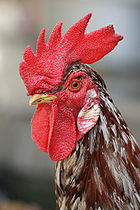
Wattle (anatomy)
A wattle is a fleshy dewlap or caruncle hanging from various parts of the head or neck in several groups of birds, goats and other animals. In some birds the caruncle is erectile tissue.The wattle is frequently an organ of sexual dimorphism...
, or crest on the top of the head of gallinaceous
Galliformes
Galliformes are an order of heavy-bodied ground-feeding domestic or game bird, containing turkey, grouse, chicken, New and Old World Quail, ptarmigan, partridge, pheasant, and the Cracidae. Common names are gamefowl or gamebirds, landfowl, gallinaceous birds or galliforms...
birds, most notably turkey
Turkey (bird)
A turkey is a large bird in the genus Meleagris. One species, Meleagris gallopavo, commonly known as the Wild Turkey, is native to the forests of North America. The domestic turkey is a descendant of this species...
s, pheasant
Pheasant
Pheasants refer to some members of the Phasianinae subfamily of Phasianidae in the order Galliformes.Pheasants are characterised by strong sexual dimorphism, males being highly ornate with bright colours and adornments such as wattles and long tails. Males are usually larger than females and have...
s, and domestic chicken
Chicken
The chicken is a domesticated fowl, a subspecies of the Red Junglefowl. As one of the most common and widespread domestic animals, and with a population of more than 24 billion in 2003, there are more chickens in the world than any other species of bird...
s. Its alternative name cockscomb (spelling variations abound) is because combs are generally larger on males than on females (a male gallinaceous bird is called a cock
Rooster
A rooster, also known as a cockerel, cock or chanticleer, is a male chicken with the female being called a hen. Immature male chickens of less than a year's age are called cockerels...
).
Rooster cockscombs are red, but in other species the color may vary from light grey to deep blue or red; turkey cockscombs can vary in colour from bright red to blue.
In cookery
Cockscombs are used in cookery, often in combination with wattleWattle (anatomy)
A wattle is a fleshy dewlap or caruncle hanging from various parts of the head or neck in several groups of birds, goats and other animals. In some birds the caruncle is erectile tissue.The wattle is frequently an organ of sexual dimorphism...
s or chicken kidney
Kidney
The kidneys, organs with several functions, serve essential regulatory roles in most animals, including vertebrates and some invertebrates. They are essential in the urinary system and also serve homeostatic functions such as the regulation of electrolytes, maintenance of acid–base balance, and...
s.
Cockscombs were formerly used in French cuisine
French cuisine
French cuisine is a style of food preparation originating from France that has developed from centuries of social change. In the Middle Ages, Guillaume Tirel , a court chef, authored Le Viandier, one of the earliest recipe collections of Medieval France...
as garnishes. They were also used to prepare salpicon
Salpicon
Salpicon is a term in French cuisine applied to a preparation consisting of one or more ingredients, diced or minced, and bound with a sauce. The resulting mixture is used to stuff tartlets, canapés, croquettes, rissoles, timbales, vol-au-vents, croustades, eggs, roulades, etc.In Mexican cuisine,...
s served in vol au vents, profiteroles, and so on; in that case, they were often combined with other luxury ingredients such as truffles, sweetbread
Sweetbread
Sweetbreads or ris are culinary names for the thymus or the pancreas especially of the calf and lamb...
s, or morel
Morel
Morchella, the true morels, is a genus of edible mushrooms closely related to anatomically simpler cup fungi. These distinctive mushrooms appear honeycomb-like in that the upper portion is composed of a network of ridges with pits between them....
s in a cream sauce.
In Italian cuisine
Italian cuisine
Italian cuisine has developed through centuries of social and political changes, with roots as far back as the 4th century BCE. Italian cuisine in itself takes heavy influences, including Etruscan, ancient Greek, ancient Roman, Byzantine, Jewish and Arab cuisines...
, cockscombs are an important ingredient in the famous sauce called Cibreo, which also includes chicken liver
Liver
The liver is a vital organ present in vertebrates and some other animals. It has a wide range of functions, including detoxification, protein synthesis, and production of biochemicals necessary for digestion...
s, wattle
Wattle (anatomy)
A wattle is a fleshy dewlap or caruncle hanging from various parts of the head or neck in several groups of birds, goats and other animals. In some birds the caruncle is erectile tissue.The wattle is frequently an organ of sexual dimorphism...
s, and unlaid eggs
Egg (food)
Eggs are laid by females of many different species, including birds, reptiles, amphibians, and fish, and have probably been eaten by mankind for millennia. Bird and reptile eggs consist of a protective eggshell, albumen , and vitellus , contained within various thin membranes...
. It is used as a sauce for tagliatelle
Tagliatelle
Tagliatelle and tagliolini are a traditional type of pasta from Emilia-Romagna and Marches, regions of Italy. Individual pieces of tagliatelle are long, flat ribbons that are similar in shape to fettuccine and are typically about 0.65 cm to 1 cm wide...
and in the molded potato-ricotta ring Cimabella con cibreo.
Cockscombs are prepared by parboil
Parboil
Parboiling is the partial boiling of food as the first step in the cooking process.The word is often used when referring to parboiled rice. Parboiling can also be used for removing poisonous or foul-tasting substances from foodstuffs...
ing and skinning, then cooking in court-bouillon. After preparation, they are greyish.
Other
Because of its bright color and distinctive shape, 'cockscomb' also describes various plants, including the florists' plant Celosia cristataCelosia cristata
Celosia cristata [Celosia in Greek means burning] is a member of the genus Celosia, and is commonly known as cockscomb, since the flower looks like the head on a rooster . It is called Chi Kuan in China...
, the meadow weed yellow rattle
Yellow rattle
Yellow Rattle or Cockscomb, Rhinanthus minor, is a flowering plant in the genus Rhinanthus in the family Orobanchaceae, native to Europe and Western Asia....
, sainfoin
Sainfoin
Onobrychis, the Sainfoins, are Eurasian perennial herbs of the legume family . Including doubtfully distinct species and provisionally accepted taxa, about 150 species are presently known...
, wild poppy
Poppy
A poppy is one of a group of a flowering plants in the poppy family, many of which are grown in gardens for their colorful flowers. Poppies are sometimes used for symbolic reasons, such as in remembrance of soldiers who have died during wartime....
, lousewort
Lousewort
Pedicularis is a genus of perennial green root parasite plants belonging to the broomrape family Orobanchaceae. Between 350 and 600 species are accepted by different authorities, mostly from the wetter northern temperate zones, as well as from South America...
, Erythronium
Erythronium
Erythronium is a genus of 20-30 species of spring-flowering perennial plants with long, tooth-like bulbs and attractive pendant flowers, native to forest and meadow in temperate regions of the Northern Hemisphere.-Species:-Uses:The bulb is edible as a root vegetable, cooked or dried, and can be...
and Erythrina crista-galli
Erythrina crista-galli
Erythrina crista-galli is a flowering tree in the family Fabaceae, native to Argentina, Uruguay, Brazil and Paraguay. It is widely planted as a street or garden tree in other countries, most notably in California...
; the characteristic jester's cap; a shape of pasta
Pasta
Pasta is a staple food of traditional Italian cuisine, now of worldwide renown. It takes the form of unleavened dough, made in Italy, mostly of durum wheat , water and sometimes eggs. Pasta comes in a variety of different shapes that serve for both decoration and to act as a carrier for the...
(creste di galli); and so on.