

Quantum reflection

Encyclopedia
Quantum reflection is a physical phenomenon involving the reflection of a matter wave from an attractive potential. In classical physics, such a phenomenon is not possible; for instance when one magnet is pulled toward another, you do not expect one of the magnets to suddenly (i.e. before the magnets `touch') turn around and retreat in the opposite direction.
Observation of quantum reflection has become possible thanks to recent advances in trapping and cooling atoms.
apply to any particles, usually the term quantum reflection means reflection of atoms from a surface of condensed matter
(liquid or solid). The full potential experienced by the incident atom does become repulsive at a very small distance from the surface (of order of size of atoms). This is when the atom becomes aware of the discrete character of material. This repulsion is responsible for the classical scattering one would expect for particles incident on a surface. Such scattering is diffuse
rather than specular, and so this component of the reflection is easy to distinguish. Indeed to reduce this part of the physical process, a grazing angle of incidence is used; this enhances the quantum reflection. This requirement of small incident velocities for the particles means that the non-relativistic approximation to quantum mechanics is all that is required.
 and
and  ), such that only a single coordinate (say
  ) is important. In this case one can examine the specular reflection
of a slow neutral atom from a solid state surface
. Where one has an atom in a region of free space close to a material capable of being polarized, a combination of the pure van der Waals
interaction, and the related Casimir-Polder
interaction attracts the atom to the surface of the material. The latter force dominates when the atom is comparatively far from the surface, and the former when the atom comes closer to the surface. The intermediate region is controversial as it is dependent upon the specific nature and quantum state of the incident atom.
The condition for a reflection to occur as the atom experiences the attractive potential can be given by the presence of regions of space where the WKB approximation
to the atomic wave-function breaks down. If, in accordance with this approximation we write the wavelength of the gross motion of the atom system toward the surface as a quantity local to every region along the axis,
axis,
Definition
Quantum reflection became an important branch of physics in 21st century. In a workshop about quantum reflection, the following definition of quantum reflection was suggested:
Quantum reflection is a classically counterintuitive phenomenon whereby the motion of particles is reverted "against the force" acting on them. This effect manifests the wave nature of particles and influences collisions of ultracold atoms and interaction of atoms with solid surfaces.
Observation of quantum reflection has become possible thanks to recent advances in trapping and cooling atoms.
Reflection of slow atoms
Although the principles of quantum mechanicsQuantum mechanics
Quantum mechanics, also known as quantum physics or quantum theory, is a branch of physics providing a mathematical description of much of the dual particle-like and wave-like behavior and interactions of energy and matter. It departs from classical mechanics primarily at the atomic and subatomic...
apply to any particles, usually the term quantum reflection means reflection of atoms from a surface of condensed matter
Condensed Matter
Condensed matter may refer to several things*Condensed matter physics, the study of the physical properties of condensed phases of matter*European Physical Journal B: Condensed Matter and Complex Systems, a scientific journal published by EDP sciences...
(liquid or solid). The full potential experienced by the incident atom does become repulsive at a very small distance from the surface (of order of size of atoms). This is when the atom becomes aware of the discrete character of material. This repulsion is responsible for the classical scattering one would expect for particles incident on a surface. Such scattering is diffuse
Diffuse reflection
Diffuse reflection is the reflection of light from a surface such that an incident ray is reflected at many angles rather than at just one angle as in the case of specular reflection...
rather than specular, and so this component of the reflection is easy to distinguish. Indeed to reduce this part of the physical process, a grazing angle of incidence is used; this enhances the quantum reflection. This requirement of small incident velocities for the particles means that the non-relativistic approximation to quantum mechanics is all that is required.
Single-dimensional approximation
So far, one usually considers the single-dimensional case of this phenomenon, that is when the potential has translational symmetry in two directions (say and ), such that only a single coordinate (say ) is important. In this case one can examine the specular reflectionSpecular reflection
Specular reflection is the mirror-like reflection of light from a surface, in which light from a single incoming direction is reflected into a single outgoing direction...
of a slow neutral atom from a solid state surface
. Where one has an atom in a region of free space close to a material capable of being polarized, a combination of the pure van der Waals
Van der Waals force
In physical chemistry, the van der Waals force , named after Dutch scientist Johannes Diderik van der Waals, is the sum of the attractive or repulsive forces between molecules other than those due to covalent bonds or to the electrostatic interaction of ions with one another or with neutral...
interaction, and the related Casimir-Polder
Casimir effect
In quantum field theory, the Casimir effect and the Casimir–Polder force are physical forces arising from a quantized field. The typical example is of two uncharged metallic plates in a vacuum, like capacitors placed a few micrometers apart, without any external electromagnetic field...
interaction attracts the atom to the surface of the material. The latter force dominates when the atom is comparatively far from the surface, and the former when the atom comes closer to the surface. The intermediate region is controversial as it is dependent upon the specific nature and quantum state of the incident atom.
The condition for a reflection to occur as the atom experiences the attractive potential can be given by the presence of regions of space where the WKB approximation
WKB approximation
In mathematical physics, the WKB approximation or WKB method is a method for finding approximate solutions to linear partial differential equations with spatially varying coefficients...
to the atomic wave-function breaks down. If, in accordance with this approximation we write the wavelength of the gross motion of the atom system toward the surface as a quantity local to every region along the
axis,-

where is the atomic mass,
  is its energy, and
  is the potential it experiences, then it is clear that we cannot give meaning to this quantity where,
-

That is, in regions of space where the variation of the atomic wavelength is significant over its own length (i.e. the gradient of is steep), there is no meaning in the approximation of a local wavelength. This breakdown occurs irrespective of the sign of the potential,
  . In such regions part of the incident atom wave-function may become reflected. Such a reflection may occur for slow atoms experiencing the comparatively rapid variation of the van der Waals potential near the material surface. This is just the same kind of phenomenon as occurs when light passes from a material of one refractive index to another of a significantly different index over a small region of space. Irrespective of the sign of the difference in index, there will be a reflected component of the light from the interface. Indeed, quantum reflection from the surface of solid-stateSolid-state physicsSolid-state physics is the study of rigid matter, or solids, through methods such as quantum mechanics, crystallography, electromagnetism, and metallurgy. It is the largest branch of condensed matter physics. Solid-state physics studies how the large-scale properties of solid materials result from...
wafer allows one to make the quantum optical analogue of a mirrorMirrorA mirror is an object that reflects light or sound in a way that preserves much of its original quality prior to its contact with the mirror. Some mirrors also filter out some wavelengths, while preserving other wavelengths in the reflection...
- the atomic mirrorAtomic mirror (physics)In physics, an atomic mirror is a device which reflects neutral atoms in the similar way as the conventional mirror reflects visible light. Atomic mirrors can be made of electric fields or magnetic fields, electromagnetic waves or just silicon wafer; in the last case, atoms are reflected by the...
- to a high precision.
Experiments with grazing incidence
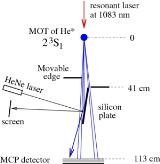
Practically, in many experiments with quantum reflection from Si, the grazing incidence angle is used (figure 0).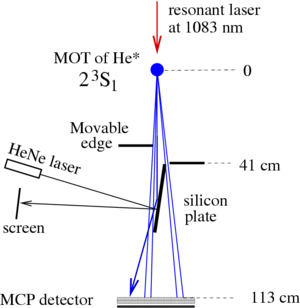
The set-up is mounted in a vacuum chamber to provide several meter free path of atoms; the good vacuum (at the level of 10−7 mm Hg ) is required. The magneto-optical trapMagneto-optical trapA magneto-optical trap is a device that uses both laser cooling with magneto-optical trapping in order to produce samples of cold, trapped, neutral atoms at temperatures as low as several microkelvins, two or three times the recoil limit.By combining the small momentum of a single photon with a...
(MOT) is used to collect cold atoms, usually excited He or Ne, approaching the point-like source of atoms. The excitation of atoms is not essential for the quantum reflection but it allows the efficient trapping and cooling using optical frequencies. In addition, the excitation of atoms allows the registration at the micro-channel plate (MCP) detector (bottom of the figure). Movable edges are used to stop atoms which do not go toward the sample (for example a Si plate), providing the collimated atomic beamAtomic beamAtomic beam is special case of particle beam; it is the collimated flux of neutral atoms.The imaging systems using the slow atomic beams can use the Fresnel zone plate of a Fresnel diffraction mirror as focusing element. The imaging system with atomic beam could provide the sub-micrometre...
. The He-Ne laser was used to control the orientation of the sample and measure the grazing angle . At the MCP, there was observed relatively intensive strip of atoms which come straightly (without reflection) from the MOTMagneto-optical trapA magneto-optical trap is a device that uses both laser cooling with magneto-optical trapping in order to produce samples of cold, trapped, neutral atoms at temperatures as low as several microkelvins, two or three times the recoil limit.By combining the small momentum of a single photon with a...
, by-passing the sample, strong shadow of the sample (the thickness of this shadow could be used for rough control of the grazing angle), and the relatively weak strip produced by the reflected atoms. The ratio of density of atoms registered at the center of this strip to the density of atoms at the directly illuminated region was considered as efficiency of quantum reflection, i.e., reflectivity. This reflectivity strongly depends on the grazing angle and speed of atoms.
In the experiments with Ne atoms, usually just fall down, when the MOT is suddenly switched-off. Then, the speed of atoms is determined as , where
  is acceleration of free fall, and
  is distance from the MOTMagneto-optical trapA magneto-optical trap is a device that uses both laser cooling with magneto-optical trapping in order to produce samples of cold, trapped, neutral atoms at temperatures as low as several microkelvins, two or three times the recoil limit.By combining the small momentum of a single photon with a...
to the sample. In experiments described, this distance was of order of 0.5 meter, providing the speed of order of 3 m/s. Then, the transversal wavenumber can be calculated as , where
  is mass of the atom, and
  is the Planck constantPlanck constantThe Planck constant , also called Planck's constant, is a physical constant reflecting the sizes of energy quanta in quantum mechanics. It is named after Max Planck, one of the founders of quantum theory, who discovered it in 1899...
.
In the case with He, the additional resonant laser could be used to release the atoms and provide them an additional velocity; the delay since the release of the atoms till the registration allowed to estimate this additional velocity; roughly, , where
  is time delay since the release of atoms till the click at the detector. Practically,
  could vary from 20 m/s to 130 m/s.
Although the scheme at the figure looks simple, the extend facility is necessary to slow atoms, trap them and cool to millikelvin temperature, providing a micrometre size source of cold atoms. Practically, the mounting and maintaining of this facility (not shown in the figure) is the heaviest job in the experiments with quantum reflection of cold atoms. The possibility of an experiment with the quantum reflection with just a pinhole instead of MOTMagneto-optical trapA magneto-optical trap is a device that uses both laser cooling with magneto-optical trapping in order to produce samples of cold, trapped, neutral atoms at temperatures as low as several microkelvins, two or three times the recoil limit.By combining the small momentum of a single photon with a...
are discussed in the literature.
Casimir and van der Waals attraction
Despite this, there is some doubt as to the physical origin of quantum reflection from solid surfaces. As was briefly mentioned above, the potential in the intermediate region between the regions dominated by the Casimir-Polder and Van der Waals interactions requires an explicit Quantum ElectrodynamicalQuantum electrodynamicsQuantum electrodynamics is the relativistic quantum field theory of electrodynamics. In essence, it describes how light and matter interact and is the first theory where full agreement between quantum mechanics and special relativity is achieved...
calculation for the particular state and type of atom incident on the surface. Such a calculation is very difficult. Indeed, there is no reason to suppose that this potential is solely attractive within the intermediate region. Thus the reflection could simply be explained by a repulsive force, which would make the phenomenon not quite so surprising. Furthermore, a similar dependence for reflectivity on the incident velocity is observed in the case of the adsorption of particles in vicinity of a surface. In the simplest case, such absorption could be described with a non-Hermitian potential (i.e. one where probability is not conserved). Until 2006, the published papers interpreted the reflection in terms of a Hermitian potential
this assumption allows to build a quantitative theory
.
Efficient quantum reflection
A qualitative estimate for the efficiency of quantum reflection can be made using dimensional analysis. Letting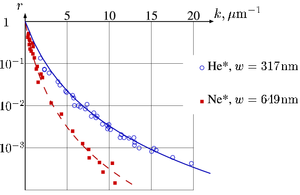
 be mass of the atom and
  the normal component of its wave-vector, then the energy of the normal motion of the particle,

should be compared to the potential, of interaction. The distance,
  at which
  can be considered as the distance the which the atom will come across a troublesome discontinuity in the potential. This is the point at which the WKB method truly becomes nonsense. The condition for efficient quantum reflection can be written as
  . In other words the wavelength is small compared to the distance at which the atom may become reflected from the surface. If this condition holds, the aforementioned effect of the discrete character of the surface may be neglected. This argument produces a simple estimate for the reflectivity,
  ,
,

which shows good agreement with experimental data for excited neon and helium atoms, reflected from a flat silicon surface (fig.1), see
and references therein. Such a fit is also in good agreement with a single-dimensional analysis of the scattering of atoms from an attractive potential,. Such agreement indicates, that, at least in the case of noble gases and Si surface, the quantun reflection can be described with single-dimensional hermitian potential, as the result of attraction of atoms to the surface.
Ridged mirror
The effect of quantum reflection can be enhanced using ridged mirror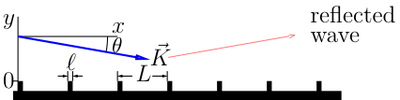 Ridged mirrorIn atomic physics, a ridged mirror is a kind of atomic mirror, designed for the specular reflection of neutral particles coming at the grazing incidence angle, characterised in the following: in order to reduce the mean attraction of particles to the surface and increase the reflectivity, this...
s
. If one produces a surface consisting of a set of narrow ridges then the resulting non-uniformity of the material allows the reduction of the effective van der Waals constant; this extends the working ranges of the grazing angle. For this reduction to be valid, we must have small distances, between the ridges. Where
  becomes large, the non-uniformity is such that the ridged mirrorRidged mirrorIn atomic physics, a ridged mirror is a kind of atomic mirror, designed for the specular reflection of neutral particles coming at the grazing incidence angle, characterised in the following: in order to reduce the mean attraction of particles to the surface and increase the reflectivity, this...
must be interpreted in terms of multiple Fresnel diffractionFresnel diffractionIn optics, the Fresnel diffraction equation for near-field diffraction, is an approximation of Kirchhoff-Fresnel diffraction that can be applied to the propagation of waves in the near field....
or the Zeno effect; these interpretations give similar estimates for the reflectivity
. See ridged mirrorRidged mirrorIn atomic physics, a ridged mirror is a kind of atomic mirror, designed for the specular reflection of neutral particles coming at the grazing incidence angle, characterised in the following: in order to reduce the mean attraction of particles to the surface and increase the reflectivity, this...
for the details.
Similar enhancement of quantum reflection takes place where one has particles incident on an array of pillars
. This was observed with very slow atoms (Bose-Einstein condensate) at almost normal incidence.
Application of quantum reflection
Quantum reflection makes the idea of solid-state atomic mirrorAtomic mirror (physics)In physics, an atomic mirror is a device which reflects neutral atoms in the similar way as the conventional mirror reflects visible light. Atomic mirrors can be made of electric fields or magnetic fields, electromagnetic waves or just silicon wafer; in the last case, atoms are reflected by the...
s and atomic-beam imaging systems (atomic nanoscopeAtomic nanoscopeThe atomic de Broglie microscope is an imaging system which is expected to provide resolution at the nanometer scale....
) possible. The use of quantum reflection in the production of atomic traps has also been suggested. Up to year 2007, no commercial application of quantum reflection is reported.
See also
- Atom opticsAtom opticsAtom optics is the area of physics which deals with beams of cold, slowly moving neutral atoms, as a special case of a particle beam....
- Ridged mirrorRidged mirrorIn atomic physics, a ridged mirror is a kind of atomic mirror, designed for the specular reflection of neutral particles coming at the grazing incidence angle, characterised in the following: in order to reduce the mean attraction of particles to the surface and increase the reflectivity, this...
- Casimir force
- van der Waals potential
- Slow atoms
- Cold atoms
- Atom optics
-