

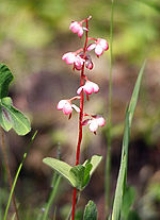
Pyrola

Encyclopedia
Pyrola is a genus of evergreen herbaceous
plant
s in the family Ericaceae
. Under the old Cronquist system it was placed in its own family Pyrolaceae
, but genetic research showed it belonged in the family Ericaceae
. The species are commonly known as wintergreen, a name shared with several other related and unrelated plants (see wintergreen
for details). They are native to northern temperate and Arctic
regions.
They are rather small plants with a rosette
of simple orbicular or ovate leaves
, with a flower
stem bearing generally rather lax raceme
s of simple white, cream or pink flowers. The immediate distinguishing feature of Pyrola species is the flower style which is often curved, sticks out beyond the petals and is expanded below the stigma which itself is branched into several lobes
. To the casual observer the flower appears to have a small bell-clapper sticking out.
and arctic
Europe
, Asia
and North America
. In North America they also occur down the western mountains south to California
. Some populations in New England
may be introductions by early European settlers.
in anthers which open by apical pores. The pollen itself is produced in tetrads and is rather sticky. Not surprisingly, wintergreens are insect
pollinated, most commonly by flies
. The rather large and complex stigma may be an adaptation to ensure that small insects carrying pollen have an attractive landing place. The flowers are produced in the summer and the rather inconspicuous greenish seed capsules are produced in the autumn. The seeds are numerous and very small.
Herbaceous
A herbaceous plant is a plant that has leaves and stems that die down at the end of the growing season to the soil level. They have no persistent woody stem above ground...
plant
Plant
Plants are living organisms belonging to the kingdom Plantae. Precise definitions of the kingdom vary, but as the term is used here, plants include familiar organisms such as trees, flowers, herbs, bushes, grasses, vines, ferns, mosses, and green algae. The group is also called green plants or...
s in the family Ericaceae
Ericaceae
The Ericaceae, commonly known as the heath or heather family, is a group of mostly calcifuge flowering plants. The family is large, with roughly 4000 species spread across 126 genera, making it the 14th most speciose family of flowering plants...
. Under the old Cronquist system it was placed in its own family Pyrolaceae
Pyrolaceae
Pyrolaceae was a small family of flowering plants under the old Cronquist system of plant classification. It included the four genera Chimaphila, Moneses, Orthilia, and Pyrola, and sometimes also the eight genera formerly usually placed in the family Monotropaceae.Recent genetic research by the...
, but genetic research showed it belonged in the family Ericaceae
Ericaceae
The Ericaceae, commonly known as the heath or heather family, is a group of mostly calcifuge flowering plants. The family is large, with roughly 4000 species spread across 126 genera, making it the 14th most speciose family of flowering plants...
. The species are commonly known as wintergreen, a name shared with several other related and unrelated plants (see wintergreen
Wintergreen
Wintergreen is a group of plants. Wintergreen once commonly referred to plants that continue photosynthesis throughout the winter...
for details). They are native to northern temperate and Arctic
Arctic
The Arctic is a region located at the northern-most part of the Earth. The Arctic consists of the Arctic Ocean and parts of Canada, Russia, Greenland, the United States, Norway, Sweden, Finland, and Iceland. The Arctic region consists of a vast, ice-covered ocean, surrounded by treeless permafrost...
regions.
They are rather small plants with a rosette
Rosette (botany)
In botany, a rosette is a circular arrangement of leaves, with all the leaves at a single height.Though rosettes usually sit near the soil, their structure is an example of a modified stem.-Function:...
of simple orbicular or ovate leaves
Leaf
A leaf is an organ of a vascular plant, as defined in botanical terms, and in particular in plant morphology. Foliage is a mass noun that refers to leaves as a feature of plants....
, with a flower
Flower
A flower, sometimes known as a bloom or blossom, is the reproductive structure found in flowering plants . The biological function of a flower is to effect reproduction, usually by providing a mechanism for the union of sperm with eggs...
stem bearing generally rather lax raceme
Raceme
A raceme is a type of inflorescence that is unbranched and indeterminate and bears pedicellate flowers — flowers having short floral stalks called pedicels — along the axis. In botany, axis means a shoot, in this case one bearing the flowers. In a raceme, the oldest flowers are borne...
s of simple white, cream or pink flowers. The immediate distinguishing feature of Pyrola species is the flower style which is often curved, sticks out beyond the petals and is expanded below the stigma which itself is branched into several lobes
Lobe (anatomy)
In anatomy, a lobe is a clear anatomical division or extension that can be determined without the use of a microscope This is in contrast to a lobule, which is a clear division only visible histologically....
. To the casual observer the flower appears to have a small bell-clapper sticking out.
Distribution
They are distributed across northern temperateTemperate
In geography, temperate or tepid latitudes of the globe lie between the tropics and the polar circles. The changes in these regions between summer and winter are generally relatively moderate, rather than extreme hot or cold...
and arctic
Arctic
The Arctic is a region located at the northern-most part of the Earth. The Arctic consists of the Arctic Ocean and parts of Canada, Russia, Greenland, the United States, Norway, Sweden, Finland, and Iceland. The Arctic region consists of a vast, ice-covered ocean, surrounded by treeless permafrost...
Europe
Europe
Europe is, by convention, one of the world's seven continents. Comprising the westernmost peninsula of Eurasia, Europe is generally 'divided' from Asia to its east by the watershed divides of the Ural and Caucasus Mountains, the Ural River, the Caspian and Black Seas, and the waterways connecting...
, Asia
Asia
Asia is the world's largest and most populous continent, located primarily in the eastern and northern hemispheres. It covers 8.7% of the Earth's total surface area and with approximately 3.879 billion people, it hosts 60% of the world's current human population...
and North America
North America
North America is a continent wholly within the Northern Hemisphere and almost wholly within the Western Hemisphere. It is also considered a northern subcontinent of the Americas...
. In North America they also occur down the western mountains south to California
California
California is a state located on the West Coast of the United States. It is by far the most populous U.S. state, and the third-largest by land area...
. Some populations in New England
New England
New England is a region in the northeastern corner of the United States consisting of the six states of Maine, New Hampshire, Vermont, Massachusetts, Rhode Island, and Connecticut...
may be introductions by early European settlers.
Reproduction
Pyrolaceae, as part of the Ericales produce pollenPollen
Pollen is a fine to coarse powder containing the microgametophytes of seed plants, which produce the male gametes . Pollen grains have a hard coat that protects the sperm cells during the process of their movement from the stamens to the pistil of flowering plants or from the male cone to the...
in anthers which open by apical pores. The pollen itself is produced in tetrads and is rather sticky. Not surprisingly, wintergreens are insect
Insect
Insects are a class of living creatures within the arthropods that have a chitinous exoskeleton, a three-part body , three pairs of jointed legs, compound eyes, and two antennae...
pollinated, most commonly by flies
Diptera
Diptera , or true flies, is the order of insects possessing only a single pair of wings on the mesothorax; the metathorax bears a pair of drumstick like structures called the halteres, the remnants of the hind wings. It is a large order, containing an estimated 240,000 species, although under half...
. The rather large and complex stigma may be an adaptation to ensure that small insects carrying pollen have an attractive landing place. The flowers are produced in the summer and the rather inconspicuous greenish seed capsules are produced in the autumn. The seeds are numerous and very small.