


Pygmy Hippopotamus

Encyclopedia
The pygmy hippopotamus (Choeropsis liberiensis or Hexaprotodon liberiensis) is a large mammal
native to the forests and swamps of western Africa (the specific name liberiensis means "of Liberia
", as this is where the vast majority live). The pygmy hippo is reclusive and nocturnal. It is one of only two extant species in the Hippopotamidae
family
, the other being its much larger cousin the common hippopotamus
.
The pygmy hippopotamus displays many terrestrial adaptation
s, but like its larger cousin, it is semi-aquatic and relies on proximity to water to keep its skin moisturized and its body temperature cool. Behaviors such as mating and giving birth may occur in water or on land. The pygmy hippo is herbivorous, feeding on ferns, broad-leaved plants, grass
es and fruit
s it finds in the forests.
A rare nocturnal forest creature, the pygmy hippopotamus is a difficult animal to study in the wild.
Pygmy hippos were unknown outside of West Africa
until the 19th century. Introduced to zoos in the early 20th century, they breed well in captivity and the vast majority of research is derived from zoo specimens. The survival of the species in captivity is more assured than in the wild, the World Conservation Union
estimates that there are fewer than 3,000 pygmy hippos remaining in the wild. Pygmy hippos are primarily threatened by loss of habitat, as forests are logged and converted to farm land, and are also vulnerable to poaching
, hunting, natural predators and war.
form by the OED
, or pygmy hippos for short). A male pygmy hippopotamus is known as a bull, a female as a cow, and a baby as a calf.
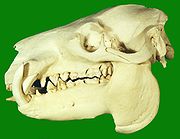 The pygmy hippopotamus is a member of the family Hippopotamidae
where it is classified as a member of either the genus
Choeropsis ("resembling a hog
") or, the genus Hexaprotodon
("six front teeth"). Members of Hippopotamidae are sometimes known as hippopotamids. Sometimes the sub-family Hippopotaminae is used. Further, some taxonomists group hippopotami and anthracotheres in the superfamily Anthracotheroidea or Hippopotamoidea.
A sister species of the pygmy hippopotamus may have been the little-studied Malagasy pygmy hippopotamus (Hexaprotodon madagascariensis or Hippopotamus madagascariensis), one of three recently extinct species from Madagascar
. C. madagascariensis was the same size as C. liberiensis and shared its terrestrial behavior, inhabiting the forested highlands of Madagascar, rather than open rivers. It is believed to have gone extinct within the last 500 years.
The taxonomy
of the genus of the pygmy hippopotamus has changed as understanding of the animal has developed. Samuel G. Morton initially classified the animal as Hippopotamus minor, but later determined it was distinct enough to warrant its own genus, and labeled it Choeropsis. In 1977, Coryndon proposed that the pygmy hippopotamus was closely related to Hexaprotodon, a genus that consisted of prehistoric hippos mostly native to Asia. This assertion was widely accepted, until Boisserie asserted in 2005 that the pygmy hippopotamus was not a member of Hexaprotodon, after a thorough examination of the phylogeny of Hippopotamidae; he suggested instead that the pygmy hippopotamus was a distinct genus, and returned the animal to Choeropsis. All agree that the modern pygmy hippopotamus, be it H. liberiensis or C. liberiensis, is the only extant member of its genus.
for the Liberian pygmy hippopotamus. The Nigerian pygmy hippopotamus subspecies was never studied in the wild and never captured. All research and all zoo specimens are the Liberian subspecies. The Nigerian subspecies is classified as C. liberiensis heslopi.
The Nigerian pygmy hippopotamus ranged in the Niger River Delta
, especially near Port Harcourt, but no reliable reports exist after the collection of the museum specimens secured by I. R. P. Heslop, a British colonial officer, in the early 1940s. It is probably extinct. The subspecies is separated by over 1800 kilometres (1,118.5 mi) and the Dahomey Gap
, a region of savanna that divides the forest regions of West Africa. The subspecies is named after I. R. P. Heslop, who claimed in 1945 to have shot a pygmy hippo in the Niger Delta region and collected several skulls. He estimated that perhaps no more than 30 pygmy hippos remained in the region.
Heslop reportedly sent four pygmy hippopotamus skulls he collected to the British Museum of Natural History in London. These specimens were not subjected to taxonomic evaluation, however, until 1969 when G. B. Corbet classified the skulls as belonging to a separate subspecies based on consistent variations in the proportions of the skulls. The Nigerian pygmy hippos were seen or shot in Rivers State
, Imo State
and Bayelsa State
, Nigeria
. While some local populations are aware that the species once existed, its history in the region is poorly documented.
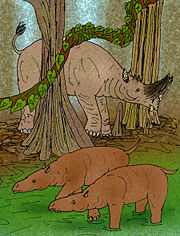
 The evolution of the pygmy hippopotamus is most often studied in the context of its larger cousin. Both species were long believed to be most closely related to the family Suidae
(pig
s and hogs) or Tayassuidae (peccaries), but research within the last 10 years has determined that pygmy hippos and hippos are most closely related to cetacea
ns (whale
s and dolphin
s). Hippos and whales shared a common semi-aquatic ancestor that branched off from other artiodactyls around . This hypothesized ancestor likely split into two branches about six million years later. One branch would evolve into cetaceans
, the other branch became the anthracotheres
, a large family of four-legged beasts, whose earliest member, from the Late Eocene
, would have resembled narrow hippopotami with comparatively small and thin heads.
Hippopotamids are deeply nested within the family Anthracotheriidae
. The oldest known hippopotamid is the genus Kenyapotamus
, which lived in Africa from . Kenyapotamus is known only through fragmentary fossils, but was similar in size to C. liberiensis. The Hippopotamidae are believed to have evolved in Africa, and while at one point the species spread across Asia and Europe, no hippopotami have ever been discovered in the Americas. Starting the Archaeopotamus
, likely ancestors to the genus Hippopotamus and Hexaprotodon
, lived in Africa and the Middle East.
While the fossil record of hippos is still poorly understood, the lineages of the two modern genera, Hippopotamus and Choeropsis, may have diverged as far back as . The ancestral form of the pygmy hippopotamus may be the genus Saotherium. Saotherium and Choeropsis are significantly more basal
than Hippopotamus and Hexaprotodon, and thus more closely resemble the ancestral species of hippos.
or early Holocene
. Though these species are sometimes known as "pygmy hippopotami" they are not believed to be closely related to C. liberiensis. These include the Cretan dwarf hippopotamus
(Hippopotamus creutzburgi), the Sicilian hippopotamus
(Hippopotamus pentlandi), the Maltese hippopotamus
(Hippopotamus melitensis) and the Cyprus dwarf hippopotamus
(Hippopotamus minor).
These species, though comparable in size to the pygmy hippopotamus, are considered dwarf hippopotamuses, rather than pygmies. They are likely descended from a full-sized species of European hippopotamus
, and reached their small size through the evolutionary process of insular dwarfism
which is common on islands; the ancestors of pygmy hippopotami were also small and thus there was never a dwarfing process. There were also several species of pygmy hippo on the island of Madagascar (see Malagasy hippopotamus
).
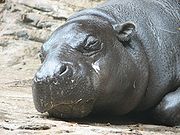 The skin is greenish-black or brown, shading to a creamy gray on the lower body. Their skin is very similar to the common hippo's, with a thin epidermis over a dermis
that is several centimeters thick. Pygmy hippos have the same unusual sweat as common hippos, that gives a pinkish tinge to their bodies, and is sometimes described as "blood sweat" though the secretion is neither sweat nor blood. The highly alkaline substance is believed to have antiseptic and sunscreening properties. The skin of hippos dries out quickly and cracks, which is why both species of hippos spend so much time in water.
The skeleton of C. liberiensis is more gracile than that of the common hippopotamus, meaning their bones are proportionally thinner. The common hippo's spine is parallel with the ground; the pygmy hippo's back slopes forward, a likely adaptation
to pass more easily through dense forest vegetation. Proportionally, the pygmy hippo's legs and neck are longer and its head smaller.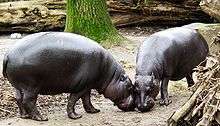 The orbits
and nostril
s of a pygmy hippo are much less pronounced, an adaptation from spending less time in deep water (where pronounced orbits and nostrils help the common hippo breathe and see). The feet of pygmy hippos are narrower, but the toes are more spread out and have less webbing, to assist in walking on the forest floor. Despite adaptations to a more terrestrial life than the common hippopotamus, pygmy hippos are still more aquatic than all other even-toed ungulate
s. The ears and nostrils of pygmy hippos have strong muscular valves to aid submerging underwater, and the skin physiology is dependent on the availability of water.
, though this is an effect of convergent evolution
. While the common hippopotamus is gregarious, pygmy hippos live either alone or in small groups, typically a mated pair or a mother and calf. Pygmy hippos tend to ignore each other rather than fight when they meet. Field studies have estimated that male pygmy hippos range over 1.85 square kilometres (457.1 acre), while the range of a female is between 0.4 to 0.6 km² (98.8 to 148.3 acre).
Pygmy hippos spend most of the day hidden in rivers. They will rest in the same spot for several days in a row, before moving to a new spot. At least some pygmy hippos make use of dens
or burrow
s that form in river banks. It is unknown if the pygmy hippos help create these dens, or how common it is to use them. Though a pygmy hippo has never been observed burrowing, other artiodactyls, such as warthog
s, are burrowers.
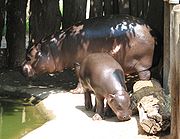 A study of breeding behavior in the wild has never been conducted; the artificial conditions of captivity may cause the observed behavior of pygmy hippos in zoos to differ from natural conditions. Sexual maturity for the pygmy hippopotamus occurs between three and five years of age. The youngest reported age for giving birth is a pygmy hippo in the Zoo Basel
, Switzerland
which bore a calf at three years and three months. The oestrus cycle of a female pygmy hippo lasts an average of 35.5 days, with the oestrus itself lasting between 24–48 hours.
Pygmy hippos consort for mating, but the duration of the relationship is unknown. In zoos they breed as monogamous pairs. Copulation can take place on land or in the water, and a pair will mate one to four times during an oestrus period. In captivity, pygmy hippos have been conceived and born in all months of the year. The gestation period ranges from 190–210 days, and usually a single young is born, though twins are known to occur.
The common hippopotamus gives birth and mates only in the water, but pygmy hippos mate and give birth on both land and water. Young pygmy hippos can swim almost immediately. At birth, pygmy hippos weigh 4.5–6.2 kg (9.9–13.7 lb) with males weighing about 0.25 kg (0.55 lb) more than females. Pygmy hippos are fully weaned between six and eight months of age; before weaning they do not accompany their mother when she leaves the water to forage, but instead hide in the water by themselves. The mother returns to the hiding spot about three times a day and calls out for the calf to suckle. Suckling occurs with the mother lying on her side.
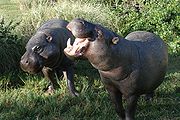 The greatest threat to the remaining pygmy hippopotamus population in the wild is loss of habitat. The forests in which pygmy hippos live have been subject to logging, settling and conversion to agriculture, with little efforts made to make logging sustainable. As forests shrink, the populations become more fragmented, leading to less genetic diversity in the potential mating pool.
Because of their reclusive lifestyle they are not a target of subsistence hunting, though they are hunted opportunistically by bush hunters. Their meat is said to be of excellent quality, like that of a wild boar; unlike those of the common hippo, the pygmy hippo's teeth have no value. The effects of West Africa's civil strife on the pygmy hippopotamus are unknown, but unlikely to be positive. Adult common hippos have no natural predators, but the pygmy hippopotamus is capable of being killed by leopard
s, pythons and crocodile
s. How often this occurs, however, is unknown.
C. liberiensis was identified as one of the top-10 "focal species" in 2007 by the Evolutionarily Distinct and Globally Endangered
(EDGE) project. Some populations inhabit protected areas, such as the Gola Forest Reserve
in Sierra Leone.
The Zoo Basel
in Switzerland holds the international studbook and coordinates the entire captive pygmy hippo population that freely breeds in zoos around the world. Between 1970 and 1991 the population of pygmy hippos born in captivity more than doubled. The survival of the species in zoos is more certain than the survival of the species in the wild. In captivity, the pygmy hippo lives from 42 to 55 years, longer than in the wild. Since 1919, only 41 percent of pygmy hippos born in zoos have been male.
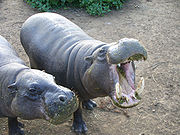 While the common hippopotamus was known to Europeans since classical antiquity
, the pygmy hippopotamus was unknown outside of its range in West Africa until the 19th century. Due to their nocturnal, forested existence, they were poorly known within their range as well. In Liberia the animal was traditionally known as a water cow.
Early field reports of the animal misidentified it as a wild hog. Several skulls of the species were sent to the American natural scientist Samuel G. Morton, during his residency in Monrovia
, Liberia
. Morton first described the species in 1843. The first complete specimens were collected as part of a comprehensive investigation of Liberian fauna in the 1870s and 1880s by Dr. Johann Büttikofer
. The specimens were taken to the Natural History Museum in Leiden, Netherlands
.
The first pygmy hippo was brought to Europe in 1873 after being captured in Sierra Leone by a member of the British Colonial Service but died shortly after arrival. Pygmy hippos were successfully introduced to Europe in 1911. They were first shipped to Germany and then to the Bronx Zoo
in New York City
where they also thrived.
In 1927, Harvey Firestone
of Firestone Tires
presented Billy the pygmy hippo
to U.S. President Calvin Coolidge
. Coolidge donated Billy to the Smithsonian National Zoological Park
. According to the zoo, Billy is a common ancestor to most pygmy hippos in U.S. zoos today.
Several folktales have been collected about the pygmy hippopotamus. One tale says that pygmy hippos carry a shining diamond in their mouths to help travel through thick forests at night; by day the pygmy hippo has a secret hiding place for the diamond, but if a hunter catches a pygmy hippo at night the diamond can be taken. Villagers sometimes believed that baby pygmy hippos do not nurse but rather lick secretions off the skin of the mother.
Mammal
Mammals are members of a class of air-breathing vertebrate animals characterised by the possession of endothermy, hair, three middle ear bones, and mammary glands functional in mothers with young...
native to the forests and swamps of western Africa (the specific name liberiensis means "of Liberia
Liberia
Liberia , officially the Republic of Liberia, is a country in West Africa. It is bordered by Sierra Leone on the west, Guinea on the north and Côte d'Ivoire on the east. Liberia's coastline is composed of mostly mangrove forests while the more sparsely populated inland consists of forests that open...
", as this is where the vast majority live). The pygmy hippo is reclusive and nocturnal. It is one of only two extant species in the Hippopotamidae
Hippopotamidae
Hippopotamuses are the members of the family Hippopotamidae. They are the only extant artiodactyls which walk on four toes on each foot.- Characteristics :...
family
Family (biology)
In biological classification, family is* a taxonomic rank. Other well-known ranks are life, domain, kingdom, phylum, class, order, genus, and species, with family fitting between order and genus. As for the other well-known ranks, there is the option of an immediately lower rank, indicated by the...
, the other being its much larger cousin the common hippopotamus
Hippopotamus
The hippopotamus , or hippo, from the ancient Greek for "river horse" , is a large, mostly herbivorous mammal in sub-Saharan Africa, and one of only two extant species in the family Hippopotamidae After the elephant and rhinoceros, the hippopotamus is the third largest land mammal and the heaviest...
.
The pygmy hippopotamus displays many terrestrial adaptation
Adaptation
An adaptation in biology is a trait with a current functional role in the life history of an organism that is maintained and evolved by means of natural selection. An adaptation refers to both the current state of being adapted and to the dynamic evolutionary process that leads to the adaptation....
s, but like its larger cousin, it is semi-aquatic and relies on proximity to water to keep its skin moisturized and its body temperature cool. Behaviors such as mating and giving birth may occur in water or on land. The pygmy hippo is herbivorous, feeding on ferns, broad-leaved plants, grass
Grass
Grasses, or more technically graminoids, are monocotyledonous, usually herbaceous plants with narrow leaves growing from the base. They include the "true grasses", of the Poaceae family, as well as the sedges and the rushes . The true grasses include cereals, bamboo and the grasses of lawns ...
es and fruit
Fruit
In broad terms, a fruit is a structure of a plant that contains its seeds.The term has different meanings dependent on context. In non-technical usage, such as food preparation, fruit normally means the fleshy seed-associated structures of certain plants that are sweet and edible in the raw state,...
s it finds in the forests.
A rare nocturnal forest creature, the pygmy hippopotamus is a difficult animal to study in the wild.
Pygmy hippos were unknown outside of West Africa
West Africa
West Africa or Western Africa is the westernmost region of the African continent. Geopolitically, the UN definition of Western Africa includes the following 16 countries and an area of approximately 5 million square km:-Flags of West Africa:...
until the 19th century. Introduced to zoos in the early 20th century, they breed well in captivity and the vast majority of research is derived from zoo specimens. The survival of the species in captivity is more assured than in the wild, the World Conservation Union
World Conservation Union
The International Union for Conservation of Nature and Natural Resources is an international organization dedicated to finding "pragmatic solutions to our most pressing environment and development challenges." The organization publishes the IUCN Red List, compiling information from a network of...
estimates that there are fewer than 3,000 pygmy hippos remaining in the wild. Pygmy hippos are primarily threatened by loss of habitat, as forests are logged and converted to farm land, and are also vulnerable to poaching
Poaching
Poaching is the illegal taking of wild plants or animals contrary to local and international conservation and wildlife management laws. Violations of hunting laws and regulations are normally punishable by law and, collectively, such violations are known as poaching.It may be illegal and in...
, hunting, natural predators and war.
Taxonomy and origins
Nomenclature of the pygmy hippopotamus reflects that of the hippopotamus. The plural form is pygmy hippopotami (hippopotamuses is also accepted as a pluralEnglish plural
In the English language, nouns are inflected for grammatical number —that is, singular or plural. This article discusses the variety of ways in which English plurals are formed for nouns...
form by the OED
Oxford English Dictionary
The Oxford English Dictionary , published by the Oxford University Press, is the self-styled premier dictionary of the English language. Two fully bound print editions of the OED have been published under its current name, in 1928 and 1989. The first edition was published in twelve volumes , and...
, or pygmy hippos for short). A male pygmy hippopotamus is known as a bull, a female as a cow, and a baby as a calf.
Hippopotamidae
Hippopotamuses are the members of the family Hippopotamidae. They are the only extant artiodactyls which walk on four toes on each foot.- Characteristics :...
where it is classified as a member of either the genus
Genus
In biology, a genus is a low-level taxonomic rank used in the biological classification of living and fossil organisms, which is an example of definition by genus and differentia...
Choeropsis ("resembling a hog
Pig
A pig is any of the animals in the genus Sus, within the Suidae family of even-toed ungulates. Pigs include the domestic pig, its ancestor the wild boar, and several other wild relatives...
") or, the genus Hexaprotodon
Hexaprotodon
Hexaprotodon is a genus of Hippopotamidae that is sometimes applied to the pygmy hippopotamus. Pygmy hippos may be classified as either Choeropsis liberiensis or Hexaprotodon liberiensis...
("six front teeth"). Members of Hippopotamidae are sometimes known as hippopotamids. Sometimes the sub-family Hippopotaminae is used. Further, some taxonomists group hippopotami and anthracotheres in the superfamily Anthracotheroidea or Hippopotamoidea.
A sister species of the pygmy hippopotamus may have been the little-studied Malagasy pygmy hippopotamus (Hexaprotodon madagascariensis or Hippopotamus madagascariensis), one of three recently extinct species from Madagascar
Malagasy Hippopotamus
Several species of Malagasy Hippopotamus lived on the island of Madagascar but are now believed to be extinct. The animals were very similar to the extant Hippopotamus and Pygmy Hippopotamus...
. C. madagascariensis was the same size as C. liberiensis and shared its terrestrial behavior, inhabiting the forested highlands of Madagascar, rather than open rivers. It is believed to have gone extinct within the last 500 years.
The taxonomy
Taxonomy
Taxonomy is the science of identifying and naming species, and arranging them into a classification. The field of taxonomy, sometimes referred to as "biological taxonomy", revolves around the description and use of taxonomic units, known as taxa...
of the genus of the pygmy hippopotamus has changed as understanding of the animal has developed. Samuel G. Morton initially classified the animal as Hippopotamus minor, but later determined it was distinct enough to warrant its own genus, and labeled it Choeropsis. In 1977, Coryndon proposed that the pygmy hippopotamus was closely related to Hexaprotodon, a genus that consisted of prehistoric hippos mostly native to Asia. This assertion was widely accepted, until Boisserie asserted in 2005 that the pygmy hippopotamus was not a member of Hexaprotodon, after a thorough examination of the phylogeny of Hippopotamidae; he suggested instead that the pygmy hippopotamus was a distinct genus, and returned the animal to Choeropsis. All agree that the modern pygmy hippopotamus, be it H. liberiensis or C. liberiensis, is the only extant member of its genus.
Nigerian subspecies
A distinct subspecies of pygmy hippopotamus lived in Nigeria until at least the 20th century, though the validity of the subspecies has been questioned. The existence of the subspecies, makes Choeropsis liberiensis liberiensis (or Hexaprotodon liberiensis liberiensis under the old classification) the full trinomial nomenclatureTrinomen
In zoological nomenclature, a trinomen , or trinominal name, refers to the name of a subspecies.A trinomen is a name consisting of three names: generic name, specific name and subspecific name. The first two parts alone form the binomen or species name. All three names are typeset in italics, and...
for the Liberian pygmy hippopotamus. The Nigerian pygmy hippopotamus subspecies was never studied in the wild and never captured. All research and all zoo specimens are the Liberian subspecies. The Nigerian subspecies is classified as C. liberiensis heslopi.
The Nigerian pygmy hippopotamus ranged in the Niger River Delta
Niger River
The Niger River is the principal river of western Africa, extending about . Its drainage basin is in area. Its source is in the Guinea Highlands in southeastern Guinea...
, especially near Port Harcourt, but no reliable reports exist after the collection of the museum specimens secured by I. R. P. Heslop, a British colonial officer, in the early 1940s. It is probably extinct. The subspecies is separated by over 1800 kilometres (1,118.5 mi) and the Dahomey Gap
Dahomey Gap
In West Africa, the Dahomey Gap refers to the portion of the Guinean forest-savanna mosaic that extends all the way to the coast in Benin, Togo and Ghana, thus separating the forest zone that covers much of the south of the region into two separate parts...
, a region of savanna that divides the forest regions of West Africa. The subspecies is named after I. R. P. Heslop, who claimed in 1945 to have shot a pygmy hippo in the Niger Delta region and collected several skulls. He estimated that perhaps no more than 30 pygmy hippos remained in the region.
Heslop reportedly sent four pygmy hippopotamus skulls he collected to the British Museum of Natural History in London. These specimens were not subjected to taxonomic evaluation, however, until 1969 when G. B. Corbet classified the skulls as belonging to a separate subspecies based on consistent variations in the proportions of the skulls. The Nigerian pygmy hippos were seen or shot in Rivers State
Rivers State
Rivers State is one of the 36 states of Nigeria. Its capital is Port Harcourt. It is bounded on the South by the Atlantic Ocean, to the North by Imo, Abia and Anambra States, to the East by Akwa Ibom State and to the West by Bayelsa and Delta states...
, Imo State
Imo State
Imo State is one of the 36 states of Nigeria and lies to the south of Nigeria with Owerri as its capital and largest city.-History:Imo State came into existence in 1976 along with other new states created under the leadership of the late military ruler of Nigeria, Murtala Muhammad, having been...
and Bayelsa State
Bayelsa State
Bayelsa State is a state in southern Nigeria in the core Niger Delta region, between Delta State and Rivers State. Its capital is Yenagoa. The language spoken here is Ijaw language and dialects of the Ijaw language such as Nembe, Atissa, Akassa, Ogbia, etc. However, like the rest of Nigeria,...
, Nigeria
Nigeria
Nigeria , officially the Federal Republic of Nigeria, is a federal constitutional republic comprising 36 states and its Federal Capital Territory, Abuja. The country is located in West Africa and shares land borders with the Republic of Benin in the west, Chad and Cameroon in the east, and Niger in...
. While some local populations are aware that the species once existed, its history in the region is poorly documented.
Evolution
Suidae
Suidae is the biological family to which pigs belong. In addition to numerous fossil species, up to sixteen extant species are currently recognized, classified into between four and eight genera...
(pig
Pig
A pig is any of the animals in the genus Sus, within the Suidae family of even-toed ungulates. Pigs include the domestic pig, its ancestor the wild boar, and several other wild relatives...
s and hogs) or Tayassuidae (peccaries), but research within the last 10 years has determined that pygmy hippos and hippos are most closely related to cetacea
Cetacea
The order Cetacea includes the marine mammals commonly known as whales, dolphins, and porpoises. Cetus is Latin and is used in biological names to mean "whale"; its original meaning, "large sea animal", was more general. It comes from Ancient Greek , meaning "whale" or "any huge fish or sea...
ns (whale
Whale
Whale is the common name for various marine mammals of the order Cetacea. The term whale sometimes refers to all cetaceans, but more often it excludes dolphins and porpoises, which belong to suborder Odontoceti . This suborder also includes the sperm whale, killer whale, pilot whale, and beluga...
s and dolphin
Dolphin
Dolphins are marine mammals that are closely related to whales and porpoises. There are almost forty species of dolphin in 17 genera. They vary in size from and , up to and . They are found worldwide, mostly in the shallower seas of the continental shelves, and are carnivores, mostly eating...
s). Hippos and whales shared a common semi-aquatic ancestor that branched off from other artiodactyls around . This hypothesized ancestor likely split into two branches about six million years later. One branch would evolve into cetaceans
Evolution of cetaceans
The cetaceans are marine mammal descendants of land mammals. Their terrestrial origins are indicated by:* Their need to breathe air from the surface;* The bones of their fins, which resemble the limbs of land mammals...
, the other branch became the anthracotheres
Anthracotheriidae
Anthracotheriidae is a family of extinct, hippopotamus-like artiodactyl ungulates related to hippopotamuses and whales. The oldest genus, Elomeryx, first appeared during the Middle Eocene in Asia...
, a large family of four-legged beasts, whose earliest member, from the Late Eocene
Eocene
The Eocene Epoch, lasting from about 56 to 34 million years ago , is a major division of the geologic timescale and the second epoch of the Paleogene Period in the Cenozoic Era. The Eocene spans the time from the end of the Palaeocene Epoch to the beginning of the Oligocene Epoch. The start of the...
, would have resembled narrow hippopotami with comparatively small and thin heads.
Hippopotamids are deeply nested within the family Anthracotheriidae
Anthracotheriidae
Anthracotheriidae is a family of extinct, hippopotamus-like artiodactyl ungulates related to hippopotamuses and whales. The oldest genus, Elomeryx, first appeared during the Middle Eocene in Asia...
. The oldest known hippopotamid is the genus Kenyapotamus
Kenyapotamus
Kenyapotamus is a possible ancestor of living hippopotamids that lived in Africa roughly 16 million to 8 million years ago during the Miocene epoch...
, which lived in Africa from . Kenyapotamus is known only through fragmentary fossils, but was similar in size to C. liberiensis. The Hippopotamidae are believed to have evolved in Africa, and while at one point the species spread across Asia and Europe, no hippopotami have ever been discovered in the Americas. Starting the Archaeopotamus
Archaeopotamus
Archaeopotamus is an extinct genus of Hippopotamidae that lived between 7.5 and 1.8 million years ago in Africa and the Middle East. The genus was described in 2005 to encompass species of hippos that were previously grouped in Hexaprotodon....
, likely ancestors to the genus Hippopotamus and Hexaprotodon
Hexaprotodon
Hexaprotodon is a genus of Hippopotamidae that is sometimes applied to the pygmy hippopotamus. Pygmy hippos may be classified as either Choeropsis liberiensis or Hexaprotodon liberiensis...
, lived in Africa and the Middle East.
While the fossil record of hippos is still poorly understood, the lineages of the two modern genera, Hippopotamus and Choeropsis, may have diverged as far back as . The ancestral form of the pygmy hippopotamus may be the genus Saotherium. Saotherium and Choeropsis are significantly more basal
Basal (phylogenetics)
In phylogenetics, a basal clade is the earliest clade to branch in a larger clade; it appears at the base of a cladogram.A basal group forms an outgroup to the rest of the clade, such as in the following example:...
than Hippopotamus and Hexaprotodon, and thus more closely resemble the ancestral species of hippos.
Extinct pygmy and dwarf hippos
Several species of small hippopotamids have also become extinct in the Mediterranean in the late PleistocenePleistocene
The Pleistocene is the epoch from 2,588,000 to 11,700 years BP that spans the world's recent period of repeated glaciations. The name pleistocene is derived from the Greek and ....
or early Holocene
Holocene
The Holocene is a geological epoch which began at the end of the Pleistocene and continues to the present. The Holocene is part of the Quaternary period. Its name comes from the Greek words and , meaning "entirely recent"...
. Though these species are sometimes known as "pygmy hippopotami" they are not believed to be closely related to C. liberiensis. These include the Cretan dwarf hippopotamus
Cretan Dwarf Hippopotamus
Hippopotamus creutzburgi is an extinct species of hippopotamus which lived on the island of Crete. Hippopopotamus colonized Crete probably 800,000 years ago and lived there during the Middle Pleistocene....
(Hippopotamus creutzburgi), the Sicilian hippopotamus
Sicilian Hippopotamus
Hippopotamus pentlandi is an extinct hippopotamus. It arrived after the Messinian salinity crisis and lived during the Pleistocene on Sicily...
(Hippopotamus pentlandi), the Maltese hippopotamus
Maltese Hippopotamus
Hippopotamus melitensis is an extinct hippopotamus. It arrived after the Messinian salinity crisis and lived during the Pleistocene on Malta. The absence of predators led to the dwarfing of the hippos...
(Hippopotamus melitensis) and the Cyprus dwarf hippopotamus
Cyprus Dwarf Hippopotamus
The Cyprus Dwarf Hippopotamus or Cypriot Pygmy Hippopotamus is an extinct species of hippopotamus that inhabited the island of Cyprus until the early Holocene....
(Hippopotamus minor).
These species, though comparable in size to the pygmy hippopotamus, are considered dwarf hippopotamuses, rather than pygmies. They are likely descended from a full-sized species of European hippopotamus
European Hippopotamus
Hippopotamus antiquus, sometimes called the European Hippopotamus, was a species of hippopotamus that ranged across Europe, becoming extinct some time before the last ice age at the end of the Pleistocene epoch. H. antiquus ranged from the Iberian Peninsula to the British Isles to the Rhine River...
, and reached their small size through the evolutionary process of insular dwarfism
Insular dwarfism
Insular dwarfism, a form of phyletic dwarfism, is the process and condition of the reduction in size of large animals – typically mammals – when their population's range is limited to a small environment, primarily islands. This natural process is distinct from the intentional creation of dwarf...
which is common on islands; the ancestors of pygmy hippopotami were also small and thus there was never a dwarfing process. There were also several species of pygmy hippo on the island of Madagascar (see Malagasy hippopotamus
Malagasy Hippopotamus
Several species of Malagasy Hippopotamus lived on the island of Madagascar but are now believed to be extinct. The animals were very similar to the extant Hippopotamus and Pygmy Hippopotamus...
).
Description
Pygmy hippos share the same general form as a hippopotamus. They have a graviportal skeleton, with four stubby legs and four toes on each foot, supporting a portly frame. The pygmy hippo, however, is only half as tall as the hippopotamus and weighs less than 1/4 as much as its larger cousin. Adult pygmy hippos stand about 75–83 cm (30–32 inches) high at the shoulder, are 150–177 cm (59–70 inches) in length and weigh 180–275 kilograms (400–600 pounds). Their lifespan in captivity ranges from 30 to 55 years, though it is unlikely that they live this long in the wild.Dermis
The dermis is a layer of skin between the epidermis and subcutaneous tissues, and is composed of two layers, the papillary and reticular dermis...
that is several centimeters thick. Pygmy hippos have the same unusual sweat as common hippos, that gives a pinkish tinge to their bodies, and is sometimes described as "blood sweat" though the secretion is neither sweat nor blood. The highly alkaline substance is believed to have antiseptic and sunscreening properties. The skin of hippos dries out quickly and cracks, which is why both species of hippos spend so much time in water.
The skeleton of C. liberiensis is more gracile than that of the common hippopotamus, meaning their bones are proportionally thinner. The common hippo's spine is parallel with the ground; the pygmy hippo's back slopes forward, a likely adaptation
Adaptation
An adaptation in biology is a trait with a current functional role in the life history of an organism that is maintained and evolved by means of natural selection. An adaptation refers to both the current state of being adapted and to the dynamic evolutionary process that leads to the adaptation....
to pass more easily through dense forest vegetation. Proportionally, the pygmy hippo's legs and neck are longer and its head smaller.
Orbit (anatomy)
In anatomy, the orbit is the cavity or socket of the skull in which the eye and its appendages are situated. "Orbit" can refer to the bony socket, or it can also be used to imply the contents...
and nostril
Nostril
A nostril is one of the two channels of the nose, from the point where they bifurcate to the external opening. In birds and mammals, they contain branched bones or cartilages called turbinates, whose function is to warm air on inhalation and remove moisture on exhalation...
s of a pygmy hippo are much less pronounced, an adaptation from spending less time in deep water (where pronounced orbits and nostrils help the common hippo breathe and see). The feet of pygmy hippos are narrower, but the toes are more spread out and have less webbing, to assist in walking on the forest floor. Despite adaptations to a more terrestrial life than the common hippopotamus, pygmy hippos are still more aquatic than all other even-toed ungulate
Even-toed ungulate
The even-toed ungulates are ungulates whose weight is borne about equally by the third and fourth toes, rather than mostly or entirely by the third as in odd-toed ungulates such as horses....
s. The ears and nostrils of pygmy hippos have strong muscular valves to aid submerging underwater, and the skin physiology is dependent on the availability of water.
Behavior
The behavior of the pygmy hippo differs from the common hippo in many ways. Much of its behavior is more similar to that of a tapirTapir
A Tapir is a large browsing mammal, similar in shape to a pig, with a short, prehensile snout. Tapirs inhabit jungle and forest regions of South America, Central America, and Southeast Asia. There are four species of Tapirs: the Brazilian Tapir, the Malayan Tapir, Baird's Tapir and the Mountain...
, though this is an effect of convergent evolution
Convergent evolution
Convergent evolution describes the acquisition of the same biological trait in unrelated lineages.The wing is a classic example of convergent evolution in action. Although their last common ancestor did not have wings, both birds and bats do, and are capable of powered flight. The wings are...
. While the common hippopotamus is gregarious, pygmy hippos live either alone or in small groups, typically a mated pair or a mother and calf. Pygmy hippos tend to ignore each other rather than fight when they meet. Field studies have estimated that male pygmy hippos range over 1.85 square kilometres (457.1 acre), while the range of a female is between 0.4 to 0.6 km² (98.8 to 148.3 acre).
Pygmy hippos spend most of the day hidden in rivers. They will rest in the same spot for several days in a row, before moving to a new spot. At least some pygmy hippos make use of dens
Lair
Lair may refer to:*An animal's lair or home; see :Category:Shelters built or used by animals*Lair , a 2007 video game*In Scots language, lair refers to a burial-plot in a graveyard...
or burrow
Burrow
A burrow is a hole or tunnel dug into the ground by an animal to create a space suitable for habitation, temporary refuge, or as a byproduct of locomotion. Burrows provide a form of shelter against predation and exposure to the elements, so the burrowing way of life is quite popular among the...
s that form in river banks. It is unknown if the pygmy hippos help create these dens, or how common it is to use them. Though a pygmy hippo has never been observed burrowing, other artiodactyls, such as warthog
Warthog
The Warthog or Common Warthog is a wild member of the pig family that lives in grassland, savanna, and woodland in Sub-Saharan Africa. In the past it was commonly treated as a subspecies of P...
s, are burrowers.
Diet
Like the common hippopotamus, the pygmy hippo emerges from the water at dusk to feed. It relies on game trails to travel through dense forest vegetation. It marks trails by vigorously waving its tail while defecating to further spread its feces. The pygmy hippo spends about six hoursReproduction
Zoo Basel
Zoo Basel is a non-profit zoo located within the city of Basel, Switzerland. Its official name is Zoologischer Garten Basel — or in English: Basel Zoological Garden. Basel residents, however, call their zoo affectionately Zolli...
, Switzerland
Switzerland
Switzerland name of one of the Swiss cantons. ; ; ; or ), in its full name the Swiss Confederation , is a federal republic consisting of 26 cantons, with Bern as the seat of the federal authorities. The country is situated in Western Europe,Or Central Europe depending on the definition....
which bore a calf at three years and three months. The oestrus cycle of a female pygmy hippo lasts an average of 35.5 days, with the oestrus itself lasting between 24–48 hours.
Pygmy hippos consort for mating, but the duration of the relationship is unknown. In zoos they breed as monogamous pairs. Copulation can take place on land or in the water, and a pair will mate one to four times during an oestrus period. In captivity, pygmy hippos have been conceived and born in all months of the year. The gestation period ranges from 190–210 days, and usually a single young is born, though twins are known to occur.
The common hippopotamus gives birth and mates only in the water, but pygmy hippos mate and give birth on both land and water. Young pygmy hippos can swim almost immediately. At birth, pygmy hippos weigh 4.5–6.2 kg (9.9–13.7 lb) with males weighing about 0.25 kg (0.55 lb) more than females. Pygmy hippos are fully weaned between six and eight months of age; before weaning they do not accompany their mother when she leaves the water to forage, but instead hide in the water by themselves. The mother returns to the hiding spot about three times a day and calls out for the calf to suckle. Suckling occurs with the mother lying on her side.
Conservation
Because of their reclusive lifestyle they are not a target of subsistence hunting, though they are hunted opportunistically by bush hunters. Their meat is said to be of excellent quality, like that of a wild boar; unlike those of the common hippo, the pygmy hippo's teeth have no value. The effects of West Africa's civil strife on the pygmy hippopotamus are unknown, but unlikely to be positive. Adult common hippos have no natural predators, but the pygmy hippopotamus is capable of being killed by leopard
Leopard
The leopard , Panthera pardus, is a member of the Felidae family and the smallest of the four "big cats" in the genus Panthera, the other three being the tiger, lion, and jaguar. The leopard was once distributed across eastern and southern Asia and Africa, from Siberia to South Africa, but its...
s, pythons and crocodile
Crocodile
A crocodile is any species belonging to the family Crocodylidae . The term can also be used more loosely to include all extant members of the order Crocodilia: i.e...
s. How often this occurs, however, is unknown.
C. liberiensis was identified as one of the top-10 "focal species" in 2007 by the Evolutionarily Distinct and Globally Endangered
EDGE Species
Evolutionarily Distinct and Globally Endangered species represent a disproportionate amount of unique evolutionary history. They have few close relatives and are often extremely unusual in the way they look, live and behave...
(EDGE) project. Some populations inhabit protected areas, such as the Gola Forest Reserve
Gola West
The Gola Rainforest National Park was enacted by the Sierra Leone Parliament in December 2010 and amalgamates Gola North Forest Reserve, Gola East Forest Reserve and Gola West Forest Reserves, being Sierra Leone's second national park....
in Sierra Leone.
The Zoo Basel
Zoo Basel
Zoo Basel is a non-profit zoo located within the city of Basel, Switzerland. Its official name is Zoologischer Garten Basel — or in English: Basel Zoological Garden. Basel residents, however, call their zoo affectionately Zolli...
in Switzerland holds the international studbook and coordinates the entire captive pygmy hippo population that freely breeds in zoos around the world. Between 1970 and 1991 the population of pygmy hippos born in captivity more than doubled. The survival of the species in zoos is more certain than the survival of the species in the wild. In captivity, the pygmy hippo lives from 42 to 55 years, longer than in the wild. Since 1919, only 41 percent of pygmy hippos born in zoos have been male.
History and folklore
Classical antiquity
Classical antiquity is a broad term for a long period of cultural history centered on the Mediterranean Sea, comprising the interlocking civilizations of ancient Greece and ancient Rome, collectively known as the Greco-Roman world...
, the pygmy hippopotamus was unknown outside of its range in West Africa until the 19th century. Due to their nocturnal, forested existence, they were poorly known within their range as well. In Liberia the animal was traditionally known as a water cow.
Early field reports of the animal misidentified it as a wild hog. Several skulls of the species were sent to the American natural scientist Samuel G. Morton, during his residency in Monrovia
Monrovia
Monrovia is the capital city of the West African nation of Liberia. Located on the Atlantic Coast at Cape Mesurado, it lies geographically within Montserrado County, but is administered separately...
, Liberia
Liberia
Liberia , officially the Republic of Liberia, is a country in West Africa. It is bordered by Sierra Leone on the west, Guinea on the north and Côte d'Ivoire on the east. Liberia's coastline is composed of mostly mangrove forests while the more sparsely populated inland consists of forests that open...
. Morton first described the species in 1843. The first complete specimens were collected as part of a comprehensive investigation of Liberian fauna in the 1870s and 1880s by Dr. Johann Büttikofer
Johann Büttikofer
Dr. Johann Büttikofer was a Swiss zoologist.Büttikofer was born in Ranflüh in Emmenthal. After his retirement he settled in Bern.-Scientific career:...
. The specimens were taken to the Natural History Museum in Leiden, Netherlands
Netherlands
The Netherlands is a constituent country of the Kingdom of the Netherlands, located mainly in North-West Europe and with several islands in the Caribbean. Mainland Netherlands borders the North Sea to the north and west, Belgium to the south, and Germany to the east, and shares maritime borders...
.
The first pygmy hippo was brought to Europe in 1873 after being captured in Sierra Leone by a member of the British Colonial Service but died shortly after arrival. Pygmy hippos were successfully introduced to Europe in 1911. They were first shipped to Germany and then to the Bronx Zoo
Bronx Zoo
The Bronx Zoo is located in the Bronx borough of New York City, within Bronx Park. It is the largest metropolitan zoo in the United States, comprising of park lands and naturalistic habitats, through which the Bronx River flows....
in New York City
New York City
New York is the most populous city in the United States and the center of the New York Metropolitan Area, one of the most populous metropolitan areas in the world. New York exerts a significant impact upon global commerce, finance, media, art, fashion, research, technology, education, and...
where they also thrived.
In 1927, Harvey Firestone
Harvey Firestone
Harvey Samuel Firestone was an American businessman, and the founder of the Firestone Tire and Rubber Company, one of the first global makers of automobile tires.-Family background:...
of Firestone Tires
Firestone Tire and Rubber Company
The Firestone Tire and Rubber Company is an American tire company founded by Harvey Firestone in 1900 to supply pneumatic tires for wagons, buggies, and other forms of wheeled transportation common in the era. Firestone soon saw the huge potential for marketing tires for automobiles. The company...
presented Billy the pygmy hippo
Billy (pygmy hippo)
Billy, or William Johnson Hippopotamus, was a Pygmy Hippopotamus given as a pet to U.S. President Calvin Coolidge. Captured in Liberia, he was given to Coolidge by Harvey Firestone in 1927. Billy spent most of his life in the Smithsonian National Zoological Park...
to U.S. President Calvin Coolidge
Calvin Coolidge
John Calvin Coolidge, Jr. was the 30th President of the United States . A Republican lawyer from Vermont, Coolidge worked his way up the ladder of Massachusetts state politics, eventually becoming governor of that state...
. Coolidge donated Billy to the Smithsonian National Zoological Park
Smithsonian National Zoological Park
The Smithsonian National Zoological Park, commonly known as the National Zoo, is one of the oldest zoos in the United States, and as part of the Smithsonian Institution, does not charge admission. Founded in 1889, its mission is to provide leadership in animal care, science, education,...
. According to the zoo, Billy is a common ancestor to most pygmy hippos in U.S. zoos today.
Several folktales have been collected about the pygmy hippopotamus. One tale says that pygmy hippos carry a shining diamond in their mouths to help travel through thick forests at night; by day the pygmy hippo has a secret hiding place for the diamond, but if a hunter catches a pygmy hippo at night the diamond can be taken. Villagers sometimes believed that baby pygmy hippos do not nurse but rather lick secretions off the skin of the mother.
External links
- Videos of Pygmy Hippos at Arkive.orgARKiveARKive is a global initiative with the mission of "promoting the conservation of the world's threatened species, through the power of wildlife imagery", which it does by locating and gathering films, photographs and audio recordings of the world's species into a centralised digital archive. Its...
- EDGE of Existence "(Pygmy hippo)" Saving the World's most Evolutionarily Distinct and Globally Endangered (EDGE) species
- Rare pygmy hippos caught on film BBC NewsBBC NewsBBC News is the department of the British Broadcasting Corporation responsible for the gathering and broadcasting of news and current affairs. The department is the world's largest broadcast news organisation and generates about 120 hours of radio and television output each day, as well as online...
2008-03-10- Camera trap results, Sapo National ParkSapo National ParkSapo National Park is a national park in Sinoe County, Liberia. It is the country's largest protected area of rainforestand its only national park,...
, LiberiaLiberiaLiberia , officially the Republic of Liberia, is a country in West Africa. It is bordered by Sierra Leone on the west, Guinea on the north and Côte d'Ivoire on the east. Liberia's coastline is composed of mostly mangrove forests while the more sparsely populated inland consists of forests that open...
, Zoological Society of LondonZoological Society of LondonThe Zoological Society of London is a charity devoted to the worldwide conservation of animals and their habitats...
(EDGE of Existence ProgrammeEDGE of Existence programmeThe EDGE of Existence programme is a research and conservation initiative that focuses on species deemed to be the world’s most Evolutionarily Distinct and Globally Endangered...
). 10 March 2008. First reports showing Pygmy Hippos in wild, surviving Liberian Civil WarSecond Liberian Civil WarThe Second Liberian Civil War began in 1999 when a rebel group backed by the government of neighbouring Guinea, the Liberians United for Reconciliation and Democracy , emerged in northern Liberia. In early 2003, a second rebel group, the Movement for Democracy in Liberia, emerged in the south, and...
. - Pygmy hippos survive two civil wars, Zoological Society of LondonZoological Society of LondonThe Zoological Society of London is a charity devoted to the worldwide conservation of animals and their habitats...
Press Release, 10 March 2008.
- Camera trap results, Sapo National Park