

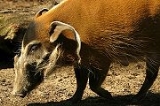
Suidae

Encyclopedia
Suidae is the biological family
to which pig
s belong. In addition to numerous fossil species, up to sixteen extant species are currently recognized, classified into between four and eight genera
. The family includes the domestic pig, Sus scrofa domesticus or Sus domesticus, in addition to numerous species of wild pig, such as the babirusa
Babyrousa babyrussa and the warthog
Phacochoerus aethiopicus. All suids are native to the Old World
, ranging from Asia and its islands, to Europe, and Africa.
The earliest fossil
suids date from the Oligocene
epoch of Asia, and their descendants reached Europe
during the Miocene
. Several fossil species are known, and show adaptations to a wide range of different diets, from strict herbivory to possible carrion-eating (in Tetraconodon).
Artiodactyla, and are generally regarded as the living members of that order most similar to the ancestral form. Unlike most other members of the order, they have four toes on each foot, although they walk only on the middle two digits, with the others staying clear of the ground. They also have a simple stomach, rather than the more complex, ruminant
, stomach found in most other Artiodactyl families.
They are small to medium animals, varying in size from 58 centimetre in length, and 6 kilogram in weight in the case of the Pygmy Hog
, to 130–210 cm (4.3–6.9 ft) and 130 kilogram in the Giant Forest Hog
. They have large heads and short necks, with relatively small eyes and prominent ears. Their heads have a distinctive snout, ending in a disc-shaped nose. Suids typically have a bristly coat, and a short tail ending in a tassle. The males possess a corkscrew
-shaped penis
, which fits into a similarly shaped groove in the female's cervix
.
Suids have a well-developed sense of hearing, and are vocal animals, communicating with a series of grunts, squeals, and similar sounds. They also have an acute sense of smell. Many species are omnivorous, eating grass, leaves, roots, insects, worms, and even frogs or mice. Other species are more selective and purely herbivorous.
Their teeth reflect their diet, and suids retain the upper incisor
s, which are lost in most other Artiodactyls. The canine teeth are enlarged to form prominent tusks, used for rooting in moist earth or undergrowth, and in fighting. They have only a short diastema
. The number of teeth varies between species, but the general dental formula
is:
Litter size varies between one and twelve, depending on the species. The mother prepares a grass nest or similar den, which the young leave after about ten days. Suids are weaned
at around three months, and become sexually mature at 18 months. In practice, however, male suids are unlikely to gain access to sows in the wild until they have reached their full physical size, at around four years of age. In all species, the male is significantly larger than the female, and possesses more prominent tusks.
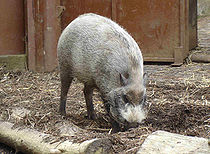 The complete list of living species, and a partial list of extinct genera known from the fossil record. Extinct taxa are marked with a dagger "†"
., follows:
Family (biology)
In biological classification, family is* a taxonomic rank. Other well-known ranks are life, domain, kingdom, phylum, class, order, genus, and species, with family fitting between order and genus. As for the other well-known ranks, there is the option of an immediately lower rank, indicated by the...
to which pig
Pig
A pig is any of the animals in the genus Sus, within the Suidae family of even-toed ungulates. Pigs include the domestic pig, its ancestor the wild boar, and several other wild relatives...
s belong. In addition to numerous fossil species, up to sixteen extant species are currently recognized, classified into between four and eight genera
Genus
In biology, a genus is a low-level taxonomic rank used in the biological classification of living and fossil organisms, which is an example of definition by genus and differentia...
. The family includes the domestic pig, Sus scrofa domesticus or Sus domesticus, in addition to numerous species of wild pig, such as the babirusa
Babirusa
The North Sulawesi babirusa, Babyrousa celebensis, is a pig-like animal native to northern Sulawesi and the nearby Lembeh Islands in Indonesia. It has two pairs of large tusks composed of enlarged canine teeth. The canines in the maxilla penetrate the top of the snout, curving back toward the...
Babyrousa babyrussa and the warthog
Warthog
The Warthog or Common Warthog is a wild member of the pig family that lives in grassland, savanna, and woodland in Sub-Saharan Africa. In the past it was commonly treated as a subspecies of P...
Phacochoerus aethiopicus. All suids are native to the Old World
Old World
The Old World consists of those parts of the world known to classical antiquity and the European Middle Ages. It is used in the context of, and contrast with, the "New World" ....
, ranging from Asia and its islands, to Europe, and Africa.
The earliest fossil
Fossil
Fossils are the preserved remains or traces of animals , plants, and other organisms from the remote past...
suids date from the Oligocene
Oligocene
The Oligocene is a geologic epoch of the Paleogene Period and extends from about 34 million to 23 million years before the present . As with other older geologic periods, the rock beds that define the period are well identified but the exact dates of the start and end of the period are slightly...
epoch of Asia, and their descendants reached Europe
Europe
Europe is, by convention, one of the world's seven continents. Comprising the westernmost peninsula of Eurasia, Europe is generally 'divided' from Asia to its east by the watershed divides of the Ural and Caucasus Mountains, the Ural River, the Caspian and Black Seas, and the waterways connecting...
during the Miocene
Miocene
The Miocene is a geological epoch of the Neogene Period and extends from about . The Miocene was named by Sir Charles Lyell. Its name comes from the Greek words and and means "less recent" because it has 18% fewer modern sea invertebrates than the Pliocene. The Miocene follows the Oligocene...
. Several fossil species are known, and show adaptations to a wide range of different diets, from strict herbivory to possible carrion-eating (in Tetraconodon).
Physical characteristics
Suids belong to the orderOrder (biology)
In scientific classification used in biology, the order is# a taxonomic rank used in the classification of organisms. Other well-known ranks are life, domain, kingdom, phylum, class, family, genus, and species, with order fitting in between class and family...
Artiodactyla, and are generally regarded as the living members of that order most similar to the ancestral form. Unlike most other members of the order, they have four toes on each foot, although they walk only on the middle two digits, with the others staying clear of the ground. They also have a simple stomach, rather than the more complex, ruminant
Ruminant
A ruminant is a mammal of the order Artiodactyla that digests plant-based food by initially softening it within the animal's first compartment of the stomach, principally through bacterial actions, then regurgitating the semi-digested mass, now known as cud, and chewing it again...
, stomach found in most other Artiodactyl families.
They are small to medium animals, varying in size from 58 centimetre in length, and 6 kilogram in weight in the case of the Pygmy Hog
Pygmy Hog
Pygmy hog is an endangered species of small wild pig, previously spread across India, Nepal, and Bhutan but now only found in Assam. The current world population is about 150 individuals or fewer...
, to 130–210 cm (4.3–6.9 ft) and 130 kilogram in the Giant Forest Hog
Giant forest hog
The Giant Forest Hog is native to wooded habitats in Africa and generally is considered the largest wild member of the Suidae . Despite its large size and relatively wide distribution, it was only described by scientists in 1904...
. They have large heads and short necks, with relatively small eyes and prominent ears. Their heads have a distinctive snout, ending in a disc-shaped nose. Suids typically have a bristly coat, and a short tail ending in a tassle. The males possess a corkscrew
Corkscrew
A corkscrew is a kitchen tool for drawing stopping corks from wine bottles. Generally, a corkscrew consists of a pointed metallic helix attached to a handle. The user grips the handle and screws the metal point into the cork, until the helix is firmly embedded, then a vertical pull on the...
-shaped penis
Penis
The penis is a biological feature of male animals including both vertebrates and invertebrates...
, which fits into a similarly shaped groove in the female's cervix
Cervix
The cervix is the lower, narrow portion of the uterus where it joins with the top end of the vagina. It is cylindrical or conical in shape and protrudes through the upper anterior vaginal wall...
.
Suids have a well-developed sense of hearing, and are vocal animals, communicating with a series of grunts, squeals, and similar sounds. They also have an acute sense of smell. Many species are omnivorous, eating grass, leaves, roots, insects, worms, and even frogs or mice. Other species are more selective and purely herbivorous.
Their teeth reflect their diet, and suids retain the upper incisor
Incisor
Incisors are the first kind of tooth in heterodont mammals. They are located in the premaxilla above and mandible below.-Function:...
s, which are lost in most other Artiodactyls. The canine teeth are enlarged to form prominent tusks, used for rooting in moist earth or undergrowth, and in fighting. They have only a short diastema
Diastema (dentistry)
Diastema is a space or gap between two teeth. Many species of mammals have diastemata as a normal feature, most commonly between the incisors and molars.-In humans:...
. The number of teeth varies between species, but the general dental formula
Dentition
Dentition pertains to the development of teeth and their arrangement in the mouth. In particular, the characteristic arrangement, kind, and number of teeth in a given species at a given age...
is:
Behaviour and reproduction
Despite their apparently 'primitive' anatomy, suids are intelligent and adaptable animals. Adult females (sows) and their young travel in a group (sounder; see List of animal names), whilst adult males (boars) are either solitary, or travel in small bachelor groups. Males generally are not territorial, and come into conflict only during the mating season.Litter size varies between one and twelve, depending on the species. The mother prepares a grass nest or similar den, which the young leave after about ten days. Suids are weaned
Weaning
Weaning is the process of gradually introducing a mammal infant, either human or animal, to what will be its adult diet and withdrawing the supply of its mother's milk.The process takes place only in mammals, as only mammals produce milk...
at around three months, and become sexually mature at 18 months. In practice, however, male suids are unlikely to gain access to sows in the wild until they have reached their full physical size, at around four years of age. In all species, the male is significantly larger than the female, and possesses more prominent tusks.
Classification
Dagger (typography)
A dagger, or obelisk. is a typographical symbol or glyph. The term "obelisk" derives from Greek , which means "little obelus"; from meaning "roasting spit"...
., follows:
- Suidae
- Subfamily †ExtinctionIn biology and ecology, extinction is the end of an organism or of a group of organisms , normally a species. The moment of extinction is generally considered to be the death of the last individual of the species, although the capacity to breed and recover may have been lost before this point...
Cainochoerinae- Genus †Albanohyus
- Genus †Cainochoerus
- Subfamily †Hyotheriinae
- Genus †Aureliachoerus
- Genus †Chicochoerus
- Genus †Hyotherium
- Genus †Nguruwe (formerly placed in Kubanochoerinae)
- Genus †Xenohyus
- Subfamily †Listriodontinae
- Tribe †Kubanochoerini
- Genus †KubanochoerusKubanochoerusKubanochoerus was a genus of large, long-legged pigs from the Miocene of Eurasia.-Description:The largest species, the aptly named K. gigas, grew to be up at the shoulder, and probably weighed up to in life. The heads of these pigs were unmistakable, with small eyebrow horns, and a large horn...
(Jr synonyms Libycochoerus, Megalochoerus)
- Genus †Kubanochoerus
- Trube †Listriodontini
- Genus †Eurolistriodon
- Genus †Listriodon (Jr synonym Bunolistriodon)
- Tribe †Namachoerini
- Genus †Lopholistriodon
- Genus †Namachoerus
- Tribe incertae sedisIncertae sedis, is a term used to define a taxonomic group where its broader relationships are unknown or undefined. Uncertainty at specific taxonomic levels is attributed by , , and similar terms.-Examples:*The fossil plant Paradinandra suecica could not be assigned to any...
- Genus †Dicoryphochoerus
- Tribe †Kubanochoerini
- Subfamily SuinaeSuinaeSuinae is a subfamily of mammals that includes at least some of the living members of the family Suidae and their closest relatives—the domestic pig and related species, such as babirusas. Several extinct species within Suidae are classified in subfamilies other than Suinae...
- Tribe Babyrousini
- Genus BabyrousaBabyrousaThe babirusas are a genus, Babyrousa, in the pig family found in Wallacea, or specifically the Indonesian islands of Sulawesi, Togian, Sula and Buru. All members of this genus were considered part of a single species until 2002, the babirusa, B...
(Pleistocene to Recent)- Species Babyrousa babyrussa Golden Babirusa
- Species †Babyrousa bolabatuensis
- Species Babyrousa celebensis Sulawesi Babirusa
- Species Babyrousa togeanensis Togian BabirusaTogian babirusaThe Togian Babirusa , also known as the Malenge Babirusa, is the largest species of babirusa. It is endemic to the Togian Islands of Indonesia, but was considered a subspecies of Babyrousa babyrussa until 2002....
- Genus Babyrousa
- Tribe †Hippohyini
- Genus †Hippohyus (Miocene to Pleistocene)
- Genus †Sinohyus (Miocene)
- Genus †Sivahyus (Miocene to Pliocene)
- Tribe Potamochoerini
- Genus †Celebochoerus (Pliocene to Pleistocene)
- Genus Hylochoerus (Pleistocene to Recent)
- Species Hylochoerus meinertzhageni Giant Forest HogGiant forest hogThe Giant Forest Hog is native to wooded habitats in Africa and generally is considered the largest wild member of the Suidae . Despite its large size and relatively wide distribution, it was only described by scientists in 1904...
- Species Hylochoerus meinertzhageni Giant Forest Hog
- Genus †KolpochoerusKolpochoerusKolpochoerus is an extinct genus of the pig family Suidae related to the modern-day genera Hylochoerus and Potamochoerus. It is believed that most of them inhabited African forests, as opposed to the Bushpig and Red River Hog that inhabit open brush and savannas. There are currently 8 recognized...
(Miocene to Pleistocene) (Jr synonyms Ectopotamochoerus, Mesochoerus, Omochoerus, Promesochoerus) - Genus PotamochoerusPotamochoerusPotamochoerus is a genus in the pig family . The two species are restricted to Sub-saharan Africa, although the Bushpig, possibly due to introduction by man, also occurs in Madagascar and nearby islands.-Species:...
(Miocene to Recent)- Species Potamochoerus larvatus BushpigBushpigThe bushpig, Potamochoerus larvatus, is a member of the pig family and lives in forests, woodland, riverine vegetation and reedbeds in East and Southern Africa. Probably introduced populations are also present in Madagascar and the Comoros archipelago. Bushpigs are mainly nocturnal. There are...
- Species Potamochoerus porcus Red River HogRed River HogThe red river hog , also known as the bush pig , is a wild member of the pig family living in Africa, with most of its distribution in the Guinean and Congolian forests...
- Species Potamochoerus larvatus Bushpig
- Genus †Propotamochoerus (Miocene to Pliocene)
- Tribe Suini
- Genus †Eumaiochoerus (Miocene)
- Genus †Hippopotamodon (Miocene to PleistocenePleistoceneThe Pleistocene is the epoch from 2,588,000 to 11,700 years BP that spans the world's recent period of repeated glaciations. The name pleistocene is derived from the Greek and ....
) (Jr synonym Limnostonyx) - Genus †Korynochoerus (Miocene to PliocenePlioceneThe Pliocene Epoch is the period in the geologic timescale that extends from 5.332 million to 2.588 million years before present. It is the second and youngest epoch of the Neogene Period in the Cenozoic Era. The Pliocene follows the Miocene Epoch and is followed by the Pleistocene Epoch...
) - Genus †Microstonyx (Miocene)
- Genus Sus (MioceneMioceneThe Miocene is a geological epoch of the Neogene Period and extends from about . The Miocene was named by Sir Charles Lyell. Its name comes from the Greek words and and means "less recent" because it has 18% fewer modern sea invertebrates than the Pliocene. The Miocene follows the Oligocene...
to Recent)- Species Sus ahoenobarbus Palawan Bearded PigPalawan Bearded PigThe Palawan Bearded Pig is a species of pig endemic to the Philippines, where they can only be found on the archipelago of islands formed by Balabac, Palawan and the Calamian Islands...
- Species Sus barbatus Bearded PigBearded PigThe bearded pig , also known as the Bornean bearded pig, is a species of pig. It can be recognized by its prominent beard. It also sometimes has tassels on its tail. It is found in Southeast Asia—Sumatra, Borneo, the Malay Peninsula, and various smaller islands—where it inhabits rainforests and...
- Species Sus bucculentus Vietnamese Warty Pig
- Species Sus cebifrons Visayan Warty PigVisayan warty pigThe Visayan Warty Pig, Sus cebifrons, is a critically endangered species of pig. The Visayan warty pig is endemic to two of the Visayan Islands in the central Philippines, and is threatened by habitat loss, food shortages and hunting - these are the leading causes of the Visayan Warty Pig's status...
- Species Sus celebensis Celebes Warty PigCelebes Warty PigThe Celebes Warty Pig , Sulawesi warty pig or Sulawesi Pig, lives on Sulawesi in Indonesia. It survives in most habitats and can live in altitudes of up to 2,500 metres.- External links :*...
- Species Sus heureni Flores Warty PigFlores Warty PigThe Flores Warty Pig , is a species of wild pig found in Southern Asia.-External links:* in The Species 2000 & ITIS Catalogue of Life....
- Species Sus oliveri Mindoro Warty Pig
- Species Sus philippensis Philippine Warty Pig
- Species Sus scrofa (also called S. domesticus) Domestic pigDomestic pigThe domestic pig is a domesticated animal that traces its ancestry to the wild boar, and is considered a subspecies of the wild boar or a distinct species in its own right. It is likely the wild boar was domesticated as early as 13,000 BC in the Tigris River basin...
, wild boar - Species Sus verrucosus Javan Warty Pig
- Species Sus ahoenobarbus Palawan Bearded Pig
- Tribe Phacochoerini
- Genus †MetridiochoerusMetridiochoerusMetridiochoerus is an extinct genus of pig indigenous to the Pliocene and Pleistocene of Africa.-Description:Metridiochoerus was a large animal, in length, resembling a giant warthog. It had two large pairs of tusks which were pointed sideways and curved upwards...
(Pliocene to Pleistocene) - Genus PhacochoerusPhacochoerusPhacochoerus is a genus of wild pigs in the Suidae family that are known as warthogs. It is the sole genus of subfamily Phacochoerinae. They are found in open and semi-open habitats, even in quite arid regions, in sub-Saharan Africa...
(Pliocene to Recent)- Species Phacochoerus aethiopicus Cape, Somali or Desert WarthogDesert WarthogThe Desert Warthog is a species of even-toed ungulate in the Suidae family. It is found in northern Kenya, Somalia, possibly Djibouti, possibly Eritrea, and possibly Ethiopia. This is the range of the extant subspecies, commonly known as the Somali Warthog...
- Species Phacochoerus africanus Common WarthogWarthogThe Warthog or Common Warthog is a wild member of the pig family that lives in grassland, savanna, and woodland in Sub-Saharan Africa. In the past it was commonly treated as a subspecies of P...
- Species Phacochoerus aethiopicus Cape, Somali or Desert Warthog
- Genus †Potamochoeroides (Pliocene, possibly Pleistocene)
- Genus †Stylochoerus (Pleistocene)
- Genus †Metridiochoerus
- Tribe incertae sedis
- Genus Porcula
- Species Porcula salvania Pygmy HogPygmy HogPygmy hog is an endangered species of small wild pig, previously spread across India, Nepal, and Bhutan but now only found in Assam. The current world population is about 150 individuals or fewer...
- Species Porcula salvania Pygmy Hog
- Genus Porcula
- Tribe Babyrousini
- Subfamily †Tetraconodontine
- Genus †Conohyus
- Genus †Notochoerus
- Genus †Nyanzachoerus
- Genus †Parachleuastochoerus
- Genus †Sivachoerus
- Genus †Tetraconodon (Miocene, Myanmar)
- Species †Tetraconodon intermedius
- Species †Tetraconodon malensis
- Species †Tetraconodon minor
- Subfamily incertae sedis
- Genus †Chleuastochoerus
- Genus †Hemichoerus
- Genus †Hyosus
- Genus †Kenyasus (formerly placed in Kubanochoerinae)
- Genus †Schizochoerus
- Genus †Sinapriculus
- Subfamily †