

Programmed Data Processor

Encyclopedia
Programmed Data Processor (PDP) was the name of a series of minicomputer
s made by Digital Equipment Corporation
. The name 'PDP' intentionally avoided the use of the term 'computer' because, at the time of the first PDPs, computers had a reputation of being large, complicated, and expensive machines, and the venture capitalists behind Digital (especially Georges Doriot
) would not support Digital's attempting to build a "computer"; the word "minicomputer" had not yet been coined. So instead, Digital used their existing line of logic modules to build a Programmable Data Processor and aimed it at a market which could not afford the larger computers.
The various PDP machines can generally be grouped into families based on word length.
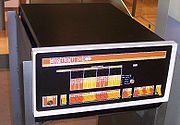
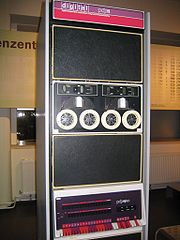
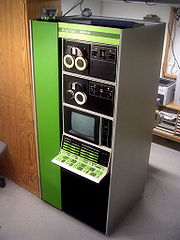 Members of the PDP series include:
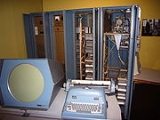
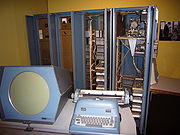
PDP-1
: The original PDP, an 18-bit
machine used in early time-sharing
operating system
work, and prominent in early hacker culture. One of the first computer games, Spacewar!, was developed for this machine.
PDP-2: An unbuilt 24-bit design.
PDP-3: First 36-bit machine DEC designed, though DEC did not offer it as a product. The only PDP-3 was built by the CIA's Scientific Engineering Institute (SEI) in Waltham, MA to process radar cross section
data for the Lockheed A-12 reconnaissance aircraft
in 1960. Architecturally it was essentially a PDP-1 stretched to 36-bit word width.
PDP-4: Supposed to be a slower, cheaper alternative to the PDP-1, but not commercially successful; all later 18-bit PDP machines were based on its instruction set
. One customer of these early PDP machines was Atomic Energy of Canada. The installation at Chalk River, Ontario included an early PDP-4 with a display system and a new PDP-5 as interface to the research reactor instrumentation and control.
PDP-5: DEC's first 12-bit
machine. Introduced the instruction set later used in the PDP-8.
PDP-6
: 36-bit timesharing machine. Very elegant architecture. It was considered a large minicomputer
or a mainframe
.
PDP-7
: Replacement for the PDP-4; DEC's first wire-wrapped machine. The first version of Unix
was for this machine.
PDP-8
: 12-bit machine with a tiny instruction set; DEC's first major commercial success. Many were purchased by schools, university departments, and research laboratories. Later models were also used in the DECmate
word processor
and the VT-78 workstation
. It is reported that Edson de Castro
, who had been a key member of the design team, left to form Data General
when his design for a 16-bit successor to the PDP-8 was rejected in favour of the PDP-11; the "PDP-X" did not resemble the Data General Nova
, although that is a common myth.
LINC-8
: A hybrid of the LINC
and PDP-8 computers; two instruction sets. Progenitor of the PDP-12.
PDP-9: Successor to the PDP-7, DEC's first micro-programmed machine.
PDP-10
: 36-bit timesharing machine, and fairly successful over several different models. The instruction set was a slightly elaborated form of that of the PDP-6.
PDP-11
: The archetypal minicomputer; a 16-bit
machine and another commercial success for DEC. (Also the LSI-11, primarily for embedded system
s). The 32-bit
VAX
series was descended from it, and early VAX models had a PDP-11 compatibility mode. The 16-bit PDP-11 instruction set has been very influential, with processors ranging from the Motorola 68000
to the Renesas H8 and Texas Instruments
MSP430, inspired by its highly orthogonal, general-register oriented instruction set
and rich addressing mode
s. The PDP-11 family was extremely long-lived, spanning 20 years and many different implementations and technologies.
PDP-12: Descendant of the LINC-8. See LINC
and PDP-12 User Manual.
PDP-13: Designation was not used, apparently due to superstition.
PDP-14: A 12-bit machine intended as an industrial controller (PLC
). Later versions (for example, the PDP-14/30) were based on PDP-8 physical packaging technology. I/O was line voltage.
PDP-15: DEC's final 18-bit machine. It was their only 18-bit machine constructed from TTL
integrated circuit
s rather than discrete transistors. Later versions of the system were referred to as the "XVM" family.
PDP-16: A "roll-your-own" sort of computer using Register Transfer Modules, mainly intended for industrial control systems with more capability than the PDP-14. The PDP-16/M was introduced as a standard version of the PDP-16.
Various sites list documents by Charles Lasner, the creator of the alt.sys.pdp8 discussion group, and related documents by various members of the alt.sys.pdp8 readership with even more authoritative information about the various models, especially detailed focus upon the various members of the PDP-8 "family" of computers both made and not made by DEC.
Minicomputer
A minicomputer is a class of multi-user computers that lies in the middle range of the computing spectrum, in between the largest multi-user systems and the smallest single-user systems...
s made by Digital Equipment Corporation
Digital Equipment Corporation
Digital Equipment Corporation was a major American company in the computer industry and a leading vendor of computer systems, software and peripherals from the 1960s to the 1990s...
. The name 'PDP' intentionally avoided the use of the term 'computer' because, at the time of the first PDPs, computers had a reputation of being large, complicated, and expensive machines, and the venture capitalists behind Digital (especially Georges Doriot
Georges Doriot
Georges F. Doriot was one of the first American venture capitalists. In 1946, he founded American Research and Development Corporation, the first publicly owned venture capital firm...
) would not support Digital's attempting to build a "computer"; the word "minicomputer" had not yet been coined. So instead, Digital used their existing line of logic modules to build a Programmable Data Processor and aimed it at a market which could not afford the larger computers.
The various PDP machines can generally be grouped into families based on word length.
PDP series
PDP-1
PDP-1
The PDP-1 was the first computer in Digital Equipment Corporation's PDP series and was first produced in 1960. It is famous for being the computer most important in the creation of hacker culture at MIT, BBN and elsewhere...
: The original PDP, an 18-bit
18-bit
18 binary digits have unique combinations.-Example 18-bit computer architectures:* Possibly the most well-known 18-bit computer architectures are the PDP-1, PDP-4, PDP-7, PDP-9 and PDP-15 minicomputers produced by Digital Equipment Corporation from 1960 to 1975.* UNIVAC produced a number of...
machine used in early time-sharing
Time-sharing
Time-sharing is the sharing of a computing resource among many users by means of multiprogramming and multi-tasking. Its introduction in the 1960s, and emergence as the prominent model of computing in the 1970s, represents a major technological shift in the history of computing.By allowing a large...
operating system
Operating system
An operating system is a set of programs that manage computer hardware resources and provide common services for application software. The operating system is the most important type of system software in a computer system...
work, and prominent in early hacker culture. One of the first computer games, Spacewar!, was developed for this machine.
PDP-2: An unbuilt 24-bit design.
PDP-3: First 36-bit machine DEC designed, though DEC did not offer it as a product. The only PDP-3 was built by the CIA's Scientific Engineering Institute (SEI) in Waltham, MA to process radar cross section
Radar cross section
Radar cross section is a measure of how detectable an object is with a radar. A larger RCS indicates that an object is more easily detected.An object reflects a limited amount of radar energy...
data for the Lockheed A-12 reconnaissance aircraft
Reconnaissance aircraft
A reconnaissance aircraft is a manned military aircraft designed, or adapted, to carry out aerial reconnaissance.-History:The majority of World War I aircraft were reconnaissance designs...
in 1960. Architecturally it was essentially a PDP-1 stretched to 36-bit word width.
PDP-4: Supposed to be a slower, cheaper alternative to the PDP-1, but not commercially successful; all later 18-bit PDP machines were based on its instruction set
Instruction set
An instruction set, or instruction set architecture , is the part of the computer architecture related to programming, including the native data types, instructions, registers, addressing modes, memory architecture, interrupt and exception handling, and external I/O...
. One customer of these early PDP machines was Atomic Energy of Canada. The installation at Chalk River, Ontario included an early PDP-4 with a display system and a new PDP-5 as interface to the research reactor instrumentation and control.
PDP-5: DEC's first 12-bit
12-bit
Possibly the best-known 12-bit CPU is the PDP-8 and its relatives, produced in various incarnations from August 1963 to mid-1990. Many ADCs have a 12-bit resolution. Some PIC microcontrollers use a 12-bit word size....
machine. Introduced the instruction set later used in the PDP-8.
PDP-6
PDP-6
The PDP-6 was a computer model developed by Digital Equipment Corporation in 1963. It was influential primarily as the prototype for the later PDP-10; the instruction sets of the two machines are almost identical.The PDP-6 was DEC's first "big" machine...
: 36-bit timesharing machine. Very elegant architecture. It was considered a large minicomputer
Minicomputer
A minicomputer is a class of multi-user computers that lies in the middle range of the computing spectrum, in between the largest multi-user systems and the smallest single-user systems...
or a mainframe
Mainframe computer
Mainframes are powerful computers used primarily by corporate and governmental organizations for critical applications, bulk data processing such as census, industry and consumer statistics, enterprise resource planning, and financial transaction processing.The term originally referred to the...
.
PDP-7
PDP-7
The DEC PDP-7 is a minicomputer produced by Digital Equipment Corporation. Introduced in 1965, it was the first to use their Flip-Chip technology. With a cost of only $72,000 USD, it was cheap but powerful by the standards of the time. The PDP-7 was the third of Digital's 18-bit machines, with...
: Replacement for the PDP-4; DEC's first wire-wrapped machine. The first version of Unix
Unix
Unix is a multitasking, multi-user computer operating system originally developed in 1969 by a group of AT&T employees at Bell Labs, including Ken Thompson, Dennis Ritchie, Brian Kernighan, Douglas McIlroy, and Joe Ossanna...
was for this machine.
PDP-8
PDP-8
The 12-bit PDP-8 was the first successful commercial minicomputer, produced by Digital Equipment Corporation in the 1960s. DEC introduced it on 22 March 1965, and sold more than 50,000 systems, the most of any computer up to that date. It was the first widely sold computer in the DEC PDP series of...
: 12-bit machine with a tiny instruction set; DEC's first major commercial success. Many were purchased by schools, university departments, and research laboratories. Later models were also used in the DECmate
DECmate
DECmate was the name of a series of PDP-8-compatible computers produced by the Digital Equipment Corporation in the late 1970s and early 1980s. All of the models used an Intersil 6100 or Harris 6120 microprocessor which emulated the 12-bit DEC PDP-8 CPU...
word processor
Word processor
A word processor is a computer application used for the production of any sort of printable material....
and the VT-78 workstation
Workstation
A workstation is a high-end microcomputer designed for technical or scientific applications. Intended primarily to be used by one person at a time, they are commonly connected to a local area network and run multi-user operating systems...
. It is reported that Edson de Castro
Edson de Castro
Edson de Castro is a computer engineer perhaps best known for designing the Data General Nova series of computers.De Castro was founder and CEO of Data General Corporation throughout the 1970s, the 1980s and into the 1990s when he was replaced by Ronald L Skates, a former Price Waterhouse Coopers...
, who had been a key member of the design team, left to form Data General
Data General
Data General was one of the first minicomputer firms from the late 1960s. Three of the four founders were former employees of Digital Equipment Corporation. Their first product, the Data General Nova, was a 16-bit minicomputer...
when his design for a 16-bit successor to the PDP-8 was rejected in favour of the PDP-11; the "PDP-X" did not resemble the Data General Nova
Data General Nova
The Data General Nova was a popular 16-bit minicomputer built by the American company Data General starting in 1969. The Nova was packaged into a single rack mount case and had enough power to do most simple computing tasks. The Nova became popular in science laboratories around the world, and...
, although that is a common myth.
LINC-8
LINC-8
LINC-8 was the name of a minicomputer manufactured by Digital Equipment Corporation between 1966 and 1969. It combined a LINC computer with a PDP-8 in one cabinet, thus being able to run programs written for either of the two architectures.-Architecture:...
: A hybrid of the LINC
LINC
The LINC was a 12-bit, 2048-word computer. The LINC can be considered the first minicomputer and a forerunner to the personal computer....
and PDP-8 computers; two instruction sets. Progenitor of the PDP-12.
PDP-9: Successor to the PDP-7, DEC's first micro-programmed machine.
PDP-10
PDP-10
The PDP-10 was a mainframe computer family manufactured by Digital Equipment Corporation from the late 1960s on; the name stands for "Programmed Data Processor model 10". The first model was delivered in 1966...
: 36-bit timesharing machine, and fairly successful over several different models. The instruction set was a slightly elaborated form of that of the PDP-6.
PDP-11
PDP-11
The PDP-11 was a series of 16-bit minicomputers sold by Digital Equipment Corporation from 1970 into the 1990s, one of a succession of products in the PDP series. The PDP-11 replaced the PDP-8 in many real-time applications, although both product lines lived in parallel for more than 10 years...
: The archetypal minicomputer; a 16-bit
16-bit
-16-bit architecture:The HP BPC, introduced in 1975, was the world's first 16-bit microprocessor. Prominent 16-bit processors include the PDP-11, Intel 8086, Intel 80286 and the WDC 65C816. The Intel 8088 was program-compatible with the Intel 8086, and was 16-bit in that its registers were 16...
machine and another commercial success for DEC. (Also the LSI-11, primarily for embedded system
Embedded system
An embedded system is a computer system designed for specific control functions within a larger system. often with real-time computing constraints. It is embedded as part of a complete device often including hardware and mechanical parts. By contrast, a general-purpose computer, such as a personal...
s). The 32-bit
32-bit
The range of integer values that can be stored in 32 bits is 0 through 4,294,967,295. Hence, a processor with 32-bit memory addresses can directly access 4 GB of byte-addressable memory....
VAX
VAX
VAX was an instruction set architecture developed by Digital Equipment Corporation in the mid-1970s. A 32-bit complex instruction set computer ISA, it was designed to extend or replace DEC's various Programmed Data Processor ISAs...
series was descended from it, and early VAX models had a PDP-11 compatibility mode. The 16-bit PDP-11 instruction set has been very influential, with processors ranging from the Motorola 68000
Motorola 68000
The Motorola 68000 is a 16/32-bit CISC microprocessor core designed and marketed by Freescale Semiconductor...
to the Renesas H8 and Texas Instruments
Texas Instruments
Texas Instruments Inc. , widely known as TI, is an American company based in Dallas, Texas, United States, which develops and commercializes semiconductor and computer technology...
MSP430, inspired by its highly orthogonal, general-register oriented instruction set
Instruction set
An instruction set, or instruction set architecture , is the part of the computer architecture related to programming, including the native data types, instructions, registers, addressing modes, memory architecture, interrupt and exception handling, and external I/O...
and rich addressing mode
Addressing mode
Addressing modes are an aspect of the instruction set architecture in most central processing unit designs. The various addressing modes that are defined in a given instruction set architecture define how machine language instructions in that architecture identify the operand of each instruction...
s. The PDP-11 family was extremely long-lived, spanning 20 years and many different implementations and technologies.
PDP-12: Descendant of the LINC-8. See LINC
LINC
The LINC was a 12-bit, 2048-word computer. The LINC can be considered the first minicomputer and a forerunner to the personal computer....
and PDP-12 User Manual.
PDP-13: Designation was not used, apparently due to superstition.
PDP-14: A 12-bit machine intended as an industrial controller (PLC
Programmable logic controller
A programmable logic controller or programmable controller is a digital computer used for automation of electromechanical processes, such as control of machinery on factory assembly lines, amusement rides, or light fixtures. PLCs are used in many industries and machines...
). Later versions (for example, the PDP-14/30) were based on PDP-8 physical packaging technology. I/O was line voltage.
PDP-15: DEC's final 18-bit machine. It was their only 18-bit machine constructed from TTL
Transistor-transistor logic
Transistor–transistor logic is a class of digital circuits built from bipolar junction transistors and resistors. It is called transistor–transistor logic because both the logic gating function and the amplifying function are performed by transistors .TTL is notable for being a widespread...
integrated circuit
Integrated circuit
An integrated circuit or monolithic integrated circuit is an electronic circuit manufactured by the patterned diffusion of trace elements into the surface of a thin substrate of semiconductor material...
s rather than discrete transistors. Later versions of the system were referred to as the "XVM" family.
PDP-16: A "roll-your-own" sort of computer using Register Transfer Modules, mainly intended for industrial control systems with more capability than the PDP-14. The PDP-16/M was introduced as a standard version of the PDP-16.
Related computers
- TX-0TX-0The TX-0, for Transistorized Experimental computer zero, but affectionately referred to as tixo , was an early fully transistorized computer and contained a then-huge 64K of 18-bit words of magnetic core memory. The TX-0 was built in 1955 and went online in 1956 and was used continually through the...
designed by MITMassachusetts Institute of TechnologyThe Massachusetts Institute of Technology is a private research university located in Cambridge, Massachusetts. MIT has five schools and one college, containing a total of 32 academic departments, with a strong emphasis on scientific and technological education and research.Founded in 1861 in...
's Lincoln LaboratoryLincoln LaboratoryMIT Lincoln Laboratory, located in Lexington, Massachusetts, is a United States Department of Defense research and development center chartered to apply advanced technology to problems of national security. Research and development activities focus on long-term technology development as well as...
, important as influence for DEC products including Ben Gurley's design for the PDP-1 - LINCLINCThe LINC was a 12-bit, 2048-word computer. The LINC can be considered the first minicomputer and a forerunner to the personal computer....
(Laboratory Instrument Computer), originally designed by MITMassachusetts Institute of TechnologyThe Massachusetts Institute of Technology is a private research university located in Cambridge, Massachusetts. MIT has five schools and one college, containing a total of 32 academic departments, with a strong emphasis on scientific and technological education and research.Founded in 1861 in...
's Lincoln LaboratoryLincoln LaboratoryMIT Lincoln Laboratory, located in Lexington, Massachusetts, is a United States Department of Defense research and development center chartered to apply advanced technology to problems of national security. Research and development activities focus on long-term technology development as well as...
, some built by DEC. Not in the PDP family, but important as progenitor of the PDP-12. The LINC and the PDP-8 can be considered the first minicomputerMinicomputerA minicomputer is a class of multi-user computers that lies in the middle range of the computing spectrum, in between the largest multi-user systems and the smallest single-user systems...
s, and perhaps the first personal computerPersonal computerA personal computer is any general-purpose computer whose size, capabilities, and original sales price make it useful for individuals, and which is intended to be operated directly by an end-user with no intervening computer operator...
s as well. The PDP-8 and PDP-11 were the most popular of the PDP series of machines. Digital never made a PDP-20, although the term was sometimes used for a PDP-10PDP-10The PDP-10 was a mainframe computer family manufactured by Digital Equipment Corporation from the late 1960s on; the name stands for "Programmed Data Processor model 10". The first model was delivered in 1966...
running TOPS-20TOPS-20The TOPS-20 operating system by Digital Equipment Corporation was the second proprietary OS for the PDP-10 mainframe computer. TOPS-20 began in 1969 as the TENEX operating system of Bolt, Beranek and Newman...
(officially known as a DECSYSTEM-20DECSYSTEM-20The DECSYSTEM-20 was a 36-bit Digital Equipment Corporation PDP-10 mainframe computer running the TOPS-20 operating system.PDP-10 computers running the TOPS-10 operating system were labeled DECsystem-10 as a way of differentiating them from the PDP-11...
). - SM EVMSM EVMSM EVM was the general name for several types of Soviet and Comecon minicomputers produced in the 1970s and 1980s. Production began in 1975....
series of computers in the USSR - DVKDVKDVK is a Soviet PDP-11-compatible personal computer.The design is also known as Elektronika MS-0501 and Elektronika MS-0502.Earlier models of DVK series were based on K1801VM1 or K1801VM2 microprocessors with 16 bit address bus. In the later models, the KM1801VM3 microprocessor was used.-...
personal computers series are PDP clones developed in USSR in 70s. - Elektronika BKElektronika BKThe Elektronika BK was a series of 16-bit PDP-11-compatible Soviet home computers developed by NPO Scientific Center, the leading Soviet microcomputer design team at the time. It was also responsible for the more powerful UKNC and DVK micros...
- UKNCUKNCUKNC was a Soviet PDP-11-compatible educational computer, aimed at teaching school informatics courses. It is also known as Elektronika MS-0511...
External links
- Mark Crispin's 1986 list of PDP's
- Several PDP and LAB's, still runnable in a German computer museum
- DEC's PDP-6 was the world's first commercial time-sharing system Gordon Bell interview at the Smithsonian
- DEC PRODUCT TIMELINE
- Description and Use of Register Transfer Modules on Gordon Bell's site at Microsoft.
- pdp12.lofty.com shows a recently restored PDP-12
- http://www.soemtron.org/pdp7.html information about the PDP-7 and PDP7A including some manuals and a customer list covering 99 of the 120 systems shipped.
Various sites list documents by Charles Lasner, the creator of the alt.sys.pdp8 discussion group, and related documents by various members of the alt.sys.pdp8 readership with even more authoritative information about the various models, especially detailed focus upon the various members of the PDP-8 "family" of computers both made and not made by DEC.