

UKNC

Encyclopedia
Soviet Union
The Soviet Union , officially the Union of Soviet Socialist Republics , was a constitutionally socialist state that existed in Eurasia between 1922 and 1991....
PDP-11
PDP-11
The PDP-11 was a series of 16-bit minicomputers sold by Digital Equipment Corporation from 1970 into the 1990s, one of a succession of products in the PDP series. The PDP-11 replaced the PDP-8 in many real-time applications, although both product lines lived in parallel for more than 10 years...
-compatible educational computer, aimed at teaching school informatics
Informatics (academic field)
Informatics is the science of information, the practice of information processing, and the engineering of information systems. Informatics studies the structure, algorithms, behavior, and interactions of natural and artificial systems that store, process, access and communicate information...
courses. It is also known as Elektronika MS-0511. UKNC stands for Educational Computer by Scientific Centre.
Hardware
- CPU: KM1801VM2 @ 8 MHz
- Peripheral processor: KM1801VM2 @ 6 MHz (in newer models; or 4 MHz in early models, according to documentation)
- CPU RAM: 64 KB
- PPU RAM: 32 KB, ROM: 32 KB, video RAM: 96 KB (3 planes 32KB each, each 3-bit pixel had a bit in each plane)
- Keyboard: 88 keys
- built-in LAN controller
- built-in controller for special tape-recorder with computer control (to use for data storage, usually 5-inch FDD's were used)
One unique part of the design is the usage of a peripheral processing unit (PPU). UKNC did not have full-featured controllers for display, LAN, keyboard, clock, in-hardware debugger etc. Instead, the PPU configured peripheral devices and managed their events. In other words, the PPU simulated all the controllers.
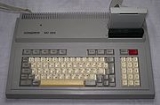
The computer was released in 3 sub-models: 0511, 0511.1, 0511.2. The 0511.1 model, intended for home use, had a power supply for 220V AC, while others utilized 42V AC. The 0511.2 featured new firmware with extended functionality and changed the marking of the keyboard's gray keys, compared to the initial version. The photo shows an 0511.2 variant.
There was no active cooling, and at least the 0511.2 variant tended to overheat and halt after several hours of operation.
The case and keyboard (with changed markings) were re-used to produce an IBM PC clone, though less well-known than the once famous Poisk computer.
Software
- Operating systemOperating systemAn operating system is a set of programs that manage computer hardware resources and provide common services for application software. The operating system is the most important type of system software in a computer system...
: RAFOS, FODOS (RT-11RT-11RT-11 was a small, single-user real-time operating system for the Digital Equipment Corporation PDP-11 family of 16-bit computers...
clones) or RT-11SJ/FBRT-11RT-11 was a small, single-user real-time operating system for the Digital Equipment Corporation PDP-11 family of 16-bit computers... - LANLocal area networkA local area network is a computer network that interconnects computers in a limited area such as a home, school, computer laboratory, or office building...
control program - Programming languageProgramming languageA programming language is an artificial language designed to communicate instructions to a machine, particularly a computer. Programming languages can be used to create programs that control the behavior of a machine and/or to express algorithms precisely....
s:- BASICBASICBASIC is a family of general-purpose, high-level programming languages whose design philosophy emphasizes ease of use - the name is an acronym from Beginner's All-purpose Symbolic Instruction Code....
(Vilnius BASICVilnius BASICVilnius BASIC was a dialect of the BASIC programming language running on the Elektronika BK-0010-01/BK-0011M and UKNC computers.It was a quite advanced BASIC and featured a runtime threaded code compiler that compiled the program when one entered the RUN command. The dialect was very close to MSX...
) - FortranFortranFortran is a general-purpose, procedural, imperative programming language that is especially suited to numeric computation and scientific computing...
- PascalPascal (programming language)Pascal is an influential imperative and procedural programming language, designed in 1968/9 and published in 1970 by Niklaus Wirth as a small and efficient language intended to encourage good programming practices using structured programming and data structuring.A derivative known as Object Pascal...
- Modula-2Modula-2Modula-2 is a computer programming language designed and developed between 1977 and 1980 by Niklaus Wirth at ETH Zurich as a revision of Pascal to serve as the sole programming language for the operating system and application software for the personal workstation Lilith...
- CC (programming language)C is a general-purpose computer programming language developed between 1969 and 1973 by Dennis Ritchie at the Bell Telephone Laboratories for use with the Unix operating system....
- AssemblerAssembly languageAn assembly language is a low-level programming language for computers, microprocessors, microcontrollers, and other programmable devices. It implements a symbolic representation of the machine codes and other constants needed to program a given CPU architecture...
- RapiraRapiraRapira is an educational procedural programming language developed in the USSR and implemented on Agat computer, PDP-11 clones and Intel-8080/Z80 clones . It was an interpreted language with dynamic type system and high level constructions. The language originally had a Russian-based set of...
- E-practicum
- LogoLogo (programming language)Logo is a multi-paradigm computer programming language used in education. It is an adaptation and dialect of the Lisp language; some have called it Lisp without the parentheses. It was originally conceived and written as functional programming language, and drove a mechanical turtle as an output...
- PrologPrologProlog is a general purpose logic programming language associated with artificial intelligence and computational linguistics.Prolog has its roots in first-order logic, a formal logic, and unlike many other programming languages, Prolog is declarative: the program logic is expressed in terms of...
- Forth
- FOCAL
- BASIC