

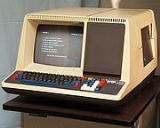
DECmate

Encyclopedia
DECmate was the name of a series of PDP-8
-compatible computers produced by the Digital Equipment Corporation
in the late 1970s and early 1980s. All of the models used an Intersil 6100
(later known as the Harris 6100) or Harris 6120 (an improved Intersil 6100) microprocessor which emulated the 12-bit
DEC PDP-8 CPU. They were text-only
and used the OS/78 or OS/278 operating system
s, which were extensions of OS/8
for the PDP-8. Aimed for the word processing
market, they typically ran the WPS-8
word-processing program.
Later models optionally had Intel 8080
or Z80 microprocessors which allowed them to run CP/M
.
The range was a development of the VT78 which was introduced in July 1977.
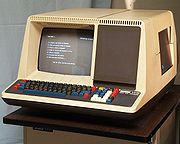
case and had an Intersil 6100
microprocessor running at 2.2 MHz. The standard configuration included an RX02 dual 8-inch floppy disk unit which was housed in the pedestal the computer rested on.
case. It had a 10 MHz clock and 32 Kwords of memory. It was also known as the VT278.
, the company released this model at the same time as the PDP-11
-based PRO-380 and the Intel 8088
-based Rainbow 100
. Like these other machines, it had a monochrome VR201 (VT220
-style) monitor, an LK201
keyboard and dual 400K single-sided quad-density 5.25 inch RX50 floppy disk
drives. It had 32 Kwords of RAM for use by programs, and a further 32 Kwords containing code which was used for device emulation. Code running in this second bank was nicknamed "slushware", in contrast to firmware
since it was loaded from floppy disk as the machine booted. It was also known as the PC278.
It could be expanded, either by adding another pair of 5.25 inch floppy disk drives, and it could also support either an additional pair of RX01 or RX02 8-inch floppy disk drives or a winchester disk.
It could also have a coprocessor board added, to allow it to run CP/M
. There was a choice of three coprocessor boards, one with a Z80 and 64 KB RAM, and a choice of two boards with both a Z80 and an Intel 8086
, the difference being that they had either 256 KB or 512 KB RAM.
Manufacture ceased in 1986. It was superseded by the DECmate III, introduced in 1984.
systems. The I/O interfaces
worked slightly differently, which meant that most existing user and system programs could not detect Control-C and exit reliably. Every program, both user and system, had to be patched to fix this anomaly. Additionally, the CPU and screen update speeds were noticeably slower than the older PDP-8 systems.
PDP-8
The 12-bit PDP-8 was the first successful commercial minicomputer, produced by Digital Equipment Corporation in the 1960s. DEC introduced it on 22 March 1965, and sold more than 50,000 systems, the most of any computer up to that date. It was the first widely sold computer in the DEC PDP series of...
-compatible computers produced by the Digital Equipment Corporation
Digital Equipment Corporation
Digital Equipment Corporation was a major American company in the computer industry and a leading vendor of computer systems, software and peripherals from the 1960s to the 1990s...
in the late 1970s and early 1980s. All of the models used an Intersil 6100
Intersil 6100
The Intersil 6100 family consisted of a 12-bit microprocessor and a range of peripheral support and memory ICs developed in the mid-1970s.The microprocessor recognised the PDP-8 instruction set....
(later known as the Harris 6100) or Harris 6120 (an improved Intersil 6100) microprocessor which emulated the 12-bit
12-bit
Possibly the best-known 12-bit CPU is the PDP-8 and its relatives, produced in various incarnations from August 1963 to mid-1990. Many ADCs have a 12-bit resolution. Some PIC microcontrollers use a 12-bit word size....
DEC PDP-8 CPU. They were text-only
Text mode
Text mode is a kind of computer display mode in which the content of the screen is internally represented in terms of characters rather than individual pixels. Typically, the screen consists of a uniform rectangular grid of character cells, each of which contains one of the characters of a...
and used the OS/78 or OS/278 operating system
Operating system
An operating system is a set of programs that manage computer hardware resources and provide common services for application software. The operating system is the most important type of system software in a computer system...
s, which were extensions of OS/8
OS/8
OS/8 was the primary operating system used on the PDP-8 minicomputer developed by Digital Equipment Corporation of Maynard, Massachusetts. OS/8 was originally called MS/8 and, for a brief time, PS/8 before Digital settled on the name OS/8 in 1971.A virtually identical version of OS/8, called...
for the PDP-8. Aimed for the word processing
Word processing
Word processing is the creation of documents using a word processor. It can also refer to advanced shorthand techniques, sometimes used in specialized contexts with a specially modified typewriter.-External links:...
market, they typically ran the WPS-8
WPS-8
WPS-8 was the name of a Word Processing System sold by Digital Equipment Corporation for use with their PDP-8 processors ....
word-processing program.
Later models optionally had Intel 8080
Intel 8080
The Intel 8080 was the second 8-bit microprocessor designed and manufactured by Intel and was released in April 1974. It was an extended and enhanced variant of the earlier 8008 design, although without binary compatibility...
or Z80 microprocessors which allowed them to run CP/M
CP/M
CP/M was a mass-market operating system created for Intel 8080/85 based microcomputers by Gary Kildall of Digital Research, Inc...
.
The range was a development of the VT78 which was introduced in July 1977.
VT78
Introduced in July 1977, this machine was built into a VT52VT52
The VT52 was a CRT-based computer terminal produced by Digital Equipment Corporation introduced in September, 1975 . It provided a screen of 24 rows and 80 columns of text and supported all 95 ASCII characters as well as 32 graphics characters. It supported asynchronous communication at baud rates...
case and had an Intersil 6100
Intersil 6100
The Intersil 6100 family consisted of a 12-bit microprocessor and a range of peripheral support and memory ICs developed in the mid-1970s.The microprocessor recognised the PDP-8 instruction set....
microprocessor running at 2.2 MHz. The standard configuration included an RX02 dual 8-inch floppy disk unit which was housed in the pedestal the computer rested on.
DECmate
Introduced in 1980, this machine was built into a VT100VT100
The VT100 is a video terminal that was made by Digital Equipment Corporation . Its detailed attributes became the de facto standard for terminal emulators.-History:...
case. It had a 10 MHz clock and 32 Kwords of memory. It was also known as the VT278.
DECmate II
As part of a three-pronged strategy against IBMIBM
International Business Machines Corporation or IBM is an American multinational technology and consulting corporation headquartered in Armonk, New York, United States. IBM manufactures and sells computer hardware and software, and it offers infrastructure, hosting and consulting services in areas...
, the company released this model at the same time as the PDP-11
PDP-11
The PDP-11 was a series of 16-bit minicomputers sold by Digital Equipment Corporation from 1970 into the 1990s, one of a succession of products in the PDP series. The PDP-11 replaced the PDP-8 in many real-time applications, although both product lines lived in parallel for more than 10 years...
-based PRO-380 and the Intel 8088
Intel 8088
The Intel 8088 microprocessor was a variant of the Intel 8086 and was introduced on July 1, 1979. It had an 8-bit external data bus instead of the 16-bit bus of the 8086. The 16-bit registers and the one megabyte address range were unchanged, however...
-based Rainbow 100
Rainbow 100
The Rainbow 100 was a microcomputer introduced by Digital Equipment Corporation in 1982. This desktop unit had the video-terminal display circuitry from the VT102, a video monitor similar to the VT220 in a dual-CPU box with both Zilog Z80 and Intel 8088 CPUs.The Rainbow 100 was a triple-use...
. Like these other machines, it had a monochrome VR201 (VT220
VT220
The VT220 was a terminal produced by Digital Equipment Corporation from 1983 to 1987.-Hardware:The VT220 improved on the earlier VT100 series of terminals with a redesigned keyboard, much smaller physical packaging, and a much faster microprocessor...
-style) monitor, an LK201
LK201
The LK201 was a detachable computer keyboard introduced by Digital Equipment Corporation of Maynard, Massachusetts in 1982. It was first used by Digital's VT220 ANSI/ASCII terminal and was subsequently used by the Rainbow-100, DECmate-II, and Pro-350 microcomputers and many of Digital's computer...
keyboard and dual 400K single-sided quad-density 5.25 inch RX50 floppy disk
Floppy disk
A floppy disk is a disk storage medium composed of a disk of thin and flexible magnetic storage medium, sealed in a rectangular plastic carrier lined with fabric that removes dust particles...
drives. It had 32 Kwords of RAM for use by programs, and a further 32 Kwords containing code which was used for device emulation. Code running in this second bank was nicknamed "slushware", in contrast to firmware
Firmware
In electronic systems and computing, firmware is a term often used to denote the fixed, usually rather small, programs and/or data structures that internally control various electronic devices...
since it was loaded from floppy disk as the machine booted. It was also known as the PC278.
It could be expanded, either by adding another pair of 5.25 inch floppy disk drives, and it could also support either an additional pair of RX01 or RX02 8-inch floppy disk drives or a winchester disk.
It could also have a coprocessor board added, to allow it to run CP/M
CP/M
CP/M was a mass-market operating system created for Intel 8080/85 based microcomputers by Gary Kildall of Digital Research, Inc...
. There was a choice of three coprocessor boards, one with a Z80 and 64 KB RAM, and a choice of two boards with both a Z80 and an Intel 8086
Intel 8086
The 8086 is a 16-bit microprocessor chip designed by Intel between early 1976 and mid-1978, when it was released. The 8086 gave rise to the x86 architecture of Intel's future processors...
, the difference being that they had either 256 KB or 512 KB RAM.
Manufacture ceased in 1986. It was superseded by the DECmate III, introduced in 1984.
DECmate III
This was introduced in 1984. It had a smaller system case, color monitor, 8 MHz clock, two 5.25-inch RX50 floppy disk drives, 32 KB user RAM, 32 KB system RAM. It was also known as the PC238.DECmate III+
This was introduced in 1985 and withdrawn in 1990. It included a hard disk controller as part of the basic configuration. Otherwise, it was very similar to the DECmate III. It was also known as the PC24P.PDP-8 compatibility
The DECmates were acceptable for word-processing, but due to various hardware quirks, were somewhat incompatible with many existing PDP-8 programs, largely eliminating one potential advantage of the DECmate series over the IBM PCIBM PC
The IBM Personal Computer, commonly known as the IBM PC, is the original version and progenitor of the IBM PC compatible hardware platform. It is IBM model number 5150, and was introduced on August 12, 1981...
systems. The I/O interfaces
Input/output
In computing, input/output, or I/O, refers to the communication between an information processing system , and the outside world, possibly a human, or another information processing system. Inputs are the signals or data received by the system, and outputs are the signals or data sent from it...
worked slightly differently, which meant that most existing user and system programs could not detect Control-C and exit reliably. Every program, both user and system, had to be patched to fix this anomaly. Additionally, the CPU and screen update speeds were noticeably slower than the older PDP-8 systems.
External links
- PDP-8 models, at faq.org
- DECmates at Columbia University
- DECmate I, Trailing Edge website
- DECmate II ROM contents, decoded and disassembled by Charles J. Lasner