


Professional Boxing

Encyclopedia

Boxing
Boxing, also called pugilism, is a combat sport in which two people fight each other using their fists. Boxing is supervised by a referee over a series of between one to three minute intervals called rounds...
gradually attained legitimacy and became a regulated, sanctioned sport. Professional boxing bouts are fought for a purse which is divided among the fighters and promoters as determined by contract. All legal professional bouts must be approved by a state athletic commission to guarantee the fighters' safety. Additionally, most high-profile bouts obtain the endorsement of a private sanctioning body, which awards championships, establishes rules, and assigns referees. Professional bouts are typically much longer than amateur bouts, and can last up to twelve rounds, though less significant fights can be as short as four rounds. Protective headgear is not permitted, and boxers are generally allowed to take substantial punishment before a fight is halted. Professional boxing has enjoyed a much higher profile than amateur boxing
Amateur boxing
Amateur boxing is practised at the collegiate level, at the Olympic Games and Commonwealth Games, and in many other venues sponsored by amateur boxing associations. Amateur boxing bouts are short in duration and fighters wear head protection, so this type of competition prizes point-scoring rather...
throughout the twentieth century and beyond.
Early history
In 1891, the National Sporting ClubNational Sporting Club
The National Sporting Club was a club founded in London in 1891, which did more to establish the sport of boxing in Great Britain than any other organisation.-Origins:...
(N.S.C.), a private club in London, began to promote professional glove fights at its own premises, and created nine of its own rules to augment the Queensberry Rules
Marquess of Queensberry rules
The Marquess of Queensberry rules is a code of generally accepted rules in the sport of boxing. They were named so because John Douglas, 9th Marquess of Queensberry publicly endorsed the code, although they were written by a sportsman named John Graham Chambers. The code of rules on which modern...
. These rules specified more accurately the role of the officials, and produced a system of scoring that enabled the referee to decide the result of a fight. The British Boxing Board of Control
British Boxing Board of Control
The British Boxing Board of Control is the governing body of professional boxing in the United Kingdom. It was formed in 1929 from the old National Sporting Club and is headquartered in Cardiff.- Councils :...
(B.B.B.C.) was first formed in 1919 with close links to the N.S.C., and was re-formed in 1929 after the N.S.C. closed.
In 1909, the first of twenty-two belts were presented by the fifth Earl of Lonsdale
Earl of Lonsdale
Earl of Lonsdale is a title that has been created twice in British history, firstly in the Peerage of Great Britain in 1784 , and then in the Peerage of the United Kingdom in 1807, both times for members of the Lowther family....
to the winner of a British title fight held at the N.S.C. In 1929, the B.B.B.C. continued to award Lonsdale belt
Lonsdale belt
The Lonsdale Belt was a boxing prize introduced by Hugh Lowther, 5th Earl of Lonsdale, to be awarded to British boxing champions. It is still awarded to British champions today.-National Sporting Club:...
s to any British boxer who won three title fights in the same weight division. The "title fight" has always been the focal point in professional boxing. In the 19th and early 20th centuries, however, there were title fights at each weight. Promoters who could stage profitable title fights became influential in the sport, as did boxers' managers. The best promoters and managers have been instrumental in bringing boxing to new audiences and provoking media
Mass media
Mass media refers collectively to all media technologies which are intended to reach a large audience via mass communication. Broadcast media transmit their information electronically and comprise of television, film and radio, movies, CDs, DVDs and some other gadgets like cameras or video consoles...
and public interest. The most famous of all three-way partnership (fighter-manager-promoter) was that of Jack Dempsey
Jack Dempsey
William Harrison "Jack" Dempsey was an American boxer who held the world heavyweight title from 1919 to 1926. Dempsey's aggressive style and exceptional punching power made him one of the most popular boxers in history. Many of his fights set financial and attendance records, including the first...
(Heavyweight Champion, 1919–1926), his manager Jack Kearns
Jack Kearns
Jack "Doc" Kearns was an American boxing manager from the state of Washington. He is most famous for managing Jack Dempsey, who was World Heavyweight Champion from 1919 to 1926. He also managed Mickey Walker, Joey Maxim, and Archie Moore. He was given the nickname "Doc" from Dempsey....
, and the promoter Tex Rickard. Together they grossed US$ 8.4 million in only five fights between 1921 and 1927 and ushered in a "golden age" of popularity for professional boxing in the 1920s. They were also responsible for the first live radio broadcast of a title fight (Dempsey v. Georges Carpentier
Georges Carpentier
Georges Carpentier was a French boxer. He fought mainly as a light heavyweight and heavyweight in a career lasting from 1908-26. Nicknamed the "Orchid Man", he stood and his fighting weight ranged from...
, in 1921). In the United Kingdom, Jack Solomons
Jack Solomons
Jack Solomons was a British boxing promoter who has been called "one of the greatest boxing promoters in history."He began promoting boxing in London during the 1930s. His first great success came when he put together a match between Jack London and Bruce Woodcock for the British heavyweight title...
' success as a fight promoter helped re-establish professional boxing after the Second World War
World War II
World War II, or the Second World War , was a global conflict lasting from 1939 to 1945, involving most of the world's nations—including all of the great powers—eventually forming two opposing military alliances: the Allies and the Axis...
and made the UK a popular place for title fights in the 1950s and 1960s.
In the first part of the 20th century, the United States became the centre for professional boxing. It was generally accepted that the "world champions" were those listed by the Police Gazette
Police Gazette
The National Police Gazette, commonly referred to as simply the Police Gazette, was an American magazine founded in 1845 by two journalists, Enoch E. Camp, also an attorney, and George Wilkes, a transcontinental railroad booster...
. After 1920, the National Boxing Association (N.B.A.) began to sanction "title fights". Also during that time, The Ring
The Ring (magazine)
The Ring is an American boxing magazine that was first published in 1922 as a boxing and wrestling magazine. As the sporting legitimacy of professional wrestling came more into question, The Ring shifted to becoming exclusively a boxing oriented publication...
was founded, and it listed champions and awarded championship belts. The N.B.A. was renamed in 1962 and became the World Boxing Association
World Boxing Association
The World Boxing Association is a boxing organization that sanctions official matches, and awards the WBA world championship title at the professional level. It was previously known as the National Boxing Association before changing its name in 1962...
(W.B.A.). The following year, a rival body, the World Boxing Council
World Boxing Council
The World Boxing Council was initially established by 11 countries: the United States, Argentina, United Kingdom, France, Mexico, Philippines, Panama, Chile, Peru, Venezuela and Brazil plus Puerto Rico, met in Mexico City on February 14, 1963, upon invitation of the then President of Mexico, Adolfo...
(W.B.C.), was formed. In 1983, another world body, the International Boxing Federation
International Boxing Federation
The International Boxing Federation or IBF is one of four major organizations recognized by IBHOF which sanction world championship boxing bouts, alongside the WBA, WBC and WBO.- History :...
(I.B.F.) was formed. By the end of the 20th century, the World Professional Boxing Federation
World Professional Boxing Federation
The World Professional Boxing Federation ' is an international sanctioning body that sanctions professional boxing matches and awards world and subordinate championship title...
(W.P.B.F.) was formed, a boxer had to be recognized by the separate bodies to be the "Undisputed World Champion
Undisputed Champion
In professional boxing, the undisputed champion of a weight class is a boxer who is recognized as the world champion at that class by each boxing organization.-History:...
". Regional sanctioning bodies such as the North American Boxing Federation
North American Boxing Federation
The North American Boxing Federation is a not-for-profit regional sanctioning body that awards regional boxing titles. It is a boxing federation within the World Boxing Council .-History:...
, the North American Boxing Council
North American Boxing Council
The North American Boxing Council is a professional Boxing and Mixed Martial Arts sanctioning body with its United States office in Indianapolis, IN. The US operations are managed by NABC President, Ed Hutchison...
and the United States Boxing Association also awarded championships. Ring Magazine also continued listing the World Champion of each weight division, and its rankings continue to be appreciated by fans.
1900 to 1920
In the early twentieth century, most professional bouts took place in the United States and Britain, and champions were recognized by popular consensus as expressed in the newspapers of the day. Among the great champions of the era were the peerless heavyweight Jim Jeffries and the New Zealander Bob FitzsimmonsBob Fitzsimmons
Robert James "Bob" Fitzsimmons , was a British boxer who made boxing history as the sport's first three-division world champion. He also achieved fame for beating Gentleman Jim Corbett, the man who beat John L. Sullivan, and is in The Guinness Book of World Records as the Lightest heavyweight...
, who weighed less than 12 stone (164 pounds), but won world titles at middleweight (1892), light heavyweight (1903), and heavyweight (1897). Other famous champions included light heavyweight Philadelphia Jack O'Brien
Philadelphia Jack O'Brien
Joseph Francis Hagan was light heavyweight boxing champion of the world.-Biography:...
and middleweight Tommy Ryan
Tommy Ryan
Tommy Ryan was a famed welterweight and middleweight champion boxer who fought from 1887-1907. Ryan was considered an excellent boxer-puncher, and many consider him one of the all time greatest middleweight champions. His won lost record is 86 wins , 3 losses and 6 draws...
. On May 12, 1902 lightweight Joe Gans became the first black boxing champion.
On December 26, 1908, heavyweight Jack Johnson
Jack Johnson (boxer)
John Arthur Johnson , nicknamed the “Galveston Giant,” was an American boxer. At the height of the Jim Crow era, Johnson became the first African American world heavyweight boxing champion...
became the first black heavyweight champion and a highly controversial figure in that racially charged era. Prizefights often had unlimited rounds, and could easily become endurance tests, favoring patient tacticians like Johnson. At lighter weights, ten round fights were common, and lightweight Benny Leonard
Benny Leonard
Benny Leonard was an American lightweight boxer. He was named as number 8 on Ring Magazine's list of the 80 Best Fighters of the Last 80 Years and number 7 on ESPN's 50 Greatest Boxers of All-Time....
dominated his division from the late teens into the early twenties.
1920 to 1940
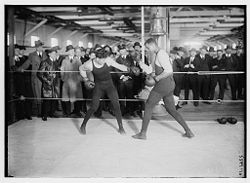
Jack Dempsey
William Harrison "Jack" Dempsey was an American boxer who held the world heavyweight title from 1919 to 1926. Dempsey's aggressive style and exceptional punching power made him one of the most popular boxers in history. Many of his fights set financial and attendance records, including the first...
, who became world heavyweight champion after brutally defeating Jess Willard
Jess Willard
Jess Willard was a world heavyweight boxing champion. He won the heavyweight title from Jack Johnson in April 1915 and lost it to Jack Dempsey in July 1919....
. Dempsey was one of the hardest punchers of all time and as Bert Randolph Sugar
Bert Randolph Sugar
Bert Randolph Sugar is a boxing writer/sports historian. He currently resides in Chappaqua, New York.-Education:...
put it, "had a left hook from hell." He is remembered for his iconic fight with Luis Angel Firpo
Luis Firpo
Luis Ángel Firpo, , was an Argentine boxer. Born in Junín, Argentina, he was nicknamed "The Wild Bull of The Pampas."...
, which was followed by a lavish life of celebrity away from the ring. The enormously popular Dempsey would conclude his career with a memorable two bouts with Gene Tunney
Gene Tunney
James Joseph "Gene" Tunney was the world heavyweight boxing champion from 1926-1928 who defeated Jack Dempsey twice, first in 1926 and then in 1927. Tunney's successful title defense against Dempsey is one of the most famous bouts in boxing history and is known as The Long Count Fight...
, breaking the $1 million gate threshold for the first time. Although Tunney dominated both fights, Dempsey retained the public's sympathy, especially after the controversy of a "long count
The Long Count Fight
The Battle Of The Long Count was the boxing rematch between world Heavyweight champion Gene Tunney and former champion Jack Dempsey, held on September 22, 1927, at Soldier Field in Chicago...
" in their second fight. This fight introduced the new rule that the counting of a downed opponent would not begin until the standing opponent went into a neutral corner. At this time, rules were negotiated by parties, as there were no sanctioning bodies.
The New York State Athletic Commission took a more prominent role in organizing fights in the 1930s. Famous champions of that era included the German heavyweight Max Schmeling
Max Schmeling
Maximillian Adolph Otto Siegfried Schmeling was a German boxer who was heavyweight champion of the world between 1930 and 1932. His two fights with Joe Louis in the late 1930s transcended boxing, and became worldwide social events because of their national associations...
and the American Max Baer, who wielded a devastating right hand. Baer was defeated by "Cinderella Man" James Braddock
James J. Braddock
James Walter "The Cinderella Man" Braddock was an American boxer who was the world heavyweight champion from 1935 to 1937....
, a former light heavyweight contender before a series of injuries and setbacks during the Great Depression and was at one point even stripped of his license. Most famous of all was Joe Louis
Joe Louis
Joseph Louis Barrow , better known as Joe Louis, was the world heavyweight boxing champion from 1937 to 1949. He is considered to be one of the greatest heavyweights of all time...
, who avenged an earlier defeat by demolishing Schmeling in the first round of their 1938 rematch, thus striking a symbolic blow against the racist ideology of Adolf Hitler
Adolf Hitler
Adolf Hitler was an Austrian-born German politician and the leader of the National Socialist German Workers Party , commonly referred to as the Nazi Party). He was Chancellor of Germany from 1933 to 1945, and head of state from 1934 to 1945...
. Louis was voted the best puncher of all time by The Ring
The Ring (magazine)
The Ring is an American boxing magazine that was first published in 1922 as a boxing and wrestling magazine. As the sporting legitimacy of professional wrestling came more into question, The Ring shifted to becoming exclusively a boxing oriented publication...
, and is arguably the greatest heavyweight of all time. In 1938, Henry Armstrong
Henry Armstrong
Henry Jackson Jr. was a world boxing champion who fought under the name Henry Armstrong. He is universally regarded as one of the greatest fighters of all time by many boxing critics and fellow professionals.Henry Jr...
became the only boxer to hold titles in three different weight classes at the same time (featherweight, lightweight, and welterweight). His attempt at winning the middleweight title would be thwarted in 1940.
1940 to 1960
The Second World War brought a lull in competitive boxing, and champion Louis fought mostly exhibitions. After the war, Louis continued his reign, but new stars emerged in other divisions, such as the inimitable featherweight Willie PepWillie Pep
Guglielmo Papaleo was an American boxer who was better known as Willie Pep. Pep boxed a total of 1956 rounds in the 241 bouts during his 26 year career, a considerable number of rounds and fights even for a fighter of his era. His final record was 229-11-1 with 65 knockouts...
, who won over 200 fights, and most notably Sugar Ray Robinson
Sugar Ray Robinson
Sugar Ray Robinson was an African-American professional boxer. Frequently cited as the greatest boxer of all time, Robinson's performances in the welterweight and middleweight divisions prompted sportswriters to create "pound for pound" rankings, where they compared fighters regardless of weight...
, widely regarded as the greatest pound-for-pound fighter of all time. Robinson held the world welterweight title from 1946 to 1951 and the world middleweight title a record five times from 1951 to 1960. His notable rivals included Jake LaMotta
Jake LaMotta
Giacobbe LaMotta , better known as Jake LaMotta, nicknamed "The Bronx Bull" and "The Raging Bull", is a former American world middleweight champion boxer...
, Gene Fullmer
Gene Fullmer
Gene Fullmer is a former American middleweight boxer and world champion.-Professional career:Fullmer began his professional career in 1951 and won his first 29 fights, 19 by knockout...
, and Carmen Basilio
Carmen Basilio
Carmine Basilio better known in the boxing world as Carmen Basilio, is an American former professional boxer who was a two weight world boxing champion...
. Unfortunately, many fights in the 1940s and 1950s were marred by suspected mafia involvement, though some fighters like Robinson and Basilio openly resisted mob influence.
Among the heavyweights, Joe Louis retained his title until his 1949 retirement, having held the championship for an unprecedented eleven years. Ezzard Charles
Ezzard Charles
Ezzard Mack Charles was an African-American professional boxer and former world heavyweight champion. He holds wins over numerous Hall of Fame fighters in three different weight classes. Charles retired with a record of 93 wins, 25 losses and 1 draw.-Career:He was born in Lawrenceville, Georgia,...
and Jersey Joe Walcott
Jersey Joe Walcott
Arnold Raymond Cream , better known as Jersey Joe Walcott, was a world heavyweight boxing champion. He broke the world's record for the oldest man to win the world's Heavyweight title when he earned it at the age of , a record that would be broken on November 5, 1994, by George Foreman, who...
succeeded him as champion, but they were soon outshone by the remarkable Rocky Marciano
Rocky Marciano
Rocky Marciano , born Rocco Francis Marchegiano, was an American boxer and the heavyweight champion of the world from September 23, 1952, to April 27, 1956. Marciano is the only champion to hold the heavyweight title and go undefeated throughout his career. Marciano defended his title six times...
, who compiled an astounding 49-0 record before retiring as world champion. Among his opponents was the ageless Archie Moore
Archie Moore
Archie Moore, born Archibald Lee Wright , was light heavyweight world boxing champion who had one of the longest professional careers in the history of that sport....
, who held the world light heavyweight title for ten years and scored more knockout victories than any other boxer in history.
1960 to 1980
In the early 1960s, the seemingly invincible Sonny ListonSonny Liston
Charles L. "Sonny" Liston was a professional boxer and ex-convict known for his toughness, punching power, and intimidating appearance who became world heavyweight champion in 1962 by knocking out Floyd Patterson in the first round...
captured the public imagination with his one-sided destruction of two-time heavyweight champion Floyd Patterson
Floyd Patterson
Floyd Patterson was an American heavyweight boxer and former undisputed heavyweight champion. At 21, Patterson became the youngest man to win the world heavyweight title. He was also the first heavyweight boxer to regain the title. He had a record of 55 wins 8 losses and 1 draw, with 40 wins by...
. One of the last mob-connected fighters, Liston had his mystique shattered in two controversial losses to the brash upstart Cassius Clay, who changed his name to Muhammad Ali
Muhammad Ali
Muhammad Ali is an American former professional boxer, philanthropist and social activist...
after becoming champion. Ali would become the most iconic figure in boxing history, transcending the sport and achieving global recognition. His refusal to serve in Vietnam resulted in the stripping of his title, and tore down the barrier between sport and culture.
After three years of inactivity, Ali returned to the sport, leading to his first epic clash with Joe Frazier
Joe Frazier
Joseph William "Joe" Frazier , also known as Smokin' Joe, was an Olympic and Undisputed World Heavyweight boxing champion, whose professional career lasted from 1965 to 1976, with a one-fight comeback in 1981....
in 1971, ushering in a "golden age" of heavyweight boxing. Ali, Frazier, and the heavy-hitting George Foreman
George Foreman
George Edward Foreman is an American two-time former World Heavyweight Boxing Champion, Olympic gold medalist, ordained Baptist minister, author and successful entrepreneur...
were the top fighters in a division overloaded with talent. Among the middleweights, Argentine Carlos Monzón
Carlos Monzón
Carlos Monzón was an Argentine professional boxer who held the undisputed world middleweight title for 7 years, during which he successfully defended the title 14 times....
emerged as a dominant champion, reigning from 1970 to his retirement in 1977, after an unprecedented 14 title defenses. Roberto Durán dismantled opponents for 6½ years as lightweight champion, Defending the title 12 times, 11 by knockout.
The late 1970s witnessed the end of universally recognized champions, as the WBC and WBA began to recognize different champions and top contenders, ushering in the era of multiple champions, unworthy mandatory challengers, and general corruption that came to be associated with sanctioning bodies in later decades. The end of this decade also saw the sport begin to become more oriented toward the casino industry, and public broadcasts would be replaced by closed-circuit, and ultimately pay-per-view, broadcasts, as the boxing audience shrank in numbers.
1980 to 2000
In the early 1980s Larry HolmesLarry Holmes
Larry Holmes is a former professional boxer. He grew up in Easton, Pennsylvania, which gave birth to his boxing nickname, The Easton Assassin....
was a lone heavyweight talent in a division full of pretenders, so the most compelling boxing matchups were to be found in the lower weight classes.Roberto Durán
Roberto Durán
Roberto Durán Samaniego is a retired professional boxer from Panama, widely regarded as one of the greatest boxers of all time. A versatile brawler in the ring, he was nicknamed "Manos de Piedra" during his career....
dominated the lightweight division and became welterweight champion, but quit during the 8th round in his second fight with Sugar Ray Leonard
Sugar Ray Leonard
Sugar Ray Leonard is an American retired professional boxer and occasional actor. He was named Ray Charles Leonard, after his mother's favorite singer, Ray Charles...
(the famous "no mas" fight of Nov. 1980), who emerged as the best fighter of the decade. Leonard went on to knock out the formidable Thomas Hearns
Thomas Hearns
Thomas "Hitman" Hearns is a retired American boxer. Nicknamed the "Motor City Cobra" and more famously "The Hitman", Hearns became the first boxer in history to win world titles in four divisions. He would also become the first fighter in history to win five world titles in five different divisions...
in 1981. Meanwhile, the junior welterweight division was ruled by Aaron Pryor
Aaron Pryor
Aaron Pryor is a former boxer from Cincinnati, Ohio, and member of the International Boxing Hall of Fame. He is the former world Junior Welterweight champion, and regarded as one of the greatest fighters in the history of the weight class.-Amateur career:Pryor, nicknamed The Hawk, had a record of...
, who made 10 title defenses from 1980 to 1985, before vacating the championship.
The prestigious middleweight division was dominated by "Marvelous" Marvin Hagler
Marvin Hagler
Marvelous Marvin Hagler , is a former professional boxer who was undisputed world middleweight champion between 1980 and 1987. Hagler holds the distinction of having the highest KO% of all middleweight champions at 78%...
, who engaged who faced Thomas Hearns
Thomas Hearns
Thomas "Hitman" Hearns is a retired American boxer. Nicknamed the "Motor City Cobra" and more famously "The Hitman", Hearns became the first boxer in history to win world titles in four divisions. He would also become the first fighter in history to win five world titles in five different divisions...
at Caesars Palace on April 15, 1985. The fight was billed as "The War", and it lived up to its billing. As soon as the bell rang, both fighters ran towards the center of the ring and began trading hooks and uppercuts nonstop. This continued into round three, when Hagler overwhelmed Hearns and knocked him out in brutal fashion. This fight made Hagler famous; he was able to lure Ray Leonard out of retirement in 1987, but lost in a highly-controversial decision. Hagler retired from boxing immediately after that fight.
In the latter half of the decade young heavyweight Mike Tyson
Mike Tyson
Michael Gerard "Mike" Tyson is a retired American boxer. Tyson is a former undisputed heavyweight champion of the world and holds the record as the youngest boxer to win the WBC, WBA and IBF world heavyweight titles, he was 20 years, 4 months and 22 days old...
emerged as a serious contender. Nicknamed "Iron Mike", Tyson became world heavyweight champion at the age of 20 and the first undisputed champion in a decade. Tyson soon became the most widely known boxer since Ali due to an aura of unrestrained ferocity, such as that exuded by Jack Dempsey or Sonny Liston.
Much like Liston, Tyson's career was marked by controversy and self-destruction. He was accused of domestic violence against his wife Robin Givens, whom he soon divorced. Meanwhile, he lost his title to 42-1 underdog James Douglas. His progress toward another title shot was derailed by allegations of rape made by Desiree Washington, a beauty pageant queen. In 1991 Tyson was imprisoned for rape, and released three years later. With Tyson removed from the heavyweight picture, Evander Holyfield
Evander Holyfield
Evander Holyfield is a professional boxer from the United States. He is a former undisputed world champion in both the cruiserweight and heavyweight divisions, earning him the nickname "The Real Deal"...
and Riddick Bowe
Riddick Bowe
Riddick Lamont Bowe is a retired American boxer. He is a two-time heavyweight champion and a former undisputed heavyweight champion...
emerged as top heavyweights in the early nineties, facing each other in three bouts.
Meanwhile, at light welterweight, Mexican Julio César Chávez
Julio César Chávez
Julio César Chávez is a retired Mexican professional boxer.He is a six-time world champion in three weight divisions, and for several years he was considered the best pound-for-pound boxer in the world...
compiled a record of 89-0 before fighting to a draw in 1993 with Pernell Whitaker
Pernell Whitaker
Pernell Whitaker , nicknamed "Sweet Pea", is a professional boxing trainer and retired American professional boxer...
, who later became a great boxer. In the late 1990s Chavez was superseded by Olympic gold medalist Oscar De La Hoya
Oscar de la Hoya
Oscar De La Hoya is a retired American boxer of Mexican descent. Nicknamed "The Golden Boy", De La Hoya won a gold medal at the Barcelona Olympic Games shortly after graduating from Garfield High School. De La Hoya comes from a boxing family. His grandfather Vicente, father Joel Sr., and brother...
, who became the most popular pay-per-view draw of his era. De la Hoya won championships in six weight classes, competing with fighters including Chavez, Whitaker, and Félix Trinidad
Félix Trinidad
Félix 'Tito' Trinidad, Jr. is a Puerto Rican professional boxer, considered one of the best in Puerto Rico's history. After winning five National Amateur Championships in Puerto Rico, he debuted as a professional when he was 17. He won his first world championship when he defeated Maurice Blocker...
.
In the late 1990s Mike Tyson made a comeback, which took an unexpected turn when he was defeated by heavy underdog Evander Holyfield in 1996. In their 1997 rematch, Tyson bit a chunk from Holyfield's ear, resulting in his disqualification; Tyson's boxing license was revoked by the Nevada State Athletic Commission for one year and he was fined US$3 million. Holyfield won two of the three title belts, but lost a final match in 1999 with WBC champion Lennox Lewis
Lennox Lewis
Lennox Claudius Lewis, CM, CBE is a retired boxer and the most recent British undisputed world heavyweight champion. He holds dual British and Canadian citizenship...
, who became undisputed champion.
2000 to present
The last decade has witnessed a continued decline in the popularity of boxing in the United States, marked by a malaise in the heavyweight division and the increased competition in the Pay-Per-View market from MMAMixed martial arts
Mixed Martial Arts is a full contact combat sport that allows the use of both striking and grappling techniques, both standing and on the ground, including boxing, wrestling, Brazilian jiu-jitsu, muay Thai, kickboxing, karate, judo and other styles. The roots of modern mixed martial arts can be...
and its main brand, UFC. The sport has grown in Germany and Eastern Europe, and is also currently strong in Britain as evidenced by the Professional Boxing Association
Professional Boxing Association
The Professional Boxing Association was formed in 2007. The original idea of an organisation designed to support the welfare and education of boxers came from Barry McGuigan, and had been an ambition of his since the 1980s....
's increasing prominence. This cultural shift is reflected in some of the changes in championship title holders, especially in the upper weight divisions.
The light heavyweight division was dominated in the early part of the decade by Roy Jones, Jr., a former middleweight champion, and the Polish-German Darius Michalczewski. Michalczewski held the WBO title, while Jones held the WBC
World Boxing Council
The World Boxing Council was initially established by 11 countries: the United States, Argentina, United Kingdom, France, Mexico, Philippines, Panama, Chile, Peru, Venezuela and Brazil plus Puerto Rico, met in Mexico City on February 14, 1963, upon invitation of the then President of Mexico, Adolfo...
, WBA
World Boxing Association
The World Boxing Association is a boxing organization that sanctions official matches, and awards the WBA world championship title at the professional level. It was previously known as the National Boxing Association before changing its name in 1962...
, and IBF
IBF
IBF may refer to:*International Boxing Federation is one of several boxing organisations* International Bandy Federation former name of Federation of International Bandy , an international governing body for bandy...
titles, two of which had been relinquished by Michalczewski. The two fighters never met, due to a dispute over whether the fight would be held in the U.S. or in Germany. This sort of dispute would be repeated among other top fighters, as Germany emerged as a top venue for world class boxing.
The most famous German-based boxers are the Ukrainian Klitschko
Klitschko
Vitali Klitschko and Wladimir Klitschko , collectively known as The Klitschko brothers are Ukrainian heavyweight boxers....
brothers, Wladimir
Wladimir Klitschko
Wladimir Klitschko is a Ukrainian heavyweight boxer. Klitschko is the WBA , IBF, WBO Super, IBO & Ring Magazine Champion. His older brother Vitali Klitschko is the current WBC champion...
and Vitali
Vitali Klitschko
Vitaliy Volodymyrovych Klychko is a Ukrainian professional heavyweight boxer and the current WBC heavyweight champion. He is a leader of the political party Ukrainian Democratic Alliance for Reform and a member of the Ukrainian delegation to the Congress of the Council of Europe. He previously...
, both of whom hold versions of the heavyweight title. The Klitschkos are often depicted as representing a new generation of fighters from ex-Soviet republics, possessing great size, yet considerable skill and stamina, developed by years of amateur experience. Most versions of the heavyweight title are held by fighters from the former Soviet Union.
Since the retirement of Lennox Lewis
Lennox Lewis
Lennox Claudius Lewis, CM, CBE is a retired boxer and the most recent British undisputed world heavyweight champion. He holds dual British and Canadian citizenship...
in 2004, the heavyweight division has been criticized as lacking talent or depth, especially among American fighters. This has resulted in a higher profile for fighters in lower weight classes, including the age-defying middleweight and light heavyweight champion Bernard Hopkins
Bernard Hopkins
Bernard Hopkins Jr, known as The Executioner is an American boxer and the current Ring Magazine and WBC light heavyweight champion...
, and the undefeated multiple weight division champion Floyd Mayweather, Jr., who won a 2007 split decision over Oscar De La Hoya in a record-breaking pay-per-view event. Perhaps unfairly billed as the "fight to save boxing", the success of this event nonetheless shows that American boxing still retains a considerable core audience when its product is of descent from the American continent.
Other notable fighters in even lower weight classes are experiencing unprecedented popularity today. In the last five years junior lightweights Marco Antonio Barrera
Marco Antonio Barrera
Marco Antonio Barrera Tapia is a Mexicanprofessional boxer. He has won numerous world titles in three different weight classes; he is a former two-time WBO super bantamweight , WBC, Lineal, & The Ring featherweight , and WBC & IBF super featherweight champion...
, Erik Morales
Erik Morales
Érik Isaac Morales Elvira is a Mexican professional boxer. He is the first Mexican born boxer in history to win a world title in four weight classes and is the current WBC Light Welterweight Champion...
, and multiple weight division champion Manny Pacquiao
Manny Pacquiao
Emmanuel "Manny" Dapidran Pacquiao, PLH is a Filipino professional boxer and politician. He is the first eight-division world champion; having won six world titles, as well as the first to win the lineal championship in four different weight classes. He was named "Fighter of the Decade" for the...
have fought numerous times on pay-per-view. These small fighters often display tremendous punching power for their size, producing exciting fights such as the incredible 2005 bout between Castillo and the late Diego Corrales
Diego Corrales
Diego "Chico" Corrales was an American boxer.He was the WBC, WBO, & The Ring lightweight champion, and the WBO & IBF super featherweight champion....
.
Interest in the lower weight divisions further increased with the possibility of a superfight between two of the current best fighters in the world, Manny Pacquiao
Manny Pacquiao
Emmanuel "Manny" Dapidran Pacquiao, PLH is a Filipino professional boxer and politician. He is the first eight-division world champion; having won six world titles, as well as the first to win the lineal championship in four different weight classes. He was named "Fighter of the Decade" for the...
and Floyd Mayweather, Jr. Experts have predicted this would break current pay-per-view records, due to the tremendous public demand for the fight. Negotiations for the fight have twice failed since Mayweather refuses to fight Manny Pacquiao without Olympic-style drug testing before the fight.
Length of bouts
Most professional bouts are limited to ten or twelve rounds, though four round fights are common for less experienced fighters or club fighters. Through the early twentieth century, it was common for fights to have unlimited rounds, ending only when one fighter quit or the fight was stopped by police. In the 1910s and 1920s, a fifteen-round limit gradually became the norm, benefiting high-energy fighters like Jack Dempsey.For decades, from the 1920s to the 1980s, world championship matches in professional boxing were scheduled for fifteen rounds, but that changed after a November 13, 1982 WBA Lightweight title bout ended with the death of boxer Duk Koo Kim
Duk Koo Kim
Kim Duk-Koo was a South Korean boxer who died following a boxing match against Ray Mancini. His death sparked a number of reforms in the sport aimed to better protect the health of fighters.-Life and boxing career:...
in a fight against Ray Mancini
Ray Mancini
Ray "Boom Boom" Mancini is a retired Italian-American boxer. He held the World Boxing Association lightweight championship from 1982 to 1984. Mancini inherited his distinctive nickname from his father, veteran boxer Lenny "Boom Boom" Mancini, who laid the foundation for his son's career...
in the 14th round of a nationally televised championship fight on CBS. Exactly three months after the fatal fight, the WBC reduced the number of their championship fights to 12 rounds. The WBA even stripped a fighter of his championship in 1983 because the fight had been a 15-round bout, shortly after the rule was changed to 12 rounds. By 1988, to the displeasure of some boxing purists, all fights had been reduced to a maximum of 12 rounds only, partially for safety, and partially for television, as a 12-round bout could be broadcast within an hour, while a 15-round bout could require up to 90 minutes to broadcast.
Scoring
If a knockout or disqualification does not occur, the fight is determined by decision. In the early days of boxing, the referee decided the winner by raising his arm at the end of the bout, a practice that is still used for some professional bouts in Britain. In the early twentieth century, it became common for the referee or judge to score bouts by the number of rounds won. To improve the reliability of scoring, two ringside judges were added besides the referee, and the winner was decided by majority decision. Since the late twentieth century, it has become common practice for all three judges to be ringside observers, though the referee still has the authority to stop a fight or deduct points.At the end of the fight, the judges add their scores for all rounds, and each judge thereby determines a winner. If all three judges choose the same fighter as the winner, that fighter wins by unanimous decision. If two judges have one boxer winning the fight and the third judge scores it a draw, the boxer wins by majority decision. If two judges have one boxer winning the fight and the third judge has the other boxer winning, the first boxer wins by split decision. If one judge chooses one boxer as the winner, the second judge chooses the other boxer, and the third judge calls it a draw, then the bout is ruled a draw
Tie (draw)
To tie or draw is to finish a competition with identical or inconclusive results. The word "tie" is usually used in North America for sports such as American football. "Draw" is usually used in the United Kingdom, Ireland and the Commonwealth of Nations and it is usually used for sports such as...
. The bout is also ruled a draw if at least two out of three judges score the fight a draw, regardless of the third score. In the United Kingdom, the bout is only scored by the referee, except when a title is at stake, in which case it is scored by three judges.
The most widely used scoring system since the mid-twentieth century is the "10-point must system
10-point must system
The 10-point must system is a method of scoring a fighting match .Under the system, the judges must give the winner of a round 10 points, and the loser 9 points or fewer...
", so named because a judge "must" award ten points to at least one fighter each round (before deductions for fouls). Most rounds are scored 10-9, with 10 points for the fighter who won the round, and 9 points for the fighter the judge believes lost the round. If a round is judged to be even, it is scored 10-10.
For each knockdown in a round, the judge deducts an additional point from the fighter knocked down, resulting in a 10-8 score if there is one knockdown or a 10-7 score if there are two knockdowns. If the referee instructs the judges to deduct a point for a foul, this deduction is applied after the preliminary computation. So, if a fighter wins a round, but is penalized for a foul, the score changes from 10-9 to 9-9. If that same fighter scored a knockdown in the round, the score would change from 10-8 in his favor to 9-8.
Other scoring systems have also been used in various locations, including the five-point must system (in which the winning fighter is awarded five points, the loser four or less), the one-point system (in which the winning fighter is awarded one or more points, and the losing fighter is awarded zero), and the rounds system which simply awards the round to the winning fighter. In the rounds system, the bout is won by the fighter determined to have won more rounds. This system often used a supplemental points system (generally the ten-point must) in the case of even rounds.
If a fight is stopped due to a cut from an unintentional headbutt, the fight goes to the scorecards only if a specified number of rounds (usually three, sometimes four) have been completed. Whoever is ahead on the scorecards wins by a technical decision. If the required number of rounds has not been completed, the fight is declared a technical draw or a no contest.
If a fight is stopped due to a cut resulting from a legal punch, the other participant is awarded a technical knockout win. For this reason, fighters often employ cutmen
Cutman
A cutman is a person responsible for preventing and treating physical damage to a fighter during the breaks between rounds of a full contact match such as a boxing, kickboxing or a mixed martial arts bout. Cutmen typically handle swelling, nosebleeds and lacerations...
, whose job is to treat cuts between rounds so that the boxer is able to continue despite the cut.
External links
- Boxing Record Archive
- The Ring magazine