

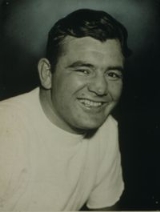
James J. Braddock

Encyclopedia
James Walter "The Cinderella Man" Braddock (June 7, 1905 – November 29, 1974) was an American
boxer
who was the world heavyweight champion from 1935 to 1937.
Fighting under the name James J. Braddock (ostensibly to follow the pattern set by two prior world boxing champions, James J. Corbett
and James J. Jeffries
), he was known for his powerful right hand, granite chin and an amazing comeback from a floundering career. He had lost several bouts due to chronic hand injuries and was forced to work on the docks and collect social assistance to feed his family during the depression. In 1935 he fought Max Baer
for the Heavyweight championship and won. For this unlikely feat he was given the nickname "The Cinderella Man" by Damon Runyon
. Braddock was managed by Joe Gould
.
in New York City
on West 48th Street within a couple of blocks of the Madison Square Garden
venue where he would later become famous. He stated his life's early ambition was to play football for Knute Rockne
at the University of Notre Dame
, but he had "more brawn than brains."
In 1928, he pulled off a major upset by knocking out highly-regarded Tuffy Griffiths
. The following year he earned a chance to fight for the championship, but he narrowly lost to Tommy Loughran
in a 15-round decision. Braddock was greatly depressed by the loss and badly fractured his right hand in several places in the process. His career suffered as a result, as did Braddock's disposition.
His record for the next 33 fights fell to 11-20-2. With his family in poverty during the Great Depression, Braddock had to give up boxing for a little while and worked as a longshoreman. Due to frequent injuries to his right hand, Braddock compensated by using his left hand during his longshoreman work, and it gradually became stronger than his right. He always remembered the humiliation of having to accept government relief money, but was inspired by the Catholic Worker Movement
, a Christian social justice organization founded by Dorothy Day
and Peter Maurin
in 1933 to help the homeless and hungry. After his boxing comeback, Braddock returned the welfare money he had received and made frequent donations to various Catholic Worker Houses, including feeding homeless guests with his family.
. Although Braddock was intended simply as a stepping stone in Griffin's career, he knocked out the "Ozark Cyclone" in the third round. Braddock then fought John Henry Lewis
, a future light heavyweight champion. He won in one of the most important fights of his career. After defeating another highly regarded heavyweight contender, Art Lasky
, whose nose he broke during the bout on March 22, 1935, Braddock was given a title fight against the World Heavyweight Champion, Max Baer.
Baer hardly trained for the bout. Braddock, on the other hand, was training hard. "I'm training for a fight. Not a boxing contest or a clownin' contest or a dance." he said. "Whether it goes 1 round or 3 rounds or 10 rounds, it will be a fight and a fight all the way. When you've been through what I've had to face in the last two years, a Max Baer or a Bengal tiger
looks like a house pet. He might come at me with a cannon and a blackjack and he would still be a picnic compared to what I've had to face."
Considered little more than a journeyman fighter, Braddock was hand-picked by Baer's handlers because he was seen as an easy payday for the champion. Instead, on June 13, 1935, at Madison Square Garden Bowl
, Braddock won the Heavyweight Championship of the World as the 10-to-1 underdog in one of the most stunning upsets in boxing history.
During the fight, a dogged Braddock took a few heavy hits from the powerful younger champion (30 years vs 26 years for Baer), but Braddock kept coming, wearing down Baer, who seemed perplexed by Braddock's ability to take a punch. In the end, the judges gave Braddock the title with a unanimous decision.
against the German
Max Schmeling
was canceled under suspicious circumstances. Braddock argued he would have received only a US$
25,000 purse against Schmeling, compared to $250,000 against rising star Joe Louis
.
Louis was considered to be the more dangerous opponent and the fact he, as a black man, could be heavyweight champion made many boxing insiders against him getting a title shot. Braddock agreed to the fight with the stipulation that he would receive a percentage of Louis's future purses. While Braddock was able to knock down Louis in the fight, Louis went on to win. Louis was quoted as saying that Braddock was the bravest man he ever fought.
in Tenafly, New Jersey
. He was inducted into the International Boxing Hall of Fame
in 2001. James J. Braddock North Hudson County Park in North Bergen, New Jersey
is named in his honor.
The 2005
biographical film
Cinderella Man
tells the story of James J. Braddock. Directed by Ron Howard
, and starring Russell Crowe
as Braddock with Renée Zellweger
as his wife, Mae. The film had an estimated budget of $88 million and grossed $108.5 million worldwide. Paul Giamatti
, playing Braddock's manager Joe Gould, was nominated for the Academy Award for Best Supporting Actor
. The role of neighbor Sara Wilson was played by Rosemarie DeWitt
, who is Braddock's real-life granddaughter (daughter of Braddock's daughter Rosemarie Braddock and husband Kenny DeWitt). The film received mostly positive reviews.
British band The BibleCode Sundays
released a song titled "The Cinderella Man" on their 2008 'Boots or No Boots' album as a tribute to Braddock.
|align="center" colspan=8|51 Wins (26 knockouts, 20 decisions), 26 Losses (2 knockouts, 24 decisions), 7 Draws, 2 No Contests http://boxrec.com/list_bouts.php?human_id=012072&cat=boxer&pageID=1
|-
| align="center" style="border-style: none none solid solid; background: #e3e3e3"|Result
| align="center" style="border-style: none none solid solid; background: #e3e3e3"|Record
| align="center" style="border-style: none none solid solid; background: #e3e3e3"|Opponent
| align="center" style="border-style: none none solid solid; background: #e3e3e3"|Type
| align="center" style="border-style: none none solid solid; background: #e3e3e3"|Round
| align="center" style="border-style: none none solid solid; background: #e3e3e3"|Date
| align="center" style="border-style: none none solid solid; background: #e3e3e3"|Location
| align="center" style="border-style: none none solid solid; background: #e3e3e3"|Notes
|-align=center
|Win
|
|align=left| Tommy Farr
|SD
|10
|21/01/1938
|align=left| Madison Square Garden
, New York
, New York
, United States
|align=left|
|-align=center
|Loss
|
|align=left| Joe Louis
|KO
|8
|22/06/1937
|align=left| Comiskey Park
, Chicago
, Illinois
, United States
|align=left|
|-align=center
|Win
|
|align=left| Max Baer
|UD
|15
|13/06/1935
|align=left| Madison Square Garden Bowl
, Long Island City
, Queens, New York
, United States
|align=left|
|-align=center
|Win
|
|align=left| Art Lasky
|UD
|15
|22/03/1935
|align=left| Madison Square Garden
, New York
, New York
, United States
|align=left|
|-align=center
|Win
|
|align=left| John Henry Lewis
|PTS
|10
|16/11/1934
|align=left| Madison Square Garden
, New York
, New York
, United States
|align=left|
|-align=center
|Win
|
|align=left| Corn Griffin
|TKO
|3
|14/06/1934
|align=left| Madison Square Garden Bowl
, Long Island City
, Queens, New York
, United States
|align=left|
|-align=center
|style="background:#ddd;"|NC
|
|align=left| Abe Feldman
|NC
|6
|25/09/1933
|align=left| Memorial Field Stadium, Mount Vernon
, New York
, United States
|align=left|
|-align=center
|Win
|
|align=left| Chester Matan
|PTS
|10
|21/07/1933
|align=left| Playgrounds Stadium, West New York
, New Jersey
, United States
|align=left|
|-align=center
|Win
|
|align=left| Les Kennedy
|PTS
|10
|21/06/1933
|align=left| Oakland Arena, West New York
, New Jersey
, United States
|align=left|
|-align=center
|Loss
|
|align=left| Al Stillman
|UD
|10
|19/06/1933
|align=left| Arena, Saint Louis, Missouri
, United States
|align=left|
|-align=center
|Loss
|
|align=left| Martin Levandowski
|MD
|10
|05/04/1933
|align=left| Arena, Saint Louis, Missouri
, United States
|align=left|
|-align=center
|Win
|
|align=left| Al Stillman
|TKO
|10
|21/03/1933
|align=left| Arena, Saint Louis, Missouri
, United States
|align=left|
|-align=center
|Loss
|
|align=left| Al Ettore
|DQ
|4
|01/03/1933
|align=left| Olympia A.C., Philadelphia, Pennsylvania
, United States
|align=left|
|-align=center
|Loss
|
|align=left| Hans Birkie
|PTS
|10
|09/11/1932
|align=left| Madison Square Garden
, New York
, New York
, United States
|align=left|
|-align=center
|Win
|
|align=left| Martin Levandowski
|PTS
|10
|13/01/1933
|align=left| Chicago Stadium
, Chicago
, Illinois
, United States
|align=left|
|-align=center
|Loss
|
|align=left| Lou Scozza
|TKO
|6
|09/11/1932
|align=left| Civic Auditorium
, San Francisco, California
, United States
|align=left|
|-align=center
|Loss
|
|align=left| Tom Patrick
|PTS
|10
|21/10/1932
|align=left| Legion Stadium, Hollywood, California
, United States
|align=left|
|-align=center
|Win
|
|align=left| Dynamite Jackson
|PTS
|10
|30/09/1932
|align=left| Coliseum, San Diego, California
, United States
|align=left|
|-align=center
|Loss
|
|align=left| John Henry Lewis
|PTS
|10
|21/09/1932
|align=left| Civic Auditorium
, San Francisco, California
, United States
|align=left|
|-align=center
|Loss
|
|align=left| Tony Shucco
|PTS
|8
|25/07/1932
|align=left| Madison Square Garden Bowl
, Long Island City
, Queens, New York
, United States
|align=left|
|-align=center
|Win
|
|align=left| Vicente Parrile
|PTS
|5
|21/06/1932
|align=left| Madison Square Garden Bowl
, Long Island City
, Queens, New York
, United States
|align=left|
|-align=center
|Loss
|
|align=left| Charley Retzlaff
|PTS
|10
|13/05/1932
|align=left| Boston Garden
, Boston
, Massachusetts
, United States
|align=left|
|-align=center
|Loss
|
|align=left| Baxter Calmes
|UD
|10
|18/03/1932
|align=left| Chicago Stadium
, Chicago
, Illinois
, United States
|align=left|
|-align=center
|Loss
|
|align=left| Al Gainer
|PTS
|10
|04/12/1931
|align=left| Arena
, New Haven
, Connecticut
, United States
|align=left|
|-align=center
|style="background:#ddd;"|NC
|
|align=left| Maxie Rosenbloom
|NC
|2
|10/11/1931
|align=left| Minneapolis Auditorium
, Minneapolis, Minnesota
, United States
|align=left|
|-align=center
|Loss
|
|align=left| Joe Sekyra
|PTS
|10
|09/10/1931
|align=left| Madison Square Garden
, New York
, New York
, United States
|align=left|
|-align=center
|style="background:#abcdef;"|Draw
|
|align=left| Andy Mitchell
|PTS
|10
|03/09/1931
|align=left| Navin Field, Detroit, Michigan
, United States
|align=left|
|-align=center
|Win
|
|align=left| Jack Kelly
|PTS
|10
|30/03/1931
|align=left| Arena
, New Haven
, Connecticut
, United States
|align=left|
|-align=center
|Win
|
|align=left| Jack Roper
|KO
|1
|05/03/1931
|align=left| Madison Square Garden Stadium
, Miami
, Florida
, United States
|align=left|
|-align=center
|Loss
|
|align=left| Ernie Schaaf
|SD
|10
|23/01/1931
|align=left| Madison Square Garden
, New York
, New York
, United States
|align=left|
|-align=center
|Win
|
|align=left| Phil Mercurio
|KO
|2
|23/01/1931
|align=left| Boston Garden
, Boston
, Massachusetts
, United States
|align=left|
|-align=center
|Loss
|
|align=left| Babe Hunt
|PTS
|10
|11/08/1930
|align=left| Braves Field
, Boston
, Massachusetts
, United States
|align=left|
|-align=center
|Win
|
|align=left| Joe Monte
|PTS
|10
|02/07/1930
|align=left| Fenway Park
, Boston
, Massachusetts
, United States
|align=left|
|-align=center
|Loss
|
|align=left| Harold Mays
|PTS
|10
|05/06/1930
|align=left| Playgrounds Stadium, West New York
, New Jersey
, United States
|align=left|
|-align=center
|Loss
|
|align=left| Billy Jones
|UD
|10
|07/04/1930
|align=left| Arena
, Philadelphia, Pennsylvania
, United States
|align=left|
|-align=center
|Loss
|36-9-6
|align=left| Leo Lomski
|SD
|10
|17/01/1930
|align=left| Coliseum
, Chicago
, Illinois
, United States
|align=left|
|-align=center
|Win
|36-8-6
|align=left| Jake Warren
|KO
|2
|07/12/1929
|align=left| Ridgewood Grove, Brooklyn, New York
, United States
|align=left|
|-align=center
|Loss
|35-8-6
|align=left| Maxie Rosenbloom
|PTS
|10
|15/11/1929
|align=left| Madison Square Garden
, New York
, New York
, United States
|align=left|
|-align=center
|Loss
|35-7-6
|align=left| Yale Okun
|PTS
|10
|27/08/1929
|align=left| Olympic Auditorium
, Los Angeles
, California
, United States
|align=left|
|-align=center
|Loss
|35-6-6
|align=left| Tommy Loughran
|UD
|15
|18/07/1929
|align=left| Yankee Stadium, Bronx, New York
, United States
|align=left|
|-align=center
|Win
|35-5-6
|align=left| Eddie Benson
|KO
|1
|22/04/1929
|align=left| Broadway Auditorium, Buffalo
, New York
, United States
|align=left|
|-align=center
|Win
|34-5-6
|align=left| Jimmy Slattery
|TKO
|9
|11/03/1929
|align=left| Madison Square Garden
, New York
, New York
, United States
|align=left|
|-align=center
|Win
|33-5-6
|align=left| George Gemas
|KO
|1
|04/02/1929
|align=left| Laurel Garden, Newark
, New Jersey
, United States
|align=left|
|-align=center
|Loss
|32-5-6
|align=left| Leo Lomski
|MD
|10
|18/01/1929
|align=left| Madison Square Garden
, New York
, New York
, United States
|align=left|
|-align=center
|Win
|32-4-6
|align=left| Tuffy Griffiths
|TKO
|2
|30/11/1928
|align=left| Madison Square Garden
, New York
, New York
, United States
|align=left|
|-align=center
|Win
|31-4-6
|align=left| Pete Latzo
|PTS
|10
|17/10/1928
|align=left| Newark Armory
, Newark
, New Jersey
, United States
|align=left|
|-align=center
|Loss
|30-4-6
|align=left| Joe Sekyra
|PTS
|10
|08/08/1928
|align=left| Ebbets Field
, Brooklyn, New York
, United States
|align=left|
|-align=center
|style="background:#abcdef;"|Draw
|30-3-6
|align=left| Nando Tassi
|PTS
|10
|25/07/1928
|align=left| Ebbets Field
, Brooklyn, New York
, United States
|align=left|
|-align=center
|style="background:#abcdef;"|Draw
|30-3-5
|align=left| Billy Vidabeck
|NWS
|10
|27/06/1928
|align=left| Playgrounds Stadium, West New York
, New Jersey
, United States
|align=left|
|-align=center
|Loss
|30-3-4
|align=left| Joe Monte
|PTS
|10
|07/06/1928
|align=left| Madison Square Garden
, New York
, New York
, United States
|align=left|
|-align=center
|Win
|30-2-4
|align=left| Jimmy Francis
|NWS
|10
|16/05/1928
|align=left| Playgrounds Stadium, West New York
, New Jersey
, United States
|align=left|
|-align=center
|Win
|29-2-4
|align=left| Jack Darnell
|KO
|4
|07/05/1928
|align=left| Grotto Auditorium, Jersey City
, New Jersey
, United States
|align=left|
|-align=center
|Win
|28-2-4
|align=left| Paul Swiderski
|PTS
|8
|06/01/1928
|align=left| Madison Square Garden
, New York
, New York
, United States
|align=left|
|-align=center
|style="background:#abcdef;"|Draw
|27-2-4
|align=left| Joe Monte
|PTS
|10
|07/10/1927
|align=left| Madison Square Garden
, New York
, New York
, United States
|align=left|
|-align=center
|Loss
|27-2-3
|align=left| Herman Heller
|NWS
|10
|21/09/1927
|align=left| Playgrounds Stadium, West New York
, New Jersey
, United States
|align=left|
|-align=center
|Win
|27-1-3
|align=left| Vic McLaughlin
|NWS
|10
|10/08/1927
|align=left| Playgrounds Stadium, West New York
, New Jersey
, United States
|align=left|
|-align=center
|Win
|26-1-3
|align=left| George LaRocco
|UD
|6
|21/07/1927
|align=left| Yankee Stadium, Bronx, New York
, United States
|align=left|
|-align=center
|Win
|25-1-3
|align=left| Jimmy Francis
|NWS
|10
|13/07/1927
|align=left| Playgrounds Stadium, West New York
, New Jersey
, United States
|align=left|
|-align=center
|Win
|24-1-3
|align=left| Jimmy Francis
|NWS
|10
|08/06/1927
|align=left| Playgrounds Stadium, West New York
, New Jersey
, United States
|align=left|
|-align=center
|Loss
|23-1-3
|align=left| Paul Cavalier
|NWS
|10
|27/05/1927
|align=left| Arcola Park, Paramus
, New Jersey
, United States
|align=left|
|-align=center
|style="background:#abcdef;"|Draw
|23-0-3
|align=left| George LaRocco
|PTS
|6
|19/05/1927
|align=left| Yankee Stadium, Bronx, New York
, United States
|align=left|
|-align=center
|Win
|22-0-2
|align=left| Jack Stone
|NWS
|10
|19/05/1927
|align=left| Playgrounds Stadium, West New York
, New Jersey
, United States
|align=left|
|-align=center
|Win
|21-0-2
|align=left| Stanley Simmons
|TKO
|1
|02/05/1927
|align=left| Oakland Arena, Jersey City
, New Jersey
, United States
|align=left|
|-align=center
|Win
|20-0-2
|align=left| Frankie Lennon
|TKO
|3
|19/04/1927
|align=left| Wilkes-Barre
, Pennsylvania
, United States
|align=left|
|-align=center
|Win
|19-0-2
|align=left| Tom McKiernan
|KO
|2
|15/03/1927
|align=left| United States
|align=left|
|-align=center
|Win
|18-0-2
|align=left| Nick Fadil
|PTS
|6
|08/03/1927
|align=left| Pioneer Sporting Club, New York
, New York
, United States
|align=left|
|-align=center
|Win
|17-0-2
|align=left| Lou Barba
|PTS
|4
|03/03/1927
|align=left| Madison Square Garden
, New York
, New York
, United States
|align=left|
|-align=center
|Win
|16-0-2
|align=left| Jack Nelson
|PTS
|6
|15/02/1927
|align=left| Wilkes-Barre
, Pennsylvania
, United States
|align=left|
|-align=center
|Win
|15-0-2
|align=left| Johnny Alberts
|KO
|4
|01/02/1927
|align=left| Wilkes-Barre
, Pennsylvania
, United States
|align=left|
|-align=center
|Win
|14-0-2
|align=left| George LaRocco
|KO
|1
|28/01/1927
|align=left| Madison Square Garden
, New York
, New York
, United States
|align=left|
|-align=center
|style="background:#abcdef;"|Draw
|13-0-2
|align=left| Doc Conrad
|NWS
|4
|20/12/1926
|align=left| 4th Regiment Armory, Jersey City
, New Jersey
, United States
|align=left|
|-align=center
|Win
|13-0-1
|align=left| Joe Hudson
|PTS
|6
|08/12/1926
|align=left| Manhattan A.C.
, New York
, New York
, United States
|align=left|
|-align=center
|Win
|12-0-1
|align=left| Al Settle
|PTS
|6
|04/12/1926
|align=left| Walker A.C., New York
, New York
, United States
|align=left|
|-align=center
|Win
|11-0-1
|align=left| Lou Barba
|PTS
|6
|12/11/1926
|align=left| Pioneer Sporting Club, New York
, New York
, United States
|align=left|
|-align=center
|Win
|10-0-1
|align=left| Carmine Caggiano
|KO
|1
|30/09/1926
|align=left| Playgrounds Stadium, West New York
, New Jersey
, United States
|align=left|
|-align=center
|Win
|9-0-1
|align=left| Ray Kennedy
|KO
|1
|16/09/1926
|align=left| Playgrounds Stadium, West New York
, New Jersey
, United States
|align=left|
|-align=center
|Win
|8-0-1
|align=left| Mike Rock
|KO
|1
|13/09/1926
|align=left| Oakland Arena, Jersey City
, New Jersey
, United States
|align=left|
|-align=center
|Win
|7-0-1
|align=left| Gene Travers
|KO
|1
|07/09/1926
|align=left| Oakland Arena, Jersey City
, New Jersey
, United States
|align=left|
|-align=center
|Win
|6-0-1
|align=left| Walter Westman
|TKO
|3
|09/07/1926
|align=left| Boyle's Thirty Acres
, Jersey City
, New Jersey
, United States
|align=left|
|-align=center
|Win
|5-0-1
|align=left| Jim Pearson
|TKO
|2
|28/06/1926
|align=left| Oakland Arena, Jersey City
, New Jersey
, United States
|align=left|
|-align=center
|Win
|4-0-1
|align=left| Leo Dobson
|KO
|1
|18/06/1926
|align=left| Boyle's Thirty Acres
, Jersey City
, New Jersey
, United States
|align=left|
|-align=center
|Win
|3-0-1
|align=left| Willie Daily
|KO
|1
|03/05/1926
|align=left| Jersey City
, New Jersey
, United States
|align=left|
|-align=center
|Win
|2-0-1
|align=left| Jack O'Day
|KO
|1
|02/05/1926
|align=left| Jersey City
, New Jersey
, United States
|align=left|
|-align=center
|Win
|1-0-1
|align=left| Phil Weisberger
|KO
|2
|22/04/1926
|align=left| Knights of Columbus, Ridgefield Park
, New Jersey
, United States
|align=left|
|-align=center
|style="background:#abcdef;"|Draw
|0-0-1
|align=left| Al Settle
|NWS
|4
|13/04/1926
|align=left| Amsterdam Hall, Union City
, New Jersey
, United States
|align=left|
|-align=center
United States
The United States of America is a federal constitutional republic comprising fifty states and a federal district...
boxer
Boxing
Boxing, also called pugilism, is a combat sport in which two people fight each other using their fists. Boxing is supervised by a referee over a series of between one to three minute intervals called rounds...
who was the world heavyweight champion from 1935 to 1937.
Fighting under the name James J. Braddock (ostensibly to follow the pattern set by two prior world boxing champions, James J. Corbett
James J. Corbett
James John "Gentleman Jim" Corbett was an Irish-American heavyweight boxing champion, best known as the man who defeated the great John L. Sullivan. He also coached boxing at the Olympic Club in San Francisco...
and James J. Jeffries
James J. Jeffries
James Jackson Jeffries was a world heavyweight boxing champion.His greatest assets were his enormous strength and stamina. Using a technique taught to him by his trainer, former welterweight and middleweight champion Tommy Ryan, Jeffries fought out of a crouch with his left arm extended forward...
), he was known for his powerful right hand, granite chin and an amazing comeback from a floundering career. He had lost several bouts due to chronic hand injuries and was forced to work on the docks and collect social assistance to feed his family during the depression. In 1935 he fought Max Baer
Max Baer
Max Baer was an American boxer of the 1930s as well as a professional wrestler and referee, and had an occasional role on film or television. He was the brother of twice World Champion boxing contender Buddy Baer and father of actor Max Baer, Jr...
for the Heavyweight championship and won. For this unlikely feat he was given the nickname "The Cinderella Man" by Damon Runyon
Damon Runyon
Alfred Damon Runyon was an American newspaperman and writer.He was best known for his short stories celebrating the world of Broadway in New York City that grew out of the Prohibition era. To New Yorkers of his generation, a "Damon Runyon character" evoked a distinctive social type from the...
. Braddock was managed by Joe Gould
Joe Gould (manager)
Joe Gould was an American boxing manager, best known for representing boxer James J. Braddock, who in 1935 upset Max Baer to take the world heavyweight championship.-Career:...
.
Early life
Braddock was born in Hell's KitchenHell's Kitchen, Manhattan
Hell's Kitchen, also known as Clinton and Midtown West, is a neighborhood of Manhattan in New York City between 34th Street and 59th Street, from 8th Avenue to the Hudson River....
in New York City
New York City
New York is the most populous city in the United States and the center of the New York Metropolitan Area, one of the most populous metropolitan areas in the world. New York exerts a significant impact upon global commerce, finance, media, art, fashion, research, technology, education, and...
on West 48th Street within a couple of blocks of the Madison Square Garden
Madison Square Garden
Madison Square Garden, often abbreviated as MSG and known colloquially as The Garden, is a multi-purpose indoor arena in the New York City borough of Manhattan and located at 8th Avenue, between 31st and 33rd Streets, situated on top of Pennsylvania Station.Opened on February 11, 1968, it is the...
venue where he would later become famous. He stated his life's early ambition was to play football for Knute Rockne
Knute Rockne
Knute Kenneth Rockne was an American football player and coach. He is regarded as one of the greatest coaches in college football history...
at the University of Notre Dame
University of Notre Dame
The University of Notre Dame du Lac is a Catholic research university located in Notre Dame, an unincorporated community north of the city of South Bend, in St. Joseph County, Indiana, United States...
, but he had "more brawn than brains."
Career
Braddock pursued boxing, turning pro at the age of 21, fighting as a light heavyweight. After three years, Braddock's record was 44-2-2 with 21 knockouts.In 1928, he pulled off a major upset by knocking out highly-regarded Tuffy Griffiths
Tuffy Griffiths
Gerald Ambrose "Tuffy" Griffiths was an American boxer. He fought as a heavyweight and occasionally as a light heavyweight under the name Tuffy Griffiths.-Early life:...
. The following year he earned a chance to fight for the championship, but he narrowly lost to Tommy Loughran
Tommy Loughran
Thomas Patrick Loughran was the light heavyweight boxing champion of the world.Loughran's effective use of coordinated foot work, sound defense and swift, accurate counter punching is now regarded as a precursor to the techniques practiced in modern boxing...
in a 15-round decision. Braddock was greatly depressed by the loss and badly fractured his right hand in several places in the process. His career suffered as a result, as did Braddock's disposition.
His record for the next 33 fights fell to 11-20-2. With his family in poverty during the Great Depression, Braddock had to give up boxing for a little while and worked as a longshoreman. Due to frequent injuries to his right hand, Braddock compensated by using his left hand during his longshoreman work, and it gradually became stronger than his right. He always remembered the humiliation of having to accept government relief money, but was inspired by the Catholic Worker Movement
Catholic Worker Movement
The Catholic Worker Movement is a collection of autonomous communities of Catholics and their associates founded by Dorothy Day and Peter Maurin in 1933. Its aim is to "live in accordance with the justice and charity of Jesus Christ." One of its guiding principles is hospitality towards those on...
, a Christian social justice organization founded by Dorothy Day
Dorothy Day
Dorothy Day was an American journalist, social activist and devout Catholic convert; she advocated the Catholic economic theory of Distributism. She was also considered to be an anarchist, and did not hesitate to use the term...
and Peter Maurin
Peter Maurin
Peter Maurin was a Roman Catholic social activist who founded the Catholic Worker Movement in 1933 with Dorothy Day.Maurin expressed his ideas through short pieces of verse that became known as - Biography :...
in 1933 to help the homeless and hungry. After his boxing comeback, Braddock returned the welfare money he had received and made frequent donations to various Catholic Worker Houses, including feeding homeless guests with his family.
Baer vs. Braddock
In 1934, Braddock was given a fight with the highly touted John "Corn" GriffinJohn Griffin (boxer)
John Charles "Corn" Griffin, was an American heavyweight boxer whose career lasted from 1930 to 1936 and included the memorable June 14, 1934 TKO loss to James J. Braddock, recreated for the 2005 film Cinderella Man....
. Although Braddock was intended simply as a stepping stone in Griffin's career, he knocked out the "Ozark Cyclone" in the third round. Braddock then fought John Henry Lewis
John Henry Lewis
John Henry Lewis was an African American boxer who was the world Light Heavyweight champion from 1935 to 1939.One interesting fact of his is that Lewis was managed by a gambler and racketeer of the 1930s: Gus Greenlee, a man who became very important to baseball's Negro Leagues as a commissioner...
, a future light heavyweight champion. He won in one of the most important fights of his career. After defeating another highly regarded heavyweight contender, Art Lasky
Art Lasky
Arthur Lakofsky , also known as Art Lasky, was a heavyweight professional boxer from Minneapolis, Minnesota.-Personal life:Art Lasky was born in Saint Paul, Minnesota in 1909. He called Minneapolis his home...
, whose nose he broke during the bout on March 22, 1935, Braddock was given a title fight against the World Heavyweight Champion, Max Baer.
Baer hardly trained for the bout. Braddock, on the other hand, was training hard. "I'm training for a fight. Not a boxing contest or a clownin' contest or a dance." he said. "Whether it goes 1 round or 3 rounds or 10 rounds, it will be a fight and a fight all the way. When you've been through what I've had to face in the last two years, a Max Baer or a Bengal tiger
Bengal Tiger
The Bengal tiger is a tiger subspecies native to the Indian subcontinent that in 2010 has been classified as endangered by IUCN...
looks like a house pet. He might come at me with a cannon and a blackjack and he would still be a picnic compared to what I've had to face."
Considered little more than a journeyman fighter, Braddock was hand-picked by Baer's handlers because he was seen as an easy payday for the champion. Instead, on June 13, 1935, at Madison Square Garden Bowl
Madison Square Garden Bowl
Madison Square Garden Bowl was the name of an outdoor arena in the New York City borough of Queens. Built in 1932, the arena hosted circuses and boxing matches. Its seating capacity was 72,000 spectators. It was eventually destroyed after years of disuse....
, Braddock won the Heavyweight Championship of the World as the 10-to-1 underdog in one of the most stunning upsets in boxing history.
During the fight, a dogged Braddock took a few heavy hits from the powerful younger champion (30 years vs 26 years for Baer), but Braddock kept coming, wearing down Baer, who seemed perplexed by Braddock's ability to take a punch. In the end, the judges gave Braddock the title with a unanimous decision.
Heavyweight Champion
James Braddock suffered from problems with his arthritic hands after injuries throughout his career, and in 1936, his title defense in Madison Square GardenMadison Square Garden (1925)
Madison Square Garden was an indoor arena in New York City, the third of that name. It was built in 1925 and closed in 1968, and was located on Eighth Avenue between 49th and 50th Streets in Manhattan on the site of the city's trolley car barns. It was the first Garden that was not located near...
against the German
Germany
Germany , officially the Federal Republic of Germany , is a federal parliamentary republic in Europe. The country consists of 16 states while the capital and largest city is Berlin. Germany covers an area of 357,021 km2 and has a largely temperate seasonal climate...
Max Schmeling
Max Schmeling
Maximillian Adolph Otto Siegfried Schmeling was a German boxer who was heavyweight champion of the world between 1930 and 1932. His two fights with Joe Louis in the late 1930s transcended boxing, and became worldwide social events because of their national associations...
was canceled under suspicious circumstances. Braddock argued he would have received only a US$
United States dollar
The United States dollar , also referred to as the American dollar, is the official currency of the United States of America. It is divided into 100 smaller units called cents or pennies....
25,000 purse against Schmeling, compared to $250,000 against rising star Joe Louis
Joe Louis
Joseph Louis Barrow , better known as Joe Louis, was the world heavyweight boxing champion from 1937 to 1949. He is considered to be one of the greatest heavyweights of all time...
.
Louis was considered to be the more dangerous opponent and the fact he, as a black man, could be heavyweight champion made many boxing insiders against him getting a title shot. Braddock agreed to the fight with the stipulation that he would receive a percentage of Louis's future purses. While Braddock was able to knock down Louis in the fight, Louis went on to win. Louis was quoted as saying that Braddock was the bravest man he ever fought.
Death and legacy
On his death in 1974 at the age of 69, James J. Braddock was interred in the Mount Carmel CemeteryMount Carmel Cemetery
Mount Carmel Cemetery is a popular name for Catholic cemeteries in many areas. A few with this name are:* Mount Carmel Cemetery, Hamden, Connecticut...
in Tenafly, New Jersey
Tenafly, New Jersey
Tenafly is a borough in Bergen County, New Jersey, United States. As of the 2010 census, the borough population was 14,488. Tenafly is an affluent suburb of New York City....
. He was inducted into the International Boxing Hall of Fame
International Boxing Hall of Fame
The modern International Boxing Hall of Fame is located in Canastota, New York, United States, within driving distance from the Baseball Hall of Fame and Museum in Cooperstown and the National Soccer Hall of Fame in Oneonta...
in 2001. James J. Braddock North Hudson County Park in North Bergen, New Jersey
North Bergen, New Jersey
North Bergen is a township in Hudson County, New Jersey, United States. As of the United States 2010 Census, the township had a total population of 60,773. Originally founded in 1843, the town was much diminished in territory by a series of secessions. Situated on the Hudson Palisades, it is one...
is named in his honor.
The 2005
2005 in film
- Highest-grossing films :Please note that following the tradition of the English-language film industry, these are the top-grossing films that were first released in the United States in 2005...
biographical film
Biographical film
A biographical film, or biopic , is a film that dramatizes the life of an actual person or people. They differ from films “based on a true story” or “historical films” in that they attempt to comprehensively tell a person’s life story or at least the most historically important years of their...
Cinderella Man
Cinderella Man
Cinderella Man is a 2005 American drama film by Ron Howard, titled after the nickname of heavyweight boxing champion James J. Braddock and inspired by his life story. The film was produced by Howard, Penny Marshall, and Brian Grazer.-Plot:James J...
tells the story of James J. Braddock. Directed by Ron Howard
Ron Howard
Ronald William "Ron" Howard is an American actor, director, and producer. He came to prominence as a child actor, playing Opie Taylor in the sitcom The Andy Griffith Show for eight years, and later the teenaged Richie Cunningham in the sitcom Happy Days for six years...
, and starring Russell Crowe
Russell Crowe
Russell Ira Crowe is a New Zealander Australian actor , film producer and musician. He came to international attention for his role as Roman General Maximus Decimus Meridius in the 2000 historical epic film Gladiator, directed by Ridley Scott, for which he won an Academy Award for Best Actor, a...
as Braddock with Renée Zellweger
Renée Zellweger
Renée Kathleen Zellweger is an American actress and producer. Zellweger first gained widespread attention for her role in the film Jerry Maguire , and subsequently received two nominations for the Academy Award for Best Actress for her roles as Bridget Jones in the comedy Bridget Jones's Diary ...
as his wife, Mae. The film had an estimated budget of $88 million and grossed $108.5 million worldwide. Paul Giamatti
Paul Giamatti
Paul Edward Valentine Giamatti is an American actor. Giamatti began his career as a supporting actor in several films produced during the 1990s including Private Parts, The Truman Show, Saving Private Ryan, The Negotiator, and Man on the Moon, before earning lead roles in several projects in the...
, playing Braddock's manager Joe Gould, was nominated for the Academy Award for Best Supporting Actor
Academy Award for Best Supporting Actor
Performance by an Actor in a Supporting Role is one of the Academy Awards of Merit presented annually by the Academy of Motion Picture Arts and Sciences to recognize an actor who has delivered an outstanding performance while working within the film industry. Since its inception, however, the...
. The role of neighbor Sara Wilson was played by Rosemarie DeWitt
Rosemarie DeWitt
Rosemarie DeWitt is an American actress. DeWitt played Emily Lehman in the Fox television series Standoff, co-starring her now husband Ron Livingston, from 2006 through 2007, and played Charmaine Craine on Showtime's acclaimed original series, United States of Tara...
, who is Braddock's real-life granddaughter (daughter of Braddock's daughter Rosemarie Braddock and husband Kenny DeWitt). The film received mostly positive reviews.
British band The BibleCode Sundays
The BibleCode Sundays
The BibleCode Sundays are a London-based celtic rock band. Their music is a lively mixture of traditional Irish folk music and contemporary rock music-History:...
released a song titled "The Cinderella Man" on their 2008 'Boots or No Boots' album as a tribute to Braddock.
Professional boxing record
|-|align="center" colspan=8|51 Wins (26 knockouts, 20 decisions), 26 Losses (2 knockouts, 24 decisions), 7 Draws, 2 No Contests http://boxrec.com/list_bouts.php?human_id=012072&cat=boxer&pageID=1
|-
| align="center" style="border-style: none none solid solid; background: #e3e3e3"|Result
| align="center" style="border-style: none none solid solid; background: #e3e3e3"|Record
| align="center" style="border-style: none none solid solid; background: #e3e3e3"|Opponent
| align="center" style="border-style: none none solid solid; background: #e3e3e3"|Type
| align="center" style="border-style: none none solid solid; background: #e3e3e3"|Round
| align="center" style="border-style: none none solid solid; background: #e3e3e3"|Date
| align="center" style="border-style: none none solid solid; background: #e3e3e3"|Location
| align="center" style="border-style: none none solid solid; background: #e3e3e3"|Notes
|-align=center
|Win
|
|align=left|
Tommy FarrTommy Farr
Thomas George Farr was one of the most famous Welsh and British boxers of all time. Born in Clydach Vale, Wales and nicknamed "the Tonypandy Terror", he became British and Empire heavyweight champion on 15 March 1937. Prior to 1936, he had boxed in the light heavyweight division in which he was...
|SD
|10
|21/01/1938
|align=left|
Madison Square GardenMadison Square Garden
Madison Square Garden, often abbreviated as MSG and known colloquially as The Garden, is a multi-purpose indoor arena in the New York City borough of Manhattan and located at 8th Avenue, between 31st and 33rd Streets, situated on top of Pennsylvania Station.Opened on February 11, 1968, it is the...
, New York
New York City
New York is the most populous city in the United States and the center of the New York Metropolitan Area, one of the most populous metropolitan areas in the world. New York exerts a significant impact upon global commerce, finance, media, art, fashion, research, technology, education, and...
, New York
New York
New York is a state in the Northeastern region of the United States. It is the nation's third most populous state. New York is bordered by New Jersey and Pennsylvania to the south, and by Connecticut, Massachusetts and Vermont to the east...
, United States
United States
The United States of America is a federal constitutional republic comprising fifty states and a federal district...
|align=left|
|-align=center
|Loss
|
|align=left|
Joe LouisJoe Louis
Joseph Louis Barrow , better known as Joe Louis, was the world heavyweight boxing champion from 1937 to 1949. He is considered to be one of the greatest heavyweights of all time...
|KO
|8
|22/06/1937
|align=left|
Comiskey ParkComiskey Park
Comiskey Park was the ballpark in which the Chicago White Sox played from 1910 to 1990. It was built by Charles Comiskey after a design by Zachary Taylor Davis, and was the site of four World Series and more than 6,000 major league games...
, Chicago
Chicago
Chicago is the largest city in the US state of Illinois. With nearly 2.7 million residents, it is the most populous city in the Midwestern United States and the third most populous in the US, after New York City and Los Angeles...
, Illinois
Illinois
Illinois is the fifth-most populous state of the United States of America, and is often noted for being a microcosm of the entire country. With Chicago in the northeast, small industrial cities and great agricultural productivity in central and northern Illinois, and natural resources like coal,...
, United States
United States
The United States of America is a federal constitutional republic comprising fifty states and a federal district...
|align=left|
|-align=center
|Win
|
|align=left|
Max Baer|UD
|15
|13/06/1935
|align=left|
Madison Square Garden BowlMadison Square Garden Bowl
Madison Square Garden Bowl was the name of an outdoor arena in the New York City borough of Queens. Built in 1932, the arena hosted circuses and boxing matches. Its seating capacity was 72,000 spectators. It was eventually destroyed after years of disuse....
, Long Island City
Long Island City, Queens
Long Island City is the westernmost neighborhood of the borough of Queens in New York City. L.I.C. is notable for its rapid and ongoing gentrification, its waterfront parks, and its thriving arts community. L.I.C. has among the highest concentration of art galleries, art institutions, and studio...
, Queens, New York
New York
New York is a state in the Northeastern region of the United States. It is the nation's third most populous state. New York is bordered by New Jersey and Pennsylvania to the south, and by Connecticut, Massachusetts and Vermont to the east...
, United States
United States
The United States of America is a federal constitutional republic comprising fifty states and a federal district...
|align=left|
|-align=center
|Win
|
|align=left|
Art LaskyArt Lasky
Arthur Lakofsky , also known as Art Lasky, was a heavyweight professional boxer from Minneapolis, Minnesota.-Personal life:Art Lasky was born in Saint Paul, Minnesota in 1909. He called Minneapolis his home...
|UD
|15
|22/03/1935
|align=left|
Madison Square GardenMadison Square Garden
Madison Square Garden, often abbreviated as MSG and known colloquially as The Garden, is a multi-purpose indoor arena in the New York City borough of Manhattan and located at 8th Avenue, between 31st and 33rd Streets, situated on top of Pennsylvania Station.Opened on February 11, 1968, it is the...
, New York
New York City
New York is the most populous city in the United States and the center of the New York Metropolitan Area, one of the most populous metropolitan areas in the world. New York exerts a significant impact upon global commerce, finance, media, art, fashion, research, technology, education, and...
, New York
New York
New York is a state in the Northeastern region of the United States. It is the nation's third most populous state. New York is bordered by New Jersey and Pennsylvania to the south, and by Connecticut, Massachusetts and Vermont to the east...
, United States
United States
The United States of America is a federal constitutional republic comprising fifty states and a federal district...
|align=left|
|-align=center
|Win
|
|align=left|
John Henry LewisJohn Henry Lewis
John Henry Lewis was an African American boxer who was the world Light Heavyweight champion from 1935 to 1939.One interesting fact of his is that Lewis was managed by a gambler and racketeer of the 1930s: Gus Greenlee, a man who became very important to baseball's Negro Leagues as a commissioner...
|PTS
|10
|16/11/1934
|align=left|
Madison Square GardenMadison Square Garden
Madison Square Garden, often abbreviated as MSG and known colloquially as The Garden, is a multi-purpose indoor arena in the New York City borough of Manhattan and located at 8th Avenue, between 31st and 33rd Streets, situated on top of Pennsylvania Station.Opened on February 11, 1968, it is the...
, New York
New York City
New York is the most populous city in the United States and the center of the New York Metropolitan Area, one of the most populous metropolitan areas in the world. New York exerts a significant impact upon global commerce, finance, media, art, fashion, research, technology, education, and...
, New York
New York
New York is a state in the Northeastern region of the United States. It is the nation's third most populous state. New York is bordered by New Jersey and Pennsylvania to the south, and by Connecticut, Massachusetts and Vermont to the east...
, United States
United States
The United States of America is a federal constitutional republic comprising fifty states and a federal district...
|align=left|
|-align=center
|Win
|
|align=left|
Corn Griffin|TKO
|3
|14/06/1934
|align=left|
Madison Square Garden BowlMadison Square Garden Bowl
Madison Square Garden Bowl was the name of an outdoor arena in the New York City borough of Queens. Built in 1932, the arena hosted circuses and boxing matches. Its seating capacity was 72,000 spectators. It was eventually destroyed after years of disuse....
, Long Island City
Long Island City, Queens
Long Island City is the westernmost neighborhood of the borough of Queens in New York City. L.I.C. is notable for its rapid and ongoing gentrification, its waterfront parks, and its thriving arts community. L.I.C. has among the highest concentration of art galleries, art institutions, and studio...
, Queens, New York
New York
New York is a state in the Northeastern region of the United States. It is the nation's third most populous state. New York is bordered by New Jersey and Pennsylvania to the south, and by Connecticut, Massachusetts and Vermont to the east...
, United States
United States
The United States of America is a federal constitutional republic comprising fifty states and a federal district...
|align=left|
|-align=center
|style="background:#ddd;"|NC
|
|align=left|
Abe Feldman|NC
|6
|25/09/1933
|align=left|
Memorial Field Stadium, Mount VernonMount Vernon, New York
Mount Vernon is a city in Westchester County, New York, United States. It lies on the border of the New York City borough of The Bronx.-Overview:...
, New York
New York
New York is a state in the Northeastern region of the United States. It is the nation's third most populous state. New York is bordered by New Jersey and Pennsylvania to the south, and by Connecticut, Massachusetts and Vermont to the east...
, United States
United States
The United States of America is a federal constitutional republic comprising fifty states and a federal district...
|align=left|
|-align=center
|Win
|
|align=left|
Chester Matan|PTS
|10
|21/07/1933
|align=left|
Playgrounds Stadium, West New YorkWest New York, New Jersey
West New York is a town in Hudson County, New Jersey, United States, situated upon the New Jersey Palisades. As of the 2010 United States Census, the town population was 49,708.-Geography:...
, New Jersey
New Jersey
New Jersey is a state in the Northeastern and Middle Atlantic regions of the United States. , its population was 8,791,894. It is bordered on the north and east by the state of New York, on the southeast and south by the Atlantic Ocean, on the west by Pennsylvania and on the southwest by Delaware...
, United States
United States
The United States of America is a federal constitutional republic comprising fifty states and a federal district...
|align=left|
|-align=center
|Win
|
|align=left|
Les Kennedy|PTS
|10
|21/06/1933
|align=left|
Oakland Arena, West New YorkJersey City, New Jersey
Jersey City is the seat of Hudson County, New Jersey, United States.Part of the New York metropolitan area, Jersey City lies between the Hudson River and Upper New York Bay across from Lower Manhattan and the Hackensack River and Newark Bay...
, New Jersey
New Jersey
New Jersey is a state in the Northeastern and Middle Atlantic regions of the United States. , its population was 8,791,894. It is bordered on the north and east by the state of New York, on the southeast and south by the Atlantic Ocean, on the west by Pennsylvania and on the southwest by Delaware...
, United States
United States
The United States of America is a federal constitutional republic comprising fifty states and a federal district...
|align=left|
|-align=center
|Loss
|
|align=left|
Al Stillman|UD
|10
|19/06/1933
|align=left|
Arena, Saint Louis, MissouriMissouri
Missouri is a US state located in the Midwestern United States, bordered by Iowa, Illinois, Kentucky, Tennessee, Arkansas, Oklahoma, Kansas and Nebraska. With a 2010 population of 5,988,927, Missouri is the 18th most populous state in the nation and the fifth most populous in the Midwest. It...
, United States
United States
The United States of America is a federal constitutional republic comprising fifty states and a federal district...
|align=left|
|-align=center
|Loss
|
|align=left|
Martin Levandowski|MD
|10
|05/04/1933
|align=left|
Arena, Saint Louis, MissouriMissouri
Missouri is a US state located in the Midwestern United States, bordered by Iowa, Illinois, Kentucky, Tennessee, Arkansas, Oklahoma, Kansas and Nebraska. With a 2010 population of 5,988,927, Missouri is the 18th most populous state in the nation and the fifth most populous in the Midwest. It...
, United States
United States
The United States of America is a federal constitutional republic comprising fifty states and a federal district...
|align=left|
|-align=center
|Win
|
|align=left|
Al Stillman|TKO
|10
|21/03/1933
|align=left|
Arena, Saint Louis, MissouriMissouri
Missouri is a US state located in the Midwestern United States, bordered by Iowa, Illinois, Kentucky, Tennessee, Arkansas, Oklahoma, Kansas and Nebraska. With a 2010 population of 5,988,927, Missouri is the 18th most populous state in the nation and the fifth most populous in the Midwest. It...
, United States
United States
The United States of America is a federal constitutional republic comprising fifty states and a federal district...
|align=left|
|-align=center
|Loss
|
|align=left|
Al Ettore|DQ
|4
|01/03/1933
|align=left|
Olympia A.C., Philadelphia, PennsylvaniaPennsylvania
The Commonwealth of Pennsylvania is a U.S. state that is located in the Northeastern and Mid-Atlantic regions of the United States. The state borders Delaware and Maryland to the south, West Virginia to the southwest, Ohio to the west, New York and Ontario, Canada, to the north, and New Jersey to...
, United States
United States
The United States of America is a federal constitutional republic comprising fifty states and a federal district...
|align=left|
|-align=center
|Loss
|
|align=left|
Hans Birkie|PTS
|10
|09/11/1932
|align=left|
Madison Square GardenMadison Square Garden
Madison Square Garden, often abbreviated as MSG and known colloquially as The Garden, is a multi-purpose indoor arena in the New York City borough of Manhattan and located at 8th Avenue, between 31st and 33rd Streets, situated on top of Pennsylvania Station.Opened on February 11, 1968, it is the...
, New York
New York City
New York is the most populous city in the United States and the center of the New York Metropolitan Area, one of the most populous metropolitan areas in the world. New York exerts a significant impact upon global commerce, finance, media, art, fashion, research, technology, education, and...
, New York
New York
New York is a state in the Northeastern region of the United States. It is the nation's third most populous state. New York is bordered by New Jersey and Pennsylvania to the south, and by Connecticut, Massachusetts and Vermont to the east...
, United States
United States
The United States of America is a federal constitutional republic comprising fifty states and a federal district...
|align=left|
|-align=center
|Win
|
|align=left|
Martin Levandowski|PTS
|10
|13/01/1933
|align=left|
Chicago StadiumChicago Stadium
The Chicago Stadium was an indoor sports arena and theater in Chicago. It opened in 1929, and closed in 1994.-History:The Stadium hosted the Chicago Blackhawks of the NHL from 1929–1994 and the Chicago Bulls of the NBA from 1967–1994....
, Chicago
Chicago
Chicago is the largest city in the US state of Illinois. With nearly 2.7 million residents, it is the most populous city in the Midwestern United States and the third most populous in the US, after New York City and Los Angeles...
, Illinois
Illinois
Illinois is the fifth-most populous state of the United States of America, and is often noted for being a microcosm of the entire country. With Chicago in the northeast, small industrial cities and great agricultural productivity in central and northern Illinois, and natural resources like coal,...
, United States
United States
The United States of America is a federal constitutional republic comprising fifty states and a federal district...
|align=left|
|-align=center
|Loss
|
|align=left|
Lou Scozza|TKO
|6
|09/11/1932
|align=left|
Civic AuditoriumBill Graham Civic Auditorium
The Bill Graham Civic Auditorium is a multi-purpose arena in San Francisco, California, currently named after promoter Bill Graham...
, San Francisco, California
California
California is a state located on the West Coast of the United States. It is by far the most populous U.S. state, and the third-largest by land area...
, United States
United States
The United States of America is a federal constitutional republic comprising fifty states and a federal district...
|align=left|
|-align=center
|Loss
|
|align=left|
Tom Patrick|PTS
|10
|21/10/1932
|align=left|
Legion Stadium, Hollywood, CaliforniaCalifornia
California is a state located on the West Coast of the United States. It is by far the most populous U.S. state, and the third-largest by land area...
, United States
United States
The United States of America is a federal constitutional republic comprising fifty states and a federal district...
|align=left|
|-align=center
|Win
|
|align=left|
Dynamite Jackson|PTS
|10
|30/09/1932
|align=left|
Coliseum, San Diego, CaliforniaCalifornia
California is a state located on the West Coast of the United States. It is by far the most populous U.S. state, and the third-largest by land area...
, United States
United States
The United States of America is a federal constitutional republic comprising fifty states and a federal district...
|align=left|
|-align=center
|Loss
|
|align=left|
John Henry LewisJohn Henry Lewis
John Henry Lewis was an African American boxer who was the world Light Heavyweight champion from 1935 to 1939.One interesting fact of his is that Lewis was managed by a gambler and racketeer of the 1930s: Gus Greenlee, a man who became very important to baseball's Negro Leagues as a commissioner...
|PTS
|10
|21/09/1932
|align=left|
Civic AuditoriumBill Graham Civic Auditorium
The Bill Graham Civic Auditorium is a multi-purpose arena in San Francisco, California, currently named after promoter Bill Graham...
, San Francisco, California
California
California is a state located on the West Coast of the United States. It is by far the most populous U.S. state, and the third-largest by land area...
, United States
United States
The United States of America is a federal constitutional republic comprising fifty states and a federal district...
|align=left|
|-align=center
|Loss
|
|align=left|
Tony Shucco|PTS
|8
|25/07/1932
|align=left|
Madison Square Garden BowlMadison Square Garden Bowl
Madison Square Garden Bowl was the name of an outdoor arena in the New York City borough of Queens. Built in 1932, the arena hosted circuses and boxing matches. Its seating capacity was 72,000 spectators. It was eventually destroyed after years of disuse....
, Long Island City
Long Island City, Queens
Long Island City is the westernmost neighborhood of the borough of Queens in New York City. L.I.C. is notable for its rapid and ongoing gentrification, its waterfront parks, and its thriving arts community. L.I.C. has among the highest concentration of art galleries, art institutions, and studio...
, Queens, New York
New York
New York is a state in the Northeastern region of the United States. It is the nation's third most populous state. New York is bordered by New Jersey and Pennsylvania to the south, and by Connecticut, Massachusetts and Vermont to the east...
, United States
United States
The United States of America is a federal constitutional republic comprising fifty states and a federal district...
|align=left|
|-align=center
|Win
|
|align=left|
Vicente Parrile|PTS
|5
|21/06/1932
|align=left|
Madison Square Garden BowlMadison Square Garden Bowl
Madison Square Garden Bowl was the name of an outdoor arena in the New York City borough of Queens. Built in 1932, the arena hosted circuses and boxing matches. Its seating capacity was 72,000 spectators. It was eventually destroyed after years of disuse....
, Long Island City
Long Island City, Queens
Long Island City is the westernmost neighborhood of the borough of Queens in New York City. L.I.C. is notable for its rapid and ongoing gentrification, its waterfront parks, and its thriving arts community. L.I.C. has among the highest concentration of art galleries, art institutions, and studio...
, Queens, New York
New York
New York is a state in the Northeastern region of the United States. It is the nation's third most populous state. New York is bordered by New Jersey and Pennsylvania to the south, and by Connecticut, Massachusetts and Vermont to the east...
, United States
United States
The United States of America is a federal constitutional republic comprising fifty states and a federal district...
|align=left|
|-align=center
|Loss
|
|align=left|
Charley RetzlaffCharley Retzlaff
Charley Retzlaff, alias The Duluth Dynamiter was a heavyweight professional boxer from Duluth, Minnesota.-Professional career:...
|PTS
|10
|13/05/1932
|align=left|
Boston GardenBoston Garden
The Boston Garden was an arena in Boston, Massachusetts, USA. Designed by boxing promoter Tex Rickard, who also built the third iteration of New York's Madison Square Garden, it opened on November 17, 1928 as "Boston Madison Square Garden" and outlived its original namesake by some 30 years...
, Boston
Boston
Boston is the capital of and largest city in Massachusetts, and is one of the oldest cities in the United States. The largest city in New England, Boston is regarded as the unofficial "Capital of New England" for its economic and cultural impact on the entire New England region. The city proper had...
, Massachusetts
Massachusetts
The Commonwealth of Massachusetts is a state in the New England region of the northeastern United States of America. It is bordered by Rhode Island and Connecticut to the south, New York to the west, and Vermont and New Hampshire to the north; at its east lies the Atlantic Ocean. As of the 2010...
, United States
United States
The United States of America is a federal constitutional republic comprising fifty states and a federal district...
|align=left|
|-align=center
|Loss
|
|align=left|
Baxter Calmes|UD
|10
|18/03/1932
|align=left|
Chicago StadiumChicago Stadium
The Chicago Stadium was an indoor sports arena and theater in Chicago. It opened in 1929, and closed in 1994.-History:The Stadium hosted the Chicago Blackhawks of the NHL from 1929–1994 and the Chicago Bulls of the NBA from 1967–1994....
, Chicago
Chicago
Chicago is the largest city in the US state of Illinois. With nearly 2.7 million residents, it is the most populous city in the Midwestern United States and the third most populous in the US, after New York City and Los Angeles...
, Illinois
Illinois
Illinois is the fifth-most populous state of the United States of America, and is often noted for being a microcosm of the entire country. With Chicago in the northeast, small industrial cities and great agricultural productivity in central and northern Illinois, and natural resources like coal,...
, United States
United States
The United States of America is a federal constitutional republic comprising fifty states and a federal district...
|align=left|
|-align=center
|Loss
|
|align=left|
Al Gainer|PTS
|10
|04/12/1931
|align=left|
ArenaNew Haven Arena
New Haven Arena was an indoor arena on Grove Street in New Haven, Connecticut, that served as a venue for ice hockey, concerts, and circuses.The first arena opened in 1914 but burned down in 1924...
, New Haven
New Haven, Connecticut
New Haven is the second-largest city in Connecticut and the sixth-largest in New England. According to the 2010 Census, New Haven's population increased by 5.0% between 2000 and 2010, a rate higher than that of the State of Connecticut, and higher than that of the state's five largest cities, and...
, Connecticut
Connecticut
Connecticut is a state in the New England region of the northeastern United States. It is bordered by Rhode Island to the east, Massachusetts to the north, and the state of New York to the west and the south .Connecticut is named for the Connecticut River, the major U.S. river that approximately...
, United States
United States
The United States of America is a federal constitutional republic comprising fifty states and a federal district...
|align=left|
|-align=center
|style="background:#ddd;"|NC
|
|align=left|
Maxie RosenbloomMaxie Rosenbloom
Max Everitt Rosenbloom, known as Slapsie Maxie was an American boxer, actor, and television personality.-Life and career:...
|NC
|2
|10/11/1931
|align=left|
Minneapolis AuditoriumMinneapolis Auditorium
Minneapolis Auditorium was an indoor arena in Minneapolis, Minnesota. It hosted the NBA's Minneapolis Lakers from 1947 until they left for Los Angeles in 1960. The arena held 10,000 people and was built in 1927. It was demolished in 1989 to make way for the convention center.-External links:*...
, Minneapolis, Minnesota
Minnesota
Minnesota is a U.S. state located in the Midwestern United States. The twelfth largest state of the U.S., it is the twenty-first most populous, with 5.3 million residents. Minnesota was carved out of the eastern half of the Minnesota Territory and admitted to the Union as the thirty-second state...
, United States
United States
The United States of America is a federal constitutional republic comprising fifty states and a federal district...
|align=left|
|-align=center
|Loss
|
|align=left|
Joe Sekyra|PTS
|10
|09/10/1931
|align=left|
Madison Square GardenMadison Square Garden
Madison Square Garden, often abbreviated as MSG and known colloquially as The Garden, is a multi-purpose indoor arena in the New York City borough of Manhattan and located at 8th Avenue, between 31st and 33rd Streets, situated on top of Pennsylvania Station.Opened on February 11, 1968, it is the...
, New York
New York City
New York is the most populous city in the United States and the center of the New York Metropolitan Area, one of the most populous metropolitan areas in the world. New York exerts a significant impact upon global commerce, finance, media, art, fashion, research, technology, education, and...
, New York
New York
New York is a state in the Northeastern region of the United States. It is the nation's third most populous state. New York is bordered by New Jersey and Pennsylvania to the south, and by Connecticut, Massachusetts and Vermont to the east...
, United States
United States
The United States of America is a federal constitutional republic comprising fifty states and a federal district...
|align=left|
|-align=center
|style="background:#abcdef;"|Draw
|
|align=left|
Andy Mitchell|PTS
|10
|03/09/1931
|align=left|
Navin Field, Detroit, MichiganMichigan
Michigan is a U.S. state located in the Great Lakes Region of the United States of America. The name Michigan is the French form of the Ojibwa word mishigamaa, meaning "large water" or "large lake"....
, United States
United States
The United States of America is a federal constitutional republic comprising fifty states and a federal district...
|align=left|
|-align=center
|Win
|
|align=left|
Jack Kelly|PTS
|10
|30/03/1931
|align=left|
ArenaNew Haven Arena
New Haven Arena was an indoor arena on Grove Street in New Haven, Connecticut, that served as a venue for ice hockey, concerts, and circuses.The first arena opened in 1914 but burned down in 1924...
, New Haven
New Haven, Connecticut
New Haven is the second-largest city in Connecticut and the sixth-largest in New England. According to the 2010 Census, New Haven's population increased by 5.0% between 2000 and 2010, a rate higher than that of the State of Connecticut, and higher than that of the state's five largest cities, and...
, Connecticut
Connecticut
Connecticut is a state in the New England region of the northeastern United States. It is bordered by Rhode Island to the east, Massachusetts to the north, and the state of New York to the west and the south .Connecticut is named for the Connecticut River, the major U.S. river that approximately...
, United States
United States
The United States of America is a federal constitutional republic comprising fifty states and a federal district...
|align=left|
|-align=center
|Win
|
|align=left|
Jack Roper|KO
|1
|05/03/1931
|align=left|
Madison Square Garden StadiumMadison Square Garden
Madison Square Garden, often abbreviated as MSG and known colloquially as The Garden, is a multi-purpose indoor arena in the New York City borough of Manhattan and located at 8th Avenue, between 31st and 33rd Streets, situated on top of Pennsylvania Station.Opened on February 11, 1968, it is the...
, Miami
Miami, Florida
Miami is a city located on the Atlantic coast in southeastern Florida and the county seat of Miami-Dade County, the most populous county in Florida and the eighth-most populous county in the United States with a population of 2,500,625...
, Florida
Florida
Florida is a state in the southeastern United States, located on the nation's Atlantic and Gulf coasts. It is bordered to the west by the Gulf of Mexico, to the north by Alabama and Georgia and to the east by the Atlantic Ocean. With a population of 18,801,310 as measured by the 2010 census, it...
, United States
United States
The United States of America is a federal constitutional republic comprising fifty states and a federal district...
|align=left|
|-align=center
|Loss
|
|align=left|
Ernie SchaafErnie Schaaf
Ernie Schaaf was a professional boxer. Schaaf is noted for boxing then-future heavyweight champion of the world Max Baer twice, the first time soundly beating Baer, and the second losing on decision....
|SD
|10
|23/01/1931
|align=left|
Madison Square GardenMadison Square Garden
Madison Square Garden, often abbreviated as MSG and known colloquially as The Garden, is a multi-purpose indoor arena in the New York City borough of Manhattan and located at 8th Avenue, between 31st and 33rd Streets, situated on top of Pennsylvania Station.Opened on February 11, 1968, it is the...
, New York
New York City
New York is the most populous city in the United States and the center of the New York Metropolitan Area, one of the most populous metropolitan areas in the world. New York exerts a significant impact upon global commerce, finance, media, art, fashion, research, technology, education, and...
, New York
New York
New York is a state in the Northeastern region of the United States. It is the nation's third most populous state. New York is bordered by New Jersey and Pennsylvania to the south, and by Connecticut, Massachusetts and Vermont to the east...
, United States
United States
The United States of America is a federal constitutional republic comprising fifty states and a federal district...
|align=left|
|-align=center
|Win
|
|align=left|
Phil Mercurio|KO
|2
|23/01/1931
|align=left|
Boston GardenBoston Garden
The Boston Garden was an arena in Boston, Massachusetts, USA. Designed by boxing promoter Tex Rickard, who also built the third iteration of New York's Madison Square Garden, it opened on November 17, 1928 as "Boston Madison Square Garden" and outlived its original namesake by some 30 years...
, Boston
Boston
Boston is the capital of and largest city in Massachusetts, and is one of the oldest cities in the United States. The largest city in New England, Boston is regarded as the unofficial "Capital of New England" for its economic and cultural impact on the entire New England region. The city proper had...
, Massachusetts
Massachusetts
The Commonwealth of Massachusetts is a state in the New England region of the northeastern United States of America. It is bordered by Rhode Island and Connecticut to the south, New York to the west, and Vermont and New Hampshire to the north; at its east lies the Atlantic Ocean. As of the 2010...
, United States
United States
The United States of America is a federal constitutional republic comprising fifty states and a federal district...
|align=left|
|-align=center
|Loss
|
|align=left|
Babe Hunt|PTS
|10
|11/08/1930
|align=left|
Braves FieldBraves Field
Braves Field was a baseball park that formerly stood on Commonwealth Avenue in Boston, Massachusetts. The stadium was home to the Boston Braves National League franchise from 1915–1952, when the team moved to Milwaukee, Wisconsin...
, Boston
Boston
Boston is the capital of and largest city in Massachusetts, and is one of the oldest cities in the United States. The largest city in New England, Boston is regarded as the unofficial "Capital of New England" for its economic and cultural impact on the entire New England region. The city proper had...
, Massachusetts
Massachusetts
The Commonwealth of Massachusetts is a state in the New England region of the northeastern United States of America. It is bordered by Rhode Island and Connecticut to the south, New York to the west, and Vermont and New Hampshire to the north; at its east lies the Atlantic Ocean. As of the 2010...
, United States
United States
The United States of America is a federal constitutional republic comprising fifty states and a federal district...
|align=left|
|-align=center
|Win
|
|align=left|
Joe Monte|PTS
|10
|02/07/1930
|align=left|
Fenway ParkFenway Park
Fenway Park is a baseball park near Kenmore Square in Boston, Massachusetts. Located at 4 Yawkey Way, it has served as the home ballpark of the Boston Red Sox baseball club since it opened in 1912, and is the oldest Major League Baseball stadium currently in use. It is one of two "classic"...
, Boston
Boston
Boston is the capital of and largest city in Massachusetts, and is one of the oldest cities in the United States. The largest city in New England, Boston is regarded as the unofficial "Capital of New England" for its economic and cultural impact on the entire New England region. The city proper had...
, Massachusetts
Massachusetts
The Commonwealth of Massachusetts is a state in the New England region of the northeastern United States of America. It is bordered by Rhode Island and Connecticut to the south, New York to the west, and Vermont and New Hampshire to the north; at its east lies the Atlantic Ocean. As of the 2010...
, United States
United States
The United States of America is a federal constitutional republic comprising fifty states and a federal district...
|align=left|
|-align=center
|Loss
|
|align=left|
Harold Mays|PTS
|10
|05/06/1930
|align=left|
Playgrounds Stadium, West New YorkWest New York, New Jersey
West New York is a town in Hudson County, New Jersey, United States, situated upon the New Jersey Palisades. As of the 2010 United States Census, the town population was 49,708.-Geography:...
, New Jersey
New Jersey
New Jersey is a state in the Northeastern and Middle Atlantic regions of the United States. , its population was 8,791,894. It is bordered on the north and east by the state of New York, on the southeast and south by the Atlantic Ocean, on the west by Pennsylvania and on the southwest by Delaware...
, United States
United States
The United States of America is a federal constitutional republic comprising fifty states and a federal district...
|align=left|
|-align=center
|Loss
|
|align=left|
Billy Jones|UD
|10
|07/04/1930
|align=left|
ArenaPhiladelphia Arena
The Philadelphia Arena was an arena used mainly for sporting events located in Philadelphia, Pennsylvania.The building, originally named the Philadelphia Ice Palace and Auditorium, was located at 4530 Market Street, next to what would become the WFIL TV Studio which broadcast American Bandstand. ...
, Philadelphia, Pennsylvania
Pennsylvania
The Commonwealth of Pennsylvania is a U.S. state that is located in the Northeastern and Mid-Atlantic regions of the United States. The state borders Delaware and Maryland to the south, West Virginia to the southwest, Ohio to the west, New York and Ontario, Canada, to the north, and New Jersey to...
, United States
United States
The United States of America is a federal constitutional republic comprising fifty states and a federal district...
|align=left|
|-align=center
|Loss
|36-9-6
|align=left|
Leo Lomski|SD
|10
|17/01/1930
|align=left|
ColiseumChicago Coliseum
The Chicago Coliseum was the name of a succession of three large indoor arenas in Chicago, Illinois from the 1860s to 1982 that each served as a sports venue, convention center, and exhibition hall over the course of their respective histories. The first Coliseum briefly made an appearance in the...
, Chicago
Chicago
Chicago is the largest city in the US state of Illinois. With nearly 2.7 million residents, it is the most populous city in the Midwestern United States and the third most populous in the US, after New York City and Los Angeles...
, Illinois
Illinois
Illinois is the fifth-most populous state of the United States of America, and is often noted for being a microcosm of the entire country. With Chicago in the northeast, small industrial cities and great agricultural productivity in central and northern Illinois, and natural resources like coal,...
, United States
United States
The United States of America is a federal constitutional republic comprising fifty states and a federal district...
|align=left|
|-align=center
|Win
|36-8-6
|align=left|
Jake Warren|KO
|2
|07/12/1929
|align=left|
Ridgewood Grove, Brooklyn, New YorkNew York
New York is a state in the Northeastern region of the United States. It is the nation's third most populous state. New York is bordered by New Jersey and Pennsylvania to the south, and by Connecticut, Massachusetts and Vermont to the east...
, United States
United States
The United States of America is a federal constitutional republic comprising fifty states and a federal district...
|align=left|
|-align=center
|Loss
|35-8-6
|align=left|
Maxie Rosenbloom|PTS
|10
|15/11/1929
|align=left|
Madison Square GardenMadison Square Garden
Madison Square Garden, often abbreviated as MSG and known colloquially as The Garden, is a multi-purpose indoor arena in the New York City borough of Manhattan and located at 8th Avenue, between 31st and 33rd Streets, situated on top of Pennsylvania Station.Opened on February 11, 1968, it is the...
, New York
New York City
New York is the most populous city in the United States and the center of the New York Metropolitan Area, one of the most populous metropolitan areas in the world. New York exerts a significant impact upon global commerce, finance, media, art, fashion, research, technology, education, and...
, New York
New York
New York is a state in the Northeastern region of the United States. It is the nation's third most populous state. New York is bordered by New Jersey and Pennsylvania to the south, and by Connecticut, Massachusetts and Vermont to the east...
, United States
United States
The United States of America is a federal constitutional republic comprising fifty states and a federal district...
|align=left|
|-align=center
|Loss
|35-7-6
|align=left|
Yale Okun|PTS
|10
|27/08/1929
|align=left|
Olympic AuditoriumGrand Olympic Auditorium
The Grand Olympic Auditorium is the former name of a sports venue in Los Angeles, California, United States. Located at 1801 S. Grand Avenue, the venue was built in 1924 specifically for the 1932 Summer Olympics, which saw the boxing, weightlifting, and wrestling events held there. At the time it...
, Los Angeles
Los Ángeles
Los Ángeles is the capital of the province of Biobío, in the commune of the same name, in Region VIII , in the center-south of Chile. It is located between the Laja and Biobío rivers. The population is 123,445 inhabitants...
, California
California
California is a state located on the West Coast of the United States. It is by far the most populous U.S. state, and the third-largest by land area...
, United States
United States
The United States of America is a federal constitutional republic comprising fifty states and a federal district...
|align=left|
|-align=center
|Loss
|35-6-6
|align=left|
Tommy Loughran|UD
|15
|18/07/1929
|align=left|
Yankee Stadium, Bronx, New YorkNew York
New York is a state in the Northeastern region of the United States. It is the nation's third most populous state. New York is bordered by New Jersey and Pennsylvania to the south, and by Connecticut, Massachusetts and Vermont to the east...
, United States
United States
The United States of America is a federal constitutional republic comprising fifty states and a federal district...
|align=left|
|-align=center
|Win
|35-5-6
|align=left|
Eddie Benson|KO
|1
|22/04/1929
|align=left|
Broadway Auditorium, BuffaloBuffalo, New York
Buffalo is the second most populous city in the state of New York, after New York City. Located in Western New York on the eastern shores of Lake Erie and at the head of the Niagara River across from Fort Erie, Ontario, Buffalo is the seat of Erie County and the principal city of the...
, New York
New York
New York is a state in the Northeastern region of the United States. It is the nation's third most populous state. New York is bordered by New Jersey and Pennsylvania to the south, and by Connecticut, Massachusetts and Vermont to the east...
, United States
United States
The United States of America is a federal constitutional republic comprising fifty states and a federal district...
|align=left|
|-align=center
|Win
|34-5-6
|align=left|
Jimmy SlatteryJimmy Slattery
James Edward Slattery was a professional boxer in the Light Heavyweight division. James Edward Slattery (born August 25, 1904 in Buffalo, NY - died August 30, 1960) was a professional boxer in the Light Heavyweight (175lb) division. James Edward Slattery (born August 25, 1904 in Buffalo, NY -...
|TKO
|9
|11/03/1929
|align=left|
Madison Square GardenMadison Square Garden
Madison Square Garden, often abbreviated as MSG and known colloquially as The Garden, is a multi-purpose indoor arena in the New York City borough of Manhattan and located at 8th Avenue, between 31st and 33rd Streets, situated on top of Pennsylvania Station.Opened on February 11, 1968, it is the...
, New York
New York City
New York is the most populous city in the United States and the center of the New York Metropolitan Area, one of the most populous metropolitan areas in the world. New York exerts a significant impact upon global commerce, finance, media, art, fashion, research, technology, education, and...
, New York
New York
New York is a state in the Northeastern region of the United States. It is the nation's third most populous state. New York is bordered by New Jersey and Pennsylvania to the south, and by Connecticut, Massachusetts and Vermont to the east...
, United States
United States
The United States of America is a federal constitutional republic comprising fifty states and a federal district...
|align=left|
|-align=center
|Win
|33-5-6
|align=left|
George Gemas|KO
|1
|04/02/1929
|align=left|
Laurel Garden, NewarkNewark, New Jersey
Newark is the largest city in the American state of New Jersey, and the seat of Essex County. As of the 2010 United States Census, Newark had a population of 277,140, maintaining its status as the largest municipality in New Jersey. It is the 68th largest city in the U.S...
, New Jersey
New Jersey
New Jersey is a state in the Northeastern and Middle Atlantic regions of the United States. , its population was 8,791,894. It is bordered on the north and east by the state of New York, on the southeast and south by the Atlantic Ocean, on the west by Pennsylvania and on the southwest by Delaware...
, United States
United States
The United States of America is a federal constitutional republic comprising fifty states and a federal district...
|align=left|
|-align=center
|Loss
|32-5-6
|align=left|
Leo Lomski|MD
|10
|18/01/1929
|align=left|
Madison Square GardenMadison Square Garden
Madison Square Garden, often abbreviated as MSG and known colloquially as The Garden, is a multi-purpose indoor arena in the New York City borough of Manhattan and located at 8th Avenue, between 31st and 33rd Streets, situated on top of Pennsylvania Station.Opened on February 11, 1968, it is the...
, New York
New York City
New York is the most populous city in the United States and the center of the New York Metropolitan Area, one of the most populous metropolitan areas in the world. New York exerts a significant impact upon global commerce, finance, media, art, fashion, research, technology, education, and...
, New York
New York
New York is a state in the Northeastern region of the United States. It is the nation's third most populous state. New York is bordered by New Jersey and Pennsylvania to the south, and by Connecticut, Massachusetts and Vermont to the east...
, United States
United States
The United States of America is a federal constitutional republic comprising fifty states and a federal district...
|align=left|
|-align=center
|Win
|32-4-6
|align=left|
Tuffy GriffithsTuffy Griffiths
Gerald Ambrose "Tuffy" Griffiths was an American boxer. He fought as a heavyweight and occasionally as a light heavyweight under the name Tuffy Griffiths.-Early life:...
|TKO
|2
|30/11/1928
|align=left|
Madison Square GardenMadison Square Garden
Madison Square Garden, often abbreviated as MSG and known colloquially as The Garden, is a multi-purpose indoor arena in the New York City borough of Manhattan and located at 8th Avenue, between 31st and 33rd Streets, situated on top of Pennsylvania Station.Opened on February 11, 1968, it is the...
, New York
New York City
New York is the most populous city in the United States and the center of the New York Metropolitan Area, one of the most populous metropolitan areas in the world. New York exerts a significant impact upon global commerce, finance, media, art, fashion, research, technology, education, and...
, New York
New York
New York is a state in the Northeastern region of the United States. It is the nation's third most populous state. New York is bordered by New Jersey and Pennsylvania to the south, and by Connecticut, Massachusetts and Vermont to the east...
, United States
United States
The United States of America is a federal constitutional republic comprising fifty states and a federal district...
|align=left|
|-align=center
|Win
|31-4-6
|align=left|
Pete LatzoPete Latzo
Pete Latzo was the boxing world welterweight champion from 1926 to 1927. Latzo fought all the top welterweights of his era and won the title from hall of famer Mickey Walker on May 20, 1926. He lost the crown to Joe Dundee on June 3, 1927.After losing the welter crown Latzo invaded the heavier...
|PTS
|10
|17/10/1928
|align=left|
Newark ArmoryJersey City Armory
The Jersey City Armory is located at 678 Montgomery Street near McGinley Square in Jersey City, New Jersey. In addition to being a military training and mustering facility of the New Jersey National Guard , the WPA era armory has long been used as a sports arena, particularly for boxing,...
, Newark
Newark, New Jersey
Newark is the largest city in the American state of New Jersey, and the seat of Essex County. As of the 2010 United States Census, Newark had a population of 277,140, maintaining its status as the largest municipality in New Jersey. It is the 68th largest city in the U.S...
, New Jersey
New Jersey
New Jersey is a state in the Northeastern and Middle Atlantic regions of the United States. , its population was 8,791,894. It is bordered on the north and east by the state of New York, on the southeast and south by the Atlantic Ocean, on the west by Pennsylvania and on the southwest by Delaware...
, United States
United States
The United States of America is a federal constitutional republic comprising fifty states and a federal district...
|align=left|
|-align=center
|Loss
|30-4-6
|align=left|
Joe Sekyra|PTS
|10
|08/08/1928
|align=left|
Ebbets FieldEbbets Field
Ebbets Field was a Major League Baseball park located in the Flatbush section of Brooklyn, New York, USA, on a city block which is now considered to be part of the Crown Heights neighborhood. It was the home of the Brooklyn Dodgers of the National League. It was also a venue for professional football...
, Brooklyn, New York
New York
New York is a state in the Northeastern region of the United States. It is the nation's third most populous state. New York is bordered by New Jersey and Pennsylvania to the south, and by Connecticut, Massachusetts and Vermont to the east...
, United States
United States
The United States of America is a federal constitutional republic comprising fifty states and a federal district...
|align=left|
|-align=center
|style="background:#abcdef;"|Draw
|30-3-6
|align=left|
Nando Tassi|PTS
|10
|25/07/1928
|align=left|
Ebbets FieldEbbets Field
Ebbets Field was a Major League Baseball park located in the Flatbush section of Brooklyn, New York, USA, on a city block which is now considered to be part of the Crown Heights neighborhood. It was the home of the Brooklyn Dodgers of the National League. It was also a venue for professional football...
, Brooklyn, New York
New York
New York is a state in the Northeastern region of the United States. It is the nation's third most populous state. New York is bordered by New Jersey and Pennsylvania to the south, and by Connecticut, Massachusetts and Vermont to the east...
, United States
United States
The United States of America is a federal constitutional republic comprising fifty states and a federal district...
|align=left|
|-align=center
|style="background:#abcdef;"|Draw
|30-3-5
|align=left|
Billy Vidabeck|NWS
|10
|27/06/1928
|align=left|
Playgrounds Stadium, West New YorkWest New York, New Jersey
West New York is a town in Hudson County, New Jersey, United States, situated upon the New Jersey Palisades. As of the 2010 United States Census, the town population was 49,708.-Geography:...
, New Jersey
New Jersey
New Jersey is a state in the Northeastern and Middle Atlantic regions of the United States. , its population was 8,791,894. It is bordered on the north and east by the state of New York, on the southeast and south by the Atlantic Ocean, on the west by Pennsylvania and on the southwest by Delaware...
, United States
United States
The United States of America is a federal constitutional republic comprising fifty states and a federal district...
|align=left|
|-align=center
|Loss
|30-3-4
|align=left|
Joe Monte|PTS
|10
|07/06/1928
|align=left|
Madison Square GardenMadison Square Garden
Madison Square Garden, often abbreviated as MSG and known colloquially as The Garden, is a multi-purpose indoor arena in the New York City borough of Manhattan and located at 8th Avenue, between 31st and 33rd Streets, situated on top of Pennsylvania Station.Opened on February 11, 1968, it is the...
, New York
New York City
New York is the most populous city in the United States and the center of the New York Metropolitan Area, one of the most populous metropolitan areas in the world. New York exerts a significant impact upon global commerce, finance, media, art, fashion, research, technology, education, and...
, New York
New York
New York is a state in the Northeastern region of the United States. It is the nation's third most populous state. New York is bordered by New Jersey and Pennsylvania to the south, and by Connecticut, Massachusetts and Vermont to the east...
, United States
United States
The United States of America is a federal constitutional republic comprising fifty states and a federal district...
|align=left|
|-align=center
|Win
|30-2-4
|align=left|
Jimmy Francis|NWS
|10
|16/05/1928
|align=left|
Playgrounds Stadium, West New YorkWest New York, New Jersey
West New York is a town in Hudson County, New Jersey, United States, situated upon the New Jersey Palisades. As of the 2010 United States Census, the town population was 49,708.-Geography:...
, New Jersey
New Jersey
New Jersey is a state in the Northeastern and Middle Atlantic regions of the United States. , its population was 8,791,894. It is bordered on the north and east by the state of New York, on the southeast and south by the Atlantic Ocean, on the west by Pennsylvania and on the southwest by Delaware...
, United States
United States
The United States of America is a federal constitutional republic comprising fifty states and a federal district...
|align=left|
|-align=center
|Win
|29-2-4
|align=left|
Jack Darnell|KO
|4
|07/05/1928
|align=left|
Grotto Auditorium, Jersey CityJersey City, New Jersey
Jersey City is the seat of Hudson County, New Jersey, United States.Part of the New York metropolitan area, Jersey City lies between the Hudson River and Upper New York Bay across from Lower Manhattan and the Hackensack River and Newark Bay...
, New Jersey
New Jersey
New Jersey is a state in the Northeastern and Middle Atlantic regions of the United States. , its population was 8,791,894. It is bordered on the north and east by the state of New York, on the southeast and south by the Atlantic Ocean, on the west by Pennsylvania and on the southwest by Delaware...
, United States
United States
The United States of America is a federal constitutional republic comprising fifty states and a federal district...
|align=left|
|-align=center
|Win
|28-2-4
|align=left|
Paul Swiderski|PTS
|8
|06/01/1928
|align=left|
Madison Square GardenMadison Square Garden
Madison Square Garden, often abbreviated as MSG and known colloquially as The Garden, is a multi-purpose indoor arena in the New York City borough of Manhattan and located at 8th Avenue, between 31st and 33rd Streets, situated on top of Pennsylvania Station.Opened on February 11, 1968, it is the...
, New York
New York City
New York is the most populous city in the United States and the center of the New York Metropolitan Area, one of the most populous metropolitan areas in the world. New York exerts a significant impact upon global commerce, finance, media, art, fashion, research, technology, education, and...
, New York
New York
New York is a state in the Northeastern region of the United States. It is the nation's third most populous state. New York is bordered by New Jersey and Pennsylvania to the south, and by Connecticut, Massachusetts and Vermont to the east...
, United States
United States
The United States of America is a federal constitutional republic comprising fifty states and a federal district...
|align=left|
|-align=center
|style="background:#abcdef;"|Draw
|27-2-4
|align=left|
Joe Monte|PTS
|10
|07/10/1927
|align=left|
Madison Square GardenMadison Square Garden
Madison Square Garden, often abbreviated as MSG and known colloquially as The Garden, is a multi-purpose indoor arena in the New York City borough of Manhattan and located at 8th Avenue, between 31st and 33rd Streets, situated on top of Pennsylvania Station.Opened on February 11, 1968, it is the...
, New York
New York City
New York is the most populous city in the United States and the center of the New York Metropolitan Area, one of the most populous metropolitan areas in the world. New York exerts a significant impact upon global commerce, finance, media, art, fashion, research, technology, education, and...
, New York
New York
New York is a state in the Northeastern region of the United States. It is the nation's third most populous state. New York is bordered by New Jersey and Pennsylvania to the south, and by Connecticut, Massachusetts and Vermont to the east...
, United States
United States
The United States of America is a federal constitutional republic comprising fifty states and a federal district...
|align=left|
|-align=center
|Loss
|27-2-3
|align=left|
Herman Heller|NWS
|10
|21/09/1927
|align=left|
Playgrounds Stadium, West New YorkWest New York, New Jersey
West New York is a town in Hudson County, New Jersey, United States, situated upon the New Jersey Palisades. As of the 2010 United States Census, the town population was 49,708.-Geography:...
, New Jersey
New Jersey
New Jersey is a state in the Northeastern and Middle Atlantic regions of the United States. , its population was 8,791,894. It is bordered on the north and east by the state of New York, on the southeast and south by the Atlantic Ocean, on the west by Pennsylvania and on the southwest by Delaware...
, United States
United States
The United States of America is a federal constitutional republic comprising fifty states and a federal district...
|align=left|
|-align=center
|Win
|27-1-3
|align=left|
Vic McLaughlin|NWS
|10
|10/08/1927
|align=left|
Playgrounds Stadium, West New YorkWest New York, New Jersey
West New York is a town in Hudson County, New Jersey, United States, situated upon the New Jersey Palisades. As of the 2010 United States Census, the town population was 49,708.-Geography:...
, New Jersey
New Jersey
New Jersey is a state in the Northeastern and Middle Atlantic regions of the United States. , its population was 8,791,894. It is bordered on the north and east by the state of New York, on the southeast and south by the Atlantic Ocean, on the west by Pennsylvania and on the southwest by Delaware...
, United States
United States
The United States of America is a federal constitutional republic comprising fifty states and a federal district...
|align=left|
|-align=center
|Win
|26-1-3
|align=left|
George LaRocco|UD
|6
|21/07/1927
|align=left|
Yankee Stadium, Bronx, New YorkNew York
New York is a state in the Northeastern region of the United States. It is the nation's third most populous state. New York is bordered by New Jersey and Pennsylvania to the south, and by Connecticut, Massachusetts and Vermont to the east...
, United States
United States
The United States of America is a federal constitutional republic comprising fifty states and a federal district...
|align=left|
|-align=center
|Win
|25-1-3
|align=left|
Jimmy Francis|NWS
|10
|13/07/1927
|align=left|
Playgrounds Stadium, West New YorkWest New York, New Jersey
West New York is a town in Hudson County, New Jersey, United States, situated upon the New Jersey Palisades. As of the 2010 United States Census, the town population was 49,708.-Geography:...
, New Jersey
New Jersey
New Jersey is a state in the Northeastern and Middle Atlantic regions of the United States. , its population was 8,791,894. It is bordered on the north and east by the state of New York, on the southeast and south by the Atlantic Ocean, on the west by Pennsylvania and on the southwest by Delaware...
, United States
United States
The United States of America is a federal constitutional republic comprising fifty states and a federal district...
|align=left|
|-align=center
|Win
|24-1-3
|align=left|
Jimmy Francis|NWS
|10
|08/06/1927
|align=left|
Playgrounds Stadium, West New YorkWest New York, New Jersey
West New York is a town in Hudson County, New Jersey, United States, situated upon the New Jersey Palisades. As of the 2010 United States Census, the town population was 49,708.-Geography:...
, New Jersey
New Jersey
New Jersey is a state in the Northeastern and Middle Atlantic regions of the United States. , its population was 8,791,894. It is bordered on the north and east by the state of New York, on the southeast and south by the Atlantic Ocean, on the west by Pennsylvania and on the southwest by Delaware...
, United States
United States
The United States of America is a federal constitutional republic comprising fifty states and a federal district...
|align=left|
|-align=center
|Loss
|23-1-3
|align=left|
Paul Cavalier|NWS
|10
|27/05/1927
|align=left|
Arcola Park, ParamusParamus, New Jersey
Paramus is a borough in Bergen County, New Jersey, United States. As of the 2010 United States Census, the borough population was 26,342. A suburb of New York City, Paramus is located between 15–20 miles northwest of Midtown Manhattan and approximately west of Upper Manhattan.Paramus is one of...
, New Jersey
New Jersey
New Jersey is a state in the Northeastern and Middle Atlantic regions of the United States. , its population was 8,791,894. It is bordered on the north and east by the state of New York, on the southeast and south by the Atlantic Ocean, on the west by Pennsylvania and on the southwest by Delaware...
, United States
United States
The United States of America is a federal constitutional republic comprising fifty states and a federal district...
|align=left|
|-align=center
|style="background:#abcdef;"|Draw
|23-0-3
|align=left|
George LaRocco|PTS
|6
|19/05/1927
|align=left|
Yankee Stadium, Bronx, New YorkNew York
New York is a state in the Northeastern region of the United States. It is the nation's third most populous state. New York is bordered by New Jersey and Pennsylvania to the south, and by Connecticut, Massachusetts and Vermont to the east...
, United States
United States
The United States of America is a federal constitutional republic comprising fifty states and a federal district...
|align=left|
|-align=center
|Win
|22-0-2
|align=left|
Jack Stone|NWS
|10
|19/05/1927
|align=left|
Playgrounds Stadium, West New YorkWest New York, New Jersey
West New York is a town in Hudson County, New Jersey, United States, situated upon the New Jersey Palisades. As of the 2010 United States Census, the town population was 49,708.-Geography:...
, New Jersey
New Jersey
New Jersey is a state in the Northeastern and Middle Atlantic regions of the United States. , its population was 8,791,894. It is bordered on the north and east by the state of New York, on the southeast and south by the Atlantic Ocean, on the west by Pennsylvania and on the southwest by Delaware...
, United States
United States
The United States of America is a federal constitutional republic comprising fifty states and a federal district...
|align=left|
|-align=center
|Win
|21-0-2
|align=left|
Stanley Simmons|TKO
|1
|02/05/1927
|align=left|
Oakland Arena, Jersey CityJersey City, New Jersey
Jersey City is the seat of Hudson County, New Jersey, United States.Part of the New York metropolitan area, Jersey City lies between the Hudson River and Upper New York Bay across from Lower Manhattan and the Hackensack River and Newark Bay...
, New Jersey
New Jersey
New Jersey is a state in the Northeastern and Middle Atlantic regions of the United States. , its population was 8,791,894. It is bordered on the north and east by the state of New York, on the southeast and south by the Atlantic Ocean, on the west by Pennsylvania and on the southwest by Delaware...
, United States
United States
The United States of America is a federal constitutional republic comprising fifty states and a federal district...
|align=left|
|-align=center
|Win
|20-0-2
|align=left|
Frankie Lennon|TKO
|3
|19/04/1927
|align=left|
Wilkes-BarreWilkes-Barre, Pennsylvania
Wilkes-Barre is a city in the U.S. state of Pennsylvania, the county seat of Luzerne County. It is at the center of the Wyoming Valley area and is one of the principal cities in the Scranton/Wilkes-Barre metropolitan area, which had a population of 563,631 as of the 2010 Census...
, Pennsylvania
Pennsylvania
The Commonwealth of Pennsylvania is a U.S. state that is located in the Northeastern and Mid-Atlantic regions of the United States. The state borders Delaware and Maryland to the south, West Virginia to the southwest, Ohio to the west, New York and Ontario, Canada, to the north, and New Jersey to...
, United States
United States
The United States of America is a federal constitutional republic comprising fifty states and a federal district...
|align=left|
|-align=center
|Win
|19-0-2
|align=left|
Tom McKiernan|KO
|2
|15/03/1927
|align=left|
United StatesUnited States
The United States of America is a federal constitutional republic comprising fifty states and a federal district...
|align=left|
|-align=center
|Win
|18-0-2
|align=left|
Nick Fadil|PTS
|6
|08/03/1927
|align=left|
Pioneer Sporting Club, New YorkNew York City
New York is the most populous city in the United States and the center of the New York Metropolitan Area, one of the most populous metropolitan areas in the world. New York exerts a significant impact upon global commerce, finance, media, art, fashion, research, technology, education, and...
, New York
New York
New York is a state in the Northeastern region of the United States. It is the nation's third most populous state. New York is bordered by New Jersey and Pennsylvania to the south, and by Connecticut, Massachusetts and Vermont to the east...
, United States
United States
The United States of America is a federal constitutional republic comprising fifty states and a federal district...
|align=left|
|-align=center
|Win
|17-0-2
|align=left|
Lou Barba|PTS
|4
|03/03/1927
|align=left|
Madison Square GardenMadison Square Garden
Madison Square Garden, often abbreviated as MSG and known colloquially as The Garden, is a multi-purpose indoor arena in the New York City borough of Manhattan and located at 8th Avenue, between 31st and 33rd Streets, situated on top of Pennsylvania Station.Opened on February 11, 1968, it is the...
, New York
New York City
New York is the most populous city in the United States and the center of the New York Metropolitan Area, one of the most populous metropolitan areas in the world. New York exerts a significant impact upon global commerce, finance, media, art, fashion, research, technology, education, and...
, New York
New York
New York is a state in the Northeastern region of the United States. It is the nation's third most populous state. New York is bordered by New Jersey and Pennsylvania to the south, and by Connecticut, Massachusetts and Vermont to the east...
, United States
United States
The United States of America is a federal constitutional republic comprising fifty states and a federal district...
|align=left|
|-align=center
|Win
|16-0-2
|align=left|
Jack Nelson|PTS
|6
|15/02/1927
|align=left|
Wilkes-BarreWilkes-Barre, Pennsylvania
Wilkes-Barre is a city in the U.S. state of Pennsylvania, the county seat of Luzerne County. It is at the center of the Wyoming Valley area and is one of the principal cities in the Scranton/Wilkes-Barre metropolitan area, which had a population of 563,631 as of the 2010 Census...
, Pennsylvania
Pennsylvania
The Commonwealth of Pennsylvania is a U.S. state that is located in the Northeastern and Mid-Atlantic regions of the United States. The state borders Delaware and Maryland to the south, West Virginia to the southwest, Ohio to the west, New York and Ontario, Canada, to the north, and New Jersey to...
, United States
United States
The United States of America is a federal constitutional republic comprising fifty states and a federal district...
|align=left|
|-align=center
|Win
|15-0-2
|align=left|
Johnny Alberts|KO
|4
|01/02/1927
|align=left|
Wilkes-BarreWilkes-Barre, Pennsylvania
Wilkes-Barre is a city in the U.S. state of Pennsylvania, the county seat of Luzerne County. It is at the center of the Wyoming Valley area and is one of the principal cities in the Scranton/Wilkes-Barre metropolitan area, which had a population of 563,631 as of the 2010 Census...
, Pennsylvania
Pennsylvania
The Commonwealth of Pennsylvania is a U.S. state that is located in the Northeastern and Mid-Atlantic regions of the United States. The state borders Delaware and Maryland to the south, West Virginia to the southwest, Ohio to the west, New York and Ontario, Canada, to the north, and New Jersey to...
, United States
United States
The United States of America is a federal constitutional republic comprising fifty states and a federal district...
|align=left|
|-align=center
|Win
|14-0-2
|align=left|
George LaRocco|KO
|1
|28/01/1927
|align=left|
Madison Square GardenMadison Square Garden
Madison Square Garden, often abbreviated as MSG and known colloquially as The Garden, is a multi-purpose indoor arena in the New York City borough of Manhattan and located at 8th Avenue, between 31st and 33rd Streets, situated on top of Pennsylvania Station.Opened on February 11, 1968, it is the...
, New York
New York City
New York is the most populous city in the United States and the center of the New York Metropolitan Area, one of the most populous metropolitan areas in the world. New York exerts a significant impact upon global commerce, finance, media, art, fashion, research, technology, education, and...
, New York
New York
New York is a state in the Northeastern region of the United States. It is the nation's third most populous state. New York is bordered by New Jersey and Pennsylvania to the south, and by Connecticut, Massachusetts and Vermont to the east...
, United States
United States
The United States of America is a federal constitutional republic comprising fifty states and a federal district...
|align=left|
|-align=center
|style="background:#abcdef;"|Draw
|13-0-2
|align=left|
Doc Conrad|NWS
|4
|20/12/1926
|align=left|
4th Regiment Armory, Jersey CityJersey City, New Jersey
Jersey City is the seat of Hudson County, New Jersey, United States.Part of the New York metropolitan area, Jersey City lies between the Hudson River and Upper New York Bay across from Lower Manhattan and the Hackensack River and Newark Bay...
, New Jersey
New Jersey
New Jersey is a state in the Northeastern and Middle Atlantic regions of the United States. , its population was 8,791,894. It is bordered on the north and east by the state of New York, on the southeast and south by the Atlantic Ocean, on the west by Pennsylvania and on the southwest by Delaware...
, United States
United States
The United States of America is a federal constitutional republic comprising fifty states and a federal district...
|align=left|
|-align=center
|Win
|13-0-1
|align=left|
Joe Hudson|PTS
|6
|08/12/1926
|align=left|
Manhattan A.C.Manhattan
Manhattan is the oldest and the most densely populated of the five boroughs of New York City. Located primarily on the island of Manhattan at the mouth of the Hudson River, the boundaries of the borough are identical to those of New York County, an original county of the state of New York...
, New York
New York City
New York is the most populous city in the United States and the center of the New York Metropolitan Area, one of the most populous metropolitan areas in the world. New York exerts a significant impact upon global commerce, finance, media, art, fashion, research, technology, education, and...
, New York
New York
New York is a state in the Northeastern region of the United States. It is the nation's third most populous state. New York is bordered by New Jersey and Pennsylvania to the south, and by Connecticut, Massachusetts and Vermont to the east...
, United States
United States
The United States of America is a federal constitutional republic comprising fifty states and a federal district...
|align=left|
|-align=center
|Win
|12-0-1
|align=left|
Al Settle|PTS
|6
|04/12/1926
|align=left|
Walker A.C., New YorkNew York City
New York is the most populous city in the United States and the center of the New York Metropolitan Area, one of the most populous metropolitan areas in the world. New York exerts a significant impact upon global commerce, finance, media, art, fashion, research, technology, education, and...
, New York
New York
New York is a state in the Northeastern region of the United States. It is the nation's third most populous state. New York is bordered by New Jersey and Pennsylvania to the south, and by Connecticut, Massachusetts and Vermont to the east...
, United States
United States
The United States of America is a federal constitutional republic comprising fifty states and a federal district...
|align=left|
|-align=center
|Win
|11-0-1
|align=left|
Lou Barba|PTS
|6
|12/11/1926
|align=left|
Pioneer Sporting Club, New YorkNew York City
New York is the most populous city in the United States and the center of the New York Metropolitan Area, one of the most populous metropolitan areas in the world. New York exerts a significant impact upon global commerce, finance, media, art, fashion, research, technology, education, and...
, New York
New York
New York is a state in the Northeastern region of the United States. It is the nation's third most populous state. New York is bordered by New Jersey and Pennsylvania to the south, and by Connecticut, Massachusetts and Vermont to the east...
, United States
United States
The United States of America is a federal constitutional republic comprising fifty states and a federal district...
|align=left|
|-align=center
|Win
|10-0-1
|align=left|
Carmine Caggiano|KO
|1
|30/09/1926
|align=left|
Playgrounds Stadium, West New YorkWest New York, New Jersey
West New York is a town in Hudson County, New Jersey, United States, situated upon the New Jersey Palisades. As of the 2010 United States Census, the town population was 49,708.-Geography:...
, New Jersey
New Jersey
New Jersey is a state in the Northeastern and Middle Atlantic regions of the United States. , its population was 8,791,894. It is bordered on the north and east by the state of New York, on the southeast and south by the Atlantic Ocean, on the west by Pennsylvania and on the southwest by Delaware...
, United States
United States
The United States of America is a federal constitutional republic comprising fifty states and a federal district...
|align=left|
|-align=center
|Win
|9-0-1
|align=left|
Ray Kennedy|KO
|1
|16/09/1926
|align=left|
Playgrounds Stadium, West New YorkWest New York, New Jersey
West New York is a town in Hudson County, New Jersey, United States, situated upon the New Jersey Palisades. As of the 2010 United States Census, the town population was 49,708.-Geography:...
, New Jersey
New Jersey
New Jersey is a state in the Northeastern and Middle Atlantic regions of the United States. , its population was 8,791,894. It is bordered on the north and east by the state of New York, on the southeast and south by the Atlantic Ocean, on the west by Pennsylvania and on the southwest by Delaware...
, United States
United States
The United States of America is a federal constitutional republic comprising fifty states and a federal district...
|align=left|
|-align=center
|Win
|8-0-1
|align=left|
Mike Rock|KO
|1
|13/09/1926
|align=left|
Oakland Arena, Jersey CityJersey City, New Jersey
Jersey City is the seat of Hudson County, New Jersey, United States.Part of the New York metropolitan area, Jersey City lies between the Hudson River and Upper New York Bay across from Lower Manhattan and the Hackensack River and Newark Bay...
, New Jersey
New Jersey
New Jersey is a state in the Northeastern and Middle Atlantic regions of the United States. , its population was 8,791,894. It is bordered on the north and east by the state of New York, on the southeast and south by the Atlantic Ocean, on the west by Pennsylvania and on the southwest by Delaware...
, United States
United States
The United States of America is a federal constitutional republic comprising fifty states and a federal district...
|align=left|
|-align=center
|Win
|7-0-1
|align=left|
Gene Travers|KO
|1
|07/09/1926
|align=left|
Oakland Arena, Jersey CityJersey City, New Jersey
Jersey City is the seat of Hudson County, New Jersey, United States.Part of the New York metropolitan area, Jersey City lies between the Hudson River and Upper New York Bay across from Lower Manhattan and the Hackensack River and Newark Bay...
, New Jersey
New Jersey
New Jersey is a state in the Northeastern and Middle Atlantic regions of the United States. , its population was 8,791,894. It is bordered on the north and east by the state of New York, on the southeast and south by the Atlantic Ocean, on the west by Pennsylvania and on the southwest by Delaware...
, United States
United States
The United States of America is a federal constitutional republic comprising fifty states and a federal district...
|align=left|
|-align=center
|Win
|6-0-1
|align=left|
Walter Westman|TKO
|3
|09/07/1926
|align=left|
Boyle's Thirty AcresBoyle's Thirty Acres
Boyle's Thirty Acres was a large wooden bowl arena in Jersey City, New Jersey. It was built specifically for the world heavyweight championship bout between Jack Dempsey of the United States and Georges Carpentier of France on July 2, 1921. It held approximately 80,000 fans and was built at a...
, Jersey City
Jersey City, New Jersey
Jersey City is the seat of Hudson County, New Jersey, United States.Part of the New York metropolitan area, Jersey City lies between the Hudson River and Upper New York Bay across from Lower Manhattan and the Hackensack River and Newark Bay...
, New Jersey
New Jersey
New Jersey is a state in the Northeastern and Middle Atlantic regions of the United States. , its population was 8,791,894. It is bordered on the north and east by the state of New York, on the southeast and south by the Atlantic Ocean, on the west by Pennsylvania and on the southwest by Delaware...
, United States
United States
The United States of America is a federal constitutional republic comprising fifty states and a federal district...
|align=left|
|-align=center
|Win
|5-0-1
|align=left|
Jim Pearson|TKO
|2
|28/06/1926
|align=left|
Oakland Arena, Jersey CityJersey City, New Jersey
Jersey City is the seat of Hudson County, New Jersey, United States.Part of the New York metropolitan area, Jersey City lies between the Hudson River and Upper New York Bay across from Lower Manhattan and the Hackensack River and Newark Bay...
, New Jersey
New Jersey
New Jersey is a state in the Northeastern and Middle Atlantic regions of the United States. , its population was 8,791,894. It is bordered on the north and east by the state of New York, on the southeast and south by the Atlantic Ocean, on the west by Pennsylvania and on the southwest by Delaware...
, United States
United States
The United States of America is a federal constitutional republic comprising fifty states and a federal district...
|align=left|
|-align=center
|Win
|4-0-1
|align=left|
Leo Dobson|KO
|1
|18/06/1926
|align=left|
Boyle's Thirty AcresBoyle's Thirty Acres
Boyle's Thirty Acres was a large wooden bowl arena in Jersey City, New Jersey. It was built specifically for the world heavyweight championship bout between Jack Dempsey of the United States and Georges Carpentier of France on July 2, 1921. It held approximately 80,000 fans and was built at a...
, Jersey City
Jersey City, New Jersey
Jersey City is the seat of Hudson County, New Jersey, United States.Part of the New York metropolitan area, Jersey City lies between the Hudson River and Upper New York Bay across from Lower Manhattan and the Hackensack River and Newark Bay...
, New Jersey
New Jersey
New Jersey is a state in the Northeastern and Middle Atlantic regions of the United States. , its population was 8,791,894. It is bordered on the north and east by the state of New York, on the southeast and south by the Atlantic Ocean, on the west by Pennsylvania and on the southwest by Delaware...
, United States
United States
The United States of America is a federal constitutional republic comprising fifty states and a federal district...
|align=left|
|-align=center
|Win
|3-0-1
|align=left|
Willie Daily|KO
|1
|03/05/1926
|align=left|
Jersey CityJersey City, New Jersey
Jersey City is the seat of Hudson County, New Jersey, United States.Part of the New York metropolitan area, Jersey City lies between the Hudson River and Upper New York Bay across from Lower Manhattan and the Hackensack River and Newark Bay...
, New Jersey
New Jersey
New Jersey is a state in the Northeastern and Middle Atlantic regions of the United States. , its population was 8,791,894. It is bordered on the north and east by the state of New York, on the southeast and south by the Atlantic Ocean, on the west by Pennsylvania and on the southwest by Delaware...
, United States
United States
The United States of America is a federal constitutional republic comprising fifty states and a federal district...
|align=left|
|-align=center
|Win
|2-0-1
|align=left|
Jack O'Day|KO
|1
|02/05/1926
|align=left|
Jersey CityJersey City, New Jersey
Jersey City is the seat of Hudson County, New Jersey, United States.Part of the New York metropolitan area, Jersey City lies between the Hudson River and Upper New York Bay across from Lower Manhattan and the Hackensack River and Newark Bay...
, New Jersey
New Jersey
New Jersey is a state in the Northeastern and Middle Atlantic regions of the United States. , its population was 8,791,894. It is bordered on the north and east by the state of New York, on the southeast and south by the Atlantic Ocean, on the west by Pennsylvania and on the southwest by Delaware...
, United States
United States
The United States of America is a federal constitutional republic comprising fifty states and a federal district...
|align=left|
|-align=center
|Win
|1-0-1
|align=left|
Phil Weisberger|KO
|2
|22/04/1926
|align=left|
Knights of Columbus, Ridgefield ParkRidgefield Park, New Jersey
Ridgefield Park is a village in Bergen County, New Jersey, United States. The population was 12,729 at the 2010 United States Census. Of 566 municipalities statewide, Ridgefield Park is only one of three with a village type of government in New Jersey, along with Loch Arbour and Ridgewood.The...
, New Jersey
New Jersey
New Jersey is a state in the Northeastern and Middle Atlantic regions of the United States. , its population was 8,791,894. It is bordered on the north and east by the state of New York, on the southeast and south by the Atlantic Ocean, on the west by Pennsylvania and on the southwest by Delaware...
, United States
United States
The United States of America is a federal constitutional republic comprising fifty states and a federal district...
|align=left|
|-align=center
|style="background:#abcdef;"|Draw
|0-0-1
|align=left|
Al Settle|NWS
|4
|13/04/1926
|align=left|
Amsterdam Hall, Union CityUnion City, New Jersey
Union City is a city in Hudson County, New Jersey, United States. According to the 2010 United States Census the city had a total population of 66,455. All of the city is on land, an area of...
, New Jersey
New Jersey
New Jersey is a state in the Northeastern and Middle Atlantic regions of the United States. , its population was 8,791,894. It is bordered on the north and east by the state of New York, on the southeast and south by the Atlantic Ocean, on the west by Pennsylvania and on the southwest by Delaware...
, United States
United States
The United States of America is a federal constitutional republic comprising fifty states and a federal district...
|align=left|
|-align=center
See also
- List of heavyweight boxing champions
- Boyle's Thirty AcresBoyle's Thirty AcresBoyle's Thirty Acres was a large wooden bowl arena in Jersey City, New Jersey. It was built specifically for the world heavyweight championship bout between Jack Dempsey of the United States and Georges Carpentier of France on July 2, 1921. It held approximately 80,000 fans and was built at a...
- Joe Louis ArenaJoe Louis ArenaJoe Louis Arena, nicknamed The Joe and JLA is a hockey arena located at 600 Civic Center Drive in Detroit, Michigan. It is the home of the Detroit Red Wings of the National Hockey League. Completed in 1979 at a cost of $57 million, Joe Louis Arena is named after boxer and former heavyweight...
(located in Detroit, MichiganDetroit, MichiganDetroit is the major city among the primary cultural, financial, and transportation centers in the Metro Detroit area, a region of 5.2 million people. As the seat of Wayne County, the city of Detroit is the largest city in the U.S. state of Michigan and serves as a major port on the Detroit River...
) - Cinderella ManCinderella ManCinderella Man is a 2005 American drama film by Ron Howard, titled after the nickname of heavyweight boxing champion James J. Braddock and inspired by his life story. The film was produced by Howard, Penny Marshall, and Brian Grazer.-Plot:James J...
(A 2005 film about Braddock)
External links
- Official James J. Braddock website (includes videos of some rounds of Braddock's fights with Baer and Louis)
- Braddock's career record - from the New Jersey Boxing Hall of Fame
- Collection of critical opinion of Cinderella Man at Rotten TomatoesRotten TomatoesRotten Tomatoes is a website devoted to reviews, information, and news of films—widely known as a film review aggregator. Its name derives from the cliché of audiences throwing tomatoes and other vegetables at a poor stage performance...
- Braddock's short biography at the International Boxing Hall of FameInternational Boxing Hall of FameThe modern International Boxing Hall of Fame is located in Canastota, New York, United States, within driving distance from the Baseball Hall of Fame and Museum in Cooperstown and the National Soccer Hall of Fame in Oneonta...
- James Braddock vs Max Baer, 13 June 1935, all rounds
- James Braddock vs Joe Louis, 22 June 1937, all rounds