
Encyclopedia
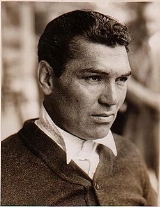
William Harrison "Jack" Dempsey was a boxer who held the world heavyweight title between 1919 and 1926, is widely regarded as the greatest heavyweight champion of all time. Twenty-six of his opponents were knocked out in round one.
Biography
Early career
Born in
Manassa, Colorado, Dempsey would go into saloons and challenge for fights saying "I can't sing and I can't dance, but I can lick any man in the house." His exact fight record is not known because sometimes he boxed under the pseudonym, "Kid Blackie". This practice continued until 1916. In between, he first appeared as "Jack Dempsey" in 1914, after an earlier middleweight boxer Jack Dempsey, drawing with Young Herman in six rounds. After that fight, he won six bouts in a row by
knockout , before losing for the first time, on a disqualification in four to Jack Downes.
During this early part of his career, Dempsey campaigned in
Utah frequently. He followed his loss against Downes with a knockout win and two draws versus Johnny Summerland in
Nevada. Three more wins and a draw followed and then he met Downes again, this time resulting in a four round draw. Dempsey was a devastating puncher with either hand. He also had graceful agility and lightning speed, allowing him to bob and weave with swift movements, giving him great skill in evading his opponent's punches.
Ten wins in a row followed, a streak during which he beat Summerland and was finally able to avenge his defeat at the hands of Downes, knocking him out in two. Then, three more non-decisions came .
When the United States entered
World War I in 1917, Dempsey worked in a shipyard while continuing to box. After the war, he was accused by some boxing fans of being a draft dodger. It was not until 1920 that he was able to clear his name on that account, when evidence was produced showing he had attempted to enlist in the
U.S. Army, but had been turned down.
Taking the title
Meanwhile, Dempsey went 9–1–4 in 14 bouts in 1917. Among his opponents were Fireman Jim Flynn, the only boxer ever to beat Dempsey by a knockout when Dempsey lost to him in the first round, and Gunboat Smith, formerly a highly ranked contender who had beaten both World Champion Jess Willard and Hall of Famer Sam Langford. Dempsey beat Smith for the third time on a second round KO.
In 1918, Dempsey boxed 17 times, going 15–1 with one no decision. He avenged his defeat against Flynn by returning the favor, knocking him out in the first round. Among others he beat were lightweight championBattling Levinsky, who had never been knocked out before Dempsey did so.
He began 1919 winning five bouts in a row by knockout in the first round. Then on July 4, he and world heavyweight champion Jess Willard met at Toledo, Ohio, for the world title. Few gave Dempsey a chance against the larger champion and many called this fight a modern David and Goliath. However, Dempsey was fearless and vowed victory. The first round of the fight was one of the most brutal in boxing history. Dempsey dealt Willard a terrible beating and knocked him down seven times in that round alone. Willard had a broken cheekbone, broken jaw, several teeth knocked out, and broken ribs. At the end of the third round the champion was forced to give up.
Champion
In his first defense, he faced friend
Billy Miske, knocking him out in three rounds. Years after the fight, it was learned Miske accepted the fight while suffering a terminal disease and needed the money to secure his family after his death, which occurred two years after challenging Dempsey.
One more defense followed, versus Bill Brennan, before he had to face world light heavyweight champion
Georges Carpentier in what became boxing's first million dollar gate ever. Carpentier, a decorated veteran of the
French Army had served in World War I. Ironically, Dempsey's promoter used this angle to promote the fight, since many Americans still regarded Dempsey as a slacker during the war. Held at a farm that had to be rented to accommodate all the public in
New Jersey, Dempsey beat Carpentier by a knockout in four rounds in front of 80,183 fans.
Dempsey was one of the top five sports stars in the United States in
1920s, along with
baseball's
Babe Ruth,
tennis'
Bill Tilden,
American football's
Red Grange and
golf's Bobby Jones. They were known in America as "the big five of sports".
In 1923, he had two fights: one against Tommy Gibbons in the small town of
Shelby, Montana, a fight which was a financial disaster. Dempsey retained the title by a decision, but the town went bankrupt after the fight. In his second match that year, he met
Argentina's
Luis Firpo in a historic fight at the
Polo Grounds in
New York City. Firpo became the first
Hispanic to challenge for the world heavyweight title, and in
the combat Dempsey had him down five times in round one, but Firpo half pushed, half punched Dempsey through the ropes and out of the ring before the end of the round. Dempsey landed on a reporter's typewriter, but he got back in the ring and then knocked Firpo out for a count of ten in the second round.
Dempsey signed a contract to fight Black contender Harry Wills in 1924, but the fight never occurred. Promoter
Tex Rickard was against the match, remembering the riots that occurred after Rickard promoted the
James J. Jeffries versus Jack Johnson bout and fearing a racial repercussion after a bout between Dempsey and a black opponent.
In 1925, he married
Hollywood actress Estelle Taylor and started appearing in films and doing more exhibition bouts. He did not defend his title again until 1926. Among those exhibitions, there was a trip to
Germany where he and future world champion Max Schmeling boxed a two-round exhibition.
Loss of title
In 1926, Dempsey fought former
US Marine Gene Tunney in
Philadelphia, losing his title on points in ten rounds in front of a record crowd announced at 120,557.
Dempsey was not ready to retire, and in July 1927, he knocked out future heavyweight champion Jack Sharkey in the seventh round of an elimination bout for a title shot against Tunney. Sharkey was out for several minutes.
The Tunney rematch took place in
Chicago, Illinois on September 22, 364 days after losing his title to Tunney in their first bout.
Dempsey was losing the fight on points when he knocked Tunney down with a left hook to the chin in the seventh round. A new rule for boxing at the time mandated that when a fighter knocks down an opponent, he must immediately go to a neutral corner, but Dempsey seemed to have forgotten that rule and refused to immediately move to the neutral corner when instructed by the referee. The referee had to escort Dempsey to the neutral corner, which bought Tunney at least an extra five seconds to recover.
The official timekeeper for the fight counted the time Tunney stayed down as 17 seconds. But, after Dempsey finally went to a neutral corner, the referee started his count, and Tunney got up at the referee's count of nine. Dempsey tried to finish Tunney off before the round ended, but failed to do so. A fully recovered Tunney dropped Dempsey for a count of one in round eight, easily won the final two rounds of the fight, and retained the title on a unanimous decision. Ironically the new rule was requested during negotiations by members of the Dempsey camp . Because of the controversial nature of the fight, it remains known in history as the fight of "The Long Count".
Retirement
He retired after this bout and made countless exhibition bouts. He opened a restaurant on Broadway in
New York City, which he kept open well into the
1960s. He divorced Taylor and in July of 1933 married
Broadway singer Hannah Williams and had two children with her.
When the United States entered
World War II, Dempsey had an opportunity to refute any remaining criticism of his war record of two decades earlier. He volunteered for national service and was commissioned as a commander in the
U.S. Coast Guard, charged with developing a physical fitness program for U.S. soldiers. Later, he served as a morale officer in the Pacific and in 1945 became a hero to many when, at age 49, he insisted on going into battle on
Okinawa with a group of men he had trained.
Dempsey wrote a book on boxing,
Championship Fighting: Explosive Punching and Aggressive Defence, which was published in 1950. Although the book has been out of print for the past 56 years, many boxers-- professional and amateur alike-- have continued to praise it as "the finest treatise on boxing ever written ." The book was also seen as a turning point in boxing, as it was the first serious study of the sweet science. Dempsey, thanks to this book, has been proclaimed by some to be the world's first modern boxer.
Legend says that one time, an elder Dempsey was mugged by a couple of teen thieves, whom he knocked out and held until the police arrived. He made friends with Wills and Tunney after retirement, and had many books written about his life. Dempsey even campaigned for Tunney's son John when he ran for the
U.S. Senate,from California. One of Dempsey's best friends was Judge
John Sirica who presided over the
Watergate trials.
He is a member of the International Boxing Hall Of Fame.
Jack Dempsey is buried in the Southampton Cemetery, Southampton, New York.
The street where Madison Square Garden is called Jack Dempsey corner.
Record
- Professional boxing: 83 Fights 62 Wins 50 KOs 6 Losses 9 Draws 6 No contests
Notes
External links