


Pori

Encyclopedia
Pori is a city and municipality on the west coast of Finland. The city is located some 15 kilometres (9 mi) from the Gulf of Bothnia
, on the estuary of the Kokemäenjoki
river, which is the largest in Finland. Pori is the most important town in the Satakunta
region
.
The municipality has a population of and covers an area of km2 of which km2 is water. The population density
is PD/km2. The municipality is unilingually Finnish. Pori is the largest city in Finland, and the 7th largest urban area.
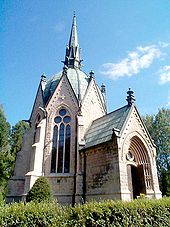
The Neo-Gothic Juselius Mausoleum, located in the Käppärä cemetery in central Pori, was built in 1903 by the wealthy industrialist F.A. Juselius for his daughter Sigrid, who died when she was only 11 years old. The mausoleum was designed by the architect Josef Stenbäck
. The mausoleum originally had frescoes painted by artist Akseli Gallen-Kallela
, but these decayed after a short time. The frescoes were restored by Akseli's son Jorma Gallen-Kallela
using his father's sketches.
Pori is known, among other things, for the sandy beaches of Yyteri
and for hosting Pori Jazz
, an annual international jazz
festival. Performers at the jazz fesival have included Miles Davis
, The Brand New Heavies and Steely Dan
The local newspaper in Pori is the Satakunnan Kansa paper, giving an overview of the recent news. There are also sports and children's articles included.
name Arctopolis means "bear city".
had become more and more difficult after the 14th century. The importance of Kokemäki and Ulvila began to decline when ships could no longer navigate the river. In the 16th century, the situation had become so bad that John III
decided to establish a new harbour and market town closer to the sea. The concept and location and were good, but the inhabitants were missing.
The Bourgeois of Rauma
and Ulvila
had been ordered to move to Helsinki
, which had recently been founded, however they did not enjoy living in Helsinki, and after numerous pleas the citizens of Rauma were given permission to return to their previous homes. However, those from Ulvila were ordered to migrate to the newly founded city of Pori. On 8 March 1558 John III
gave the charter of Pori, which read: "Because we have seen that it would be best to build a strong market town alongside the sea, and because we cannot find anywhere suitable for fortifying in Ulvila, we have chosen another location at Pori."
At the time Pori had around 300 involuntary residents. However, they soon recognised the advantages of their new location, which offered opportunities for profitable trading, amongst other things.
The neighboring municipality of Noormarkku
was annexed with Pori on 1 January 2010.
. In 2008, the party gained 29.8% of the votes, while the second largest party, National Coalition Party, got 26.1%. The mayor of Pori is Aino-Maija Luukkonen
, who was elected to run the city in 2004 after the former mayor, Martti Sinisalmi, retired from the post.
team that play in highest Finnish level, SM-liiga
. They have won the championship twice (1971 and 1978).
Porin Narukerä, or just Narukerä, play in the highest bandy
division and have become Finnish champions once.
in the Satakunta region.
in 2010 the population rose to the current 83,000.
Source
with: Bremerhaven
, Germany, since 1967 Eger
, Hungary, since 1973 Kołobrzeg, Poland, since 1975 Mâcon
, France, since 1990 Porsgrunn
, Norway, since 1956 Riga
, Latvia, since 1965 Stralsund
, Germany, since 1968 Sundsvall
, Sweden, since 1940 Sønderborg
, Denmark, since 1952
1499 Pori
was named after the city by its discoverer, the Finnish astronomer
Yrjö Väisälä
.
. The medium-wave transmitter uses a 185 m (607 ft) guyed mast as an aerial.
Gulf of Bothnia
The Gulf of Bothnia is the northernmost arm of the Baltic Sea. It is situated between Finland's west coast and Sweden's east coast. In the south of the gulf lie the Åland Islands, between the Sea of Åland and the Archipelago Sea.-Name:...
, on the estuary of the Kokemäenjoki
Kokemäenjoki
The Kokemäenjoki is a river and its drainage basin in southwestern Finland.-Geography:The river originates at Lake Liekovesi in the Pirkanmaa region, and flows to the Gulf of Bothnia at Pori in the Satakunta region...
river, which is the largest in Finland. Pori is the most important town in the Satakunta
Satakunta (region)
Satakunta is a region of Finland, part of the former Western Finland Province. It borders the regions of Finland Proper, Pirkanmaa, Southern Ostrobothnia and Ostrobothnia. The main city of the region is Pori. The name of the region literally means Hundred...
region
Regions of Finland
Finland consists of 19 regions called in Finnish and in Swedish. The regions are governed by regional councils, which serve as forums of cooperation for the municipalities of a region. The main tasks of the regions are regional planning and development of enterprise and education. In addition,...
.
The municipality has a population of and covers an area of km2 of which km2 is water. The population density
Population density
Population density is a measurement of population per unit area or unit volume. It is frequently applied to living organisms, and particularly to humans...
is PD/km2. The municipality is unilingually Finnish. Pori is the largest city in Finland, and the 7th largest urban area.
The Neo-Gothic Juselius Mausoleum, located in the Käppärä cemetery in central Pori, was built in 1903 by the wealthy industrialist F.A. Juselius for his daughter Sigrid, who died when she was only 11 years old. The mausoleum was designed by the architect Josef Stenbäck
Josef Stenbäck
Josef Daniel Stenbäck was a Finnish church architect and engineer who worked in the Imperial Russia and independent Finland. He designed 35 churches for Finland and Finnish Karelia ceded to Soviet Union in 1944...
. The mausoleum originally had frescoes painted by artist Akseli Gallen-Kallela
Akseli Gallen-Kallela
Akseli Gallen-Kallela was a Finnish painter who is best known for his illustrations of the Kalevala, the Finnish national epic . His work was considered very important for the Finnish national identity...
, but these decayed after a short time. The frescoes were restored by Akseli's son Jorma Gallen-Kallela
Jorma Gallen-Kallela
Jorma Gallen-Kallela was a Finnish artist. He followed in the footsteps of his father, the famed artist Akseli Gallen-Kallela....
using his father's sketches.
Pori is known, among other things, for the sandy beaches of Yyteri
Yyteri
Yyteri is a district in the city of Pori, Finland.Yyteri is located about 17 km away from the centre of Pori, bordering the Baltic sea. Yyteri is not an urban district, instead it is mostly like a holiday resort...
and for hosting Pori Jazz
Pori Jazz
Pori Jazz is a large international jazz festival, held annually in the coastal city of Pori , Finland. It is one of the oldest and best known jazz festivals in Europe, having been arranged every year since 1966...
, an annual international jazz
Jazz
Jazz is a musical style that originated at the beginning of the 20th century in African American communities in the Southern United States. It was born out of a mix of African and European music traditions. From its early development until the present, jazz has incorporated music from 19th and 20th...
festival. Performers at the jazz fesival have included Miles Davis
Miles Davis
Miles Dewey Davis III was an American jazz musician, trumpeter, bandleader, and composer. Widely considered one of the most influential musicians of the 20th century, Miles Davis was, with his musical groups, at the forefront of several major developments in jazz music, including bebop, cool jazz,...
, The Brand New Heavies and Steely Dan
Steely Dan
Steely Dan is an American rock band; its core members are Donald Fagen and Walter Becker. The band's popularity peaked in the late 1970s, with the release of seven albums blending elements of jazz, rock, funk, R&B, and pop...
The local newspaper in Pori is the Satakunnan Kansa paper, giving an overview of the recent news. There are also sports and children's articles included.
Name
The name Pori comes from the borg part (meaning "castle") of the original name in Swedish with a Fennicised pronunciation. The Swedish name Björneborg means "bear castle", and the LatinLatin
Latin is an Italic language originally spoken in Latium and Ancient Rome. It, along with most European languages, is a descendant of the ancient Proto-Indo-European language. Although it is considered a dead language, a number of scholars and members of the Christian clergy speak it fluently, and...
name Arctopolis means "bear city".
History
The river had a key role in the creation of Pori. Sailing in the Kokemäki riverKokemäenjoki
The Kokemäenjoki is a river and its drainage basin in southwestern Finland.-Geography:The river originates at Lake Liekovesi in the Pirkanmaa region, and flows to the Gulf of Bothnia at Pori in the Satakunta region...
had become more and more difficult after the 14th century. The importance of Kokemäki and Ulvila began to decline when ships could no longer navigate the river. In the 16th century, the situation had become so bad that John III
John III of Sweden
-Family:John married his first wife, Catherine Jagellonica of Poland , house of Jagiello, in Vilnius on 4 October 1562. In Sweden, she is known as Katarina Jagellonica. She was the sister of king Sigismund II Augustus of Poland...
decided to establish a new harbour and market town closer to the sea. The concept and location and were good, but the inhabitants were missing.
The Bourgeois of Rauma
Rauma, Finland
Rauma is a town and municipality of ca. inhabitants on the west coast of Finland, north of Turku, and south of Pori. Granted town privileges on May 17, 1442 , Rauma is known of its high quality lace , and of the old wooden architecture of its centre , which is a Unesco world heritage...
and Ulvila
Ulvila
Ulvila is a town and municipality of Finland. It is one of the six medieval cities of Finland. Its position as city was taken over by Pori in the 16th century....
had been ordered to move to Helsinki
Helsinki
Helsinki is the capital and largest city in Finland. It is in the region of Uusimaa, located in southern Finland, on the shore of the Gulf of Finland, an arm of the Baltic Sea. The population of the city of Helsinki is , making it by far the most populous municipality in Finland. Helsinki is...
, which had recently been founded, however they did not enjoy living in Helsinki, and after numerous pleas the citizens of Rauma were given permission to return to their previous homes. However, those from Ulvila were ordered to migrate to the newly founded city of Pori. On 8 March 1558 John III
John III of Sweden
-Family:John married his first wife, Catherine Jagellonica of Poland , house of Jagiello, in Vilnius on 4 October 1562. In Sweden, she is known as Katarina Jagellonica. She was the sister of king Sigismund II Augustus of Poland...
gave the charter of Pori, which read: "Because we have seen that it would be best to build a strong market town alongside the sea, and because we cannot find anywhere suitable for fortifying in Ulvila, we have chosen another location at Pori."
At the time Pori had around 300 involuntary residents. However, they soon recognised the advantages of their new location, which offered opportunities for profitable trading, amongst other things.
The neighboring municipality of Noormarkku
Noormarkku
Noormarkku is a former municipality of Finland.It is located in the province of Western Finland and was part of the Satakunta region. The municipality had a population of 6,158 and covered an area of of which is water. The population density was .Noormarkku is the birthplace of the Ahlstrom...
was annexed with Pori on 1 January 2010.
Climate
Politics
Pori gives relatively strong support to the Social Democratic PartySocial Democratic Party of Finland
The Social Democratic Party of Finland is one of the three major political parties in Finland, along with the Centre Party and the National Coalition Party. Jutta Urpilainen is the current SDP leader. The party has been in the Finnish government cabinet for long periods and has set many...
. In 2008, the party gained 29.8% of the votes, while the second largest party, National Coalition Party, got 26.1%. The mayor of Pori is Aino-Maija Luukkonen
Aino-Maija Luukkonen
Aino-Maija Luukkonen is the mayor of the Finnish city Pori.She is a member of the Social Democratic Party of Finland .- External links :*...
, who was elected to run the city in 2004 after the former mayor, Martti Sinisalmi, retired from the post.
Sports
Porin Ässät are the ice hockeyIce hockey
Ice hockey, often referred to as hockey, is a team sport played on ice, in which skaters use wooden or composite sticks to shoot a hard rubber puck into their opponent's net. The game is played between two teams of six players each. Five members of each team skate up and down the ice trying to take...
team that play in highest Finnish level, SM-liiga
SM-liiga
The SM-liiga is the top professional ice hockey league in Finland. As of March 2008, it is ranked by the IIHF as the second strongest league in Europe. It was created in 1975 to replace the SM-sarja, which was fundamentally an amateur league. The SM-liiga is not directly overseen by the Finnish Ice...
. They have won the championship twice (1971 and 1978).
Porin Narukerä, or just Narukerä, play in the highest bandy
Bandy
Bandy is a team winter sport played on ice, in which skaters use sticks to direct a ball into the opposing team's goal.The rules of the game have many similarities to those of association football: the game is played on a rectangle of ice the same size as a football field. Each team has 11 players,...
division and have become Finnish champions once.
Demographics
More than of the population has Finnish as their first language, and about has either Arabic, French, German, Russian or Swedish as their first language. There is a small minority of about of Swedish speakers in the city. There is a Swedish School and a Swedish Culture Club that are aimed at serving the Finland-Swedish minorityFinland-Swedes
Swedish-speaking Finns constitute a linguistic minority in Finland. They maintain a strong identity and are alternatively seen either as a distinct subgroup of the Finnish people or as a separate ethnic group or even as a distinct nationality...
in the Satakunta region.
Population development
The population peaked in the mid-1970s, when it was over 80 000. After that the population declined, and in recent years has remained steady at just over 76 000. The significant population increase in 1950 was the result of annexing nearby areas. After the annex of the neighbouring municipality NoormarkkuNoormarkku
Noormarkku is a former municipality of Finland.It is located in the province of Western Finland and was part of the Satakunta region. The municipality had a population of 6,158 and covered an area of of which is water. The population density was .Noormarkku is the birthplace of the Ahlstrom...
in 2010 the population rose to the current 83,000.
|
|
|
|
People
- Eija Kantola – Finnish singer born 1966
- Veli-Pekka KetolaVeli-Pekka KetolaVeli-Pekka Ketola . He is a retired professional ice hockey player and coach.-Playing career:Veli-Pekka Ketola played in the Finnish League, World Hockey Association, and National Hockey League...
– Finnish ice hockey player born 1948 - Antti Sumiala – Finnish footballer born 1974
- Timo KoivusaloTimo KoivusaloTimo Johannes Koivusalo is a Finnish actor, director, writer, columnist, composer and musician. His most successful film to date was Työnnän syvälle kammioon, which debuted in the movie theaters in 2001....
– Finnish actor and film director born 1963 - Olli Lindholm – Finnish singer of the band YöYöYö is a Finnish rock band, established in 1981. The only member of the band from the original lineup that is still with the band is Olli Lindholm...
. Born 1964 - Visa MäkinenVisa MäkinenVisa Mäkinen is a Finnish film director, film producer, actor and screen writer.He has directed and produced films such as the 1983 James Bond spoof Agentti 000 ja kuoleman kurvit which featured actors Ilmari Saarelainen and Tenho Sauren.He has also acted and written for several films.-Feature...
– Finnish film director born 1945 - Pertti Neumann – Finnish singer of the band DingoDingo (band)Dingo is a Finnish rock band formed around 1982 which fused Finnish melancholy with catchy rock melodies, headed by singer Pertti Neumann...
in the 80's. Born 1959 - Kai NiemiKai NiemiKai Juhani Niemi is former international motorcycle speedway rider who represented Finland in the World Team Cup...
– Motorcycle speedwayMotorcycle speedwayMotorcycle speedway, usually referred to as speedway, is a motorcycle sport involving four and sometimes up to six riders competing over four anti-clockwise laps of an oval circuit. Speedway motorcycles use only one gear and have no brakes and racing takes place on a flat oval track usually...
rider born 1955 - Selim PalmgrenSelim PalmgrenSelim Gustaf Adolf Palmgren , dubbed "The Finnish Chopin", was a Finnish composer, pianist, and conductor. Palmgren was born in Pori, Finland, February 16, 1878. He studied at the Conservatory in Helsinki from 1895 to 1899, then continued his piano studies in Berlin with Ansorge, Berger and Busoni...
– Finnish composer born 1878 - Jukka Rintala – Finnish designer born 1952
- Jukka Syrenius – Finnish blues musician born 1951
- Leo-Pekka TähtiLeo-Pekka TähtiLeo-Pekka Tähti is an athlete and Paralympian from Finland competing mainly in category T54 sprint events.He won the gold medal in the 100m and 200m events at the 2004 Summer Paralympics in Athens, Greece...
– Finnish paraathletic with two olympic golds. Born 1983 - Kielo TommilaKielo TommilaKielo Tommila is a Finnish actress and stage actress.She began acting in film in 1982 making several appearances such as in the 1983 James Bond spoof Agentti 000 ja kuoleman kurvit opposite actors Ilmari Saarelainen and Tenho Sauren and in the 2001 Timo Koivusalo film Rentun ruusu more...
– Finnish actress born 1950 - Jorma UotinenJorma UotinenJorma Leo Kalevi Uotinen is a Finnish dancer, singer and choreographer. As a dancer and choreographer, Uotinen has worked both in many dance groups, both in and outside of Finland, since 1970...
– Finnish dancer born 1950 - Mikko Salo – Winner of the Men's division of the 2009 CrossFit Games
- Jussi RynnäsJussi RynnäsJussi Rynnäs is an ice hockey goalie who is in the Toronto Maple Leafs system. In 2009, he played for Ässät of the SM-liigaHe had the top save percentage during the 2009-10 season while playing for Ässat in Finland...
- ice hockey goaltender for the Toronto Maple LeafsToronto Maple LeafsThe Toronto Maple Leafs are a professional ice hockey team based in Toronto, Ontario, Canada. They are members of the Northeast Division of the Eastern Conference of the National Hockey League...
, and formerly Ässät Pori - Joel ArmiaJoel ArmiaJoel Armia is a Finnish ice hockey player currently with the Porin Ässät of the SM-Liiga Finland. He was selected 16th overall in the 2011 NHL Entry Draft by the Buffalo Sabres.- Career statistics :- External links :* *...
- ice hockey winger drafted by the Buffalo SabresBuffalo SabresThe Buffalo Sabres are a professional ice hockey team based in Buffalo, New York. They are members of the Northeast Division of the Eastern Conference of the National Hockey League .-Founding and early success: 1970-71—1980-81:...
but currently still playing for Ässät Pori born 1993
Twin towns – Sister cities
Pori is twinnedTown twinning
Twin towns and sister cities are two of many terms used to describe the cooperative agreements between towns, cities, and even counties in geographically and politically distinct areas to promote cultural and commercial ties.- Terminology :...
with: Bremerhaven
Bremerhaven
Bremerhaven is a city at the seaport of the free city-state of Bremen, a state of the Federal Republic of Germany. It forms an enclave in the state of Lower Saxony and is located at the mouth of the River Weser on its eastern bank, opposite the town of Nordenham...
, Germany, since 1967 Eger
Eger
Eger is the second largest city in Northern Hungary, the county seat of Heves, east of the Mátra Mountains. Eger is best known for its castle, thermal baths, historic buildings , and red and white wines.- Name :...
, Hungary, since 1973 Kołobrzeg, Poland, since 1975 Mâcon
Mâcon
Mâcon is a small city in central France. It is prefecture of the Saône-et-Loire department, in the region of Bourgogne, and the capital of the Mâconnais district. Mâcon is home to over 35,000 residents, called Mâconnais.-Geography:...
, France, since 1990 Porsgrunn
Porsgrunn
is a town and municipality in Telemark county, Norway. It is part of the traditional region of Grenland. The administrative centre of the municipality is the town of Porsgrunn....
, Norway, since 1956 Riga
Riga
Riga is the capital and largest city of Latvia. With 702,891 inhabitants Riga is the largest city of the Baltic states, one of the largest cities in Northern Europe and home to more than one third of Latvia's population. The city is an important seaport and a major industrial, commercial,...
, Latvia, since 1965 Stralsund
Stralsund
- Main sights :* The Brick Gothic historic centre is a UNESCO World Heritage Site.* The heart of the old town is the Old Market Square , with the Gothic Town Hall . Behind the town hall stands the imposing Nikolaikirche , built in 1270-1360...
, Germany, since 1968 Sundsvall
Sundsvall
-External links:* - Official site from Nordisk Familjebok - Sundsvalls tourist information bureau. - The alternative guide to Sundsvall. - Blog with photos from Sundsvall....
, Sweden, since 1940 Sønderborg
Sønderborg
Sønderborg Municipality , is a municipality in Region of Southern Denmark partially on the Jutland peninsula and partially on the island of Als in south Denmark, at the border with Germany. The municipality covers an area of , and has a total population of 76,236...
, Denmark, since 1952
Trivia
The asteroidAsteroid
Asteroids are a class of small Solar System bodies in orbit around the Sun. They have also been called planetoids, especially the larger ones...
1499 Pori
1499 Pori
1499 Pori is a main-belt asteroid discovered on October 16, 1938 by Y. Väisälä at Turku, and is named after the city of Pori, Finland.- External links :*...
was named after the city by its discoverer, the Finnish astronomer
Astronomer
An astronomer is a scientist who studies celestial bodies such as planets, stars and galaxies.Historically, astronomy was more concerned with the classification and description of phenomena in the sky, while astrophysics attempted to explain these phenomena and the differences between them using...
Yrjö Väisälä
Yrjö Väisälä
Yrjö Väisälä was a Finnish astronomer and physicist.His main contributions were in the field of optics, but he was also very active in geodetics, astronomy and optical metrology...
.
Transmitter facility
There is a broadcasting facility near Pori for medium-wave and short-wave broadcasting managed by DigitaDigita
Digita is a genus of moths of the Micronoctuidae family.-Species:*Digita biuncus Fibiger, 2008*Digita ampullai Fibiger, 2008-References: 2008: Revision of the Micronoctuidae . Part 2, Taxonomy of the Belluliinae, Magninae and Parachrostiinae. 1867: 1-136....
. The medium-wave transmitter uses a 185 m (607 ft) guyed mast as an aerial.
External links
- City of Pori – Official website