

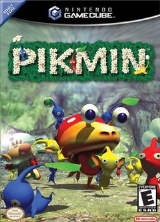
Pikmin

Encyclopedia
is a strategy video game developed and published by Nintendo
for the Nintendo GameCube
video game console
in 2001. Pikmin is the first game in the Pikmin series of video games, and the third game for the Gamecube overall. It was designed by Shigeru Miyamoto
. Pikmin was released on October 26, 2001 in Japan, December 2, 2001 in North America, and June 14, 2002 in Europe. The sequel, Pikmin 2
, was released in 2004. The image song
, "Ai No Uta" by Strawberry Flower
, appeared in the Japanese commercials for the game, but soon became an unexpected hit song, eventually eclipsing Pikmins sales. As of March 31, 2002, Pikmin has sold over one million copies.
Pikmin is a 3D
, top-down, strategy
game, with the player controlling from a third-person
viewpoint. Olimar is followed by the Pikmin, whom he directs.
In 2009, the original Pikmin was re-released for the Wii
as part of the New Play Control!
series. Pikmin 2
was also re-released for Wii in Japan, Europe, and Australia, but it was never released in North America.
Time in the game is divided into 30 days. With the exception of the first day, which lasts until the player finds the first ship part, all days in the game are about 13 minutes in length. By the end of each day, all Pikmin should be immediately rounded up, work halted, and Olimar must return with the Pikmin to the ship. The reason for this is that many of the creatures which inhabit the Pikmin's planet are nocturnal predators and eat all Pikmin that are left behind on the surface after the sun sets. If Olimar doesn't collect all 25 mandatory ship parts within this 30 day time limit, his ship's life support systems will fail and Olimar will die from oxygen poisoning. If he does find the parts, then he blasts off into space successfully and returns home.
Apart from the main gameplay, Pikmin also contains a Challenge mode that is unlocked once Olimar gets all three types of Pikmin. Each of the five levels in the main game is available for play. The object of Challenge mode is to grow the greatest number of Pikmin in one day as is possible.
. However, during his flight, a comet
hits his spaceship
, the S.S. Dolphin (a reference to the Nintendo GameCube
's codename, "Project Dolphin"), which is then pulled into the gravity field of an uncharted planet. Parts of the spaceship fall off as it plummets to the ground and crashes.
When he regains consciousness, Olimar finds out that the planet's atmosphere contains high levels of oxygen
- an element deadly to his people- and he can stay on the planet for only 30 days before his life support system stops functioning. Olimar must retrieve many of the spaceship parts so he can rebuild his spaceship and return to Hocotate. Although Olimar initially states in his journal entries that he needs all 30 parts, as the game moves on it is hinted at that some parts might not be actually necessary to lift off, and, indeed, one can win the game without said parts.
To help Olimar are indigenous creatures called Pikmin, which are nearly extinct and unable to survive in the environment without his leadership when he arrives. As this element of symbiosis
develops, Olimar discovers parts of his ship and travels across the Pikmin Planet, which is assumed to be Earth
, albeit with unknown fauna, although, the game is speculated to be taking place in a post-apocalyptic Earth where humans have died out, due to the unknown species, and debris that which humans would use. The game has three endings depending upon how successful the player is.
was widely considered an improvement on the original. Pikmin 2 came out in 2004 and features the same basic idea with some new multiplayer modes, three new Pikmin colors (white, purple and Bulbmin), caves, more beasts and Bosses, and an unlimited amount of days allowed in single-player mode. When asked about Pikmin appearing on the Wii at E3 2008, Shigeru Miyamoto simply replied, "We're making Pikmin." There were originally suspicions that he may have been referring to the re-releases of the two games, but it was confirmed in an interview that he was talking about a completely new game. At his developer roundtable at E3 2011
, Miyamoto revealed that development for the new Pikmin game was moved over to the newly announced Wii U.
Both Pikmin and Pikmin 2, are part of the New Play Control!
series, a selection of Nintendo GameCube
video game remakes adding support for features of the Wii
. It was released on December 25, 2008 in Japan, February 6, 2009 in Europe and March 9, 2009 in North America (original version only). New Play Control! Pikmin uses the Wii Remote
, and requires the player to point and click on the screen to do various tasks instead of manually moving a cursor with a control stick. It was also announced that the game saves day-by-day records of the player's playthrough, allowing the player to restart from any recorded day of his or her choice. In an interview, director Shigefumi Hino stated that besides adding motion controls, they wanted to include the ability to go back to saves they have made in the past, allowing players to replay all 30 days one by one in order to improve.
praised it for its uniqueness and its stunning graphics, with only a few negative points such as a poor camera. It was awarded the title of "Best Puzzle/Trivia/Parlor Game" from Game Critics Award, beating out ChuChu Rocket!
for the Game Boy Advance
. It was also runner-up for "Most Original Game", losing out to Majestic.
Since its release for the Nintendo GameCube
, Pikmin has received positive reception. It holds an average score of 89/100 and 86.37% from Metacritic
and Game Rankings
respectively. It was given the award for interactivity from the British Academy of Film and Television Arts
.
Pikmin has received significant praise for its graphics, in particular the design of the surrounding environment. Gaming Age editor Craig Majaski described Pikmin as both stunning and having a detailed environment.
The Wii re-release of Pikmin was not as well-received as the GameCube version, though it still had mostly positive reception; it holds an average score of 77/100 and 79.73% from Metacritic and Game Rankings respectively.
version of Pikmin has sold 169,036 copies in Japan. Since its release, Pikmin has developed a vocal and devoted fanbase.
Nintendo
is a multinational corporation located in Kyoto, Japan. Founded on September 23, 1889 by Fusajiro Yamauchi, it produced handmade hanafuda cards. By 1963, the company had tried several small niche businesses, such as a cab company and a love hotel....
for the Nintendo GameCube
Nintendo GameCube
The , officially abbreviated to NGC in Japan and GCN in other regions, is a sixth generation video game console released by Nintendo on September 15, 2001 in Japan, November 18, 2001 in North America, May 3, 2002 in Europe, and May 17, 2002 in Australia...
video game console
Video game console
A video game console is an interactive entertainment computer or customized computer system that produces a video display signal which can be used with a display device to display a video game...
in 2001. Pikmin is the first game in the Pikmin series of video games, and the third game for the Gamecube overall. It was designed by Shigeru Miyamoto
Shigeru Miyamoto
is a Japanese video game designer and producer. Miyamoto was born and raised in Kyoto Prefecture; the natural surroundings of Kyoto inspired much of Miyamoto's later work....
. Pikmin was released on October 26, 2001 in Japan, December 2, 2001 in North America, and June 14, 2002 in Europe. The sequel, Pikmin 2
Pikmin 2
is a real-time strategy video game developed by Nintendo for the Nintendo GameCube. It was released in Japan on April 29, 2004, in North America on August 30, 2004, in Europe on October 8, 2004, and in Australia on November 4, 2004....
, was released in 2004. The image song
Image song
An image song or character song is a song on a tie-in single or album for an anime, game or dorama that is usually sung by the seiyū or actor of a character, in character...
, "Ai No Uta" by Strawberry Flower
Strawberry Flower
is a Japanese virtual band. In the first years, it was a trio of three Pikmin, the red, yellow and blue Pikmin, and debuted on December 6, 2001 with the single, Ai No Uta. The purple or white Pikmin did not join the group until their 3rd single, Tane No Uta. Since then, the group has been a pentadrio...
, appeared in the Japanese commercials for the game, but soon became an unexpected hit song, eventually eclipsing Pikmins sales. As of March 31, 2002, Pikmin has sold over one million copies.
Pikmin is a 3D
3D computer graphics
3D computer graphics are graphics that use a three-dimensional representation of geometric data that is stored in the computer for the purposes of performing calculations and rendering 2D images...
, top-down, strategy
Strategy
Strategy, a word of military origin, refers to a plan of action designed to achieve a particular goal. In military usage strategy is distinct from tactics, which are concerned with the conduct of an engagement, while strategy is concerned with how different engagements are linked...
game, with the player controlling from a third-person
Third-person shooter
Third-person shooter is a genre of 3D action games in which the player character is visible on-screen, and the gameplay consists primarily of shooting.-Definition:...
viewpoint. Olimar is followed by the Pikmin, whom he directs.
In 2009, the original Pikmin was re-released for the Wii
Wii
The Wii is a home video game console released by Nintendo on November 19, 2006. As a seventh-generation console, the Wii primarily competes with Microsoft's Xbox 360 and Sony's PlayStation 3. Nintendo states that its console targets a broader demographic than that of the two others...
as part of the New Play Control!
New Play Control!
The New Play Control! series, known in Japan as is a program by Nintendo to upgrade several GameCube games for release on the Wii. These re-releases incorporate graphical improvements, which include 16:9 widescreen support. They also feature reconfigured controls to fit the Wii Remote...
series. Pikmin 2
Pikmin 2
is a real-time strategy video game developed by Nintendo for the Nintendo GameCube. It was released in Japan on April 29, 2004, in North America on August 30, 2004, in Europe on October 8, 2004, and in Australia on November 4, 2004....
was also re-released for Wii in Japan, Europe, and Australia, but it was never released in North America.
Gameplay
The basis of gameplay in Pikmin is to retrieve ship parts by using the three varieties of Pikmin available in different combinations. Olimar discovers multi-coloured plant-animal hybrids that willingly follow his orders and help him recover ship parts. All three of the Pikmin colors that Captain Olimar discovers must be used in order to overcome various obstacles and complete the game. The Pikmin creatures come in three different varieties - red, yellow, and blue. Red Pikmin are the basic type, though more powerful than the other two varieties and resistant to fire. Yellow Pikmin can be thrown higher than the other two and can carry explosives called "bombs rocks", while blue Pikmin are the only ones that can survive in water. They are utilized in various tasks, including carrying objects and enemies, breaking down walls, and defeating enemies. Objects that can be carried vary between ship parts, enemy corpses, and pellets.Time in the game is divided into 30 days. With the exception of the first day, which lasts until the player finds the first ship part, all days in the game are about 13 minutes in length. By the end of each day, all Pikmin should be immediately rounded up, work halted, and Olimar must return with the Pikmin to the ship. The reason for this is that many of the creatures which inhabit the Pikmin's planet are nocturnal predators and eat all Pikmin that are left behind on the surface after the sun sets. If Olimar doesn't collect all 25 mandatory ship parts within this 30 day time limit, his ship's life support systems will fail and Olimar will die from oxygen poisoning. If he does find the parts, then he blasts off into space successfully and returns home.
Apart from the main gameplay, Pikmin also contains a Challenge mode that is unlocked once Olimar gets all three types of Pikmin. Each of the five levels in the main game is available for play. The object of Challenge mode is to grow the greatest number of Pikmin in one day as is possible.
Plot
In Pikmin, the main character is Captain Olimar, a tiny extraterrestrial from the planet Hocotate. The story starts when Olimar is taking an intergalactic vacation in outer spaceOuter space
Outer space is the void that exists between celestial bodies, including the Earth. It is not completely empty, but consists of a hard vacuum containing a low density of particles: predominantly a plasma of hydrogen and helium, as well as electromagnetic radiation, magnetic fields, and neutrinos....
. However, during his flight, a comet
Comet
A comet is an icy small Solar System body that, when close enough to the Sun, displays a visible coma and sometimes also a tail. These phenomena are both due to the effects of solar radiation and the solar wind upon the nucleus of the comet...
hits his spaceship
Starship
A starship or interstellar spacecraft is a theoretical spacecraft designed for traveling between the stars, as opposed to a vehicle designed for orbital spaceflight or interplanetary travel....
, the S.S. Dolphin (a reference to the Nintendo GameCube
Nintendo GameCube
The , officially abbreviated to NGC in Japan and GCN in other regions, is a sixth generation video game console released by Nintendo on September 15, 2001 in Japan, November 18, 2001 in North America, May 3, 2002 in Europe, and May 17, 2002 in Australia...
's codename, "Project Dolphin"), which is then pulled into the gravity field of an uncharted planet. Parts of the spaceship fall off as it plummets to the ground and crashes.
When he regains consciousness, Olimar finds out that the planet's atmosphere contains high levels of oxygen
Oxygen
Oxygen is the element with atomic number 8 and represented by the symbol O. Its name derives from the Greek roots ὀξύς and -γενής , because at the time of naming, it was mistakenly thought that all acids required oxygen in their composition...
- an element deadly to his people- and he can stay on the planet for only 30 days before his life support system stops functioning. Olimar must retrieve many of the spaceship parts so he can rebuild his spaceship and return to Hocotate. Although Olimar initially states in his journal entries that he needs all 30 parts, as the game moves on it is hinted at that some parts might not be actually necessary to lift off, and, indeed, one can win the game without said parts.
To help Olimar are indigenous creatures called Pikmin, which are nearly extinct and unable to survive in the environment without his leadership when he arrives. As this element of symbiosis
Symbiosis
Symbiosis is close and often long-term interaction between different biological species. In 1877 Bennett used the word symbiosis to describe the mutualistic relationship in lichens...
develops, Olimar discovers parts of his ship and travels across the Pikmin Planet, which is assumed to be Earth
Earth
Earth is the third planet from the Sun, and the densest and fifth-largest of the eight planets in the Solar System. It is also the largest of the Solar System's four terrestrial planets...
, albeit with unknown fauna, although, the game is speculated to be taking place in a post-apocalyptic Earth where humans have died out, due to the unknown species, and debris that which humans would use. The game has three endings depending upon how successful the player is.
Development
Before witnessing multiple Pikmin working together to carry a large creature, director Shigefumi Hino and the other developers were having trouble finding the direction the game would have. However, upon seeing it in action, he states that it helped determine the future of it.Sequels and re-releases
Pikmin 2Pikmin 2
is a real-time strategy video game developed by Nintendo for the Nintendo GameCube. It was released in Japan on April 29, 2004, in North America on August 30, 2004, in Europe on October 8, 2004, and in Australia on November 4, 2004....
was widely considered an improvement on the original. Pikmin 2 came out in 2004 and features the same basic idea with some new multiplayer modes, three new Pikmin colors (white, purple and Bulbmin), caves, more beasts and Bosses, and an unlimited amount of days allowed in single-player mode. When asked about Pikmin appearing on the Wii at E3 2008, Shigeru Miyamoto simply replied, "We're making Pikmin." There were originally suspicions that he may have been referring to the re-releases of the two games, but it was confirmed in an interview that he was talking about a completely new game. At his developer roundtable at E3 2011
Electronic Entertainment Expo 2011
The Electronic Entertainment Expo 2011, commonly known as E3 2011, was the 15th Electronic Entertainment Expo held. E3 is an annual trade show for the computer and video games industry presented by the Entertainment Software Association . The event took place June 7–9, 2011 at the Los Angeles...
, Miyamoto revealed that development for the new Pikmin game was moved over to the newly announced Wii U.
Both Pikmin and Pikmin 2, are part of the New Play Control!
New Play Control!
The New Play Control! series, known in Japan as is a program by Nintendo to upgrade several GameCube games for release on the Wii. These re-releases incorporate graphical improvements, which include 16:9 widescreen support. They also feature reconfigured controls to fit the Wii Remote...
series, a selection of Nintendo GameCube
Nintendo GameCube
The , officially abbreviated to NGC in Japan and GCN in other regions, is a sixth generation video game console released by Nintendo on September 15, 2001 in Japan, November 18, 2001 in North America, May 3, 2002 in Europe, and May 17, 2002 in Australia...
video game remakes adding support for features of the Wii
Wii
The Wii is a home video game console released by Nintendo on November 19, 2006. As a seventh-generation console, the Wii primarily competes with Microsoft's Xbox 360 and Sony's PlayStation 3. Nintendo states that its console targets a broader demographic than that of the two others...
. It was released on December 25, 2008 in Japan, February 6, 2009 in Europe and March 9, 2009 in North America (original version only). New Play Control! Pikmin uses the Wii Remote
Wii Remote
The , also known as the Wiimote, is the primary controller for Nintendo's Wii console. A main feature of the Wii Remote is its motion sensing capability, which allows the user to interact with and manipulate items on screen via gesture recognition and pointing through the use of accelerometer and...
, and requires the player to point and click on the screen to do various tasks instead of manually moving a cursor with a control stick. It was also announced that the game saves day-by-day records of the player's playthrough, allowing the player to restart from any recorded day of his or her choice. In an interview, director Shigefumi Hino stated that besides adding motion controls, they wanted to include the ability to go back to saves they have made in the past, allowing players to replay all 30 days one by one in order to improve.
Reception
Upon being revealed at E3 2001, Pikmin garnered positive reception. IGNIGN
IGN is an entertainment website that focuses on video games, films, music and other media. IGN's main website comprises several specialty sites or "channels", each occupying a subdomain and covering a specific area of entertainment...
praised it for its uniqueness and its stunning graphics, with only a few negative points such as a poor camera. It was awarded the title of "Best Puzzle/Trivia/Parlor Game" from Game Critics Award, beating out ChuChu Rocket!
ChuChu Rocket!
is a puzzle video game for Dreamcast developed by Sonic Team. The game was the first popular game with online mode support for any major video game console...
for the Game Boy Advance
Game Boy Advance
The is a 32-bit handheld video game console developed, manufactured, and marketed by Nintendo. It is the successor to the Game Boy Color. It was released in Japan on March 21, 2001; in North America on June 11, 2001; in Australia and Europe on June 22, 2001; and in the People's Republic of China...
. It was also runner-up for "Most Original Game", losing out to Majestic.
Since its release for the Nintendo GameCube
Nintendo GameCube
The , officially abbreviated to NGC in Japan and GCN in other regions, is a sixth generation video game console released by Nintendo on September 15, 2001 in Japan, November 18, 2001 in North America, May 3, 2002 in Europe, and May 17, 2002 in Australia...
, Pikmin has received positive reception. It holds an average score of 89/100 and 86.37% from Metacritic
Metacritic
Metacritic.com is a website that collates reviews of music albums, games, movies, TV shows and DVDs. For each product, a numerical score from each review is obtained and the total is averaged. An excerpt of each review is provided along with a hyperlink to the source. Three colour codes of Green,...
and Game Rankings
Game Rankings
GameRankings is a website that collects review scores from both offline and online sources to give an average rating. It indexes over 315,000 articles relating to more than 14,500 games.GameRankings is owned by CBS Interactive...
respectively. It was given the award for interactivity from the British Academy of Film and Television Arts
British Academy of Film and Television Arts
The British Academy of Film and Television Arts is a charity in the United Kingdom that hosts annual awards shows for excellence in film, television, television craft, video games and forms of animation.-Introduction:...
.
Pikmin has received significant praise for its graphics, in particular the design of the surrounding environment. Gaming Age editor Craig Majaski described Pikmin as both stunning and having a detailed environment.
The Wii re-release of Pikmin was not as well-received as the GameCube version, though it still had mostly positive reception; it holds an average score of 77/100 and 79.73% from Metacritic and Game Rankings respectively.
Sales
In its first week, Pikmin sold more than 101,000 copies. However, sales fell to only between 10,000 and 15,000 copies in the weeks following. Following the release of "Ai no Uta", a song related to Pikmin, its sales surged to about 22,000 copies in a week. In the weeks of December 24, 2001 and January 6, 2002, Pikmin sold approximately 53,000 copies and 102,000 copies respectively. To date, Pikmin has sold approximately 1.18 million copies worldwide; 680,000 in the United States and 507,011 in Japan. By January 3, 2010, the WiiWii
The Wii is a home video game console released by Nintendo on November 19, 2006. As a seventh-generation console, the Wii primarily competes with Microsoft's Xbox 360 and Sony's PlayStation 3. Nintendo states that its console targets a broader demographic than that of the two others...
version of Pikmin has sold 169,036 copies in Japan. Since its release, Pikmin has developed a vocal and devoted fanbase.