
|
|
|
|
Wii Remote
|
| |
|
| |
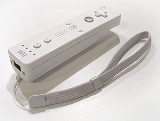
The Wii Remote is the primary controller for Nintendo's Wii console. A main feature of the Wii Remote is its motion sensing capability, which allows the user to interact with and manipulate items on screen via movement and pointing through the use of accelerometer and optical sensor technology. Another feature is its expandability through the use of attachments.
The Wii Remote was announced at the Tokyo Game Show on September 16, 2005.

Discussion
Ask a question about 'Wii Remote'
Start a new discussion about 'Wii Remote'
Answer questions from other users
|
Encyclopedia
The Wii Remote is the primary controller for Nintendo's Wii console. A main feature of the Wii Remote is its motion sensing capability, which allows the user to interact with and manipulate items on screen via movement and pointing through the use of accelerometer and optical sensor technology. Another feature is its expandability through the use of attachments.
The Wii Remote was announced at the Tokyo Game Show on September 16, 2005. It has since received much attention due to its unique features and the contrast between it and typical gaming controllers. It has also gained significant attention from hackers using it to control non Wii-related devices through Wii homebrew.
Development
Development of the Wii Remote began in or around 2001, coinciding with development of the Wii console. In that year, Nintendo licensed a number of motion-sensing patents from Gyration Inc., a company that produces wireless motion-sensing computer mice. Nintendo then commissioned Gyration Inc. to create a one-handed controller for it, which eventually developed the "'Gyropod' concept", a more traditional gamepad which allowed its right half to break away for motion-control. At this point, Gyration Inc. brought in a separate design firm to help pitch its concept to Nintendo. Under requirement to "roughly preserve the existing Game Cube button layout", it experimented with different forms "through sketches, models and interviewing various hardcore gamers". By "late 2004, early 2005", however, Nintendo had come up with the Wii Remote's less traditional "wand shape", and the design of the Nunchuk attachment. Nintendo had also decided upon using a motion sensor, infrared pointer, and the layout of the buttons, and by the end of 2005 the controller was ready for mass production.
During development of the Wii Remote in 2001, video game designer Shigeru Miyamoto brought in mobile phones and controllers for automotive navigation systems for inspiration, eventually producing a prototype that resembled a cell phone. Another design featured both an analog stick and a touchscreen, but Nintendo rejected the idea of a touchscreen on the controller, "since the portable console and living-room console would have been exactly the same".
Sources also indicate that the Wii Remote was originally in development as a controller for the Nintendo GameCube, rather than the Wii. Video game developer Factor 5 stated that during development of launch title Star Wars Rogue Squadron II: Rogue Leader, it had an early prototype of a motion-sensing controller. Video game journalist Matt Casamassina, from gaming website IGN, stated that he believed that Nintendo had planned to release the Wii Remote for the GameCube, noting that "Nintendo said that it hoped that GCN could enjoy a longer life cycle with the addition of top-secret peripherals that would forever enhance the gameplay experience." He suggested that Nintendo may have wanted to release the Wii Remote with a new system, instead of onto the GameCube, as "[the] Revolution addresses one of the GameCube's biggest drawbacks, which is that it was/is perceived as a toy."
Third-party use
Since the release of the Wii console, people have been exploring different new ways in which to use the Wii Remote. Many third-party applications are currently in development through Wii homebrew. One popular Windows program called GlovePIE allows the Wii Remote to be used on a personal computer to emulate a keyboard, mouse or joystick. Connecting the Wii Remote to a personal computer is done via a Bluetooth connection. The Bluetooth program BlueSoleil has been proven to successfully connect a Wii Remote to a PC. Still another program (like GlovePIE) is needed to utilize the Wii Remotes protocol and to use the data it offers.
The Wii Remote Bluetooth protocol can be implemented on other devices including cell phones, which often have poor usability with games. Two students have demonstrated this concept by creating a driver software that has the capability to connect the Wii Remote to a Symbian OS smartphone. The idea behind this driver is that a mobile phone with a TV-out port can replace the game console.
Programmer Johnny Lee has posted video demos and sample code at related to the use of the Wii Remote for finger tracking, low-cost multipoint interactive whiteboards, and head tracking for desktop VR displays. This was the subject for his presentation at the prestigious TED conference, where he demonstrated several such applications.
The Wii Remote is also used in fields outside of standard computing. The United States government has experimented with using it to control Packbot, a bomb disposal robot. Studies have also been conducted to use the Wii Remote as a practice method to fine-tune surgeons' hand motions. Utilizing DarwiinRemote, researchers at the University of Memphis have adapted the Wii Remote for data collection in cognitive psychology experiments. Autodesk have released a plugin that allows the Wii Remote to control orientation of 3D models in Autodesk Design Review.
Design
The Wii Remote assumes a one-handed remote control-based design instead of the traditional gamepad controllers of previous gaming consoles. This was done to make motion sensitivity more intuitive, as a remote design is fitted perfectly for pointing, and in part to help the console appeal to a broader audience that includes non-gamers. The body of the Wii Remote measures 148 mm (5.83 in) long, 36.2 mm (1.43 in) wide, and 30.8 mm (1.21 in) thick. The Wii Remote model number is RVL-003, a reference to the project codename "Revolution". The controller communicates wirelessly with the console via short-range Bluetooth radio, with which it is possible to operate up to four controllers as far as 10 meters (approx. 30ft) away from the console. However, to utilize pointer functionality, the Wii Remote must be used within five meters (approx. 16ft) of the Sensor Bar. The controller's symmetrical design allows it to be used in either hand. The Wii Remote can also be turned horizontally and used like a Famicom/NES controller, or in some cases (like Excite Truck, Sonic and the Secret Rings, and Mario Kart Wii) a steering wheel. It is also possible to play a single player game with a Wii Remote in each hand, as in the 'Shooting Range' game contained in Wii Play.
At E3 2006, a few minor changes were made to the controller from the design presented at the Game Developer's Conference. The controller was made slightly longer, and a speaker was added to the face beneath the center row of buttons. The "B" button became more curved resembling a trigger. The "Start" and "Select" buttons were changed to plus "+" and minus "–", and the "b" and "a" buttons were changed to 1 and 2 to differentiate them from the "A" and "B" buttons. Also, the symbol on the "Home" button was changed from a blue dot to a shape resembling a home/house, the shape of the power button was made circular rather than rectangular, and the blue LEDs indicating player number are now labeled using small Braille-like raised dots instead of Arabic numerals, with "1" being "•", "2" being "••", "3" being "•••", and "4" being "••••". The Nintendo logo at the bottom of the controller face was replaced with the Wii logo. Also, the expansion port was redesigned, with expansion plugs featuring a smaller snap-on design.
The blue LEDs also show how much battery power remains on the Wii Remote. By pressing any button, besides the power button while the controller is not being used to play games, a certain number of the four blue LEDs will light up, showing the battery life: four of the LEDs flash when it is at, or near, full power. Three lights flash when it is at 75%, two lights when at 50%, and one light flashes when there is 25% or less power remaining.
Similarities have been noted between the Wii Remote and an early Dreamcast controller prototype.
In the Red Steel trailer shown at E3 2006, the Wii Remote featured a smaller circular shaped image sensor, as opposed to the larger opaque IR filters shown on other versions. In the initial teaser video that revealed the controller at Tokyo Game Show 2005, the 1 and 2 buttons were labeled X and Y, respectively.
Colors
At E3 2006, Nintendo displayed white, black, and blue controllers. At a Wii event held on August 15, 2006 held by THQ, where the publisher's launch titles were demonstrated to press and children, all the controllers were in a two-toned scheme, black on the face, gunmetal on the reverse side. The controllers were glossy on the front, matte on the back, similar to the controllers Nintendo showed after the 2005 Tokyo Game Show. IGN published numerous photos of the event featuring the black controllers, but have since taken them down, as well as requesting their removal at other sites that had republished the photos. The Wii console launched with only the white model, with Shigeru Miyamoto commenting that new hues will be provided after the relief of supply limitations. Currently, controllers are only available in white, but third party protective skins, stickers and replacement shells are available in different colors. These colors would include solid colors like pink and green, as well as designs like camouflage and flames.
Strap
The Wii Remote comes with a wrist strap attached to the bottom to ensure the safety of the device. Every Wii game displays a caution screen upon loading to warn the player to use the strap in order to avoid the remote slipping from the grip during erratic movements.
Video game web site IGN reported that the strap tends to break under heavy use, which would potentially send the Wii Remote flying in various directions. WarioWare: Smooth Moves also sometimes requires the Wii Remote to be dropped, which would cause problems in the event of a strap failure. In response, Nintendo has posted guidelines on proper use of the strap and the Wii Remote. On December 8, 2006, units with thicker straps began to appear in some areas of the world. On December 15, 2006, Nintendo denied reports of a Wii wrist strap recall. While Nintendo refuted claims that three million straps had been recalled, it provided replacement wrist straps free of charge for users who have broken theirs. However, the U.S. Consumer Product Safety Commission has become involved in the "replacement program". The old 0.6 mm (0.024 in) diameter strap is replaced by a larger, 1.0 mm (0.039 in) diameter version. Nintendo's online allows owners to receive up to four free straps when a Wii serial number and shipping details are provided.
On August 3, 2007, a new wrist strap was discovered to be in circulation. The strap featured a lock clip instead of a slide to ensure that the clip would not slide away from a player's wrist during frequent play. The lock clip wrist strap is featured in the newest wrist strap reminder screens.
Jacket
Nintendo announced a free new accessory for the Wii Remote, the Wii Remote Jacket, on October 1, 2007.
The removable silicone sleeve wraps around the Wii Remote to provide users a better grip and cushioning. The cushioning intends to keep the Wii Remote protected in case it is accidentally dropped or thrown. Nintendo started shipping consoles, separately-packaged controllers, and the controller included in the game Wii Play with the jacket on October 15, 2007. As with the wrist strap replacements, Nintendo has put up a Wii Remote Jacket request form on its , , , , , , and websites allowing current Wii owners to request up to four of the jackets free of charge, including shipping charges.
Home Menu
Accessed with the Wii Remote's home button, the Home Menu displays information about the controller(s) currently being used, and allows the user to configure certain options. At the bottom of the menu screen, the battery life of all connected controllers is displayed. Below that is a bar labeled Wii Remote Settings. Selecting it brings users to an options screen where they can control the audio output volume, rumble settings, and reconnect the controllers, for example to connect Wii Remotes through one-time synchronization. Depending on when the Home Menu is accessed, there will be a different amount of buttons displayed.
Wii Menu: No matter when the menu is accessed, the Wii Menu button will always be present. Selecting this will bring back the Wii Menu, where users can choose another channel.
Reset: In applications, the Reset button is available. This performs a soft reset of that particular application, for example returning a game to its title screen or returning to the loading screen of a Wii Menu channel, what would happen if the player were to press the console's physical reset button.
Operations Guide: On Wii Menu channels, including the News Channel, Forecast Channel, Internet Channel, Everybody Votes Channel and Virtual Console titles, the Operations Guide button will appear on the Home Menu. The guide accessed acts as an instruction manual for the currently played game.
The Home Menu can be compared to the Xbox 360's in-game menu (accessible by the "Xbox" button). It may be accessed under most circumstances during Wii operation, which pauses the on-screen action. Otherwise a Home symbol with a strikethrough appears onscreen. It is also inaccessible during Nintendo GameCube play.
Functionality
Sensing
LEDs]]
The Wii Remote has the ability to sense acceleration along three axes through the use of an accelerometer. The Wii Remote also features a PixArt optical sensor, allowing it to determine where the Wii Remote is pointing.
Unlike a light gun that senses light from a television screen, the Wii Remote senses light from the console's Sensor Bar (model number RVL-014), which allows consistent usage regardless of a television's type or size. The Sensor Bar is about 20 cm (8 in) long and features ten infrared LEDs, five at each end of the bar The LEDs farthest away from the center are pointed slightly away from the center, the LEDs closest to the center are pointed slightly inwards, while the rest are pointed straight forward. The Sensor Bar's cable is 353 cm (11 ft 7 in) in length. The bar may be placed above or below the television, and should be centered. If placed above, the sensor should be in line with the front of the television, and if placed below, should be in line with the front of the surface the television is placed on. It is not necessary to point directly at the Sensor Bar, but pointing significantly away from the bar will disrupt position-sensing ability due to the limited viewing angle of the Wii Remote.
Use of the Sensor Bar allows the Wii Remote to be used as an accurate pointing device up to 5 meters (approx. 16 ft) away from the bar. The Wii Remote's image sensor is used to locate the Sensor Bar's points of light in the Wii Remote's field of view. The light emitted from each end of the Sensor Bar is focused onto the image sensor which sees the light as two bright dots separated by a distance "mi" on the image sensor. The second distance "m" between the two clusters of light emitters in the Sensor Bar is a fixed distance. From these two distances m and mi, the Wii CPU calculates the distance between the Wii Remote and the Sensor Bar using triangulation. In addition, rotation of the Wii Remote with respect to the ground can also be calculated from the relative angle of the two dots of light on the image sensor. Games can be programmed to sense whether the image sensor is covered, which is demonstrated in a Microgame of Smooth Moves, where if the player does not uncover the sensor, the champagne bottle that the remote represents will not open.
The Sensor Bar is required when the Wii Remote is controlling up-down, left-right motion of a cursor or reticle on the TV screen to point to menu options or objects such as enemies in first-person shooters. Because the Sensor Bar also allows the Wii Remote to calculate the distance between the Wii Remote and the Sensor Bar, the Wii Remote can also control slow forward-backward motion of an object in a 3-dimensional game. Rapid forward-backward motion, such as punching in a boxing game, is controlled by the acceleration sensors. Using these acceleration sensors (acting as tilt sensors), the Wii Remote can also control rotation of a cursor or other objects.
The use of an infrared sensor to detect position can cause some detection problems when other infrared sources are around, such as incandescent light bulbs or candles. This can be easily alleviated by using fluorescent lights around the Wii, which emit little to no infrared light. Innovative users have used other sources of IR light as Sensor Bar substitutes such as a pair of flashlights and a pair of candles. Such substitutes for the Sensor Bar illustrate the fact that a pair of non-moving lights provide continuous calibration of the direction that the Wii Remote is pointing and its physical location relative to the light sources. There is no way to calibrate the position of the cursor relative to where the user is pointing the controller without the two stable reference sources of light provided by the Sensor Bar or substitutes. Wireless sensor bars have also been released.
The position and motion tracking of the Wii Remote allows the player to mimic actual game actions, such as swinging a sword or aiming a gun, instead of simply pressing buttons. An early marketing video showed actors miming actions such as fishing, cooking, drumming, conducting a string quartet, shooting a gun, sword fighting, and performing dental surgery.
The LEDs can be seen through some cameras and other devices with a wider visible spectrum than the human eye.
Controller feedback
The Wii Remote provides basic audio and rumble functionality. At the 2006 E3 press conference, it was revealed that the Wii Remote has its own independent speaker on the face of the unit. This was demonstrated by a developer as he strung and shot a bow in The Legend of Zelda: Twilight Princess. The sound from both the Wii Remote and television was altered as the bow shot to give the impression of the arrow traveling away from the player. Another example of its use is in Red Steels Killer match, where the players will receive their objective through the Wii Remote's speaker or No More Heroes' feature allowing players to listen to phonecalls through the Wii Remote. The volume can be changed or muted with the "Home" button and selecting the corresponding controller icon at the bottom of the screen. The rumble feature can also be switched on or off using the Home Menu.
Memory
The Wii Remote contains a 16 KiB EEPROM chip from which a section of 6 kilobytes can be freely read and written by the host. Part of this memory is available to store up to ten Mii avatars, which can be transported to use with another Wii console. At least 4,000 bytes are available and unused before the Mii data. Pokémon Battle Revolution and Super Swing Golf also use this memory. This function is also used in Super Smash Bros. Brawl, allowing the user to save controller configuration data to the Wii Remote.
Power source
The Wii Remote uses two AA batteries as a power source, which can power a Wii Remote for sixty hours using only the accelerometer functionality and 25 hours using both accelerometer and pointer functionality. An official direct recharging option for the Wii Remote does not exist, but various third-party manufacturers market charging solutions for the controller (see section on chargers). According to an interview with Nintendo industrial designer Lance Barr, limitations of the Wii Remote's expansion port make it unlikely that it will be used for internal battery charging. Although Nintendo discourages other rechargeable battery types such as lithium ion (Li-ion) and nickel-cadmium (NiCd), the company's support website indicates that nickel-metal hydride (NiMH) rechargeable batteries may be used. A 3300µF capacitor provides a temporary source of power during quick movements of the Wii Remote when connection to the batteries may be temporarily interrupted.
Expansions and accessories
2006]]
The Wii Remote also features an expansion port at the bottom which allows various functional attachments to be added. This expandability is similar to that available with the port on the Nintendo 64 controller.
Nunchuk
The Nunchuk (model number RVL-004) is the first controller attachment Nintendo revealed for the Wii Remote at the 2005 Tokyo Game Show. It connects to the Wii Remote via a cord that is about 3.5 to 4 feet (1 ~ 1.2 m) long. Its appearance when attached resembles the nunchaku, hence the name. It features an analog stick similar to the one found on the Nintendo GameCube controller and two trigger buttons (a last-minute modification changed the two triggers to one trigger and a "C" button, as described below). It works in tandem with the main controller in many games. Like the Wii Remote, the Nunchuk also provides a three-axis accelerometer for motion-sensing and tilting, but without a speaker, a rumble function, or a pointer function. The Nunchuk's accelerometer is an STMicroelectronics .
A Nunchuk comes bundled with the Wii console. Additional Wii Remote units are sold separately without the Nunchuk. The two shoulder buttons, formerly named Z1 and Z2 respectively, had been reshaped and renamed since the Game Developers Conference. The circular top shoulder button, now called C, is much smaller than the lower rectangular shoulder button, now called Z.
The body of the Nunchuk measures 113 mm (4.45 in) long, 38 mm (1.5 in) wide, and 37 mm (1.48 in) thick. The connection port was also larger.
Classic Controller
During E3 2006 Nintendo introduced a Classic Controller (model number RVL-005), which plugs into the Wii Remote via a cord in a similar fashion as the Nunchuk. It contains two analog sticks and two extra shoulder buttons: the ZL and ZR buttons, used to replicate the Z button found on the Nintendo GameCube controller. The overall configuration is similar to that of other major seventh generation console controllers.
The Classic Controller cord comes from the bottom instead of the top of the controller (a configuration shared by the Dreamcast controller). The Classic Controller contains slots on its backside, opened via a rectangular button at the top of the controller, presumably for attaching the controller to something else. The purpose for these slots remains undisclosed, but it is commonly believed to be used with a special clip that attaches the Wii Remote to the Classic Controller, enabling it to take advantage of the Wii Remote's motion-sensing and rumble capabilities (the Classic Controller does not have its own accelerometer or vibration motor); Nyko has released such a clip, in addition to a grip shell and a place to store the cable. The body of the Classic Controller measures 65.7 mm tall, 135.7 mm wide, and 26 mm thick.
The Classic Controller cannot be used to play Nintendo GameCube games. According to the Nintendo Online Shop, the Classic Controller can only be used with Virtual Console games. Specific Wii games have been designed to function with it, however. The Nintendo GameCube controller can be used instead of the Classic Controller for playing most Virtual Console games. When in the Wii Menu, the left analog stick takes control of the cursor when the Wii Remote is not pointed at the screen. The Classic Controller can navigate through the Message Board, settings menus and Wii Shop Channel. It becomes inactive on all other channels, excluding Virtual Console games.
Nintendo had previously announced a controller "shell" which resembled a traditional game controller, often referred to as a "classic-style expansion controller." As described at the time, the Wii Remote would fit inside the shell, allowing gamers to play games using a traditional-style gamepad, while allowing use of the remote's motion sensing capability. According to Satoru Iwata, it would be meant for playing "the existing games, Virtual Console games, and multi-platform games."
The Classic Controller features two analog sticks, a D-pad, face buttons labeled "a", "b", "x" and "y", analog shoulder buttons labeled "L" and "R" and two "Z" buttons (labeled "ZL" and "ZR") next to the L and R buttons on the inside, respectively. It also has a set of "-", "Home" and "+" buttons like those on the Wii Remote, with the - and + buttons labeled "Select" and "Start", respectively. A button on the top operates a latch mechanism on the back of the unit, but no peripherals currently use this.
In November 2007, Nintendo listed a special Super Famicom Classic Controller as one of the choices for the free gift for 2007 Club Nintendo platinum members.
Anascape Ltd filed a lawsuit against Nintendo claiming that the Classic Controller and other Nintendo devices violated Anascape's "six degrees of freedom" interface device patent. In July 2008, the court ruled in favor of Anascape; Nintendo was ordered to stop selling the Classic Controller in the United States until further notice. Nintendo has exercised the right to continue selling the Classic Controller pending a verdict at the U.S. Court of Appeals for the Federal Circuit.
On February 26 2009, Nintendo listed a Classic Controller PRO on its Japanese website, which features the ZL and ZR buttons as full-fledged shoulder buttons, as well as added controller grips. It is expected to be released in Japan during Summer 2009.
Wii Zapper
The Wii Zapper is a gun shell peripheral for the Wii Remote. The name is a reference to the NES Zapper light gun for the Nintendo Entertainment System. According to an interview with Shigeru Miyamoto, the idea of a Zapper-type expansion formed when the Wii Remote was first created. He expressed that "What we found is that the reason we wanted to have a Zapper is when you hold a Wii Remote, it can be difficult for some people to keep a steady hand. And holding your arm out like that can get your arm somewhat tired."
A staff member of The Legend of Zelda: Twilight Princesss development team later created a makeshift gun-like frame using rubber bands and wires, which held the Wii Remote and Nunchuk together. In response, Miyamoto stated "this isn't the time or the place to be making things like this!". When Miyamoto held the prototype in his hands, he found it very comfortable, however. He proposed it to the hardware developers, who started on the formal development project. The Wii Zapper underwent an extensive development period involving many design phases, including one that produced a rumble whenever the player hit a target. To save battery life, the rumble function was abandoned.
A "Zapper" prototype was shown at E3 2006 featuring a shotgun-like design with a "trigger hole", as well as an analog stick built into the top of the handle. This made it similar to the Nunchuk attachment, but without the accelerometer and the second button. In this version, the "gun barrel" of the shell housed the Wii Remote and connected with its expansion port.
A revised design was revealed on July 11, 2007 at E3 2007 with a form reminiscent of a Tommy gun but even more so of a Steyr AUG, in which the Wii Remote is fitted in the gun barrel and the Nunchuk is cradled in the rear handle. This design came about with the realization that making the Wii Zapper functionally independent from attachments would "allow for more diverse play styles." Some concern has been raised by this arrangement, since most people would naturally end up holding the Nunchuk with their dominant hand and be forced to pull the trigger with their non-dominant hand. Third-party titles designed to support the Wii Zapper include Resident Evil: The Umbrella Chronicles, Ghost Squad, Medal of Honor: Heroes 2, The House of the Dead 2 & 3 Return, Call of Duty: World at War, Wild West Guns and Quantum of Solace.
The Wii Zapper was first released in Japan on October 25, 2007 as a pack-in with Ghost Squad, with standalone units also made available for purchase on Nintendo's Japanese online store. A bundle with Umbrella Chronicles was later released in the region on November 15, 2007. For other regions, the Wii Zapper is packaged with Link's Crossbow Training, a training game based on The Legend of Zelda: Twilight Princess. It was released in North America on November 19, 2007, in Europe on December 7, 2007 and in Australia on December 13, 2007.
Wii Wheel
A Wii Wheel peripheral comes packaged with Mario Kart Wii, which was released in the second quarter of 2008. A button which triggers the Wii Remote's "B" button protrudes from the back of the Wii Wheel. The wheel has a large, encircled Wii logo at its middle, although this has no function. The Wii Wheel has a hole on the right side in the back to allow use of the wrist strap while the Wii Remote is attached to the accessory, and to make removing the remote from the wheel easier. The user is also able to use the pointing function of the Wii Remote while it is in the peripheral. The Wii Wheel can be used for games that share a sideways steering control configuration.
A single Wii Wheel is packaged with Mario Kart Wii, but more can be bought separately.
Wii MotionPlus
The Wii MotionPlus is an expansion device that allows the Wii Remote to more accurately capture complex motion. According to Nintendo, the sensor in the device supplements the accelerometer and Sensor Bar capabilities of the Wii Remote to enable actions to be rendered identically on the screen in real time. The Wii MotionPlus was announced by Nintendo in a press release on July 14, 2008, and revealed the next day at a press conference at the E3 Media & Business Summit. It will be bundled with the sports game collection Wii Sports Resort, which is scheduled for release in Spring 2009. The device will also be available for purchase separately. Games currently planned to feature Wii MotionPlus functionality are: Red Steel 2, EA Sports Grand Slam Tennis, and Tiger Woods PGA Tour 10.
The device incorporates a dual-axis "tuning fork" angular rate sensor, which can determine rotational motion. The information captured by the angular rate sensor can then be used to distinguish true linear motion from the accelerometer readings. This allows for the capture of more complex movements than possible with the Wii Remote alone.
The Wii MotionPlus features a pass-through expansion port, allowing other expansions such as the Nunchuk or Classic Controller to be used simultaneously with the device. The attachment has a color-coded mechanical slide switch for locking the clip release. When attached to the Wii Remote, the unit extends the length of the controller body by approximately 1˝ inches. Each Wii MotionPlus will be packaged with a longer version of the Wii Remote Jacket to accommodate the added length.
The Wii MotionPlus was developed by Nintendo in collaboration with game development tool company AiLive. The sensor used is an InvenSense IDG-600; designed in accordance to Nintendo's specification; with a high dynamic range, high mechanical shock tolerance, high temperature and humidity resistance, and small physical size.
In an interview with video game trade journal GameDaily BIZ, Satoru Iwata stated that the Wii MotionPlus was conceived soon after the completion of the initial Wii Remote design, to address developer demand for more capable motion sensing, but was only announced after the sensors could be purchased in sufficient volume at a reasonable price. During a developer roundtable discussion at E3 2008, Wii Sports Resort producer Katsuya Eguchi discussed the potential influence of the Wii MotionPlus on the Wii's existing market, stating that Nintendo was looking at whether the MotionPlus capability will be built into the Wii Remote in the future, or kept "as an attachment we only use for certain software."
Third-party accessories Since the release of the Wii console, many aesthetic, ergonomic and functional accessories have been developed for the Wii Remote by third parties.
Glove kits
Although Nintendo has released its own free Wii Remote Jacket that is shipped by request to existing Wii Remote owners, third-party glove kits have been available for the controller since its launch. These have been produced in several colors, some of which glow in the dark or change hue depending on the heat of the player's hand. There are various themes as well, including The Legend of Zelda: Twilight Princess and Pokémon Battle Revolution.
Steering wheels
Prior to Nintendo's own Wii Wheel, several third-party steering wheel accessories had been introduced for the Wii Remote. One released by Ubisoft, the Wii Steering Wheel, was developed by Thrustmaster. It is bundled with certain games, such as Monster 4x4 World Circuit and GT Pro Series. The accessory, which is only for aesthetic/ergonomic enhancement, is meant for driving-style gameplay in which the Wii Remote would be held lengthwise in a two-handed gamepad orientation, steering the subject by tilting the controller. The Wii Steering Wheel is also sold separately. Since the Wii Steering Wheel was revealed, other similarly designed steering wheel accessories have been produced, including the Wii Racing Wheel by Intec.
Sword and shield attachments
Sword and shield attachment sets have been released by various manufacturers, including ASiD Tech and Camy International. The accessories are simply shells, and do not provide any other functional purpose. The ASiD kit comes with a sword, a shield, and knife with a design resembling a scimitar, all molded from monotone plastic (white or black). The Hero Pack by Camy International consists of a sword and a shield, with colored designs very similar to the Master Sword and Hylian Shield from The Legend of Zelda series. The blade of the Hero Pack sword is made of soft foam for safety.
With both sets, the Wii Remote is cradled in the handle of the sword or knife so that the face buttons are accessible, with clearings for the B button and pointer lens. The Nunchuk is clipped into the handle of the shield. The configurations correspond to the sword and shield controls for The Legend of Zelda: Twilight Princess.
GameStop carries the Wii Dual Glow Sabers made by dreamGEAR.
Sports packages
The Wii Sports pack was released by GameStop in the United States and Logic3 in Europe. It includes a baseball bat, a golf club, and a tennis racket. It is very similar to the sword accessory and attaches to the Wii Remote to allow a more realistic experience with Wii Sports.
Soon after GameStop released their pack, PDP (formally Pelican Accessories) released a Wii Nerf Sports Pack. It is identical to GameStop's pack however all the attachments are made out of Nerf foam material.
The boxing gloves are a separate accessory to the Wii Sports pack. With those, the player can put the Wii Remote and Nunchuk inside each glove underneath where one slips in hands. The Nunchuk is assigned to the left glove while the Wii Remote is right. In this way one can punch like an actual boxer instead of jabbing the controllers away from oneself.
The Wii Cue is a snooker cue extension for the Wii Remote. It is bundled with the game WSC REAL 08: World Snooker Championship, due for release on the Wii in May in the United Kingdom. The Wii Cue is in effect a large stick that comes out in front of the Wii Remote. The player holds the remote in one hand and rests the cue between the thumb and forefinger to simulate a cue for snooker or pool.
The Wii Rod is a fishing rod attachment for the Wii Remote. The remote slips into a plastic jacket that has a rod on the end. It also features a reel that the Nunchuk fits into, allowing the player to reel in the fish with the Nunchuk. The Wii Rod will be bundled with the game Rapala's Fishing Frenzy with Rod.
Chargers
While Nintendo does not currently offer a rechargeable option for the Wii Remote, recharging systems have been developed by various third-party peripheral companies. Though Nintendo has not released a rechargeable battery kit in regions outside Japan, the Wii Remote and WaveBird controllers both use special battery contacts that are compatible with previously-released Game Boy Advance accessories (AGB-003 and AGB-004, battery and charger respectively).
Several manufacturers offer direct-charging systems, most of which involve an integrated battery pack/compartment door with electrical contacts that connect to a charging cradle. Other available features include silicone-covered battery packs for added grip, nunchuk cradles, and compatibility with WaveBird and GameBoy Advance.
A contactless charger set for the Wii Remote was announced by electronics company Sanyo on July 24, 2008. The product uses inductive charging, allowing the controller to be charged in the stand with a standard Wii Remote Jacket on. The product will also feature Sanyo's "eneloop" low self-discharge NiMH battery technology, and will be marketed under the eneloop brand. It is currently the only Wii Remote battery/charging product to be licensed by Nintendo. The charger set was released in Japan on August 25, 2008.
Arcade joysticks
With the announcement of Neo Geo games being available on the Wii Virtual Console service, third-party game peripheral manufacturer Hori revealed the "Fighting Stick Wii" controller. An expansion of the Wii Remote, the Fighting Stick Wii is an arcade style controller with compatibility with the non-analog functionality of the Classic Controller (the L and R buttons have no analog functionality, and analog sticks are not included). In addition, the action buttons have turbo button functionality (approximately 20 presses per second). The controller was released in Japan on August 30, 2007, for JPĄ5,280. The Fighting Stick Wii was released on November 6, 2007 in the United States.
SNK Playmore have also released a Wii-compatible version of the Neo Geo Stick 2, which resembles the first party controller of the Neo Geo console. Like the Hori Fighting Stick Wii, it has similar non-analog Classic Controller functionality. It was released in Japan on April 10, 2008.
Horizontal stand
Pelican designed a horizontal stand for the Wii console. The stand has a storage compartment capable of securing a Wii Remote and Nunchuk, as well as segregated exhaust port that allows the Wii fan to have unrestricted access to fresh air. The stand also has an inset on the front, which is designed to hold the Sensor Bar. A wire groove leading to the stern of the stand makes for a clean installation.
Gun peripherals
Despite an official Wii Zapper expansion released by Nintendo, some gun peripherals have been shown by third parties. The first of these appeared in early April, when video game retailer GameStop listed a "Wii Blaster" peripheral on its website, with a release date of May 1, 2007. Originally listed without a specified manufacturer, the Wii Blaster had been speculated to be the Zapper, but has since been indicated to be produced by third party accessories manufacturer Core Gamer. According to GameStop on May 5, 2007, the Wii Blaster release date has changed to June 26, 2007 and is available for purchase.
Another variation on the official Wii Zapper is the Wii Light Gun. It is designed much like a sub-machine gun and although it is not sold with any games, it is available for purchase at the GAME website and GAME retailers.
While not technically an expansion, details on an aesthetic gun accessory for the Wii Remote and Nunchuk, named the "Sharp Shooter", have been released by third-party manufacturer Joytech. In this accessory, the Wii Remote is housed in the gun barrel. The Nunchuk is fitted into the handle so that the Nunchuk's buttons serve as gun triggers.
A new gun peripheral, the , is designed to be an alternative of the Wii Zapper and is designed by Nyko. It has a pistol-like design that uses only the Wii Remote.
Below the Perfect Shot is a slot, where the user can attach the Nunchuk or other Wii Remote add-ons. The trigger is mechanically spring-loaded, which gives tactile feedback and aids rapid shots. Some new battery covers, such as those provided by recharging stations, are not compatible with the Perfect Shot and must be removed in order to fit.
Hong Kong-based accessory manufacturer Brando has also released two Wii gun shells: One of them is the 2-in-1 combined light gun, that very closely resembles the Nyko perfect shot, while they have another one, named the Wii Cyber Gun, that is more similar to the Zapper.
There will also be a Wii Remote-only gun shell released with the game Cocoto magic circus with gun.
To coincide with the release of the Nerf N-Strike video game, an arcade-style light gun shooter, Hasbro will be releasing the "N-Strike Switch Shot EX-3", a functional Nerf dart shooter that can be modified by removing the dart shooting mechanism and replacing it with a Wii Remote to allow it to be used as a light gun shell. The Switch Shot will be available both in a bundle with the Nerf N-Strike game and as a separate peripheral.
Other Wii Gun peripherals include a Wii Crossbow, a Wii Magnum, and a Wii Shotgun.
Musical instrument controllers
Les Paul controller]]
The Wii version of Guitar Hero III: Legends of Rock is bundled with a white Gibson Les Paul style guitar controller. It includes a slot for the Wii Remote to fit into, though the Wii Remote Jacket must be removed first, and utilizes the wireless capabilities, accelerometer, rumble feature and speaker of the Wii Remote. It also features an analog stick that can be used to navigate the Wii Menu. Like the PS3 and Xbox 360 guitar controllers, the Wii Les Paul can be customized with detachable faceplates. The Les Paul also comes with the special edition of Guitar Hero: Aerosmith which includes an Aerosmith faceplate. The Gibson Les Paul controller is also available for purchase separately from the game.
At the 2008 Consumer Electronics Show, Nyko revealed a similar guitar controller for the Wii, a replica of a butterscotch blonde Fender Telecaster. This marks the first third-party guitar controller for the console. Other third-party guitar controllers have also since become available. In lieu of using guitar controllers, the Wii version of PopStar Guitar uses a Wii Remote controller shell called the AirG that allows players to play air guitar-style in conjunction with the Nunchuk.
In addition to a revised guitar controller, Guitar Hero World Tour, the sequel to Guitar Hero III features a wireless drum kit controller which also has a slot for the Wii Remote. The Wii version of Taiko no Tatsujin features its own drum controller called the TaTaCon (styled as a miniature taiko drum) that plugs into the Wii Remote.
The Wii version of Samba de Amigo features additional maraca shaped attachments for the Wii Remote and Nunchuk.
Reception
Overall reception to the Wii Remote has changed over time. The control styles provided by the controller were met with praise at its first public exhibition at E3. Since then, comments have been noted by the press on its functionality. Matt Wales of IGN UK highlighted the aiming and precision of Red Steel and stated "Taking down swathes of enemies with nothing more than a twitch of the wrist proves immensely satisfying and, more importantly, incredibly involving."
Other publications have noted specific complaints regarding control. GameSpot expressed that some motions in Cooking Mama: Cook Off failed to transmit or meet expectation during gameplay. Similar observations were made on other titles made available during the Wii launch period. ComputerAndVideoGames.com reported that "Most prominent is the first batch of games, many of which do a better job at exposing the obstacles of full motion control, rather than the benefits... Need For Speed...is near unplayable, Far Cry got it all wrong, and the motion control in Marvel: Ultimate Alliance just feels tacked on."
The overall situation was described by Joystiq thus: "Over the months since launch, the unpredictable Wii Remote has led to a maddening dichotomy. Some games are too easy, while others are too hard -- for all the wrong reasons...Gamers who crave a deeper challenge have to settle for battling incomprehensible controls." Critics felt that fault was largely attributed to the developers' lack of experience with the Wii Remote. Jeremy Parish of Electronic Gaming Monthly compared the initial phase of control implementation to that of the Nintendo DS. Matt Casamassina of IGN also presumed that the first generation of Wii games were of an experimental stage and that potential for refinement had yet to be exploited.
Later-released titles have seen mixed reactions in terms of control. Of Tiger Woods PGA Tour 07 from Electronic Arts, Matthew Kato of Game Informer stated that the controller "has a hard time detecting your backswing. Thus, it’s harder to control. There were even times the game putted for me by accident." A GamePro review for Medal of Honor: Vanguard offers that the title "is an encouraging sign that developers are finally starting to work out the kinks and quirks of the Wii Remote."
First- and second-party titles have produced more favorable utilization of the Wii Remote's unique capabilities. Metroid Prime 3: Corruption (a first-party game), in particular, was nearly universally lauded for its unique control scheme, which is seen as being unrivaled by any other console game. Corruption utilizes the Nunchuk for strafing and the infrared pointing capability of the Wii Remote for turning and special "gestures", which are used to select visors. Other Nintendo titles take a more minimalist approach, using mostly the pointer and buttons only, as with Big Brain Academy: Wii Degree, or use the controller in a sideways configuration to resemble an NES controller while de-emphasizing more advanced capabilities, as seen in Super Paper Mario and Sonic and the Secret Rings.
In 2006, the Wii Remote and Nunchuk combined to sell over 8.5 million units in the United States, and took the top two spots in video game accessories sales. In the US, the Nunchuk was the best-selling video game hardware for January 2008, with 375,000 units sold, in a month where the Wii was the best-selling console with 274,000 units sold.
See also
External links
|
| |
|
|