

Phosphatidylinositol

Encyclopedia
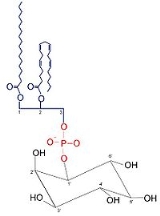
Phosphatidylinositol is a negatively charged phospholipid
and a minor component in the cytosolic side of eukaryotic cell membranes.
The inositol
can be phosphorylated to form phosphatidylinositol phosphate
(PIP), phosphatidylinositol bisphosphate
(PIP2) and phosphatidylinositol trisphosphate
(PIP3). PIP, PIP2 and PIP3 are collectively called phosphoinositides.
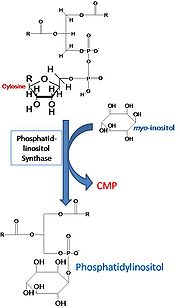 The synthesis of phosphatidylinositol is catalyzed by phosphatidylinositol synthase and involves CDP-diacylglycerol and L-myo-inositol..
behavior, a current academic research topic. Phosphatidylinositol is classified as a glycerophospholipid
that contains a glycerol
backbone, two non-polar fatty acid
tails, a phosphate
group substituted with an inositol
polar head group.
The most common fatty acids of phosphoinositides are stearic acid
in the SN1 position and arachidonic acid
, in the SN2 position. Hydrolysis of phosphoinositides yield one mole of glycerol, two moles of fatty acids, one mole of inositol and one, two, or three moles of phosphoric acid
s, depending on the number of phosphates on the inositol rings. Phosphoinositides are regarded as the most acidic phospholipid.
, cell signaling
and membrane trafficking. The inositol ring can be phosphorylated by a variety of kinases on the three, four and five hydroxyl groups in seven different combinations. However, the two and six hydroxyl group is typically not phosphorylated due to steric hindrance.
All seven variations of the following phosphoinositides have been found in animals:
Phosphatidylinositol monophosphates:
Phosphatidylinositol bisphophosphates:
Phosphatidylinositol trisphophosphate:
These phosphoinositides are also found in plant cells, with the exception of PIP3.
Phospholipid
Phospholipids are a class of lipids that are a major component of all cell membranes as they can form lipid bilayers. Most phospholipids contain a diglyceride, a phosphate group, and a simple organic molecule such as choline; one exception to this rule is sphingomyelin, which is derived from...
and a minor component in the cytosolic side of eukaryotic cell membranes.
The inositol
Inositol
Inositol or cyclohexane-1,2,3,4,5,6-hexol is a chemical compound with formula 6126 or 6, a sixfold alcohol of cyclohexane. It exists in nine possible stereoisomers, of which the most prominent form, widely occurring in nature, is cis-1,2,3,5-trans-4,6-cyclohexanehexol, or myo-inositol...
can be phosphorylated to form phosphatidylinositol phosphate
Phosphatidylinositol phosphate
Phosphatidylinositol phosphate may refer to:* Phosphatidylinositol 3-phosphate, also known as PIP* Phosphatidylinositol 4-phosphate, also known as PIP* Phosphatidylinositol 5-phosphate, also known as PIP...
(PIP), phosphatidylinositol bisphosphate
Phosphatidylinositol bisphosphate
Phosphatidylinositol bisphosphate may refer to:* Phosphatidylinositol -bisphosphate* Phosphatidylinositol -bisphosphate* Phosphatidylinositol -bisphosphate...
(PIP2) and phosphatidylinositol trisphosphate
Phosphatidylinositol (3,4,5)-trisphosphate
Phosphatidylinositol -triphosphate , abbreviated PIP3, is the product of the class I phosphoinositide 3-kinases phosphorylation on phosphatidylinositol -bisphosphate .-Discovery:...
(PIP3). PIP, PIP2 and PIP3 are collectively called phosphoinositides.
Biosynthesis
Chemistry
PI has a polar and non-polar region, making the lipid an amphiphile. Amphiphatic lipids demonstrate polymorphicLipid polymorphism
Polymorphism in biophysics is the aspect of the behaviour of lipids that influences their long-range order, i.e. how they aggregate. This can be in the form of spheres of lipid molecules , pairs of layers that face one another , a tubular arrangement , or various cubic phases Polymorphism in...
behavior, a current academic research topic. Phosphatidylinositol is classified as a glycerophospholipid
Glycerophospholipid
Glycerophospholipids or phosphoglycerides are glycerol-based phospholipids. They are the main component of biological membranes.-Structures:...
that contains a glycerol
Glycerol
Glycerol is a simple polyol compound. It is a colorless, odorless, viscous liquid that is widely used in pharmaceutical formulations. Glycerol has three hydroxyl groups that are responsible for its solubility in water and its hygroscopic nature. The glycerol backbone is central to all lipids...
backbone, two non-polar fatty acid
Fatty acid
In chemistry, especially biochemistry, a fatty acid is a carboxylic acid with a long unbranched aliphatic tail , which is either saturated or unsaturated. Most naturally occurring fatty acids have a chain of an even number of carbon atoms, from 4 to 28. Fatty acids are usually derived from...
tails, a phosphate
Phosphate
A phosphate, an inorganic chemical, is a salt of phosphoric acid. In organic chemistry, a phosphate, or organophosphate, is an ester of phosphoric acid. Organic phosphates are important in biochemistry and biogeochemistry or ecology. Inorganic phosphates are mined to obtain phosphorus for use in...
group substituted with an inositol
Inositol
Inositol or cyclohexane-1,2,3,4,5,6-hexol is a chemical compound with formula 6126 or 6, a sixfold alcohol of cyclohexane. It exists in nine possible stereoisomers, of which the most prominent form, widely occurring in nature, is cis-1,2,3,5-trans-4,6-cyclohexanehexol, or myo-inositol...
polar head group.
The most common fatty acids of phosphoinositides are stearic acid
Stearic acid
Stearic acid is the saturated fatty acid with an 18 carbon chain and has the IUPAC name octadecanoic acid. It is a waxy solid, and its chemical formula is CH316CO2H. Its name comes from the Greek word στέαρ "stéatos", which means tallow. The salts and esters of stearic acid are called stearates...
in the SN1 position and arachidonic acid
Arachidonic acid
Arachidonic acid is a polyunsaturated omega-6 fatty acid 20:4.It is the counterpart to the saturated arachidic acid found in peanut oil, Arachidonic acid (AA, sometimes ARA) is a polyunsaturated omega-6 fatty acid 20:4(ω-6).It is the counterpart to the saturated arachidic acid found in peanut oil,...
, in the SN2 position. Hydrolysis of phosphoinositides yield one mole of glycerol, two moles of fatty acids, one mole of inositol and one, two, or three moles of phosphoric acid
Phosphoric acid
Phosphoric acid, also known as orthophosphoric acid or phosphoric acid, is a mineral acid having the chemical formula H3PO4. Orthophosphoric acid molecules can combine with themselves to form a variety of compounds which are also referred to as phosphoric acids, but in a more general way...
s, depending on the number of phosphates on the inositol rings. Phosphoinositides are regarded as the most acidic phospholipid.
Phosphoinositides
Phosphorylated forms of phosphatidylinositol are called phosphoinositides and play important roles in lipid signalingLipid signaling
Lipid signaling, broadly defined, refers to any biological signaling event involving a lipid messenger that binds a protein target, such as a receptor, kinase or phosphatase, which in turn mediate the effects of these lipids on specific cellular responses...
, cell signaling
Signal transduction
Signal transduction occurs when an extracellular signaling molecule activates a cell surface receptor. In turn, this receptor alters intracellular molecules creating a response...
and membrane trafficking. The inositol ring can be phosphorylated by a variety of kinases on the three, four and five hydroxyl groups in seven different combinations. However, the two and six hydroxyl group is typically not phosphorylated due to steric hindrance.
All seven variations of the following phosphoinositides have been found in animals:
Phosphatidylinositol monophosphates:
- Phosphatidylinositol 3-phosphatePhosphatidylinositol 3-phosphatePhosphatidylinositol 3-phosphate is a phospholipid found in cell membranes that helps to recruit a range of proteins, many of which are involved in protein trafficking, to the membranes...
, also known as PtdIns3P or PI(3)P - Phosphatidylinositol 4-phosphatePhosphatidylinositol 4-phosphatePhosphatidylinositol 4-phosphate is a precursor of Phosphatidylinositol -bisphosphate. PtdIns4P is prevalent in the membrane of the Golgi apparatus....
, also known as PtdIns4P or PI(4)P - Phosphatidylinositol 5-phosphatePhosphatidylinositol 5-phosphatePhosphatidylinositol 5-phosphate is one of the seven phosphoinositides, and is the last to have been discovered to be naturally occurring....
, also known as PtdIns5P or PI(5)P
Phosphatidylinositol bisphophosphates:
- Phosphatidylinositol 3,4-bisphosphate, also known as PtdIns(3,4)P or PI(3,4)P2
- Phosphatidylinositol 3,5-bisphosphate, also known as PtdIns(3,5)P or PI(3,5)P2
- Phosphatidylinositol 4,5-bisphosphatePhosphatidylinositol 4,5-bisphosphatePhosphatidylinositol 4,5-bisphosphate or PtdInsP2, also known simply as PIP2, is a minor phospholipid component of cell membranes...
, also known as PtdIns(4,5)P, PI(4,5)P2 or often simply referred to as PIP2
Phosphatidylinositol trisphophosphate:
- Phosphatidylinositol 3,4,5-trisphosphate, also known as PtdIns(3,4,5)P or PI(3,4,5)P3
These phosphoinositides are also found in plant cells, with the exception of PIP3.
See also
- PI 3-kinase
- Inositol phosphateInositol phosphateInositol phosphates are a group of mono- to polyphosphorylated inositols. They play crucial roles in diverse cellular functions, such as cell growth, apoptosis, cell migration, endocytosis, and cell differentiation.The group comprises:...
- Phosphatidylinositol 3-phosphatePhosphatidylinositol 3-phosphatePhosphatidylinositol 3-phosphate is a phospholipid found in cell membranes that helps to recruit a range of proteins, many of which are involved in protein trafficking, to the membranes...
- Phosphatidylinositol 4-phosphatePhosphatidylinositol 4-phosphatePhosphatidylinositol 4-phosphate is a precursor of Phosphatidylinositol -bisphosphate. PtdIns4P is prevalent in the membrane of the Golgi apparatus....
- Phosphatidylinositol 5-phosphatePhosphatidylinositol 5-phosphatePhosphatidylinositol 5-phosphate is one of the seven phosphoinositides, and is the last to have been discovered to be naturally occurring....
- Phosphatidylinositol (3,4)-bisphosphatePhosphatidylinositol (3,4)-bisphosphatePhosphatidylinositol -bisphosphate is a minor phospholipid component of cell membranes, yet an important second messenger...
- Phosphatidylinositol (3,5)-bisphosphatePhosphatidylinositol (3,5)-bisphosphatePhosphatidylinositol -bisphosphate is a minor phospholipid component of cell membranes, yet important in distinguishing cell compartments...
- Phosphatidylinositol (4,5)-bisphosphatePhosphatidylinositol (4,5)-bisphosphatePhosphatidylinositol 4,5-bisphosphate or PtdInsP2, also known simply as PIP2, is a minor phospholipid component of cell membranes...
- Inositol 1,4,5-triphosphate
- Phosphatidylinositol (3,4,5)-trisphosphatePhosphatidylinositol (3,4,5)-trisphosphatePhosphatidylinositol -triphosphate , abbreviated PIP3, is the product of the class I phosphoinositide 3-kinases phosphorylation on phosphatidylinositol -bisphosphate .-Discovery:...
- inositol pentakisphosphateInositol pentakisphosphateInositol pentakisphosphate is a molecule derived from inositol tetrakisphosphate by adding a phosphate group with the help of inositol polyphosphate multikinase . It is believed to be one of the many second messengers in the inositol phosphate family...
- inositol hexaphosphate
- inositol triphosphate receptorInositol triphosphate receptorInositol trisphosphate receptor is a membrane glycoprotein complex acting as Ca2+ channel activated by inositol trisphosphate . InsP3R is very diverse among organisms, and is necessary for the control of cellular and physiological processes including cell division, cell proliferation, apoptosis,...