

Pennsylvania Mutiny of 1783

Encyclopedia
The Pennsylvania Mutiny of 1783 (also known as the Philadelphia Mutiny) was an anti-government protest by nearly 400 soldiers of the Continental Army
in June 1783. The mutiny, and the refusal of the Executive Council of Pennsylvania
to stop it, ultimately resulted in Congress vacating Philadelphia and the creation of a federal district
to serve as the national capital.
and the Supreme Executive Council of the Commonwealth of Pennsylvania
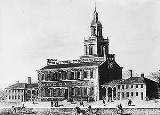
were situated at Independence Hall in Philadelphia. Under the authority of the Articles of Confederation
, the national government did not have direct control over the military, except in times of war, and was largely reliant on the use of state militias to enforce laws and keep order.
On June 17, 1783, Congress received a message from soldiers of the Continental Army
stationed in Philadelphia, which demanded payment for their service during the American Revolutionary War
. The soldiers threatened to take action that day if their complaints were not addressed. Congress ignored their message, but the soldiers did not act on their threat. Two days later, however, the Congress received word that a group of about 80 soldiers had left their post at Lancaster, Pennsylvania
, approximately 60 miles (96.6 km) west of Philadelphia, and had joined with the soldiers stationed at the city barracks. The group of approximately 500 men had effective control over the weapons stores and munition depot.
, then a delegate from New York
, persuaded the soldiers to allow Congress to meet later to address their concerns. The soldiers did allow the members of Congress to peacefully adjourn that afternoon. That evening, a small Congressional committee, headed by Hamilton, met in secret to draft a message to the Pennsylvania Council, asking them to protect Congress from the mutineers. The letter threatened that Congress would be forced to move elsewhere if the Council did not act.
On June 21, the Congressional committee met again at Independence Hall with members of the Pennsylvania Executive Council, including its president, John Dickinson
. The members of Congress asked the council to do more to protect the national government. Dickinson and the council agreed to consult with the militia commanders and reply to Congress the next day. The following morning, the Pennsylvania Council again refused Congress' request. Lacking sufficient assurances that the state would be willing to protect Congress, the members left Philadelphia that day for Princeton
, New Jersey
.
There are three reasons put forth as to why Dickinson and the Pennsylvania Council did not act. The Council's official reasoning was that they were unsure that the local militiamen would actually protect Congress from their fellow soldiers. Further, the council may have thought that the conflict was not as serious as Congress believed and that the mutiny could be resolved peacefully. The second theory put forth is that Dickinson, having been an officer in the militia, was sympathetic to the soldiers' grievances. The third theory is that the Council refused to allow Pennsylvania, a sovereign state, to be subjugated by the demands of a few members of Congress.
After Congress completed its business at Princeton in early November 1783, the capital was moved later that month to Annapolis, Maryland
, then to Trenton, New Jersey
in November 1784, and finally to New York City
in January 1785. It was not until the Constitutional Convention
in 1787 that delegates decided to meet again in Philadelphia. Pennsylvania's failure to protect the institutions of the national government, however, was a primary reason why the framers of the Constitution decided to create a federal district
, distinct from the states, where Congress could provide for its own security. The delegates therefore agreed in Article One, Section 8, of the United States Constitution
to give the Congress the power "to exercise exclusive legislation in all cases whatsoever, over such District (not exceeding ten miles square) as may, by cession of particular states, and the acceptance of Congress, become the seat of the government of the United States".
Following the ratification of the United States Constitution by the state of New York
in 1788, the delegates agreed to keep New York City as the temporary federal capital. In 1790, Congress passed the Residence Act
, which created the District of Columbia
, located on the banks Potomac River
between the states of Maryland
and Virginia
, to serve as the new federal capital. Robert Morris, a representative from Pennsylvania, convinced Congress to return to Philadelphia while the new permanent capital was being built. As a result, the Residence Act also declared Philadelphia to be the temporary capital for a period of 10 years. In a final attempt to convince Congress to keep the capital in Philadelphia, the city began construction on a new Presidential palace and an expansion to Congress Hall. However, their efforts failed, and the national government relocated from Philadelphia for the final time on May 14, 1800.
Continental Army
The Continental Army was formed after the outbreak of the American Revolutionary War by the colonies that became the United States of America. Established by a resolution of the Continental Congress on June 14, 1775, it was created to coordinate the military efforts of the Thirteen Colonies in...
in June 1783. The mutiny, and the refusal of the Executive Council of Pennsylvania
Supreme Executive Council of the Commonwealth of Pennsylvania
The Supreme Executive Council of the Commonwealth of Pennsylvania comprised the executive branch of the Pennsylvania State government between 1777 and 1790...
to stop it, ultimately resulted in Congress vacating Philadelphia and the creation of a federal district
Federal district
Federal districts are a type of administrative division of a federation, under the direct control of a federal government. They exist in various countries and states all over the world.-United States:...
to serve as the national capital.
Background
From March 1781, the Congress of the ConfederationCongress of the Confederation
The Congress of the Confederation or the United States in Congress Assembled was the governing body of the United States of America that existed from March 1, 1781, to March 4, 1789. It comprised delegates appointed by the legislatures of the states. It was the immediate successor to the Second...
and the Supreme Executive Council of the Commonwealth of Pennsylvania
Supreme Executive Council of the Commonwealth of Pennsylvania
The Supreme Executive Council of the Commonwealth of Pennsylvania comprised the executive branch of the Pennsylvania State government between 1777 and 1790...
were situated at Independence Hall in Philadelphia. Under the authority of the Articles of Confederation
Articles of Confederation
The Articles of Confederation, formally the Articles of Confederation and Perpetual Union, was an agreement among the 13 founding states that legally established the United States of America as a confederation of sovereign states and served as its first constitution...
, the national government did not have direct control over the military, except in times of war, and was largely reliant on the use of state militias to enforce laws and keep order.
On June 17, 1783, Congress received a message from soldiers of the Continental Army
Continental Army
The Continental Army was formed after the outbreak of the American Revolutionary War by the colonies that became the United States of America. Established by a resolution of the Continental Congress on June 14, 1775, it was created to coordinate the military efforts of the Thirteen Colonies in...
stationed in Philadelphia, which demanded payment for their service during the American Revolutionary War
American Revolutionary War
The American Revolutionary War , the American War of Independence, or simply the Revolutionary War, began as a war between the Kingdom of Great Britain and thirteen British colonies in North America, and ended in a global war between several European great powers.The war was the result of the...
. The soldiers threatened to take action that day if their complaints were not addressed. Congress ignored their message, but the soldiers did not act on their threat. Two days later, however, the Congress received word that a group of about 80 soldiers had left their post at Lancaster, Pennsylvania
Lancaster, Pennsylvania
Lancaster is a city in the south-central part of the Commonwealth of Pennsylvania. It is the county seat of Lancaster County and one of the older inland cities in the United States, . With a population of 59,322, it ranks eighth in population among Pennsylvania's cities...
, approximately 60 miles (96.6 km) west of Philadelphia, and had joined with the soldiers stationed at the city barracks. The group of approximately 500 men had effective control over the weapons stores and munition depot.
Protests
The next morning on June 20, Independence Hall was mobbed by as many as 400 soldiers demanding payment. The soldiers blocked the door and initially refused to allow the delegates to leave. Alexander HamiltonAlexander Hamilton
Alexander Hamilton was a Founding Father, soldier, economist, political philosopher, one of America's first constitutional lawyers and the first United States Secretary of the Treasury...
, then a delegate from New York
New York
New York is a state in the Northeastern region of the United States. It is the nation's third most populous state. New York is bordered by New Jersey and Pennsylvania to the south, and by Connecticut, Massachusetts and Vermont to the east...
, persuaded the soldiers to allow Congress to meet later to address their concerns. The soldiers did allow the members of Congress to peacefully adjourn that afternoon. That evening, a small Congressional committee, headed by Hamilton, met in secret to draft a message to the Pennsylvania Council, asking them to protect Congress from the mutineers. The letter threatened that Congress would be forced to move elsewhere if the Council did not act.
On June 21, the Congressional committee met again at Independence Hall with members of the Pennsylvania Executive Council, including its president, John Dickinson
John Dickinson (delegate)
John Dickinson was an American lawyer and politician from Philadelphia, Pennsylvania and Wilmington, Delaware. He was a militia officer during the American Revolution, a Continental Congressman from Pennsylvania and Delaware, a delegate to the U.S. Constitutional Convention of 1787, President of...
. The members of Congress asked the council to do more to protect the national government. Dickinson and the council agreed to consult with the militia commanders and reply to Congress the next day. The following morning, the Pennsylvania Council again refused Congress' request. Lacking sufficient assurances that the state would be willing to protect Congress, the members left Philadelphia that day for Princeton
Princeton, New Jersey
Princeton is a community located in Mercer County, New Jersey, United States. It is best known as the location of Princeton University, which has been sited in the community since 1756...
, New Jersey
New Jersey
New Jersey is a state in the Northeastern and Middle Atlantic regions of the United States. , its population was 8,791,894. It is bordered on the north and east by the state of New York, on the southeast and south by the Atlantic Ocean, on the west by Pennsylvania and on the southwest by Delaware...
.
Effect
- See also: List of capitals in the United States
There are three reasons put forth as to why Dickinson and the Pennsylvania Council did not act. The Council's official reasoning was that they were unsure that the local militiamen would actually protect Congress from their fellow soldiers. Further, the council may have thought that the conflict was not as serious as Congress believed and that the mutiny could be resolved peacefully. The second theory put forth is that Dickinson, having been an officer in the militia, was sympathetic to the soldiers' grievances. The third theory is that the Council refused to allow Pennsylvania, a sovereign state, to be subjugated by the demands of a few members of Congress.
After Congress completed its business at Princeton in early November 1783, the capital was moved later that month to Annapolis, Maryland
Annapolis, Maryland
Annapolis is the capital of the U.S. state of Maryland, as well as the county seat of Anne Arundel County. It had a population of 38,394 at the 2010 census and is situated on the Chesapeake Bay at the mouth of the Severn River, south of Baltimore and about east of Washington, D.C. Annapolis is...
, then to Trenton, New Jersey
Trenton, New Jersey
Trenton is the capital of the U.S. state of New Jersey and the county seat of Mercer County. As of the 2010 United States Census, Trenton had a population of 84,913...
in November 1784, and finally to New York City
New York City
New York is the most populous city in the United States and the center of the New York Metropolitan Area, one of the most populous metropolitan areas in the world. New York exerts a significant impact upon global commerce, finance, media, art, fashion, research, technology, education, and...
in January 1785. It was not until the Constitutional Convention
Philadelphia Convention
The Constitutional Convention took place from May 14 to September 17, 1787, in Philadelphia, Pennsylvania, to address problems in governing the United States of America, which had been operating under the Articles of Confederation following independence from...
in 1787 that delegates decided to meet again in Philadelphia. Pennsylvania's failure to protect the institutions of the national government, however, was a primary reason why the framers of the Constitution decided to create a federal district
Federal district
Federal districts are a type of administrative division of a federation, under the direct control of a federal government. They exist in various countries and states all over the world.-United States:...
, distinct from the states, where Congress could provide for its own security. The delegates therefore agreed in Article One, Section 8, of the United States Constitution
Article One of the United States Constitution
Article One of the United States Constitution describes the powers of Congress, the legislative branch of the federal government. The Article establishes the powers of and limitations on the Congress, consisting of a House of Representatives composed of Representatives, with each state gaining or...
to give the Congress the power "to exercise exclusive legislation in all cases whatsoever, over such District (not exceeding ten miles square) as may, by cession of particular states, and the acceptance of Congress, become the seat of the government of the United States".
Following the ratification of the United States Constitution by the state of New York
New York
New York is a state in the Northeastern region of the United States. It is the nation's third most populous state. New York is bordered by New Jersey and Pennsylvania to the south, and by Connecticut, Massachusetts and Vermont to the east...
in 1788, the delegates agreed to keep New York City as the temporary federal capital. In 1790, Congress passed the Residence Act
Residence Act
The Residence Act of 1790, officially titled An Act for establishing the temporary and permanent seat of the Government of the United States, is the United States federal law that settled the question of locating the capital of the United States, selecting a site along the Potomac River...
, which created the District of Columbia
Washington, D.C.
Washington, D.C., formally the District of Columbia and commonly referred to as Washington, "the District", or simply D.C., is the capital of the United States. On July 16, 1790, the United States Congress approved the creation of a permanent national capital as permitted by the U.S. Constitution....
, located on the banks Potomac River
Potomac River
The Potomac River flows into the Chesapeake Bay, located along the mid-Atlantic coast of the United States. The river is approximately long, with a drainage area of about 14,700 square miles...
between the states of Maryland
Maryland
Maryland is a U.S. state located in the Mid Atlantic region of the United States, bordering Virginia, West Virginia, and the District of Columbia to its south and west; Pennsylvania to its north; and Delaware to its east...
and Virginia
Virginia
The Commonwealth of Virginia , is a U.S. state on the Atlantic Coast of the Southern United States. Virginia is nicknamed the "Old Dominion" and sometimes the "Mother of Presidents" after the eight U.S. presidents born there...
, to serve as the new federal capital. Robert Morris, a representative from Pennsylvania, convinced Congress to return to Philadelphia while the new permanent capital was being built. As a result, the Residence Act also declared Philadelphia to be the temporary capital for a period of 10 years. In a final attempt to convince Congress to keep the capital in Philadelphia, the city began construction on a new Presidential palace and an expansion to Congress Hall. However, their efforts failed, and the national government relocated from Philadelphia for the final time on May 14, 1800.
External links
- Bibliography of the Continental Army in Pennsylvania compiled by the United States Army Center of Military History