


Pennsylvania-Reading Seashore Lines

Encyclopedia
Pennsylvania-Reading Seashore Lines was a railroad that operated in southern New Jersey
in the 20th century. It was created as a joint venture of the Pennsylvania Railroad
(PRR) and the Reading Company
(RDG).
and the South Jersey seashore
were major seaside vacation
destinations for the Philadelphia area
for both wealthy and working class
alike. The popularity of South Jersey's seashore was made possible by rail transport
providing inexpensive and fast service between the cities and towns where people lived, and the seashore where they played.
There were two competing railroad companies connecting Camden
(and by ferry
to Philadelphia), with the resorts of Southern New Jersey seashore.
Competition was fierce and by its height in the 1920s competition between the West Jersey and Seashore Railroad
(WJ&S, owned by the Pennsylvania) and the Atlantic City Railroad
(owned by the Reading) was so keen that at one time both lines boasted some of the fastest trains in the world.
Trains often raced one another so as to be the first to arrive at their destination. Racing was encouraged by the fact that in many areas, the two lines were only several hundred feet apart. On the Cape May lines, the trains were in sight of each other for 11 miles between Cape May Court House
and Cape May
. Over the last 5 miles into Cape May, the tracks were only 50 feet apart.
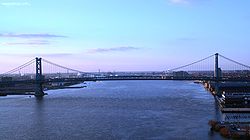
On July 1, 1926, the Benjamin Franklin Bridge
opened. It was originally called Delaware River Bridge, and spanned the Delaware River
, connecting Philadelphia
and Camden
. Car
, truck
and bus
usage increased as the State of New Jersey built roads in the 1920s and 30s next to the railroads going from Camden to the shore, cutting into profits
.
 On March 4, 1931, New Jersey's public utility
regulators
ordered the two companies to join their southern New Jersey lines into one company, The Consolidation Agreement had decreed that the Pennsylvania Railroad had two-thirds ownership, and the Reading Company had one-third ownership.
But the post-war
rise of the automobile and the Atlantic City Expressway
built in the 1960s not only caused people to abandon the railroad for their cars, but also to abandon Atlantic City for more exotic vacation destinations. By the late 1960s, the surviving former Camden and Atlantic Main Line was reduced to a commuter service funded by the New Jersey Department of Transportation
(NJDOT) running trains of Budd RDC railcars operating from a small terminal at Lindenwold
PATCO station and Atlantic City.
With both of its owners bankrupt, Penn Central, (successor to the PRR) and RDG, but not the P-RSL, Conrail took over the P-RSL on April 1, 1976.
. The WJ&S had lines coming from its Federal Street Terminal in Camden.
The "Main Line" ran to Atlantic City and to other shore points via Winslow Junction
, and its line via Woodbury
to Millville
. It was electrified
with 650 volt DC
third rail
and overhead lines
, with branches going to Salem
, and Deep Water Point from Woodbury, and Bridgeton
from Glassboro
.
While the WJ&S line via Woodbury was a pioneering example of railroad electrification, electric multiple unit
(MU) service between Newfield
and Atlantic City ended September 26, 1931. The PRSL only inherited the electrified Millville–Camden commuter rail service from WJ&S.
(ACRR).
The ACRR, a subsidiary of the Reading Company
, had one line from its Kaighn's Point Terminal going to Winslow Junction with lines splitting off to Atlantic City, Ocean City
, Wildwood
, and Cape May. Branch lines included the Gloucester Branch to Grenloch, and the Willamstown Branch from Willamstown Junction (on the Atlantic City Main) to Mullica Hill
to the south, and Atco
to the north.
On 15 July 1933, The WJ&S was leased by the ACRR, and changed its name to Pennsylvania-Reading Seashore Lines, as the Consolidation Agreement had decreed.
WJ&S. They all consisted of PRR classes.
Before dieselization the PRSL was more apt to lease its motive power from either of its parent railroads as it completely lacked any heavy passenger locomotives (like 4-6-2 Pacifics
). As its parent railroads began to replace steam with diesel locomotives the PRSL was used to let many displaced steam units run out their useful lives. Perhaps most notably, the late model Reading G3 class Pacific's were used on the Atlantic City main line commuter service in the mid 1950's.
While not operating on the PRSL proper, a number of iconic PRR steam locomotive types made their final runs into the PRSL terminal complex in downtown Camden, NJ. These included the last PRR K4 Pacific
, the last PRR E6
Atlantic and in 1959 the last PRR B6
class switcher, which was the last operating steam locomotive on the PRR system.
type was assigned class B, and was used in switcher
service.
"Atlantic" type was assigned class E. and was used in passenger service.
"Consolidation" type was assigned class H, and was used in freight service.
Since the Consolidation Agreement had decreed that the PRR Mechanical Department would oversee equipment policy decisions, the PRSL did not gain ownership of any ACRR-RDG locomotives.
Additional locomotives were leased as needed from PRSL's parent companies, PRR and RDG.
at the PRSL's Pavonia yard.
The first generation of PRSL diesel locomotives were all from the nearby Baldwin Locomotive Works
, which was the vendor of choice for the parent PRR in both the steam and early diesel era.
The PRSL's diesel locomotives were almost all painted in what is commonly referred to as Brunswick Green which was so dark it seemed almost black. The paint scheme was borrowed from its Pennsylvania railroad parent and with the PRR's official name for this color being DGLE (Dark Green Locomotive Enamel). The undercarriage of the locomotives were painted in black referred to as "True Black." A few of the first diesels were delivered in a lighter Ivy
Green, but were later re-painted.
Additional passenger cars were leased as needed from P-RSL's parent companies, PRR and RDG, and sometimes from the Central Railroad of New Jersey
(CNJ).
The PRSL did not own any of the P70’s that carried its name. They were leased from the WJ&S. The passenger cars of the P-RSL were painted Tuscan Red. This is a brick-colored shade of red.
The Main Line (Mile Post 0.0 to 57.9) 57.9 miles, is the former Camden and Atlantic line. It was the main passenger route from Camden and Philadelphia (via the Delair Bridge
Line) to Atlantic City (and Cape May via Winslow Junction and the Cape May Branch).
station in Lindenwold and Camden to the Delaware River Port Authority
for $2,150,000, in order to build the (PATCO) HiSpeedline. On January 14, 1966 the last train ran over the "Main Line" between Center Tower in Camden and Vernon Tower in West Haddonfield
, as result of PATCO construction. On October 1, 1969, service over Delair Bridge Line between Lindenwold and the Delair Bridge was abandoned, and passengers had to change to the PATCO High Speed Line at Lindenwold. Today it is known as NJ Transit's
Atlantic City Line
, and features restored direct to Philadelphia service over the Delair Bridge, as well as the New York–Atlantic City Atlantic City Express Service
.
.
.
.
power plant
located on the Delaware River.
New Jersey
New Jersey is a state in the Northeastern and Middle Atlantic regions of the United States. , its population was 8,791,894. It is bordered on the north and east by the state of New York, on the southeast and south by the Atlantic Ocean, on the west by Pennsylvania and on the southwest by Delaware...
in the 20th century. It was created as a joint venture of the Pennsylvania Railroad
Pennsylvania Railroad
The Pennsylvania Railroad was an American Class I railroad, founded in 1846. Commonly referred to as the "Pennsy", the PRR was headquartered in Philadelphia, Pennsylvania....
(PRR) and the Reading Company
Reading Company
The Reading Company , usually called the Reading Railroad, officially the Philadelphia and Reading Rail Road and then the Philadelphia and Reading Railway until 1924, operated in southeast Pennsylvania and neighboring states...
(RDG).
History
In the early 20th century, Atlantic CityAtlantic City, New Jersey
Atlantic City is a city in Atlantic County, New Jersey, United States, and a nationally renowned resort city for gambling, shopping and fine dining. The city also served as the inspiration for the American version of the board game Monopoly. Atlantic City is located on Absecon Island on the coast...
and the South Jersey seashore
Coast
A coastline or seashore is the area where land meets the sea or ocean. A precise line that can be called a coastline cannot be determined due to the dynamic nature of tides. The term "coastal zone" can be used instead, which is a spatial zone where interaction of the sea and land processes occurs...
were major seaside vacation
Holiday
A Holiday is a day designated as having special significance for which individuals, a government, or a religious group have deemed that observance is warranted. It is generally an official or unofficial observance of religious, national, or cultural significance, often accompanied by celebrations...
destinations for the Philadelphia area
Delaware Valley
The Delaware Valley is a term used to refer to the valley where the Delaware River flows, along with the surrounding communities. This includes the metropolitan area centered on the city of Philadelphia. Such educational institutions as Delaware Valley Regional High School in Alexandria Township...
for both wealthy and working class
Working class
Working class is a term used in the social sciences and in ordinary conversation to describe those employed in lower tier jobs , often extending to those in unemployment or otherwise possessing below-average incomes...
alike. The popularity of South Jersey's seashore was made possible by rail transport
Rail transport
Rail transport is a means of conveyance of passengers and goods by way of wheeled vehicles running on rail tracks. In contrast to road transport, where vehicles merely run on a prepared surface, rail vehicles are also directionally guided by the tracks they run on...
providing inexpensive and fast service between the cities and towns where people lived, and the seashore where they played.
There were two competing railroad companies connecting Camden
Camden, New Jersey
The city of Camden is the county seat of Camden County, New Jersey. It is located across the Delaware River from Philadelphia, Pennsylvania. As of the 2010 United States Census, the city had a total population of 77,344...
(and by ferry
Ferry
A ferry is a form of transportation, usually a boat, but sometimes a ship, used to carry primarily passengers, and sometimes vehicles and cargo as well, across a body of water. Most ferries operate on regular, frequent, return services...
to Philadelphia), with the resorts of Southern New Jersey seashore.
Competition was fierce and by its height in the 1920s competition between the West Jersey and Seashore Railroad
West Jersey and Seashore Railroad
The West Jersey and Seashore Railroad was a Pennsylvania Railroad subsidiary that became part of Pennsylvania-Reading Seashore Lines in 1933.-History:...
(WJ&S, owned by the Pennsylvania) and the Atlantic City Railroad
Atlantic City Railroad
The Atlantic City Railroad was a Philadelphia and Reading Railway subsidiary that became part of Pennsylvania-Reading Seashore Lines in 1933.- History :...
(owned by the Reading) was so keen that at one time both lines boasted some of the fastest trains in the world.
Trains often raced one another so as to be the first to arrive at their destination. Racing was encouraged by the fact that in many areas, the two lines were only several hundred feet apart. On the Cape May lines, the trains were in sight of each other for 11 miles between Cape May Court House
Cape May Court House, New Jersey
Cape May Court House is a census-designated place and unincorporated area located within Middle Township, in Cape May County, New Jersey. It is part of the Ocean City Metropolitan Statistical Area. As of the United States 2000 Census, the CDP population was 4,704...
and Cape May
Cape May, New Jersey
Cape May is a city at the southern tip of Cape May Peninsula in Cape May County, New Jersey, where the Delaware Bay meets the Atlantic Ocean and is one of the country's oldest vacation resort destinations. It is part of the Ocean City Metropolitan Statistical Area. As of the 2010 United States...
. Over the last 5 miles into Cape May, the tracks were only 50 feet apart.
On July 1, 1926, the Benjamin Franklin Bridge
Benjamin Franklin Bridge
The Benjamin Franklin Bridge , originally named the Delaware River Bridge, is a suspension bridge across the Delaware River connecting Philadelphia, Pennsylvania and Camden, New Jersey...
opened. It was originally called Delaware River Bridge, and spanned the Delaware River
Delaware River
The Delaware River is a major river on the Atlantic coast of the United States.A Dutch expedition led by Henry Hudson in 1609 first mapped the river. The river was christened the South River in the New Netherland colony that followed, in contrast to the North River, as the Hudson River was then...
, connecting Philadelphia
Philadelphia, Pennsylvania
Philadelphia is the largest city in the Commonwealth of Pennsylvania and the county seat of Philadelphia County, with which it is coterminous. The city is located in the Northeastern United States along the Delaware and Schuylkill rivers. It is the fifth-most-populous city in the United States,...
and Camden
Camden, New Jersey
The city of Camden is the county seat of Camden County, New Jersey. It is located across the Delaware River from Philadelphia, Pennsylvania. As of the 2010 United States Census, the city had a total population of 77,344...
. Car
Automobile
An automobile, autocar, motor car or car is a wheeled motor vehicle used for transporting passengers, which also carries its own engine or motor...
, truck
Truck
A truck or lorry is a motor vehicle designed to transport cargo. Trucks vary greatly in size, power, and configuration, with the smallest being mechanically similar to an automobile...
and bus
Bus
A bus is a road vehicle designed to carry passengers. Buses can have a capacity as high as 300 passengers. The most common type of bus is the single-decker bus, with larger loads carried by double-decker buses and articulated buses, and smaller loads carried by midibuses and minibuses; coaches are...
usage increased as the State of New Jersey built roads in the 1920s and 30s next to the railroads going from Camden to the shore, cutting into profits
Profit (accounting)
In accounting, profit can be considered to be the difference between the purchase price and the costs of bringing to market whatever it is that is accounted as an enterprise in terms of the component costs of delivered goods and/or services and any operating or other expenses.-Definition:There are...
.
Public utility
A public utility is an organization that maintains the infrastructure for a public service . Public utilities are subject to forms of public control and regulation ranging from local community-based groups to state-wide government monopolies...
regulators
Regulation
Regulation is administrative legislation that constitutes or constrains rights and allocates responsibilities. It can be distinguished from primary legislation on the one hand and judge-made law on the other...
ordered the two companies to join their southern New Jersey lines into one company, The Consolidation Agreement had decreed that the Pennsylvania Railroad had two-thirds ownership, and the Reading Company had one-third ownership.
But the post-war
World War II
World War II, or the Second World War , was a global conflict lasting from 1939 to 1945, involving most of the world's nations—including all of the great powers—eventually forming two opposing military alliances: the Allies and the Axis...
rise of the automobile and the Atlantic City Expressway
Atlantic City Expressway
The Atlantic City Expressway is a , controlled-access toll road in New Jersey, managed and operated by the South Jersey Transportation Authority...
built in the 1960s not only caused people to abandon the railroad for their cars, but also to abandon Atlantic City for more exotic vacation destinations. By the late 1960s, the surviving former Camden and Atlantic Main Line was reduced to a commuter service funded by the New Jersey Department of Transportation
New Jersey Department of Transportation
The New Jersey Department of Transportation is the agency responsible for transportation issues and policy in New Jersey. It is headed by the Commissioner of Transportation...
(NJDOT) running trains of Budd RDC railcars operating from a small terminal at Lindenwold
Lindenwold (NJT station)
Lindenwold Station is a New Jersey Transit train station in Lindenwold, New Jersey, United States on the Atlantic City Line. Eastbound service is offered to Atlantic City and Westbound service is offered to Philadelphia. The station is also the first station of the PATCO Speedline which also offers...
PATCO station and Atlantic City.
With both of its owners bankrupt, Penn Central, (successor to the PRR) and RDG, but not the P-RSL, Conrail took over the P-RSL on April 1, 1976.
West Jersey and Seashore Railroad
Effective May 4, 1896, the Pennsylvania Railroad consolidated all of it railroads and several smaller properties in Southern New Jersey into the West Jersey and Seashore RailroadWest Jersey and Seashore Railroad
The West Jersey and Seashore Railroad was a Pennsylvania Railroad subsidiary that became part of Pennsylvania-Reading Seashore Lines in 1933.-History:...
. The WJ&S had lines coming from its Federal Street Terminal in Camden.
The "Main Line" ran to Atlantic City and to other shore points via Winslow Junction
Winslow Township, New Jersey
As of the census of 2010, there were 39,599 people, 13,567 households, and 9,662 families residing in the township. The population density was 599.9 people per square mile . There were 12,413 housing units at an average density of 215.1 per square mile...
, and its line via Woodbury
Woodbury, New Jersey
Woodbury is a city in Gloucester County, New Jersey, in the United States. As of the United States 2000 Census, 10,307 residents were counted. Woodbury is the county seat of Gloucester County....
to Millville
Millville, New Jersey
Millville is a city in Cumberland County, New Jersey, United States. As of the 2000 United States Census, the city population was 26,847. Millville, Bridgeton and Vineland are the three principal New Jersey cities of the Vineland-Millville-Bridgeton Primary Metropolitan Statistical Area which...
. It was electrified
Railway electrification system
A railway electrification system supplies electrical energy to railway locomotives and multiple units as well as trams so that they can operate without having an on-board prime mover. There are several different electrification systems in use throughout the world...
with 650 volt DC
Direct current
Direct current is the unidirectional flow of electric charge. Direct current is produced by such sources as batteries, thermocouples, solar cells, and commutator-type electric machines of the dynamo type. Direct current may flow in a conductor such as a wire, but can also flow through...
third rail
Third rail
A third rail is a method of providing electric power to a railway train, through a semi-continuous rigid conductor placed alongside or between the rails of a railway track. It is used typically in a mass transit or rapid transit system, which has alignments in its own corridors, fully or almost...
and overhead lines
Overhead lines
Overhead lines or overhead wires are used to transmit electrical energy to trams, trolleybuses or trains at a distance from the energy supply point...
, with branches going to Salem
Salem, New Jersey
Salem is a city in Salem County, New Jersey, United States. As of the United States 2010 Census, the city population was 5,146. It is the county seat of Salem County, the most rural county in the state of New Jersey. The name Salem is related to the Hebrew word shalom, meaning "peace".The town and...
, and Deep Water Point from Woodbury, and Bridgeton
Bridgeton, New Jersey
Bridgeton is a city in Cumberland County, New Jersey, United States, in the south part of the state, on the Cohansey River, near Delaware Bay. As of the 2010 United States Census, the city population was 25,349. It is the county seat of Cumberland County...
from Glassboro
Glassboro, New Jersey
Glassboro is a borough in Gloucester County, New Jersey, United States. As of the United States 2000 Census, the borough population was 19,068....
.
While the WJ&S line via Woodbury was a pioneering example of railroad electrification, electric multiple unit
Multiple unit
The term multiple unit or MU is used to describe a self-propelled carriages capable of coupling with other units of the same or similar type and still being controlled from one driving cab. The term is commonly used to denote passenger trainsets consisting of more than one carriage...
(MU) service between Newfield
Newfield, New Jersey
Newfield is a Borough in Gloucester County, New Jersey, United States. As of the United States 2000 Census, the borough population was 1,616.Newfield was formed as a borough by an Act of the New Jersey Legislature on March 8, 1924, from portions of Franklin Township, based on the results of a...
and Atlantic City ended September 26, 1931. The PRSL only inherited the electrified Millville–Camden commuter rail service from WJ&S.
Atlantic City Railroad
Effective April 1, 1889, the Philadelphia and Reading Railway consolidated all of its railroads in Southern New Jersey into the Atlantic City RailroadAtlantic City Railroad
The Atlantic City Railroad was a Philadelphia and Reading Railway subsidiary that became part of Pennsylvania-Reading Seashore Lines in 1933.- History :...
(ACRR).
The ACRR, a subsidiary of the Reading Company
Reading Company
The Reading Company , usually called the Reading Railroad, officially the Philadelphia and Reading Rail Road and then the Philadelphia and Reading Railway until 1924, operated in southeast Pennsylvania and neighboring states...
, had one line from its Kaighn's Point Terminal going to Winslow Junction with lines splitting off to Atlantic City, Ocean City
Ocean City, New Jersey
Ocean City is a city in Cape May County, New Jersey, United States. It is the principal city of the Ocean City Metropolitan Statistical Area which encompasses all of Cape May County. As of the 2010 United States Census, the city population was 11,701...
, Wildwood
Wildwood, New Jersey
Wildwood is a city in Cape May County, New Jersey, United States. It is part of the Ocean City Metropolitan Statistical Area and is a popular summer resort destination. As of the 2010 United States Census, the city's year-round population was 5,325...
, and Cape May. Branch lines included the Gloucester Branch to Grenloch, and the Willamstown Branch from Willamstown Junction (on the Atlantic City Main) to Mullica Hill
Mullica Hill, New Jersey
Mullica Hill is a census-designated place and unincorporated area located within Harrison Township, in Gloucester County, New Jersey. As of the United States 2000 Census, Mullica Hill population was 1,658.-History:...
to the south, and Atco
Atco, New Jersey
Atco is an unincorporated area in Waterford Township in Camden County, New Jersey, United States, in the Philadelphia-Camden metropolitan area, located 16 miles southeast of Camden. The town is at the western edge of Wharton State Forest and the Pine Barrens. Atco is the home of the Atco Raceway,...
to the north.
On 15 July 1933, The WJ&S was leased by the ACRR, and changed its name to Pennsylvania-Reading Seashore Lines, as the Consolidation Agreement had decreed.
Steam locomotives
The 21 steam locomotives owned by the PRSL were from the PRR subsidiarySubsidiary
A subsidiary company, subsidiary, or daughter company is a company that is completely or partly owned and wholly controlled by another company that owns more than half of the subsidiary's stock. The subsidiary can be a company, corporation, or limited liability company. In some cases it is a...
WJ&S. They all consisted of PRR classes.
Before dieselization the PRSL was more apt to lease its motive power from either of its parent railroads as it completely lacked any heavy passenger locomotives (like 4-6-2 Pacifics
4-6-2
4-6-2, in the Whyte notation for the classification of steam locomotives, represents the wheel arrangement of four leading wheels on two axles , six powered and coupled driving wheels on three axles, and two trailing wheels on one axle .These locomotives are also known as Pacifics...
). As its parent railroads began to replace steam with diesel locomotives the PRSL was used to let many displaced steam units run out their useful lives. Perhaps most notably, the late model Reading G3 class Pacific's were used on the Atlantic City main line commuter service in the mid 1950's.
While not operating on the PRSL proper, a number of iconic PRR steam locomotive types made their final runs into the PRSL terminal complex in downtown Camden, NJ. These included the last PRR K4 Pacific
PRR K4s
The Pennsylvania Railroad's K4s 4-6-2 "Pacific" was their premier passenger-hauling steam locomotive from 1914 through the end of steam on the PRR in 1957....
, the last PRR E6
PRR E6
Class E6 on the Pennsylvania Railroad was the final type of 4-4-2 "Atlantic" locomotive built by the railroad, and second only to the Milwaukee Road's streamlined class A in size, speed and power. Although quickly ceding the crack trains to the larger K4s Pacifics, the E6 remained a popular...
Atlantic and in 1959 the last PRR B6
PRR B6
The Pennsylvania Railroad's class B6 was its most successful class of switcher, or as the PRR termed them, "shifter". The PRR preferred the 0-6-0 wheel arrangement for larger switchers, whereas on other roads the 0-8-0 gained preference...
class switcher, which was the last operating steam locomotive on the PRR system.
Class B: 0-6-0
The 0-6-00-6-0
Under the Whyte notation for the classification of steam locomotives, 0-6-0 represents the wheel arrangement of no leading wheels, six powered and coupled driving wheels on three axles, and no trailing wheels...
type was assigned class B, and was used in switcher
Switcher
A switcher or shunter is a small railroad locomotive intended not for moving trains over long distances but rather for assembling trains ready for a road locomotive to take over, disassembling a train that has been...
service.
- B-6sbPRR B6The Pennsylvania Railroad's class B6 was its most successful class of switcher, or as the PRR termed them, "shifter". The PRR preferred the 0-6-0 wheel arrangement for larger switchers, whereas on other roads the 0-8-0 gained preference...
- B8
Class E: 4-4-2
The 4-4-24-4-2 (locomotive)
Under the Whyte notation for the classification of steam locomotives, 4-4-2 represents the wheel arrangement of four leading wheels on two axles , four powered and coupled driving wheels on two axles, and two trailing wheels on one axle...
"Atlantic" type was assigned class E. and was used in passenger service.
- E-3sb
- E6sPRR E6Class E6 on the Pennsylvania Railroad was the final type of 4-4-2 "Atlantic" locomotive built by the railroad, and second only to the Milwaukee Road's streamlined class A in size, speed and power. Although quickly ceding the crack trains to the larger K4s Pacifics, the E6 remained a popular...
Class H: 2-8-0
The 2-8-02-8-0
Under the Whyte notation for the classification of steam locomotives, 2-8-0 represents the wheel arrangement of two leading wheels on one axle , eight powered and coupled driving wheels on four axles, and no trailing wheels...
"Consolidation" type was assigned class H, and was used in freight service.
- H-6sb
- H9s
- H10s
Since the Consolidation Agreement had decreed that the PRR Mechanical Department would oversee equipment policy decisions, the PRSL did not gain ownership of any ACRR-RDG locomotives.
Additional locomotives were leased as needed from PRSL's parent companies, PRR and RDG.
Diesel locomotives
Beginning in the 1950s the PRSL purchased a rather modest fleet of its own diesel locomotives to replace its steam engines for passenger and freight services. When additional power was needed for the busy summer tourist season engines were borrowed from the parent corporations (usually the PRR) as was true previously the with steam locomotives. To further supplement its small fleet the PRSL made increasing use of run through power on certain freight trains to large customers that didn't require classificationClassification yard
A classification yard or marshalling yard is a railroad yard found at some freight train stations, used to separate railroad cars on to one of several tracks. First the cars are taken to a track, sometimes called a lead or a drill...
at the PRSL's Pavonia yard.
The first generation of PRSL diesel locomotives were all from the nearby Baldwin Locomotive Works
Baldwin Locomotive Works
The Baldwin Locomotive Works was an American builder of railroad locomotives. It was located in Philadelphia, Pennsylvania, originally, and later in nearby Eddystone, Pennsylvania. Although the company was very successful as a producer of steam locomotives, its transition to the production of...
, which was the vendor of choice for the parent PRR in both the steam and early diesel era.
The PRSL's diesel locomotives were almost all painted in what is commonly referred to as Brunswick Green which was so dark it seemed almost black. The paint scheme was borrowed from its Pennsylvania railroad parent and with the PRR's official name for this color being DGLE (Dark Green Locomotive Enamel). The undercarriage of the locomotives were painted in black referred to as "True Black." A few of the first diesels were delivered in a lighter Ivy
Ivy
Ivy, plural ivies is a genus of 12–15 species of evergreen climbing or ground-creeping woody plants in the family Araliaceae, native to western, central and southern Europe, Macaronesia, northwestern Africa and across central-southern Asia east to Japan and Taiwan.-Description:On level ground they...
Green, but were later re-painted.
Baldwin Locomotive Works
| Builder Model designation/PRR Class | |Build month/year | |AAR wheel arrangement AAR wheel arrangement The AAR wheel arrangement system is a method of classifying locomotive wheel arrangements that was developed by the Association of American Railroads. It is essentially a simplification of the European UIC classification, and it is widely used in North America to describe diesel and electric... | Prime mover Prime mover (locomotive) In engineering, a prime mover is an engine that converts fuel to useful work. In locomotives, the prime mover is thus the source of power for its propulsion. The term is generally used when discussing any locomotive powered by an internal combustion engine... | Power output Horsepower Horsepower is the name of several units of measurement of power. The most common definitions equal between 735.5 and 750 watts.Horsepower was originally defined to compare the output of steam engines with the power of draft horses in continuous operation. The unit was widely adopted to measure the... | DRS-4-4-1500 / BS-15ms | † ‡ | 4/1950 | 608SC | 1500 hp | 6000-6005 |
|---|---|---|---|---|---|---|---|
| S-8 Baldwin S-8 The Baldwin S-8 was an 800-horsepower diesel-electric locomotive intended for use in yard switching. The Baldwin Locomotive Works produced a total of 54 units between 1951 and 1953. In addition, nine "calf" units were built for Oliver Iron Mining Company in Minnesota... / BS-8 |
฿ | 5/1951 | 1 | B-B | 606 | 800 hp | 6006 |
| AS-16 / BS-16ms | † ₡ ₣ | 3/1953 | 10 | B-B | 608A | 1600 hp | 6007-6016 |
| S-12 Baldwin S-12 The Baldwin S-12 was a 1,200-horsepower diesel-electric locomotive intended for use in yard switching. The Baldwin Locomotive Works produced a total of 451 units between 1951 and 1956... / BS-12 |
฿ | 606A | 1200 hp | 6017-6021 | |||
| AS-16 / BS-16m | † ₤ | 3/1953 | 2 | B-B | 608A | 1600 hp | 6022-6023 |
| AS-16 / BS-16ms | † ♦ | 11/1953 | 4 | B-B | 608A | 1600 hp | 6024-6027 |
| S-12 Baldwin S-12 The Baldwin S-12 was a 1,200-horsepower diesel-electric locomotive intended for use in yard switching. The Baldwin Locomotive Works produced a total of 451 units between 1951 and 1956... / BS-12m |
♥ | 606A | 1200 hp | 6028-6033 | |||
General Motors Electro-Motive Division (GM-EMD)
| Builder Model designation/PRR Class | |Build month/year | |AAR wheel arrangement AAR wheel arrangement The AAR wheel arrangement system is a method of classifying locomotive wheel arrangements that was developed by the Association of American Railroads. It is essentially a simplification of the European UIC classification, and it is widely used in North America to describe diesel and electric... | Prime mover Prime mover (locomotive) In engineering, a prime mover is an engine that converts fuel to useful work. In locomotives, the prime mover is thus the source of power for its propulsion. The term is generally used when discussing any locomotive powered by an internal combustion engine... | Power output Horsepower Horsepower is the name of several units of measurement of power. The most common definitions equal between 735.5 and 750 watts.Horsepower was originally defined to compare the output of steam engines with the power of draft horses in continuous operation. The unit was widely adopted to measure the... | GP38 EMD GP38 An EMD GP38 is a 4-axle diesel locomotive built by General Motors Electro-Motive Division between January 1966 and December 1971. Power was provided by an EMD 645 16-cylinder engine which generated .... / EF-20A | ♣ | 12/1967 | 5 | B-B | EMD 16-645E EMD 645 The EMD 645 family of diesel engines was designed and manufactured by the Electro-Motive Division of General Motors. Intended primarily for locomotive, marine and stationary engine use, one 16-cylinder version powered the 33-19 "Titan" prototype haul truck designed by GM's Terex... |
2,000 hp Horsepower Horsepower is the name of several units of measurement of power. The most common definitions equal between 735.5 and 750 watts.Horsepower was originally defined to compare the output of steam engines with the power of draft horses in continuous operation. The unit was widely adopted to measure the... (1.5 MW) |
2000–2004 |
|---|---|---|---|---|---|---|---|
| GP38 EMD GP38 An EMD GP38 is a 4-axle diesel locomotive built by General Motors Electro-Motive Division between January 1966 and December 1971. Power was provided by an EMD 645 16-cylinder engine which generated .... / EF-20A |
♣ | 3/1969 | 5 | B-B | EMD 16-645E EMD 645 The EMD 645 family of diesel engines was designed and manufactured by the Electro-Motive Division of General Motors. Intended primarily for locomotive, marine and stationary engine use, one 16-cylinder version powered the 33-19 "Titan" prototype haul truck designed by GM's Terex... |
2,000 hp Horsepower Horsepower is the name of several units of measurement of power. The most common definitions equal between 735.5 and 750 watts.Horsepower was originally defined to compare the output of steam engines with the power of draft horses in continuous operation. The unit was widely adopted to measure the... (1.5 MW) |
2005–2009 |
Note
- (♣) built with dual control stands, which required the front of the cab to be built out an extra foot to allow extra room in the cab.
Gas-electric car
Also known as a Doodlebug| Road Number | PRR Class | Builder | Builder Model | Built month/year | Power output | Note |
|---|---|---|---|---|---|---|
| 400 | OEW250A | Brill | 250A | 9/1926 | 250 | † |
| 401 | OEG350B | Pullman/Brill | 350B | 4/1929 | 350 2x175 | ‡ |
Budd Rail Diesel Car
| Model | Note | Built month/year | Total owned | Road Numbers |
|---|---|---|---|---|
| RDC-1 | # | 9/1950 - 6/1951 | 12 | M-402 - M-413 |
Passenger Cars
The P-RSL inherited the following from the WJ&S:- 71 PRR-Type P-70 passenger cars №'s 9865-9936 (steelSteelSteel is an alloy that consists mostly of iron and has a carbon content between 0.2% and 2.1% by weight, depending on the grade. Carbon is the most common alloying material for iron, but various other alloying elements are used, such as manganese, chromium, vanadium, and tungsten...
, 44 seats) - 21 PRR-Type PB-70 passenger-combines Cars №'s 9938-9958 (steel, 40 seats) 9959-9962 (steel, 40 seats)
- 17 various PRR-Type mail and baggage cars №'s 25 (steel underfame), 6403 (steel), 6428-6438 (steel), 9963-9966 (steel)
Additional passenger cars were leased as needed from P-RSL's parent companies, PRR and RDG, and sometimes from the Central Railroad of New Jersey
Central Railroad of New Jersey
The Central Railroad of New Jersey , commonly known as the Jersey Central Lines or CNJ, was a Class I railroad with origins in the 1830s, lasting until 1976 when it was absorbed into Conrail with the other bankrupt railroads of the Northeastern United States...
(CNJ).
The PRSL did not own any of the P70’s that carried its name. They were leased from the WJ&S. The passenger cars of the P-RSL were painted Tuscan Red. This is a brick-colored shade of red.
List
| Class | Note | Built month/year | Total owned | Road Numbers |
|---|---|---|---|---|
| ND | † ♥ | ?? | 21 | 203 - 224 |
| N-5 | † ‡ ♠ ♣ | 3/17 - 11/29 | 22 | 200 - 202, 225-242 |
| N-11E | ‡ ♦ | 9/69 | 3 | 250 - 252 |
Main Line
(From ETT No. 8-A. In effect 27 Oct, 1963)The Main Line (Mile Post 0.0 to 57.9) 57.9 miles, is the former Camden and Atlantic line. It was the main passenger route from Camden and Philadelphia (via the Delair Bridge
Delair Bridge
The Delair Bridge is a lift bridge carrying the New Jersey Transit Atlantic City Line and a former Conrail line, now a shared asset between Norfolk Southern Railway and CSX Transportation. It crosses the Delaware River between Philadelphia, Pennsylvania and Pennsauken Township, New Jersey, just...
Line) to Atlantic City (and Cape May via Winslow Junction and the Cape May Branch).
History
On April 3, 1964 the P-RSL sold the right of way between KirkwoodKirkwood, New Jersey
Kirkwood is an unincorporated area within Voorhees Township in Camden County, New Jersey, United States. Together with Voorhees and Kirkwood Voorhees, the area is served as United States Postal Service ZIP Code 08043....
station in Lindenwold and Camden to the Delaware River Port Authority
Delaware River Port Authority
The Delaware River Port Authority is a bi-state instrumentality created by a Congressionally approved interstate compact between the governments of the Commonwealth of Pennsylvania and the State of New Jersey...
for $2,150,000, in order to build the (PATCO) HiSpeedline. On January 14, 1966 the last train ran over the "Main Line" between Center Tower in Camden and Vernon Tower in West Haddonfield
Haddonfield, New Jersey
Haddonfield is a borough located in Camden County, New Jersey. As of the 2010 United States Census, the borough had a total population of 11,593....
, as result of PATCO construction. On October 1, 1969, service over Delair Bridge Line between Lindenwold and the Delair Bridge was abandoned, and passengers had to change to the PATCO High Speed Line at Lindenwold. Today it is known as NJ Transit's
New Jersey Transit rail operations
New Jersey Transit Rail Operations is the rail division of New Jersey Transit. It provides regional rail service in New Jersey, with most service centered around transportation to and from New York City, Hoboken, and Newark...
Atlantic City Line
Atlantic City Line
The Atlantic City Line is a rail line operated by New Jersey Transit between Philadelphia, Pennsylvania and Atlantic City, New Jersey, operating along the corridor of the White Horse Pike. It runs over trackage that was controlled by both the Pennsylvania Railroad and the Pennsylvania-Reading...
, and features restored direct to Philadelphia service over the Delair Bridge, as well as the New York–Atlantic City Atlantic City Express Service
Atlantic City Express Service
ACES is an inter-city train service offered by the Borgata, Caesars Atlantic City, and Harrah's Entertainment. It is operated by New Jersey Transit under contract, and funded by the Casino Reinvestment Development Authority...
.
Millville
The Millville Branch (Mile Post 0.0 to 41.2) is the former WJ&S, ex-West Jersey Railroad. The line runs from Camden via Woodbury and Glassboro to Millville. It was electrified during 1906 to 1949 with 650 volt DC third rail and overhead wire.Clementon
The Clementon Branch (Mile Post 2.8 to 25.9) is the former ACRR, ex-Philadelphia and Atlantic City Railway. The branch runs from Brown Tower in Camden via Clementon, New Jersey to Winslow Junction.Cape May
The Cape May Branch (Mile Post 25.9 to 80.0) 79.29 miles, is the former ACRR, ex-Seacoast Railroad. The branch runs from Winslow Junction via Tuckahoe to Cape May.Ocean City
The Ocean City Branch (Mile Post 53.8 to 66.8) is the former ACRR, ex-Ocean City Railroad. The branch runs from Tuckahoe to Ocean City at 10th StreetOcean City Tenth Street Station
Ocean City Tenth Street Station, is located in Ocean City, New Jersey. The station was built in 1898 by the Ocean City Railroad, which was acquired by the Atlantic City Railroad in 1901, and later by the Pennsylvania-Reading Seashore Lines...
.
Wildwood
The Wildwood Branch (Mile Post 72.5 to 76.5) 4.06 miles, is the former ACRR, ex-Wildwood and Delaware Bay Short Line Railroad. The branch runs from Wildwood Junction to Wildwood.Penns Grove
The Penns Grove Branch (Mile Post 8.8 to 32.7) is the former WJ&S, ex-Delaware River Railroad. The branch runs from Woodbury to Penns GrovePenns Grove, New Jersey
Penns Grove is a Borough in Salem County, New Jersey, United States. As of the 2000 United States Census, the borough population was 4,886.Penns Grove was incorporated as a borough by an Act of the New Jersey Legislature on March 8, 1894, from portions of Upper Penns Neck Township Penns Grove is a...
.
Manumuskin
The Manumuskin Secondary Track (Mile Post 41.2 to 48.5) is part of the former WJ&S, ex-Cape May and Millville Railroad from Millville to Manumuskin.Leesburg
The Leesburg Secondary Track (Mile Post 46.8 to 52.5 ) is the former WJ&S, ex-Maurice River Railroad from Manumuskin to LeesburgLeesburg, New Jersey
Leesburg is an unincorporated area within Maurice River Township in Cumberland County, New Jersey, United States. The area is served as United States Postal Service ZIP code 08327....
.
Williamstown
The Williamstown Secondary Track (Mile Post 18.2 to 25.7) is part of the former ACRR, ex-Williamstown and Delaware River Railroad, ex-Williamstown Railroad, from Glassboro to Williamstown.Grenloch
The Grenloch Secondary Track (Mile Post 2.8 to 13.4) 9.63 miles, is the former ACRR, ex-Camden, Gloucester & Mt Ephraim Railway, and Camden County Railroad. From Brown Tower in Camden to Grenloch. Its nickname is "The Peanut Line."Deepwater Point
The Deepwater Point Secondary Track (Mile Post 29.1 to 32.7) goes from the end of the Penns Grove Branch to the DeepwaterDeepwater, New Jersey
Deepwater is a community in Pennsville, in Salem County, New Jersey, lying at the east end of the Delaware Memorial Bridge. Deepwater is the location of the United States Postal Service area covering ZIP code 08023...
power plant
Power station
A power station is an industrial facility for the generation of electric energy....
located on the Delaware River.
Salem
The Salem Secondary Track (Mile Post 8.8 to 37.5) is the former WJ&S, ex-Salem Railroad from Woodbury to Salem.Woodbine
The Woodbine Secondary Track (Mile Post 56.8 to 60) is a short part of the former WJ&S, ex-Cape May and Millville Railroad. From Woodbine to Woodbine Junction.Newfield
The Newfield Secondary Track (Mile Post 47.7 to 64.4) is part of the former WJ&S, ex-West Jersey and Atlantic Railroad from Mays Landing to Atlantic City. At one time it was electrified with 600 volt DC third rail.Successor railroads
- Cape May Seashore LinesCape May Seashore LinesCape May Seashore Lines is a short line railroad in southern New Jersey. It offers two excursion services; a 30-mile round trip between Richland and Tuckahoe, and a 14-mile round trip between Rio Grande, Cold Spring Village, and Cape May City. The track is owned by New Jersey Transit and leased to...
(CMSL) - Conrail Shared Assets OperationsConrail Shared Assets OperationsConrail Shared Assets Operations is an American railroad company. It operates three networks—the North Jersey, South Jersey/Philadelphia, and Detroit Shared Assets Areas, where it serves as a local carrier and switching company for CSX Transportation and the Norfolk Southern Railway...
(CSAO) - New Jersey Transit Rail OperationsNew Jersey Transit rail operationsNew Jersey Transit Rail Operations is the rail division of New Jersey Transit. It provides regional rail service in New Jersey, with most service centered around transportation to and from New York City, Hoboken, and Newark...
(NJT) - PATCO Speedline (DRPA)
- SMS Rail Service (SLRS)
- Southern Railroad of New JerseySouthern Railroad of New JerseyThe Southern Railroad of New Jersey is a small short-line railroad company based in Winslow, New Jersey. Trains operate between Winslow Junction and Pleasantville and between Winslow Junction and Vineland...
(SRNJ) - Winchester and Western RailroadWinchester and Western RailroadThe Winchester and Western Railroad is a shortline railroad operating from Gore through Winchester, Virginia and West Virginia to Hagerstown, Maryland. It also operates several lines in southern New Jersey, connecting to Conrail Shared Assets Operations at Millville and Vineland...
(WW)
See also
- Atlantic City Express ServiceAtlantic City Express ServiceACES is an inter-city train service offered by the Borgata, Caesars Atlantic City, and Harrah's Entertainment. It is operated by New Jersey Transit under contract, and funded by the Casino Reinvestment Development Authority...
- Central Railroad of New JerseyCentral Railroad of New JerseyThe Central Railroad of New Jersey , commonly known as the Jersey Central Lines or CNJ, was a Class I railroad with origins in the 1830s, lasting until 1976 when it was absorbed into Conrail with the other bankrupt railroads of the Northeastern United States...
- Delair BridgeDelair BridgeThe Delair Bridge is a lift bridge carrying the New Jersey Transit Atlantic City Line and a former Conrail line, now a shared asset between Norfolk Southern Railway and CSX Transportation. It crosses the Delaware River between Philadelphia, Pennsylvania and Pennsauken Township, New Jersey, just...
- New Jersey Southern RailroadNew Jersey Southern Railroad- Raritan and Delaware Bay Railroad :The New Jersey Southern Railroad began life as the Raritan and Delaware Bay Railroad Company , in March 1854. The R&DB was chartered to construct a railroad from the Raritan Bay to Cape Island , near the outlet of the Delaware Bay. It was to form part of a...
- PATCO Speedline
- Pennsylvania RailroadPennsylvania RailroadThe Pennsylvania Railroad was an American Class I railroad, founded in 1846. Commonly referred to as the "Pennsy", the PRR was headquartered in Philadelphia, Pennsylvania....
- Reading CompanyReading CompanyThe Reading Company , usually called the Reading Railroad, officially the Philadelphia and Reading Rail Road and then the Philadelphia and Reading Railway until 1924, operated in southeast Pennsylvania and neighboring states...
- Shore Fast LineShore Fast LineThe Shore Fast Line was a line of fast trolley cars running from Atlantic City, New Jersey, to Ocean City, New Jersey, by way of the mainland communities of Pleasantville, Northfield, Linwood and Somers Point. The line ran from 1907 until 1948...
- 1922 Winslow Junction Train Derailment1922 Winslow Junction Train DerailmentOn July 2, 1922, Atlantic City Railroad's Camden to Atlantic City train № 33 the Owl going per hour sped through an open switch at Winslow Junction. 7 were killed, 89 were injured.-Accident:...
- 1896 Atlantic City rail crash1896 Atlantic City rail crashThe 1896 Atlantic City rail crash occurred soon after 6:30 pm on July 30, 1896 at a crossing just west of Atlantic City, New Jersey, crushing five loaded passenger coaches, killing 50 people and seriously injuring approximately 60.-Accident:...
Further reading
- Trans-Anglo Books By Rail to the Boardwalk (1986) Richard M. Gladulich ISBN 0-87046-076-5
- West Jersey Chapter-NRHS West Jersey Rails (1983) NRHS
- West Jersey Chapter-NRHS West Jersey Rails II (1985) NRHS
- West Jersey Chapter-NRHS West Jersey Rails III (2002) NRHS
- Crusader Press Pennsylvania-Reading Seashore Lines (1980) ISBN 0-937-156-02-7
- West Jersey Chapter-NRHS The Reading Seashore Lines (2007) LIbrary of Congress Control Number 2005936161
- West Jersey Chapter-NRHS Atlantic City Railroad (1980) Library of Congress Control Number 77-79997
- West Jersey Chapter-NRHS The Philadelphia Marlton and Medford Railroad Co. 1881 - 1931 (1973)
- West Jersey Chapter-NRHS The Trains to America's Playground (1988) Morning Sun Books Inc.
- Morning Sun Books Inc Pennsylvania-Reading Seashores Lines In Color (1996) ISBN 1-87887-57-2
- Morning Sun Books Inc Pennsylvania-Reading Seashores Lines In Color II (2009) . ISBN 1-87887-57-2
- Robert Stanton The Railroads of Camden New Jersey (2006)
- Robert Stanton Trolley Days in Camden New Jersey (2004)
External links
- Your # 1 source of Southern New Jersey Railroad History on the Internet!
- Pennsylvania-Reading Seashore Lines Historical Society
- Pennsylvania-Reading Seashore Lines EQUIPMENT ROSTER
- Seashore Lines Reading Company 1954 Freight Shippers' Guide - Pennsylvania-Reading Seashore Lines
- PRSL Photos
- PRSL Baldwin Diesels Photos