

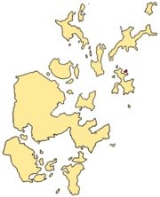
Papa Stronsay

Encyclopedia
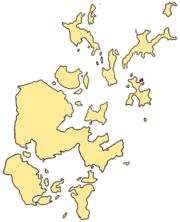
Papa Stronsay is a small island
in Orkney, Scotland
, lying north east of Stronsay
. It is 74 hectare (0.285715597358476 sq mi) in size, and 13 metres (43 ft) at its highest point.
According to folklore, some of the natives were descended from a female selkie
. This was because they had horny skin on their feet and hands, and permanently smelt of fish.
monastery may lie under it. It has been described as the most northerly early Christian monastery ever found. Other remains include cairn
s and a Burnt mound
, and a number of abandoned crofts.
The island is one of the "Papey"s or "islands of the papar
. Joseph Anderson noted that:
The Orkneyinga saga
recalls in Chapter XXXIV that Earl Rögnvald
was killed on Papa Stronsay in 1046:
Everyone agrees that of all the Earls of Orkney Rögnvald Brusason
was the most popular and gifted, and his death was mourned by many (Orkneyinga saga
Ch. XXIX).
Earl's Knowle on Papa Stronsay is traditionally thought to be the final resting place of Sir Patrick Spens. The history relating to the burial of Sir Patrick Spens
on Earl’s Knowle on Papa Stronsay is related by William Edmonstoune Aytoun
(b. Edinburgh 21 June 1813, d. 4 August 1865). He was made Sheriff and Lord Admiral of Orkney and Shetland in 1852. It was after his retirement from this position that he edited a collection of Scottish poetry in which the first poem is Sir Patrick Spens. In his forward to the poem Aytoun writes:
 A fertile island, it became an important centre for herring
curing
in the eighteenth century, but was abandoned in the 1970s.
The island was purchased by the monastic community of the Sons of the Most Holy Redeemer, [F.SS.R] in 1999. The traditional Catholic order was formerly affiliated with the Society of St. Pius X
, but since 2008 has been received into full communion with the Roman Catholic Church
. Their Golgotha Monastery, is the base for 25 monk
s, from novices to priests, who hail from as far afield as Australia
, Samoa
, South Africa
and Poland
. The monastery
has expanded to include a working farm
. The ancient monastic ruins dating back to the 7th and 8th centuries mark Papa Stronsay as a holy island and inspire the monks living there now to continue with the traditions of the Catholic Church and the Redemptorist Order, as well as to rebuild the ruins to their ancient splendour.
.
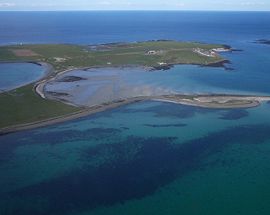
A thin tongue of land curls west from the main part of the island, and then south to form the Point of the Graand (a local word meaning a "sandbar"). The island in general is low lying, reaching a mere 13 metres (43 ft) at its highest point.
There is an 8 metres (26 ft) high light beacon in the north east.
Island
An island or isle is any piece of sub-continental land that is surrounded by water. Very small islands such as emergent land features on atolls can be called islets, cays or keys. An island in a river or lake may be called an eyot , or holm...
in Orkney, Scotland
Scotland
Scotland is a country that is part of the United Kingdom. Occupying the northern third of the island of Great Britain, it shares a border with England to the south and is bounded by the North Sea to the east, the Atlantic Ocean to the north and west, and the North Channel and Irish Sea to the...
, lying north east of Stronsay
Stronsay
Stronsay is an island in Orkney, off the north coast of Scotland. The main village is Whitehall, home to a heritage centre. It is in size, and at its highest point....
. It is 74 hectare (0.285715597358476 sq mi) in size, and 13 metres (43 ft) at its highest point.
According to folklore, some of the natives were descended from a female selkie
Selkie
Selkies are mythological creatures that are found in Faroese, Icelandic, Irish, and Scottish folklore....
. This was because they had horny skin on their feet and hands, and permanently smelt of fish.
History
The island has remains of two chapels. One dates from the eleventh century, and an eighth century PictishPicts
The Picts were a group of Late Iron Age and Early Mediaeval people living in what is now eastern and northern Scotland. There is an association with the distribution of brochs, place names beginning 'Pit-', for instance Pitlochry, and Pictish stones. They are recorded from before the Roman conquest...
monastery may lie under it. It has been described as the most northerly early Christian monastery ever found. Other remains include cairn
Cairn
Cairn is a term used mainly in the English-speaking world for a man-made pile of stones. It comes from the or . Cairns are found all over the world in uplands, on moorland, on mountaintops, near waterways and on sea cliffs, and also in barren desert and tundra areas...
s and a Burnt mound
Burnt mound
A burnt mound is an archaeological feature consisting of a mound of shattered stones and charcoal, normally with an adjacent hearth and trough. The trough could be rock-cut, wood-lined or clay-lined to ensure it was watertight...
, and a number of abandoned crofts.
The island is one of the "Papey"s or "islands of the papar
Papar
The Papar were, according to early Icelandic historical sources, a group of Irish or Scottish monks resident in parts of Iceland at the time of the arrival of the Norsemen...
. Joseph Anderson noted that:
- "The two Papeys, the great and the little (anciently Papey Meiri and Papey Minni), [are] now Papa WestrayPapa WestrayPapa Westray, also known as Papay, is one of the Orkney Islands in Scotland, with a population of 65 at the time of the 2001 Census, now increased to 70 people...
and Papa Stronsay... FordunJohn of FordunJohn of Fordun was a Scottish chronicler. It is generally stated that he was born at Fordoun, Mearns. It is certain that he was a secular priest, and that he composed his history in the latter part of the 14th century; and it is probable that he was a chaplain in the St Machar's Cathedral of...
in his enumeration of the islands, has a 'Papeay tertia' [third Papey], which is not now known. There are three islands in Shetland called Papey, and both in Orkney and in Shetland, there are several districts named Paplay or Papplay, doubtless the same as Papyli of IcelandIcelandIceland , described as the Republic of Iceland, is a Nordic and European island country in the North Atlantic Ocean, on the Mid-Atlantic Ridge. Iceland also refers to the main island of the country, which contains almost all the population and almost all the land area. The country has a population...
"
The Orkneyinga saga
Orkneyinga saga
The Orkneyinga saga is a historical narrative of the history of the Orkney Islands, from their capture by the Norwegian king in the ninth century onwards until about 1200...
recalls in Chapter XXXIV that Earl Rögnvald
Rognvald Brusason
Rognvald Brusason , son of Brusi Sigurdsson, was Earl of Orkney jointly with Thorfinn Sigurdsson from about 1037 onwards. His life is recorded in the Orkneyinga Saga....
was killed on Papa Stronsay in 1046:
- "Earl RögnvaldRognvald BrusasonRognvald Brusason , son of Brusi Sigurdsson, was Earl of Orkney jointly with Thorfinn Sigurdsson from about 1037 onwards. His life is recorded in the Orkneyinga Saga....
resided in KirkjuvágKirkwallKirkwall is the biggest town and capital of Orkney, off the coast of northern mainland Scotland. The town is first mentioned in Orkneyinga saga in the year 1046 when it is recorded as the residence of Rögnvald Brusason the Earl of Orkney, who was killed by his uncle Thorfinn the Mighty...
(Kirkwall) and brought there all necessaries for the winter; he had a great number of men, and much good cheer. A little before YuleYuleYule or Yuletide is a winter festival that was initially celebrated by the historical Germanic people as a pagan religious festival, though it was later absorbed into, and equated with, the Christian festival of Christmas. The festival was originally celebrated from late December to early January...
(ChristmasChristmasChristmas or Christmas Day is an annual holiday generally celebrated on December 25 by billions of people around the world. It is a Christian feast that commemorates the birth of Jesus Christ, liturgically closing the Advent season and initiating the season of Christmastide, which lasts twelve days...
), earl Rognvald fared with a great following into the Little Papey (Papa Stronsay) to fetch maltMaltMalt is germinated cereal grains that have been dried in a process known as "malting". The grains are made to germinate by soaking in water, and are then halted from germinating further by drying with hot air...
, to be brewed for Yule. And at even, as they were on the isle, they sate long over a roasting fire, and he who made up the fire spoke and said that the firewood began to fall short. Then the earl made a slip of the tongue, and these were the words he spoke: “Then are we full old when these fires are burnt out.” But he meant so to have spoken, that they would then be full warmed. And as soon as ever he found it out, he said “I have not made a slip of the tongue before this so that I call it to mind; it comes into my mind what king OlafOlaf II of NorwayOlaf II Haraldsson was King of Norway from 1015 to 1028. He was posthumously given the title Rex Perpetuus Norvegiae and canonised in Nidaros by Bishop Grimkell, one year after his death in the Battle of Stiklestad on 29 July 1030. Enshrined in Nidaros Cathedral...
my foster-father said at SticklesteadStiklestadStiklestad is a village and parish in the municipality of Verdal in Nord-Trøndelag county, Norway. It is located east of the municipal center of Verdalsøra and about southeast of Forbregd/Lein. The village is mainly known as the site of the Battle of Stiklestad on 29 July 1030...
when I took him up for a slip of the tongue: If it ever happens that I made a slip of the tongue I might make up my mind that I should then have but a short time unlived. May be that my kinsman Thorfinn is yet alive.” And just then they heard how that the homestead was girt round by men. There was come earl Thorfinn. They bore fire at once to the house, and laid up a pile of fuel before the doors. They allowed all to go out save the earl’s men. And when most of the men were drawn out, a man went out into the doorway in linen underclothes, and begged earl Thorfinn to stretch out his hand toward the deaconDeaconDeacon is a ministry in the Christian Church that is generally associated with service of some kind, but which varies among theological and denominational traditions...
. But that man rested his hands on the balk of wood across the doorway, and vaulted out over the balk and the ring of men, so that he came down ever so far off all of them, and was lost in the darkness of night. Thorfinn bade them hold on after him, and says there went earl Rognvald, “this is his nimbleness, and no one’s else.” Then they fared to hunt for him, and parted themselves into companies, and Thorkell fosterer went along the sea-shore to search. They heard how a dog barked among the rocks on the seashore. Earl Rognvald had his lap dogLap dogA lapdog or lap dog is a dog that is small enough to be held in the arms or lie comfortably on a person's lap. Lapdogs are not a specific breed, but is a generic term for a type of dog of small size and friendly disposition....
with him, and he betrayed the earl. They put him to death at once among the rocks, and it is the story of some men that Thorkell fosterer slew him, because there were no other men who would do it."
Everyone agrees that of all the Earls of Orkney Rögnvald Brusason
Rognvald Brusason
Rognvald Brusason , son of Brusi Sigurdsson, was Earl of Orkney jointly with Thorfinn Sigurdsson from about 1037 onwards. His life is recorded in the Orkneyinga Saga....
was the most popular and gifted, and his death was mourned by many (Orkneyinga saga
Orkneyinga saga
The Orkneyinga saga is a historical narrative of the history of the Orkney Islands, from their capture by the Norwegian king in the ninth century onwards until about 1200...
Ch. XXIX).
Earl's Knowle on Papa Stronsay is traditionally thought to be the final resting place of Sir Patrick Spens. The history relating to the burial of Sir Patrick Spens
Sir Patrick Spens
"Sir Patrick Spens" is one of the most popular of the Child Ballads , and is of Scottish origin.-Historicity:The events of the ballad are similar to, and may chronicle, an actual event: the bringing home of the Scottish queen Margaret, Maid of Norway across the North Sea in 1290...
on Earl’s Knowle on Papa Stronsay is related by William Edmonstoune Aytoun
William Edmonstoune Aytoun
William Edmondstoune Aytoun FRSE was a Scottish lawyer and poet.Born in Edinburgh, he was the only son of Joan Keith and Roger Aytoun , a writer to the signet, and was related to Sir Robert Aytoun...
(b. Edinburgh 21 June 1813, d. 4 August 1865). He was made Sheriff and Lord Admiral of Orkney and Shetland in 1852. It was after his retirement from this position that he edited a collection of Scottish poetry in which the first poem is Sir Patrick Spens. In his forward to the poem Aytoun writes:
- "“It is true that the name of Sir Patrick Spens is not mentioned in history; but I am able to state that tradition has preserved it. In the little island of Papa Stronsay, one of the Orcadian group, lying over against Norway, there is a large grave or tumulus, which has been known to the inhabitants, from time immemorial, as ‘The grave of Sir Patrick Spens’. The Scottish ballads were not early current in Orkney, a Scandinavian country; so it is very unlikely that the poem could have originated the name. The people know nothing beyond the traditional appellation of the spot, and they have no legend to tell. Spens is a Scottish, not a Scandinavian name. Is it, then, a forced conjecture, that the shipwreck took place off the iron bound coast of the northern islands, which did not then belong to the Crown of Scotland? ‘Half ower to AberdourAberdourAberdour is a scenic and historic village on the south coast of Fife, Scotland. It is on the north shore of the Firth of Forth, looking south to the island of Inchcolm and its Abbey, and to Leith and Edinburgh beyond. According to the 2006 population estimate, the village has a population of...
’ signifies nothing more than that the vessel went down half-way between Norway and the port of embarkation.”
Herring
Herring is an oily fish of the genus Clupea, found in the shallow, temperate waters of the North Pacific and the North Atlantic oceans, including the Baltic Sea. Three species of Clupea are recognized. The main taxa, the Atlantic herring and the Pacific herring may each be divided into subspecies...
curing
Curing (food preservation)
Curing refers to various food preservation and flavoring processes, especially of meat or fish, by the addition of a combination of salt, nitrates, nitrite or sugar. Many curing processes also involve smoking, the process of flavoring, or cooking...
in the eighteenth century, but was abandoned in the 1970s.
The island was purchased by the monastic community of the Sons of the Most Holy Redeemer, [F.SS.R] in 1999. The traditional Catholic order was formerly affiliated with the Society of St. Pius X
Society of St. Pius X
The Society of Saint Pius X is an international Traditionalist Catholic organisation, founded in 1970 by the French archbishop Marcel Lefebvre...
, but since 2008 has been received into full communion with the Roman Catholic Church
Roman Catholic Church
The Catholic Church, also known as the Roman Catholic Church, is the world's largest Christian church, with over a billion members. Led by the Pope, it defines its mission as spreading the gospel of Jesus Christ, administering the sacraments and exercising charity...
. Their Golgotha Monastery, is the base for 25 monk
Monk
A monk is a person who practices religious asceticism, living either alone or with any number of monks, while always maintaining some degree of physical separation from those not sharing the same purpose...
s, from novices to priests, who hail from as far afield as Australia
Australia
Australia , officially the Commonwealth of Australia, is a country in the Southern Hemisphere comprising the mainland of the Australian continent, the island of Tasmania, and numerous smaller islands in the Indian and Pacific Oceans. It is the world's sixth-largest country by total area...
, Samoa
Samoa
Samoa , officially the Independent State of Samoa, formerly known as Western Samoa is a country encompassing the western part of the Samoan Islands in the South Pacific Ocean. It became independent from New Zealand in 1962. The two main islands of Samoa are Upolu and one of the biggest islands in...
, South Africa
South Africa
The Republic of South Africa is a country in southern Africa. Located at the southern tip of Africa, it is divided into nine provinces, with of coastline on the Atlantic and Indian oceans...
and Poland
Poland
Poland , officially the Republic of Poland , is a country in Central Europe bordered by Germany to the west; the Czech Republic and Slovakia to the south; Ukraine, Belarus and Lithuania to the east; and the Baltic Sea and Kaliningrad Oblast, a Russian exclave, to the north...
. The monastery
Monastery
Monastery denotes the building, or complex of buildings, that houses a room reserved for prayer as well as the domestic quarters and workplace of monastics, whether monks or nuns, and whether living in community or alone .Monasteries may vary greatly in size – a small dwelling accommodating only...
has expanded to include a working farm
Farm
A farm is an area of land, or, for aquaculture, lake, river or sea, including various structures, devoted primarily to the practice of producing and managing food , fibres and, increasingly, fuel. It is the basic production facility in food production. Farms may be owned and operated by a single...
. The ancient monastic ruins dating back to the 7th and 8th centuries mark Papa Stronsay as a holy island and inspire the monks living there now to continue with the traditions of the Catholic Church and the Redemptorist Order, as well as to rebuild the ruins to their ancient splendour.
Geography and geology
The geology is middle old red sandstoneOld Red Sandstone
The Old Red Sandstone is a British rock formation of considerable importance to early paleontology. For convenience the short version of the term, 'ORS' is often used in literature on the subject.-Sedimentology:...
.
A thin tongue of land curls west from the main part of the island, and then south to form the Point of the Graand (a local word meaning a "sandbar"). The island in general is low lying, reaching a mere 13 metres (43 ft) at its highest point.
There is an 8 metres (26 ft) high light beacon in the north east.