

Nils Dacke

Encyclopedia
Småland
' is a historical province in southern Sweden.Småland borders Blekinge, Scania or Skåne, Halland, Västergötland, Östergötland and the island Öland in the Baltic Sea. The name Småland literally means Small Lands. . The latinized form Smolandia has been used in other languages...
, southern Sweden
Sweden
Sweden , officially the Kingdom of Sweden , is a Nordic country on the Scandinavian Peninsula in Northern Europe. Sweden borders with Norway and Finland and is connected to Denmark by a bridge-tunnel across the Öresund....
called the Dacke War
Dacke War
Dackefejden was a peasant uprising led by Nils Dacke in Småland, Sweden, in 1542 against the rule of Gustav Vasa. Dacke and his followers were dissatisfied with the heavy burden of the taxes, the introduction of lutheranism and the confiscations of the churches property...
(Swedish: Dackefejden), fought against the Swedish king Gustav I. It was the most widespread and serious civil war
Civil war
A civil war is a war between organized groups within the same nation state or republic, or, less commonly, between two countries created from a formerly-united nation state....
in Swedish history and almost toppled the king.
Background
Gustav Vasa had come to power at the head of a peasantPeasant
A peasant is an agricultural worker who generally tend to be poor and homeless-Etymology:The word is derived from 15th century French païsant meaning one from the pays, or countryside, ultimately from the Latin pagus, or outlying administrative district.- Position in society :Peasants typically...
army in 1523. He had established Sweden's independence from Denmark
Denmark
Denmark is a Scandinavian country in Northern Europe. The countries of Denmark and Greenland, as well as the Faroe Islands, constitute the Kingdom of Denmark . It is the southernmost of the Nordic countries, southwest of Sweden and south of Norway, and bordered to the south by Germany. Denmark...
and made Protestantism
Protestantism
Protestantism is one of the three major groupings within Christianity. It is a movement that began in Germany in the early 16th century as a reaction against medieval Roman Catholic doctrines and practices, especially in regards to salvation, justification, and ecclesiology.The doctrines of the...
the national religion. Småland found itself on the border between Sweden and Denmark and was hard hit by Vasa's ban on cross border trade. In addition, the hard-handed way the church was reformed and the increasing tax burden led to much dissatisfaction among the poor peasants. Already in 1536, Nils Dacke was tried at a local court for killing a sheriff
Sheriff
A sheriff is in principle a legal official with responsibility for a county. In practice, the specific combination of legal, political, and ceremonial duties of a sheriff varies greatly from country to country....
: according to court records he was fined 10 oxen.
The Dacke War
The uprising started in June 1542 with the assassination of more sheriffs and tax collectors. Gustav Vasa underestimated the military prowess of the peasants and sent his German mercenariesMercenary
A mercenary, is a person who takes part in an armed conflict based on the promise of material compensation rather than having a direct interest in, or a legal obligation to, the conflict itself. A non-conscript professional member of a regular army is not considered to be a mercenary although he...
to quell the revolt. The landsknecht
Landsknecht
Landsknechte were European, predominantly German mercenary pikemen and supporting foot soldiers from the late 15th to the late 16th century, and achieved the reputation for being the universal mercenary of Early modern Europe.-Etymology:The term is from German, Land "land, country" + Knecht...
s were, however, unsuited for battle in the rugged forests and suffered heavy losses. Dacke had devised defensive tactics that allowed the peasants to use their steel crossbow
Crossbow
A crossbow is a weapon consisting of a bow mounted on a stock that shoots projectiles, often called bolts or quarrels. The medieval crossbow was called by many names, most of which derived from the word ballista, a torsion engine resembling a crossbow in appearance.Historically, crossbows played a...
s with devastating effect. Dacke's successes helped spread the revolt over all the southern province
Province
A province is a territorial unit, almost always an administrative division, within a country or state.-Etymology:The English word "province" is attested since about 1330 and derives from the 13th-century Old French "province," which itself comes from the Latin word "provincia," which referred to...
s of Sweden. The situation was so serious that the king was forced to sue for peace, and a one-year ceasefire
Ceasefire
A ceasefire is a temporary stoppage of a war in which each side agrees with the other to suspend aggressive actions. Ceasefires may be declared as part of a formal treaty, but they have also been called as part of an informal understanding between opposing forces...
was signed on November 8. During the ceasefire, Dacke was the de facto ruler of southern Sweden and received (and declined) offers of foreign support. He reinstated the ceremonies of the Roman Catholic Church
Roman Catholic Church
The Catholic Church, also known as the Roman Catholic Church, is the world's largest Christian church, with over a billion members. Led by the Pope, it defines its mission as spreading the gospel of Jesus Christ, administering the sacraments and exercising charity...
and reopened the cross border trade in the areas under his control.
The king broke the ceasefire in January 1543 and sent a new and larger army into the rebellious area. Royal propaganda had been spread to win over the population and turn them against Dacke. Dacke himself had become overconfident after earlier successes and met the Royal army in a pitched battle
Pitched battle
A pitched battle is a battle where both sides choose to fight at a chosen location and time and where either side has the option to disengage either before the battle starts, or shortly after the first armed exchanges....
in March. The trained soldiers fighting on their own terms shattered the peasant army, and Dacke was severely injured. After this defeat, the rebellion was effectively over and Dacke became an outlaw
Outlaw
In historical legal systems, an outlaw is declared as outside the protection of the law. In pre-modern societies, this takes the burden of active prosecution of a criminal from the authorities. Instead, the criminal is withdrawn all legal protection, so that anyone is legally empowered to persecute...
.
Death
Dacke was shot and killed in the high summer of 1543 in the forests which, at the time, surrounded the southeastern border between Sweden and Denmark (nowadays southern Swedish provinces Småland and BlekingeBlekinge
' is one of the traditional provinces of Sweden , situated in the south of the country. It borders Småland, Scania and the Baltic Sea.The name "Blekinge" comes from the adjective bleke, which corresponds to the nautical term for "dead calm"....
). According to contemporary sources, he had been injured in both legs by hits from the king's crossbows during the decisive battle a few months earlier, his forces had been routed and he was likely trying to escape from the king's mercenaries. There is no doubt that he was killed on the spot.
Dacke was executed posthumously
Posthumous execution
Posthumous execution is the ritual or ceremonial mutilation of an already dead body as a punishment.-Examples:* Li Linfu, Chancellor of Tang China during the reign of Emperor Xuanzong in the latter years, was exhumed and executed for crimes of high treason by his rival Yang Guozhong for his...
, quartered, and his limbs were sent for public display in larger communities that had supported him during the rebellion. Gustav Vasa ordered the annihilation of Dacke's entire family, but showed some leniency against those who had given themselves up. Thus, the unity of the realm was restored.
As a result of the war the king was henceforth more careful when dealing with his subjects. The reliance on foreign mercenaries in the army was reduced in favour of soldier
Soldier
A soldier is a member of the land component of national armed forces; whereas a soldier hired for service in a foreign army would be termed a mercenary...
s of Swedish extraction (many of which were recruited in Småland) and this laid the foundation for Sweden's military successes in later wars.
Legacy
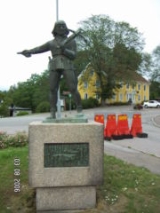
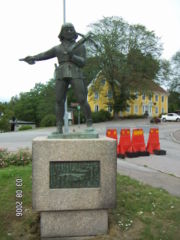
Today Nils Dacke is perceived as a Småland freedom hero. His name is often linked to an independence streak in Småland. Statues in memory of him have been erected including one in VirserumVirserum
Virserum is a locality situated in Hultsfred Municipality, Kalmar County, Sweden with 1,847 inhabitants in 2005. It was before 1971 a Köping. Today the town has around 2000 inhabitants...
, where the final battle allegedly took place during 1543. (Nils Dacke-partiet) is a local political party in Gnosjö
Gnosjö
Gnosjö is a locality and the seat of Gnosjö Municipality, Jönköping County, Sweden with 4,364 inhabitants in 2005, out of a municipal total of 9,600.-Famous people:* Morgan Nilsson* Uno Svenningsson* Maria Larsson...
County. M/S Nils Dacke is a vessel, owned by TT-Line serving the Trelleborg
Trelleborg
Trelleborg is a locality and the seat of Trelleborg Municipality, Skåne County, Sweden with 25,643 inhabitants in 2005. It is the southernmost town in Sweden.-History:...
-Travemünde
Travemünde
Travemünde is a borough of Lübeck, Germany, located at the mouth of the river Trave in Lübeck Bay. It began life as a fortress built by Henry the Lion, Duke of Saxony, in the 12th century to guard the mouth of the Trave, and the Danes subsequently strengthened it. It became a town in 1317 and in...
route. In 1961, a made for television movie titled Dacke, was released by Swedish director and screenwriter Bengt Lagerkvist.
Other sources
- Moberg, VilhelmVilhelm MobergKarl Artur Vilhelm Moberg was a Swedish author and historian, most commonly associated with his four novels known as The Emigrants Series.-Early life:...
History of The Swedish People (Heinemann. 1973) ISBN 978-0-434-47301-4 - Larsson, Lars-Olof Dackeland (Norstedt. 1979) ISBN 978-91-1-793312-8