


New Perspective on Paul

Encyclopedia
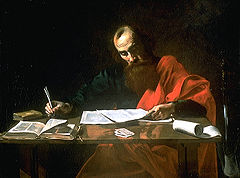
Description
Since the Protestant ReformationProtestant Reformation
The Protestant Reformation was a 16th-century split within Western Christianity initiated by Martin Luther, John Calvin and other early Protestants. The efforts of the self-described "reformers", who objected to the doctrines, rituals and ecclesiastical structure of the Roman Catholic Church, led...
(c. 1517), studies of Paul's writings
Pauline epistles
The Pauline epistles, Epistles of Paul, or Letters of Paul, are the thirteen New Testament books which have the name Paul as the first word, hence claiming authorship by Paul the Apostle. Among these letters are some of the earliest extant Christian documents...
have been heavily influenced by Lutheran and Reformed
Calvinism
Calvinism is a Protestant theological system and an approach to the Christian life...
views that are said to ascribe the negative attributes associated with sixteenth-century Roman Catholicism
Christianity in the 16th century
- Age of Discovery :During the Age of Discovery, the Roman Catholic Church established a number of Missions in the Americas and other colonies in order to spread Christianity in the New World and to convert the indigenous peoples...
to first-century Judaism. The said Lutheran and Reformed views on Paul's Writings are called the "old perspective" by adherents of the "New Perspective on Paul". Thus, the "new perspective" is an attempt to lift Paul's letters out of the Lutheran/Reformed framework and interpret them based on what is said to be an understanding of first-century Judaism, taken on its own terms. (Within this article, "the old perspective" refers specifically to Reformed and Lutheran traditions, especially the views descended from John Calvin
John Calvin
John Calvin was an influential French theologian and pastor during the Protestant Reformation. He was a principal figure in the development of the system of Christian theology later called Calvinism. Originally trained as a humanist lawyer, he broke from the Roman Catholic Church around 1530...
and Martin Luther
Martin Luther
Martin Luther was a German priest, professor of theology and iconic figure of the Protestant Reformation. He strongly disputed the claim that freedom from God's punishment for sin could be purchased with money. He confronted indulgence salesman Johann Tetzel with his Ninety-Five Theses in 1517...
, see also Law and Gospel
Law and Gospel
In Christianity the relationship between God's Law and the Gospel is a major topic in Lutheran and Reformed theology. In these traditions, the distinction between the doctrines of Law, which demands obedience to God's ethical will, and Gospel, which promises the forgiveness of sins in light of the...
.)
Paul, especially in his Epistle to the Romans, advocates justification through faith in Jesus Christ over justification through works of the Law. In the old perspective, Paul was understood to be arguing that Christians' good works would not factor into their salvation, only their faith. According to the new perspective, Paul was questioning only observances such as circumcision
Circumcision controversy in early Christianity
There is evidence of a controversy over religious male circumcision in Early Christianity. A Council of Jerusalem, possibly held in approximately 50 AD, decreed that male circumcision was not a requirement for Gentile converts. This became known as the "Apostolic Decree" and may be one of the...
and dietary laws, not good works
Good works
Good works, or simply works, within Christian theology are a person's actions or deeds, contrasting with interior qualities such as grace or faith.The New Testament exhibits a tension between two aspects of grace:...
in general.
Development
In 1963 the Lutheran theologian Krister StendahlKrister Stendahl
Krister Stendahl was a Swedish theologian and New Testament scholar, and Church of Sweden Bishop of Stockholm. He also served as professor and professor emeritus at Harvard Divinity School.-Life:...
published a paper arguing that the typical Lutheran view of the Apostle Paul’s theology did not fit with statements in Paul’s writings
Pauline epistles
The Pauline epistles, Epistles of Paul, or Letters of Paul, are the thirteen New Testament books which have the name Paul as the first word, hence claiming authorship by Paul the Apostle. Among these letters are some of the earliest extant Christian documents...
, and in fact was based more on mistaken assumptions about Paul’s beliefs
Pauline Christianity
Pauline Christianity is a term used to refer to the Christianity associated with the beliefs and doctrines espoused by Paul of Tarsus through his writings. Most of orthodox Christianity relies heavily on these teachings and considers them to be amplifications and explanations of the teachings of...
than careful interpretation of his writings.
In 1977 E. P. Sanders
E. P. Sanders
Ed Parish Sanders is a New Testament scholar, and is one of the principal proponents of the New Perspective on Paul. He has been Arts and Sciences Professor of Religion at Duke University, North Carolina, since 1990. He retired in 2005....
published Paul and Palestinian Judaism. In this work he performed an extensive study of Jewish literature and an analysis of Paul's writings in which he argued that the traditional Lutheran understanding of the theology of Judaism and Paul were fundamentally incorrect.
Sanders continued to publish books and articles in this field, and was soon joined by the scholar James D. G. Dunn. In 1982 Dunn labelled the movement "The New Perspective on Paul". The work of these writers inspired a large number of scholars to study, discuss, and debate the relevant issues. Many books and articles dealing with the issues raised have since been published. The Anglican Bishop and theologian N. T. Wright has written a large number of works aimed at popularising the new perspective outside of academia.
The new-perspective movement is closely connected with a surge of recent scholarly interest in studying the Bible in the context of other ancient texts, and the use of social-scientific methods to understand ancient culture. Scholars affiliated with The Context Group
The Context Group
The Context Group is a working group of international biblical scholars who promote research into the Bible using social-scientific methods such as anthropology and sociology...
. as well as many others in the field, have called for various reinterpretations of biblical texts based on their studies of the ancient world.
Main ideas
It is often noted that the singular title "the new perspective" gives an unjustified impression of unity. It is a field of study in which many scholars are actively pursuing research and continuously revising their own theories in light of new evidence, and who do not necessarily agree with each other on any given issue. It has been suggested by many that the plural title "the new perspectives" may therefore be more accurate. In 2003, N. T. Wright, distancing himself from both Sanders and Dunn, commented that "there are probably almost as many ‘new perspective’ positions as there are writers espousing it – and I disagree with most of them." There are certain trends and commonalities within the movement, but what is held in common is the belief that the "old perspective" (the Lutheran and Reformed interpretations of Paul of Tarsus and JudaismPaul of Tarsus and Judaism
The relationship between Paul of Tarsus and Second Temple Judaism continues to be the subject of much scholarly research, as it is thought that Paul played an important role in the relationship between Christianity and Judaism as a whole...
) is fundamentally incorrect. The following are some of the issues being widely discussed.
Works of the Law
Paul's letters contain a substantial amount of criticism of "works of the law". The radical difference in these two interpretations of what Paul meant by "works of the law" is the most consistent distinguishing feature between the two perspectives. The old perspective interprets this phrase as referring to human effort to do good works in order to meet God's standards (Works RighteousnessLegalism (theology)
Legalism, in Christian theology, is a sometimes-pejorative term referring to an over-emphasis on discipline of conduct, or legal ideas, usually implying an allegation of misguided rigour, pride, superficiality, the neglect of mercy, and ignorance of the grace of God or emphasizing the letter of...
). In this view, Paul is arguing against the idea that humans can merit salvation from God by their good works (note the New Perspective agrees that we cannot merit salvation- the issue is what exactly Paul is addressing).
By contrast, new-perspective scholars see Paul as talking about "badges of covenant membership" or criticizing Gentile believers who had begun to rely on the Torah to reckon Jewish kinship. It is argued that in Paul's time, Israelites were being faced with a choice of whether to continue to follow their ancestral customs, the Torah
Torah
Torah- A scroll containing the first five books of the BibleThe Torah , is name given by Jews to the first five books of the bible—Genesis , Exodus , Leviticus , Numbers and Deuteronomy Torah- A scroll containing the first five books of the BibleThe Torah , is name given by Jews to the first five...
('the ancestral customs'), or to follow the Roman Empire's trend to adopt Greek customs (Hellenization
Hellenization
Hellenization is a term used to describe the spread of ancient Greek culture, and, to a lesser extent, language. It is mainly used to describe the spread of Hellenistic civilization during the Hellenistic period following the campaigns of Alexander the Great of Macedon...
, see also Antinomianism
Antinomianism
Antinomianism is defined as holding that, under the gospel dispensation of grace, moral law is of no use or obligation because faith alone is necessary to salvation....
, Hellenistic Judaism
Hellenistic Judaism
Hellenistic Judaism was a movement which existed in the Jewish diaspora that sought to establish a Hebraic-Jewish religious tradition within the culture and language of Hellenism...
, and Circumcision controversy in early Christianity
Circumcision controversy in early Christianity
There is evidence of a controversy over religious male circumcision in Early Christianity. A Council of Jerusalem, possibly held in approximately 50 AD, decreed that male circumcision was not a requirement for Gentile converts. This became known as the "Apostolic Decree" and may be one of the...
). This is comparable with Westernization
Westernization
Westernization or Westernisation , also occidentalization or occidentalisation , is a process whereby societies come under or adopt Western culture in such matters as industry, technology, law, politics, economics, lifestyle, diet, language, alphabet,...
and the decision faced by modern individuals such as American Indians
Indigenous peoples of the Americas
The indigenous peoples of the Americas are the pre-Columbian inhabitants of North and South America, their descendants and other ethnic groups who are identified with those peoples. Indigenous peoples are known in Canada as Aboriginal peoples, and in the United States as Native Americans...
to follow their native culture or to adopt Western customs and lifestyle, see also Cultural imperialism
Cultural imperialism
Cultural imperialism is the domination of one culture over another. Cultural imperialism can take the form of a general attitude or an active, formal and deliberate policy, including military action. Economic or technological factors may also play a role...
. The new-perspective view is that Paul's writings discuss the comparative merits of following ancient Israelite
Torah
Torah- A scroll containing the first five books of the BibleThe Torah , is name given by Jews to the first five books of the bible—Genesis , Exodus , Leviticus , Numbers and Deuteronomy Torah- A scroll containing the first five books of the BibleThe Torah , is name given by Jews to the first five...
or ancient Greek customs. Paul is interpreted as being critical of a common Jewish view that following traditional Israelite customs make a person better off before God. Paul identifies customs he is concerned about as circumcision
Circumcision controversy in early Christianity
There is evidence of a controversy over religious male circumcision in Early Christianity. A Council of Jerusalem, possibly held in approximately 50 AD, decreed that male circumcision was not a requirement for Gentile converts. This became known as the "Apostolic Decree" and may be one of the...
, dietary laws, and observance of special days.
Human effort and good works
Due to their interpretation of the phrase "works of the law", old-perspective theologians see Paul's rhetoric as being against human effort to earn righteousness. This is often cited by Lutheran and Reformed theologians as a central feature of the Christian religion, and the concepts of grace aloneSola gratia
Sola gratia is one of the five solas propounded to summarise the Reformers' basic beliefs during the Protestant Reformation; it is a Latin term meaning grace alone...
and faith alone
Sola fide
Sola fide , also historically known as the doctrine of justification by faith alone, is a Christian theological doctrine that distinguishes most Protestant denominations from Catholicism, Eastern Christianity, and some in the Restoration Movement.The doctrine of sola fide or "by faith alone"...
are of great importance within the creeds of these denominations.
New-perspective interpretations of Paul tend to result in Paul having nothing negative to say about the idea of human effort or good works, and saying many positive things about both. New-perspective scholars point to the many statements in Paul's writings that specify the criteria of final judgment
Last Judgment
The Last Judgment, Final Judgment, Day of Judgment, Judgment Day, or The Day of the Lord in Christian theology, is the final and eternal judgment by God of every nation. The concept is found in all the Canonical gospels, particularly the Gospel of Matthew. It will purportedly take place after the...
as being the works of the individual.
"Final Judgment According to Works... was quite clear for Paul (as indeed for Jesus). Paul, in company with mainstream second-Temple Judaism, affirms that God’s final judgment will be in accordance with the entirety of a life led – in accordance, in other words, with works." (N. T. Wright)
Wright however does not hold the view that good works contribute to one's salvation but rather that the final judgement is something we can look forward to as a future vindication of God's present declaration of our righteousness. In other words our works are a result of our salvation and the future judgement will show that. Others tend to place a higher value on the importance of good works than the old perspective does, taking the view that they causally contribute to the salvation of the individual.
Old-perspective advocates often see this as being "salvation by works" and as a bad thing, contradicting fundamental tenets of Christianity. New-perspective scholars often respond that their views are not so different. For in the old perspective, God graciously empowers the individual to the faith which leads to salvation and also to good works, while in the new perspective God graciously empowers individuals to the faith and good works, which lead to salvation.
See also synergy
Synergy
Synergy may be defined as two or more things functioning together to produce a result not independently obtainable.The term synergy comes from the Greek word from , , meaning "working together".-Definitions and usages:...
in theosis
Theosis
In Christian theology, divinization, deification, making divine or theosis is the transforming effect of divine grace. This concept of salvation is historical and fundamental for Christian understanding that is prominent in the Eastern Orthodox Church and also in the Catholic Church, and is a...
in the Eastern Orthodox Church
Eastern Orthodox Church
The Orthodox Church, officially called the Orthodox Catholic Church and commonly referred to as the Eastern Orthodox Church, is the second largest Christian denomination in the world, with an estimated 300 million adherents mainly in the countries of Belarus, Bulgaria, Cyprus, Georgia, Greece,...
and Orthopraxy in Christianity.
Faith, or faithfulness
An ongoing debate related to the new perspective has been over Paul's use of the Greek word pistis (πίστις, meaning "trust," "belief," "faith," or "faithfulness"). Old-perspective writers have typically interpreted this word as meaning a belief in God and ChristFaith in Christianity
Faith, in Christianity, has been most commonly defined by the biblical formulation in the Letter to the Hebrews as "'the assurance of things hoped for, the conviction of things not seen". Most of the definitions in the history of Christian theology have followed this biblical formulation...
, and trust in Christ for salvation with faith that he will save you. This interpretation is based on several passages from the Christian Bible, notably Ephesians 2:8-9, which reads "For by grace you have been saved through faith. And this is not your own doing; it is the gift of God, not as a result of works, so that no one may boast." Interestingly, E. P. Sanders
E. P. Sanders
Ed Parish Sanders is a New Testament scholar, and is one of the principal proponents of the New Perspective on Paul. He has been Arts and Sciences Professor of Religion at Duke University, North Carolina, since 1990. He retired in 2005....
, a major figure in the development of the "new perspective of Paul", himself notes that Ephesians 2:9 teaches the traditional (or "old") perspective.
By contrast, many recent studies of the Greek word pistis have concluded that its primary and most common meaning was faithfulness, meaning firm commitment in an interpersonal relationship. As such, the word could be almost synomymous with "obedience" when the people in the relationship held different status levels (e.g. a slave being faithful to his master). Far from being equivalent to 'lack of human effort', the word seems to imply and require human effort. The interpretation of Paul's writings that we need to "faithfully" obey God's commands is quite different to one which sees him saying that we need to have "faith" that he will do everything for us. This is also argued to explain why James was adamant that "faith without works is dead" and that "a man is saved by works, and not by faith alone," while also saying that to merely believe places one on the same level as the demons (see James 2). The New Perspective argues that James was concerned with those who were trying to reduce faith to an intellectual subscription without any intent to follow God or Jesus, and that Paul always intended "faith" to mean a full submission to God.
Another related issue is the pistis Christou ('faith of Christ') debate. Paul several times uses this phrase at key points in his writings and it is linguistically ambiguous as to whether it refers to our faith in Christ ("objective genitive"), or Christ's own faithfulness to God ("subjective genitive"), or even our faith/faithfulness to God like that which Christ had ("adjectival genitive"). There is wide disagreement within the academic community over which of these is the best rendering. The NET Bible translation became the first mainstream English Bible translation to use a subjective genitive translation of this phrase.
Grace, or favor
Old-perspective writers have generally translated the Greek word charis as "grace" and understood it to refer to the idea that there is a lack of human effort in salvation because God is the controlling factor. However those who study ancient Greek culture have pointed out that "favor" is a better translation, as the word refers normally to 'doing a favor'. In ancient societies there was the expectation that such favors be repaid, and this semi-formal system of favors acted like loans. Therefore, it is argued that when Paul speaks of how God did us a 'favor' by sending Jesus, he is saying that God took the initiative, but is not implying a lack of human effort in salvation, and is in fact implying that Christians have an obligation to repay the favor God has done for them. Some argue that this view then undermines the initial 'favor' — of sending Jesus — by saying that, despite his incarnation, life and death, Christians still have, as before, to earn their way to heaven. However, others note this is the horns of a false dilemmaFalse dilemma
A false dilemma is a type of logical fallacy that involves a situation in which only two alternatives are considered, when in fact there are additional options...
(all grace versus all works). Many new-perspective proponents that see "charis" as "favor" do not teach that Christians earn their way to heaven outside of the death of Christ. Forgiveness of sins through the blood of Christ is still necessary to salvation. But, that forgiveness demands effort on the part of the individual (cf. Paul in Phil. 3:12-16).
The Atonement
For old-perspective writers the atonement theory of Penal SubstitutionPenal substitution
Penal substitution is a theory of the atonement within Christian theology, developed with the Reformed tradition. It argues that Christ, by his own sacrificial choice, was punished in the place of sinners , thus satisfying the demands of justice so God can justly forgive the sins...
and the belief in the "finished work" of Christ have been central. New-perspective writers have regularly questioned whether this view is really of such central importance in Paul's writings. Generally new-perspective writers have argued that other theories of the atonement are more central to Paul's thinking, but there has been minimal agreement among them as to what Paul's real view of the atonement might be.
The following is a broad sample of different views advocated by various scholars. E. P. Sanders argued that Paul's central idea was that we mystically spiritually participate in the risen Christ and that all Paul's judicial language was subordinate to the participationary language. N. T. Wright has argued that Paul sees Israel as representative of humanity and taking onto itself the sinfulness of humanity through history. Jesus, in turn, as Messiah is representative of Israel and so focuses the sins of Israel on himself on the cross. Wright's view is thus a "historicized" form of Penal Substitution. Chris VanLandingham has argued that Paul sees Christ as having defeated the Devil and as teaching humans how God wants them to live and setting them an example. David Brondos has argued that Paul sees Jesus as just a part in a wider narrative in which the Church is working to transform lives of individuals and the world, and that Paul's participatory language should be understood in an ethical sense (humans living Christ-like lives) rather than mystically as Sanders thought. Pilch and Malina take the view that Paul holds to the Satisfaction theory of atonement. Stephen Finlan holds that Paul uses numerous different metaphors to describe the atonement but that he fundamentally sees Christ as a martyr and holds that humans are to be divinely transformed into the image of God through Christ (Theosis
Theosis
In Christian theology, divinization, deification, making divine or theosis is the transforming effect of divine grace. This concept of salvation is historical and fundamental for Christian understanding that is prominent in the Eastern Orthodox Church and also in the Catholic Church, and is a...
).
Criticism and rhetoric
The new perspective has been an extremely controversial subject and has drawn strong arguments and recriminations from both sides of the debate.In 2003 Steve Chalke
Steve Chalke
Steve Chalke, is an ordained Baptist minister who is a prominent, and often outspoken, Christian leader and social activist based in the UK. He is the author of numerous books and articles as well as a regular presenter and contributor on television and radio programmes...
, after being influenced by new-perspective writers, published a book targeted at a popular audience which made comments highly critical of the penal substitution
Penal substitution
Penal substitution is a theory of the atonement within Christian theology, developed with the Reformed tradition. It argues that Christ, by his own sacrificial choice, was punished in the place of sinners , thus satisfying the demands of justice so God can justly forgive the sins...
theory of the atonement. This caused an extensive and ongoing controversy among Evangelicals in Britain, with a strong backlash from lay-people and advocates of the Lutheran and Reformed
Calvinism
Calvinism is a Protestant theological system and an approach to the Christian life...
traditions.
Both sides of the debate attempt to claim the higher, and more accurate, view of scripture. New-perspective advocates claim that old-perspective supporters are too committed to historic Protestant
Protestant Reformation
The Protestant Reformation was a 16th-century split within Western Christianity initiated by Martin Luther, John Calvin and other early Protestants. The efforts of the self-described "reformers", who objected to the doctrines, rituals and ecclesiastical structure of the Roman Catholic Church, led...
tradition, and therefore fail to take a 'natural' reading of the Bible; while old-perspectivists claim that new-perspective advocates are too intrigued by certain interpretations of context and history, which then lead to a biased hermeneutical approach to the text.
The new perspective has been heavily criticized by conservative scholars in the Reformed tradition, arguing that it undermines the classical, individualistic, Augustinian interpretation of election and does not faithfully reflect the teachings of their founding theologian, John Calvin
John Calvin
John Calvin was an influential French theologian and pastor during the Protestant Reformation. He was a principal figure in the development of the system of Christian theology later called Calvinism. Originally trained as a humanist lawyer, he broke from the Roman Catholic Church around 1530...
(as N. T. Wright had asserted). It has been the subject of fierce debate among Evangelicals in recent years, mainly due to N. T. Wright's increasing popularity in evangelical
Evangelicalism
Evangelicalism is a Protestant Christian movement which began in Great Britain in the 1730s and gained popularity in the United States during the series of Great Awakenings of the 18th and 19th century.Its key commitments are:...
circles. Its most outspoken critics include Calvinists John Piper
John Piper (theologian)
John Stephen Piper is a Christian preacher and author, currently serving as Pastor for Preaching and Vision of Bethlehem Baptist Church in Minneapolis, Minnesota...
, Sinclair Ferguson
Sinclair Ferguson
Sinclair Ferguson is a Scottish theologian known in Reformed Christian circles for his teaching, writing, and editorial work. He is currently a professor at Redeemer Seminary in Dallas.-Career:Ferguson received his Ph.D...
, C. W. Powell, Mark Seifrid, D. A. Carson, Tom Holland, Ligon Duncan
Ligon Duncan
J. Ligon Duncan III is an American Southern Presbyterian scholar and pastor.-Early life and education:Duncan is native to Greenville, South Carolina. His father, J. Ligon Duncan, Jr. was an eighth-generation Southern Presbyterian ruling elder. He had a small commercial printing company, still in...
. Barry D. Smith has claimed that the New Perspective's challenge to the traditional view of Jewish faith practice as legalistic
Legalism (theology)
Legalism, in Christian theology, is a sometimes-pejorative term referring to an over-emphasis on discipline of conduct, or legal ideas, usually implying an allegation of misguided rigour, pride, superficiality, the neglect of mercy, and ignorance of the grace of God or emphasizing the letter of...
is misplaced.
Catholic and Orthodox reactions
The new perspective has, by and large, been an internal debate among Protestant scholars. Roman Catholic and Eastern Orthodox writers have generally responded favorably to new-perspective ideas, seeing both a greater commonality with their own beliefs and seeing strong similarities with the views of many of the early Church FathersChurch Fathers
The Church Fathers, Early Church Fathers, Christian Fathers, or Fathers of the Church were early and influential theologians, eminent Christian teachers and great bishops. Their scholarly works were used as a precedent for centuries to come...
. Former Protestant and one-time adherent to the New Perspective, Taylor Marshall, published the first Catholic response to the New Perspective on Paul, entitled The Catholic Perspective on Paul (2010). Marshall draws out the continuity and discontinuities between the Protestant New Perspective and the traditional Catholic doctrines of the Council of Trent by emphasizing the doctrine of participation and the believer's union with Christ. From this Catholic point of view, the New Perspective is seen as a step toward the progressive reality of human salvation in Christ. Moreover, passages in the works of many early Church Fathers show that new-perspective-style interpretations were widely held among them.
One of the many exceptions is the influential Augustine of Hippo
Augustine of Hippo
Augustine of Hippo , also known as Augustine, St. Augustine, St. Austin, St. Augoustinos, Blessed Augustine, or St. Augustine the Blessed, was Bishop of Hippo Regius . He was a Latin-speaking philosopher and theologian who lived in the Roman Africa Province...
. While most in the Roman Catholic and Eastern Orthodox schools would see him as espousing a view of grace and justification in keeping with this new perspective, Augustine is blamed by some for introducing incorrect ideas (some Orthodox would agree that Augustine erred on these ideas, and introduced novelties into the teachings of the Church Fathers).
The increased importance new-perspective writers have given to good works in salvation has created strong common ground with the Roman Catholic and Eastern Orthodox churches. Historic Protestantism
Protestantism
Protestantism is one of the three major groupings within Christianity. It is a movement that began in Germany in the early 16th century as a reaction against medieval Roman Catholic doctrines and practices, especially in regards to salvation, justification, and ecclesiology.The doctrines of the...
has never denied that there is a place for good and faithful works, but has always excluded them from justification
Justification (theology)
Rising out of the Protestant Reformation, Justification is the chief article of faith describing God's act of declaring or making a sinner righteous through Christ's atoning sacrifice....
and salvation, which Protestants argue is through faith alone, and in which good deeds are of no account, either within or without God's grace. This has, since the Reformation
Protestant Reformation
The Protestant Reformation was a 16th-century split within Western Christianity initiated by Martin Luther, John Calvin and other early Protestants. The efforts of the self-described "reformers", who objected to the doctrines, rituals and ecclesiastical structure of the Roman Catholic Church, led...
, been a line of distinction between Protestantism (both Reformed and Lutheran) and other Christian communions.
Further Reading
- Badenas, Robert, Christ the End of the Law, Romans 10.4 in Pauline Perspective, 1985. ISBN 0-905774-93-0
- Dunn, James D. G., "The New Perspective on Paul", in: Jesus, Paul and the Law, 1990. ISBN 0-664-25095-5
- Gathercole, Simon J.Simon J. GathercoleSimon Gathercole is a New Testament scholar, Senior Lecturer in New Testament Studies and Director of Studies at Fitzwilliam College, Cambridge University. He was formerly Senior Lecturer in New Testament at the University of Aberdeen, Scotland for seven years. Gathercole received an MA at...
, Where Is Boasting? Early Jewish Soteriology and Paul's Response in Romans 1–5, 2002. ISBN 0-8028-3991-6 - Irons, Lee, Seyoon Kim’s Critique of the New Perspective on Paul, 2007.
- Kim, Yung Suk.Yung Suk KimYung Suk Kim is a Korean American New Testament scholar specializing in theories of biblical interpretation and early Christianity. Dr. Kim is Assistant Professor of New Testament and Early Christianity at Samuel DeWitt Proctor School of Theology of Virginia Union University in Richmond...
Christ's Body in Corinth: The Politics of a Metaphor 2008 ISBN 0-80-066285-7 - Kim, Yung Suk.Yung Suk KimYung Suk Kim is a Korean American New Testament scholar specializing in theories of biblical interpretation and early Christianity. Dr. Kim is Assistant Professor of New Testament and Early Christianity at Samuel DeWitt Proctor School of Theology of Virginia Union University in Richmond...
A Theological Introduction to Paul's Letters: Exploring a Threefold Theology of Paul 2011 ISBN 978-1608997930 - Marshall, Taylor R. The Catholic Perspective on Paul, 2010.
- Smith, Barry D., What Must I Do to Be Saved? Paul Parts Company with His Jewish Heritage, 2007.
- Thompson, Michael B., The New Perspective on Paul (Grove Biblical Series), 2002. ISBN 1-85174-518-1.
- Wright, N. T., What St Paul Really Said, 1997.
- Wright, N. T., New Perspectives on Paul, 2003.
- Wright, N. T., Paul: Fresh Perspectives, 2005.
- Young, Brad, Paul the Jewish Theologian, 1998
External links
- The Paul Page Extensive list of online articles relating to the New Perspective
- Transcript of An Evening Conversation on Paul with James D.G. Dunn and N.T. Wright, 2004
- Theopedia: New Perspective on Paul (traditional Reformed perspective)
- Report on justification presented to the 73rd General Assembly (Orthodox Presbyterian ChurchOrthodox Presbyterian ChurchThe Orthodox Presbyterian Church is a conservative Presbyterian denomination located primarily in the United States. It was founded by conservative members of the Presbyterian Church in the United States of America who strongly objected to the pervasive Modernist theology during the 1930s . Led...
) - Mississippi Valley Presbytery Report (Presbyterian Church in AmericaPresbyterian Church in AmericaThe Presbyterian Church in America is an evangelical Protestant Christian denomination, the second largest Presbyterian church body in the United States after the Presbyterian Church . The PCA professes a strong commitment to evangelism, missionary work, and Christian education...
) - Catholic Perspective on Paul A Catholic analysis of topics pertaining to the New Perspective on Paul