


National Etruscan Museum

Encyclopedia
The National Etruscan Museum is a museum of the Etruscan civilization
housed in the Villa Giulia
in Rome
, Italy
.
s and remained their property until 1870 when, in the wake of the Risorgimento and the demise of the Papal States
, it became the property of the Kingdom of Italy
. The museum was founded in 1889 as part of the same nationalistic movement, with the aim of collecting together all the pre-Roman
antiquities
of Latium
, southern Etruria
and Umbria
belonging to the Etruscan and Faliscan
civilizations, and has been housed in the villa since the beginning of the 20th century.
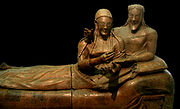 The museum's most famous single treasure is the terracotta funerary monument, the almost life-size Bride and Groom (the so-called Sarcofago degli Sposi, or Sarcophagus of the Spouses) reclining as if they were at a dinner party.
Other objects held are:
Etruscan civilization
Etruscan civilization is the modern English name given to a civilization of ancient Italy in the area corresponding roughly to Tuscany. The ancient Romans called its creators the Tusci or Etrusci...
housed in the Villa Giulia
Villa Giulia
The Villa Giulia is a villa in Rome, Italy. It was built by Pope Julius III in 1550–1555 on what was then the edge of the city. Today it is publicly owned, and houses the Museo Nazionale Etrusco, an impressive collection of Etruscan art and artifacts....
in Rome
Rome
Rome is the capital of Italy and the country's largest and most populated city and comune, with over 2.7 million residents in . The city is located in the central-western portion of the Italian Peninsula, on the Tiber River within the Lazio region of Italy.Rome's history spans two and a half...
, Italy
Italy
Italy , officially the Italian Republic languages]] under the European Charter for Regional or Minority Languages. In each of these, Italy's official name is as follows:;;;;;;;;), is a unitary parliamentary republic in South-Central Europe. To the north it borders France, Switzerland, Austria and...
.
History
The villa was built by the popePope
The Pope is the Bishop of Rome, a position that makes him the leader of the worldwide Catholic Church . In the Catholic Church, the Pope is regarded as the successor of Saint Peter, the Apostle...
s and remained their property until 1870 when, in the wake of the Risorgimento and the demise of the Papal States
Papal States
The Papal State, State of the Church, or Pontifical States were among the major historical states of Italy from roughly the 6th century until the Italian peninsula was unified in 1861 by the Kingdom of Piedmont-Sardinia .The Papal States comprised territories under...
, it became the property of the Kingdom of Italy
Italy
Italy , officially the Italian Republic languages]] under the European Charter for Regional or Minority Languages. In each of these, Italy's official name is as follows:;;;;;;;;), is a unitary parliamentary republic in South-Central Europe. To the north it borders France, Switzerland, Austria and...
. The museum was founded in 1889 as part of the same nationalistic movement, with the aim of collecting together all the pre-Roman
Ancient Rome
Ancient Rome was a thriving civilization that grew on the Italian Peninsula as early as the 8th century BC. Located along the Mediterranean Sea and centered on the city of Rome, it expanded to one of the largest empires in the ancient world....
antiquities
Antiquities
Antiquities, nearly always used in the plural in this sense, is a term for objects from Antiquity, especially the civilizations of the Mediterranean: the Classical antiquity of Greece and Rome, Ancient Egypt and the other Ancient Near Eastern cultures...
of Latium
Latium
Lazio is one of the 20 administrative regions of Italy, situated in the central peninsular section of the country. With about 5.7 million residents and a GDP of more than 170 billion euros, Lazio is the third most populated and the second richest region of Italy...
, southern Etruria
Etruria
Etruria—usually referred to in Greek and Latin source texts as Tyrrhenia—was a region of Central Italy, an area that covered part of what now are Tuscany, Latium, Emilia-Romagna, and Umbria. A particularly noteworthy work dealing with Etruscan locations is D. H...
and Umbria
Umbria
Umbria is a region of modern central Italy. It is one of the smallest Italian regions and the only peninsular region that is landlocked.Its capital is Perugia.Assisi and Norcia are historical towns associated with St. Francis of Assisi, and St...
belonging to the Etruscan and Faliscan
Faliscan
Faliscan may refer to:*Falisci, an ancient Italian people group*Faliscan language...
civilizations, and has been housed in the villa since the beginning of the 20th century.
Collections
Other objects held are:
- The Etruscan-Phoenician Pyrgi TabletsPyrgi TabletsThe Pyrgi Tablets, found in a 1964 excavation of a sanctuary of ancient Pyrgi on the Tyrrhenian coast of Italy , are three golden leaves that record a dedication made around 500 BC by Thefarie Velianas, king of Caere, to the Phoenician goddess ʻAshtaret. Pyrgi was the port of the southern Etruscan...
- The Apollo of VeiiApollo of VeiiThe Apollo of Veii is an over-life-size painted terracotta Etruscan statue of Apollo . Originally at Veii, it dates from c. 550 - 520 BC ans was sculpted in the in the so-called "international" Ionic or late-archaic Etruscan style...
- The CistaCistaA cista in the classical world was generally a casket, used for example to hold unguents or jewels. More specifically, in the Mystery cult, a cista mystica is a basket or chest used to house snakes. Cistae mysticae were used in the initiation ceremony of the cult of Bacchus, or Dionysus, as well...
Ficoroni - A reconstructed frieze displaying Kreugas eating the brain of his enemy
- The Tita Vendia vaseTita Vendia vaseThe Tita Vendia vase is a ceramic impasto pithos , crafted around 620-600 BC, most likely in Rome. The pithos, which exists only as an incomplete set of sherds, carries one of two earliest known inscriptions in Latin language and is usually, but not unanimously, interpreted as the earliest...