


Narai

Encyclopedia
Somdet Phra Narai or Somdet Phra Ramathibodi III was the king of Ayutthaya
from 1656 to 1688 and arguably the most famous Ayutthayan king. His reign was the most prosperous during the Ayutthaya period and saw the great commercial and diplomatic activities with foreign nations including the Persians and the West. During the later years of his reign, Narai gave his favorite – the Greek adventurer Constantine Phaulkon
– so much power that Phaulkon technically became the chancellor of the state. Through the arrangements of Phaulkon, the Siamese kingdom came into close diplomatic relations with the court of Louis XIV and French soldiers and missionaries filled the Siamese aristocracy and defense. The dominance of French officials led to frictions between them and the native mandarins and led to the turbulent revolution of 1688
towards the end of his reign. Narai’s reign was also known for a small war with England in 1687 and the invasion of Burmese Lanna
in 1662.
Nevertheless, the presence of numerous foreigners from the French Jesuits to the Persian delegates has left historians with rich sources of material on the city of Ayutthaya and its courtly life in the seventeenth century that otherwise would not have survived the complete destruction of the capital in 1767.
and his Queen Sirikalayani who was a daughter of Songtham
. Prasat Thong had just usurped the throne from the ruling Sukhothai dynasty in 1629 and founded the dynasty of his own. Narai had an elder half-brother Prince Chai and an uncle Prince Sri Sudharmmaraja. Upon Prasat Thong’s death in 1656, Prince Chai succeeded his father as King Sanpet VI.
However, it was Thai tradition that gave brothers a higher priority over sons in succession. Prince Sudharmmaraja plotted with his nephew Prince Narai to bring Sanpet VI down. After nine months of ascension, Sanpet VI was executed in a coup. Narai and his uncle marched into the palace and Sri Sudharmmaraja crowned himself king. Sri Sudharmmaraja appointed Narai as the Uparaja or the Front Palace
. However, Narai himself was also an ambitious prince who had requested the Dutch for support against his uncle. Sri Sudharmmaraja’s rule was weak and he fell under the control of Chao Phraya Chakri – an ambitious mandarin who also wanted the throne himself.
In 1656, Narai and his uncle finally alienated each other. Sri Sudharmmaraja had affections of Narai’s sister Princess Rajakalayani. He ordered his soldiers to enclose her residence and himself invade the house. The princess hid in the book chest and was moved to the Front Palace were she met her brother.
Enraged at his uncle behavior, Prince Narai decided to take actions. Prince Narai drew his supports from the Persian and Japanese mercenaries that were largely persecuted during the reign of his father. Among the Siamese he got his brothers and the Okya Sukhothai as supporters. On the Day of Ashura
the commemorating Persian army stormed the palace along with the Japanese. The prince engaged in personal battle with his uncle until the latter fled to the Rear Palace. Sri Sudharmmaraja was captured and was brought to execution at Wat Kok Phraya in October 1656.
Fearing a possible weakening of influence in the northern vassal states following the successful Chinese invasion of Ava in 1660, King Narai mounted an expedition to bring Chiang Mai under the direct control of Ayutthya. Although the expedition was successful in taking control of Lampang and other smaller cities, a second expedition had to be conducted to bring Chiang Mai under control.
There was also trouble on the Tenasserim coast at the port of Mergui. In July 1687, an incident that came to be known as the Mergui massacre occurred that resulted in the massacre of some sixty Englishmen. The incident had origins in a deterioration of the relationship between Siam and the East India Company. Phaulkon had appointed two English acquaintances of his as governors of Mergui, and they used the port as a base for privateering expeditions against the Kingdom of Golconda, which had friendly relations with the East India Company. In April 1687 the East India Company demanded £65,000 compensation from Narai and blockaded Mergui. Fearing a trial on the charge of piracy, the two English governors of Mergui lavishly entertained the captains of the ship. However, the entertainment aroused the suspicion of the Siamese authorities, who took matters into their own hands and opened fire on the English ships and massacred all the Englishmen they could lay their hands on. Narai then declared war on the East India Company, and handed control of Mergui over to a French governor and a small French garrison. At the same time, he also granted a concession of the strategic port of Bangkok to France with the view of countering Dutch influence.
King Narai also constructed a new palace
at present-day Lopburi ("Louvo" in the French accounts) utilising the expertise of Jesuit architects and engineers. European influences are clearly evident in the architectural style, especially the use of wide windows. The move to Lopburi was arguably prompted by the Dutch naval blockade of Ayutthaya in 1664 to enforce a fur monopoly.
Although Catholic missions had been present in Ayutthaya as early as 1567 under Portuguese Dominicans, King Narai's reign saw the first concerted attempt to convert the monarch to Catholicism under the auspices of French Jesuits who were given permission to settle in Ayutthaya in 1662. The conversion attempt ultimately failed and arguably backfired but Catholics were to remain in Siam up to the present day.
Most controversially, King Narai allowed the rise of Constantine Phaulkon
, a Greek adventurer who arrived in Ayutthaya in 1675. Within a few years, Phaulkon had managed to ingratiate himself with the king and became Narai's closest councillor. Under Phaulkon's guidance, King Narai balanced the influence of the Dutch by favouring the French. Phaulkon also encouraged French interest by initially leading them to believe that the king was about to convert to Catholicism. Although King Narai did display a degree of interest in Catholicism, he also displayed an equal interest in Islam and there is no concrete evidence that he wished to convert to either. However, both Catholic and Islamic missions were to come to the conclusion that Phaulkon was responsible for their failures. Siamese courtiers also resented Phaulkon's influence and he quickly became the focus of xenophobic sentiments at court, with the future King Phetracha
at their head.
Undoubtedly, the most celebrated of these missions were those to Europe, in particular France. In 1673, a French ecclesiastical mission arrived at the Siamese court with letters from Pope Clement IX
and King Louis XIV of France. King Narai reciprocated by sending a mission to France in 1680 led by Phya Pipatkosa. Although the mission was lost at sea near Madagascar, the French responded positively by sending a commercial mission to Ayutthaya headed by Monsignor Pallu in 1682.

who formerly worked for the English East India Company. Phaulkon was introduced into the court by Kosa Lek in 1681 as a witted interpreter and quickly gained the royal favor. In 1682 he served as the interpreter during the royal audience with François Pallu
, who arrived with letters from Louis XIV. Phaulkon suggested his plan of the reconstruction of the fort of Mergui
in polygonal European style, which was strongly opposed by Kosa Lek. Kosa Lek was found out receiving bribery from the peasants who did not want to be levied into the Mergui construction. He was beaten to death under royal orders.
Narai responded the French by the dispatch of Siamese mission to France in January 1684 led by Khun Pijaivanit and Khun Pijitmaitri accompanied by missionary Benigne Vachet. They reached Calais
by November and eventually had the French royal audience. Louis XIV sent de Chaumont and de Choisy to lead the French mission in 1685 to return the Siamese embassadors and to convert Narai to Catholicism
. The mission contained a large number of Jesuit priests and scientists. Colbert
sent his letter to Phaulkon to instruct him to persuade the Siamese king to concede to French requests with the promises of knighting him as a count.
 Though not convert to Christianity, Narai agreed to allow the French troops to be stationed in Siamese ports. Chevalier de Forbin
was made the commander of Bangkok
fort and trainers of Siamese armies in Western warfare. Several Siamese forts including Mergui, Ligor, Singora (Songkhla
), Lavo
, and Ayutthaya itself were reconstructed in European style. Another Siamese mission to France was led by Phra Visutsundhorn (Kosa Pan
, younger brother of Kosa Lek) and Guy Tachard
in 1686 with enthusiastic European reception. A fragmentary Siamese account of the mission compiled by Kosa Pan was re-discovered in Paris in the 1980s.
Samuel White
, the governor of Mergui fort and companion of Phaulkon, conflicted with the English fleets from India in 1687, leading to the English blockade of Mergui. The Siamese native mandarins massacred the local Englishmen out of frustration. With English fleets threatening Narai decided to denounce the English and executed the mandarins.
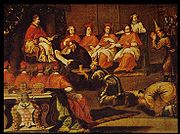 In March 1687 the new French mission left Brest
for Ayutthaya. The mission includes Kosa Pan returning home, Guy Tachard again, Simon de La Loubère
, Claude Céberet du Boullay
, and the General Desfarges. The large number of French army and navy was sent with this mission to station in Siamese forts with Desfarges as the military commander. Narai agreed to station French troops at Mergui and Bangkok, both turned into a Western fort, with Desfarges at Bangkok. (The fort is now called the Vijaiprasit Fort later the royal fort of King Taksin
). The last Siamese embassy was led by Ok-khun Chamnan
in 1688 visiting Rome
and Pope Innocent XI
.
, at the river mouth. In dealing with the activities, the French mostly depended on Constantin Phaulkon, the king's favorite. The threat of the French military presence, reportedly, was felt among the court noble. All in all, factionalism, favoritism and nepotism
became apparent.
The native mandarin somehow managed to reserve their powers, most notably Kosa Lek. With the death of Kosa Lek, Petracha, the chief of the Royal Elephant Department, emerged as the leading native power. Petracha had familial connections to Narai, with his mother as the king’s milkmaid and his sister as the king’s concubine.
Narai is said to fear of fathering a son. He therefore ordered the abortion of any of his impregnated consorts. He, however, adopted a son of a minor mandarin with the name of Phra Piya and made him his successor. The young prince was embraced by the French who managed to convert him to Catholicism.
Matters were brought to a head when King Narai fell gravely ill in March 1688 while the king stayed in Lopburi
palaces. Aware of the coming succession dispute, in May 1688 Narai called together his closest councillors: Phaulkon, Phra Phetracha, and Mom Pi and nominated his daughter, Kromluang Yothathep to succeed him. The three councillors were to act as regents until the princess took on a partner of her choice from one of the two Siamese councillors. Far from calming the situation, Narai's decision spurred Phetracha to act. With Narai essentially incapacitated by his illness, Phetracha was given a free hand to usurp the throne with the support of a resentful court as well as the Buddhist clergy and ethnic-Persian mandarins. Mom Pi and Phaulkon were arrested and executed as Narai laid furious on his deathbed, unable to do anything to save his favourite
.
On the death of King Narai, Phetracha proclaimed himself king, expelled the French and virtually severed all ties with the West.Siamese troops attacked the French troops at Bangkok fort, ending with the flee of the French. After an initial confinement, missionaries were allowed to continue their work in Ayutthaya under some restrictions. Contact between Siam and the West remained sporadic, and would not return to the level seen in the reign of King Narai until the reign of King Mongkut
in the mid-nineteenth century.
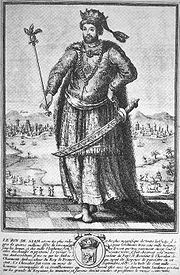 Although King Narai's reign witnessed the greatest extent of foreign influence at the Siamese court, his diplomatic achievements were to be reversed by his successor. It is debatable whether the new introspective attitude of his successors contributed to the weakening and eventual fall of Ayutthaya. On the other hand, the curtailing of foreign influences in the court may have prevented the colonisation of Ayutthaya. Nevertheless, his reign's diplomatic achievements contributed to him being posthumously styled "the Great," one of seven recognised as such in the history of Thailand.
At the same time, the records of those involved in the diplomatic missions, particularly those from the west, have allowed historians to obtain a rare glimpse into the world of the Ayutthayan court as most original Ayutthaya records were destroyed with the city in 1767. These include the French accounts of the Chevalier de Chaumont, the Abbé de Choisy, Fr. Tachard, Claude de Forbin, de la Loubere and the Persian account of Muhammad Rabi' ibn Muhammad Ibrahim. Domestically, the relative stability during his reign also gave rise to the revival of Siamese literature during his reign.
Further afield, one of the main streets of the city of Brest
as well as another in Marseilles have been named "Rue de Siam
" to commemorate Narai's missions. In addition, among the gifts that were exchanged between the Siamese and the French courts, two items from Siam were to have an unexpected impact on French history. The items were a pair of silver cannons that were eventually stored in the Royal Furniture Repository in Paris since they were classed as gifts rather than weapons. After failing to find usable weapons at the Arsenal, rioting Parisians broke into the Repository and discovered some 20 cannons. However, the Siamese cannons were the only ones that still functioned, and so they were hauled to the Bastille
. The date was 14 July 1789.
Ayutthaya kingdom
Ayutthaya was a Siamese kingdom that existed from 1350 to 1767. Ayutthaya was friendly towards foreign traders, including the Chinese, Vietnamese , Indians, Japanese and Persians, and later the Portuguese, Spanish, Dutch and French, permitting them to set up villages outside the walls of the...
from 1656 to 1688 and arguably the most famous Ayutthayan king. His reign was the most prosperous during the Ayutthaya period and saw the great commercial and diplomatic activities with foreign nations including the Persians and the West. During the later years of his reign, Narai gave his favorite – the Greek adventurer Constantine Phaulkon
Constantine Phaulkon
Constantine Phaulkon was a Greek adventurer, who became first counsellor to King Narai of Ayutthaya.Born on the Ionian island of...
– so much power that Phaulkon technically became the chancellor of the state. Through the arrangements of Phaulkon, the Siamese kingdom came into close diplomatic relations with the court of Louis XIV and French soldiers and missionaries filled the Siamese aristocracy and defense. The dominance of French officials led to frictions between them and the native mandarins and led to the turbulent revolution of 1688
Siamese revolution of 1688
The Siamese revolution of 1688 was a major popular upheaval in the Siamese Ayutthaya Kingdom which led to the overthrow of the pro-foreign Siamese king Narai...
towards the end of his reign. Narai’s reign was also known for a small war with England in 1687 and the invasion of Burmese Lanna
Lanna
The Kingdom of Lanna was a kingdom centered in present-day northern Thailand from the 13th to 18th centuries. The cultural development of the people of Lanna, the Tai Yuan people, had begun long before as successive Tai Yuan kingdoms preceded Lanna...
in 1662.
Nevertheless, the presence of numerous foreigners from the French Jesuits to the Persian delegates has left historians with rich sources of material on the city of Ayutthaya and its courtly life in the seventeenth century that otherwise would not have survived the complete destruction of the capital in 1767.
Succession
Prince Narai was born in 1633 to King Prasat ThongPrasat Thong
King Prasat Thong was the first king of Prasat Thong dynasty, the 4th dynasty of Ayutthaya kingdom. He was the Defense minister of King Songtham....
and his Queen Sirikalayani who was a daughter of Songtham
Songtham
Somdet Phra Boromma Trailokanat Songtham was the King of Ayutthaya from 1611 to 1628 of the House of Sukhōday. His reign was marked as prosperity after the First Fall of Ayutthaya and saw the commencement of trade with foreign nations especially the Dutch and the Japanese...
. Prasat Thong had just usurped the throne from the ruling Sukhothai dynasty in 1629 and founded the dynasty of his own. Narai had an elder half-brother Prince Chai and an uncle Prince Sri Sudharmmaraja. Upon Prasat Thong’s death in 1656, Prince Chai succeeded his father as King Sanpet VI.
However, it was Thai tradition that gave brothers a higher priority over sons in succession. Prince Sudharmmaraja plotted with his nephew Prince Narai to bring Sanpet VI down. After nine months of ascension, Sanpet VI was executed in a coup. Narai and his uncle marched into the palace and Sri Sudharmmaraja crowned himself king. Sri Sudharmmaraja appointed Narai as the Uparaja or the Front Palace
Front Palace
Krom Phra Rajawang Bovorn Sathan Mongkol ) or the Front Palace was a royal title granted by the Siamese monarchy until the nineteenth century. The holder of the title of Front Palace was considered the heir to the throne and second only to the King. The title originated in the Ayutthaya period and...
. However, Narai himself was also an ambitious prince who had requested the Dutch for support against his uncle. Sri Sudharmmaraja’s rule was weak and he fell under the control of Chao Phraya Chakri – an ambitious mandarin who also wanted the throne himself.
In 1656, Narai and his uncle finally alienated each other. Sri Sudharmmaraja had affections of Narai’s sister Princess Rajakalayani. He ordered his soldiers to enclose her residence and himself invade the house. The princess hid in the book chest and was moved to the Front Palace were she met her brother.
Enraged at his uncle behavior, Prince Narai decided to take actions. Prince Narai drew his supports from the Persian and Japanese mercenaries that were largely persecuted during the reign of his father. Among the Siamese he got his brothers and the Okya Sukhothai as supporters. On the Day of Ashura
Day of Ashura
The Day of Ashura is on the 10th day of Muharram in the Islamic calendar and marks the climax of the Remembrance of Muharram.It is commemorated by Shia Muslims as a day of mourning for the martyrdom of Husayn ibn Ali, the grandson of the Islamic Prophet Muhammad at the Battle of Karbala on 10...
the commemorating Persian army stormed the palace along with the Japanese. The prince engaged in personal battle with his uncle until the latter fled to the Rear Palace. Sri Sudharmmaraja was captured and was brought to execution at Wat Kok Phraya in October 1656.
Domestic Policy
Domestic policies in King Narai's reign were greatly affected by the interference of foreign powers most notably the Chinese to the north, the Dutch to the South, and the English who were making their first forays into India to the west. Policies revolved around either directly countering the influence, or creating a delicate balance of power between the different parties.Fearing a possible weakening of influence in the northern vassal states following the successful Chinese invasion of Ava in 1660, King Narai mounted an expedition to bring Chiang Mai under the direct control of Ayutthya. Although the expedition was successful in taking control of Lampang and other smaller cities, a second expedition had to be conducted to bring Chiang Mai under control.
There was also trouble on the Tenasserim coast at the port of Mergui. In July 1687, an incident that came to be known as the Mergui massacre occurred that resulted in the massacre of some sixty Englishmen. The incident had origins in a deterioration of the relationship between Siam and the East India Company. Phaulkon had appointed two English acquaintances of his as governors of Mergui, and they used the port as a base for privateering expeditions against the Kingdom of Golconda, which had friendly relations with the East India Company. In April 1687 the East India Company demanded £65,000 compensation from Narai and blockaded Mergui. Fearing a trial on the charge of piracy, the two English governors of Mergui lavishly entertained the captains of the ship. However, the entertainment aroused the suspicion of the Siamese authorities, who took matters into their own hands and opened fire on the English ships and massacred all the Englishmen they could lay their hands on. Narai then declared war on the East India Company, and handed control of Mergui over to a French governor and a small French garrison. At the same time, he also granted a concession of the strategic port of Bangkok to France with the view of countering Dutch influence.
King Narai also constructed a new palace
King Narai's Palace
The King Narai's Palace in Lopburi was built by King Narai the Great, the king who ruled Ayutthaya from 1656 to 1688. He ordered to build the palace in 1666 in the same area of King Ramesuan's Palace. King Narai stayed here for about 8-9 months a year, except rainy season...
at present-day Lopburi ("Louvo" in the French accounts) utilising the expertise of Jesuit architects and engineers. European influences are clearly evident in the architectural style, especially the use of wide windows. The move to Lopburi was arguably prompted by the Dutch naval blockade of Ayutthaya in 1664 to enforce a fur monopoly.
Although Catholic missions had been present in Ayutthaya as early as 1567 under Portuguese Dominicans, King Narai's reign saw the first concerted attempt to convert the monarch to Catholicism under the auspices of French Jesuits who were given permission to settle in Ayutthaya in 1662. The conversion attempt ultimately failed and arguably backfired but Catholics were to remain in Siam up to the present day.
Most controversially, King Narai allowed the rise of Constantine Phaulkon
Constantine Phaulkon
Constantine Phaulkon was a Greek adventurer, who became first counsellor to King Narai of Ayutthaya.Born on the Ionian island of...
, a Greek adventurer who arrived in Ayutthaya in 1675. Within a few years, Phaulkon had managed to ingratiate himself with the king and became Narai's closest councillor. Under Phaulkon's guidance, King Narai balanced the influence of the Dutch by favouring the French. Phaulkon also encouraged French interest by initially leading them to believe that the king was about to convert to Catholicism. Although King Narai did display a degree of interest in Catholicism, he also displayed an equal interest in Islam and there is no concrete evidence that he wished to convert to either. However, both Catholic and Islamic missions were to come to the conclusion that Phaulkon was responsible for their failures. Siamese courtiers also resented Phaulkon's influence and he quickly became the focus of xenophobic sentiments at court, with the future King Phetracha
Phetracha
Phetracha was a king of the Ayutthaya kingdom in Thailand, usurping the throne from his predecessor King Narai and founding the Ban Phlu Luang dynasty, the final one of the Ayutthaya kingdom...
at their head.
Foreign Missions
The most remarkable aspect of King Narai's reign were the diplomatic missions that he sent and received during his reign. Missions were sent as far afield as France, England, and the Vatican, although at least two missions were lost at sea. Ties with states closer to Ayutthaya were not neglected as missions were also sent to Persia, Golconda (India), China, as well as other neighbouring states.Undoubtedly, the most celebrated of these missions were those to Europe, in particular France. In 1673, a French ecclesiastical mission arrived at the Siamese court with letters from Pope Clement IX
Pope Clement IX
Pope Clement IX , born Giulio Rospigliosi, was Pope from 1667 to 1669.-Early life:Born Giulio Rospigliosi to a noble family of Pistoia, Grand Duchy of Tuscany, he was a pupil of the Jesuits. After receiving his doctorate in philosophy at the University of Pisa, he taught theology there...
and King Louis XIV of France. King Narai reciprocated by sending a mission to France in 1680 led by Phya Pipatkosa. Although the mission was lost at sea near Madagascar, the French responded positively by sending a commercial mission to Ayutthaya headed by Monsignor Pallu in 1682.
Rising French influence
The later half of Narai’s reign was the period of the growing French influence until the coup of 1688. This was achieved through a Greek adventurer with the Latinized name of Constantine PhaulkonConstantine Phaulkon
Constantine Phaulkon was a Greek adventurer, who became first counsellor to King Narai of Ayutthaya.Born on the Ionian island of...
who formerly worked for the English East India Company. Phaulkon was introduced into the court by Kosa Lek in 1681 as a witted interpreter and quickly gained the royal favor. In 1682 he served as the interpreter during the royal audience with François Pallu
François Pallu
François Pallu was a French bishop. He was a founding member of the Paris Foreign Missions Society and became a missionnary in Asia.-Life:...
, who arrived with letters from Louis XIV. Phaulkon suggested his plan of the reconstruction of the fort of Mergui
Mergui
Myeik is a city in Tanintharyi Division in Myanmar , located in the extreme south of the country on the coast of an island on the Andaman Sea. the estimated population was over 209,000. The area inland from the city is a major smuggling corridor into Thailand.-History:Myeik was the southernmost...
in polygonal European style, which was strongly opposed by Kosa Lek. Kosa Lek was found out receiving bribery from the peasants who did not want to be levied into the Mergui construction. He was beaten to death under royal orders.
Narai responded the French by the dispatch of Siamese mission to France in January 1684 led by Khun Pijaivanit and Khun Pijitmaitri accompanied by missionary Benigne Vachet. They reached Calais
Calais
Calais is a town in Northern France in the department of Pas-de-Calais, of which it is a sub-prefecture. Although Calais is by far the largest city in Pas-de-Calais, the department's capital is its third-largest city of Arras....
by November and eventually had the French royal audience. Louis XIV sent de Chaumont and de Choisy to lead the French mission in 1685 to return the Siamese embassadors and to convert Narai to Catholicism
Catholicism
Catholicism is a broad term for the body of the Catholic faith, its theologies and doctrines, its liturgical, ethical, spiritual, and behavioral characteristics, as well as a religious people as a whole....
. The mission contained a large number of Jesuit priests and scientists. Colbert
Jean-Baptiste Colbert
Jean-Baptiste Colbert was a French politician who served as the Minister of Finances of France from 1665 to 1683 under the rule of King Louis XIV. His relentless hard work and thrift made him an esteemed minister. He achieved a reputation for his work of improving the state of French manufacturing...
sent his letter to Phaulkon to instruct him to persuade the Siamese king to concede to French requests with the promises of knighting him as a count.
Claude de Forbin
Claude, chevalier, then count de Forbin-Gardanne was a French naval commander. In 1685-1688 he was on a diplomatic mission to Siam...
was made the commander of Bangkok
Bangkok
Bangkok is the capital and largest urban area city in Thailand. It is known in Thai as Krung Thep Maha Nakhon or simply Krung Thep , meaning "city of angels." The full name of Bangkok is Krung Thep Mahanakhon Amon Rattanakosin Mahintharayutthaya Mahadilok Phop Noppharat Ratchathani Burirom...
fort and trainers of Siamese armies in Western warfare. Several Siamese forts including Mergui, Ligor, Singora (Songkhla
Songkhla
Songkhla is a city in the Songkhla Province of southern Thailand, near the border with Malaysia. As of 2006 it had a population of 75,048...
), Lavo
Lavo
Known as Lavo during most of its history, Lopburi province is one of the most important cities in the history of Thailand. The city has a long history, dating back into the prehistory period since the bronze age of more than 3,500 years ago....
, and Ayutthaya itself were reconstructed in European style. Another Siamese mission to France was led by Phra Visutsundhorn (Kosa Pan
Kosa Pan
Pan , known by his rank Chao Phraya Kosathibodi or former rank Ok Phra Wisut Sunthon or by the nickname Kosa Pan , was a Siamese diplomat and minister who led the Second Siamese Embassy to France sent by king Narai in 1686...
, younger brother of Kosa Lek) and Guy Tachard
Guy Tachard
Guy Tachard , also known as Père Tachard, was a French Jesuit missionary and mathematician of the 17th century, who was sent on two occasions to the Kingdom of Siam by Louis XIV...
in 1686 with enthusiastic European reception. A fragmentary Siamese account of the mission compiled by Kosa Pan was re-discovered in Paris in the 1980s.
Samuel White
Samuel White
Samuel White was an American lawyer and politician from Wilmington, in New Castle County, Delaware. He was a member of the Federalist Party, who served as U.S. Senator from Delaware.-Early life and family:...
, the governor of Mergui fort and companion of Phaulkon, conflicted with the English fleets from India in 1687, leading to the English blockade of Mergui. The Siamese native mandarins massacred the local Englishmen out of frustration. With English fleets threatening Narai decided to denounce the English and executed the mandarins.
Brest, France
Brest is a city in the Finistère department in Brittany in northwestern France. Located in a sheltered position not far from the western tip of the Breton peninsula, and the western extremity of metropolitan France, Brest is an important harbour and the second French military port after Toulon...
for Ayutthaya. The mission includes Kosa Pan returning home, Guy Tachard again, Simon de La Loubère
Simon de la Loubère
Simon de la Loubère was a French diplomat, writer, mathematician and poet.-Mission to Siam:Simon de la Loubère led an embassy to Siam in 1687 . The embassy, composed of five warships, arrived in Bangkok in October 1687 and was received by Ok-khun Chamnan...
, Claude Céberet du Boullay
Claude Céberet du Boullay
Claude Céberet du Boullay was a 17th century French diplomat who participated in the La Loubère-Céberet embassy as "envoy extraordinary" to the kingdom of Siam in 1687. He was co-representative of the mission with the diplomat Simon de la Loubère.-Mission to Siam:In 1685, Céberet became one of...
, and the General Desfarges. The large number of French army and navy was sent with this mission to station in Siamese forts with Desfarges as the military commander. Narai agreed to station French troops at Mergui and Bangkok, both turned into a Western fort, with Desfarges at Bangkok. (The fort is now called the Vijaiprasit Fort later the royal fort of King Taksin
Taksin
Taksin ; was the only King of the Thonburi Kingdom...
). The last Siamese embassy was led by Ok-khun Chamnan
Ok-khun Chamnan
Ok-khun Chamnan Chaichong was a Siamese diplomat who visited France and Rome on an embassy in 1688. He was preceded by the embassay of Kosa Pan in 1686.-Failed embassy to Portugal :...
in 1688 visiting Rome
Rome
Rome is the capital of Italy and the country's largest and most populated city and comune, with over 2.7 million residents in . The city is located in the central-western portion of the Italian Peninsula, on the Tiber River within the Lazio region of Italy.Rome's history spans two and a half...
and Pope Innocent XI
Pope Innocent XI
Blessed Pope Innocent XI , born Benedetto Odescalchi, was Pope from 1676 to 1689.-Early life:Benedetto Odescalchi was born at Como in 1611 , the son of a Como nobleman, Livio Odescalchi, and Paola Castelli Giovanelli from Gandino...
.
The "Revolution" of 1688
Narai spent his whole reign reducing the power of native mandarins that caused much bloodshed during his predecessors’ time. He firstly supported Persian and later the French guards and advisors against the Thai mandarins. Even his ascension to the throne was orchestrated by Persian mercenaries. The French eventually enjoyed special favors from religious affairs to the military activities. One of the critical turning points concerned with the construction of the French forts and military barracks in BangkokBangkok
Bangkok is the capital and largest urban area city in Thailand. It is known in Thai as Krung Thep Maha Nakhon or simply Krung Thep , meaning "city of angels." The full name of Bangkok is Krung Thep Mahanakhon Amon Rattanakosin Mahintharayutthaya Mahadilok Phop Noppharat Ratchathani Burirom...
, at the river mouth. In dealing with the activities, the French mostly depended on Constantin Phaulkon, the king's favorite. The threat of the French military presence, reportedly, was felt among the court noble. All in all, factionalism, favoritism and nepotism
Nepotism
Nepotism is favoritism granted to relatives regardless of merit. The word nepotism is from the Latin word nepos, nepotis , from which modern Romanian nepot and Italian nipote, "nephew" or "grandchild" are also descended....
became apparent.
The native mandarin somehow managed to reserve their powers, most notably Kosa Lek. With the death of Kosa Lek, Petracha, the chief of the Royal Elephant Department, emerged as the leading native power. Petracha had familial connections to Narai, with his mother as the king’s milkmaid and his sister as the king’s concubine.
Narai is said to fear of fathering a son. He therefore ordered the abortion of any of his impregnated consorts. He, however, adopted a son of a minor mandarin with the name of Phra Piya and made him his successor. The young prince was embraced by the French who managed to convert him to Catholicism.
Matters were brought to a head when King Narai fell gravely ill in March 1688 while the king stayed in Lopburi
Lopburi
Lopburi ) is the capital city of Lopburi Province in Thailand. It is located about 150 km north-east of Bangkok. As of 2006 it has a population of 26,500...
palaces. Aware of the coming succession dispute, in May 1688 Narai called together his closest councillors: Phaulkon, Phra Phetracha, and Mom Pi and nominated his daughter, Kromluang Yothathep to succeed him. The three councillors were to act as regents until the princess took on a partner of her choice from one of the two Siamese councillors. Far from calming the situation, Narai's decision spurred Phetracha to act. With Narai essentially incapacitated by his illness, Phetracha was given a free hand to usurp the throne with the support of a resentful court as well as the Buddhist clergy and ethnic-Persian mandarins. Mom Pi and Phaulkon were arrested and executed as Narai laid furious on his deathbed, unable to do anything to save his favourite
Favourite
A favourite , or favorite , was the intimate companion of a ruler or other important person. In medieval and Early Modern Europe, among other times and places, the term is used of individuals delegated significant political power by a ruler...
.
On the death of King Narai, Phetracha proclaimed himself king, expelled the French and virtually severed all ties with the West.Siamese troops attacked the French troops at Bangkok fort, ending with the flee of the French. After an initial confinement, missionaries were allowed to continue their work in Ayutthaya under some restrictions. Contact between Siam and the West remained sporadic, and would not return to the level seen in the reign of King Narai until the reign of King Mongkut
Mongkut
Phra Bat Somdet Phra Poramenthramaha Mongkut Phra Chom Klao Chao Yu Hua , or Rama IV, known in foreign countries as King Mongkut , was the fourth monarch of Siam under the House of Chakri, ruling from 1851-1868...
in the mid-nineteenth century.
Legacy
At the same time, the records of those involved in the diplomatic missions, particularly those from the west, have allowed historians to obtain a rare glimpse into the world of the Ayutthayan court as most original Ayutthaya records were destroyed with the city in 1767. These include the French accounts of the Chevalier de Chaumont, the Abbé de Choisy, Fr. Tachard, Claude de Forbin, de la Loubere and the Persian account of Muhammad Rabi' ibn Muhammad Ibrahim. Domestically, the relative stability during his reign also gave rise to the revival of Siamese literature during his reign.
Further afield, one of the main streets of the city of Brest
Brest, France
Brest is a city in the Finistère department in Brittany in northwestern France. Located in a sheltered position not far from the western tip of the Breton peninsula, and the western extremity of metropolitan France, Brest is an important harbour and the second French military port after Toulon...
as well as another in Marseilles have been named "Rue de Siam
Rue de Siam
The Rue de Siam is the main arterial street of Brest. Its name comes from the arrival of three ambassadors led by Kosa Pan, sent by the King of Siam on the 29th of June 1686 to meet Louis XIV in Versailles. They went with six mandarins, three translators, two secretaries and a retinue of servants,...
" to commemorate Narai's missions. In addition, among the gifts that were exchanged between the Siamese and the French courts, two items from Siam were to have an unexpected impact on French history. The items were a pair of silver cannons that were eventually stored in the Royal Furniture Repository in Paris since they were classed as gifts rather than weapons. After failing to find usable weapons at the Arsenal, rioting Parisians broke into the Repository and discovered some 20 cannons. However, the Siamese cannons were the only ones that still functioned, and so they were hauled to the Bastille
Bastille
The Bastille was a fortress in Paris, known formally as the Bastille Saint-Antoine. It played an important role in the internal conflicts of France and for most of its history was used as a state prison by the kings of France. The Bastille was built in response to the English threat to the city of...
. The date was 14 July 1789.
See also
- France-Thailand relations
- Constantine PhaulkonConstantine PhaulkonConstantine Phaulkon was a Greek adventurer, who became first counsellor to King Narai of Ayutthaya.Born on the Ionian island of...
- Claude de ForbinClaude de ForbinClaude, chevalier, then count de Forbin-Gardanne was a French naval commander. In 1685-1688 he was on a diplomatic mission to Siam...
- François-Timoléon de ChoisyFrançois-Timoléon de ChoisyFrançois Timoléon, abbé de Choisy was a French author.-Life:He was born in Paris. His father was attached to the household of the duke of Orléans, and his mother, who was on intimate terms with Anne of Austria, was regularly called upon to amuse Louis XIV...