

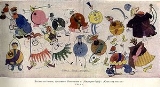
Mystery-Bouffe

Encyclopedia
Myster-Bouffe is a socialist
drama
tic play
written by Vladimir Mayakovsky
in 1918/1921. Mayakovsky stated in a preface to the 1921 edition that "in the future, all persons performing, presenting, reading or publishing Mystery-Bouffe should change the content, making it contemporary, immediate, up-to-the-minute."
, and the art was done by Kazimir Malevich
. The premiere was in the Theatre of Musical Drama on November 7, 1918.
Mayakovsky himself played the role of the "simple man", as well as some bit roles including Methuselah and one of the demons. This version of the play lasted three seances.
In 2007, after several decades of the play not being seen anywhere, the Moscow A.R.T.O. theatre put on an updated version of the play which was dubbed "Mystery-Bouffe. The Clean Variant", based on the texts of the first and second versions. It premiered in France on May 1, 2007.
Socialism
Socialism is an economic system characterized by social ownership of the means of production and cooperative management of the economy; or a political philosophy advocating such a system. "Social ownership" may refer to any one of, or a combination of, the following: cooperative enterprises,...
drama
Drama
Drama is the specific mode of fiction represented in performance. The term comes from a Greek word meaning "action" , which is derived from "to do","to act" . The enactment of drama in theatre, performed by actors on a stage before an audience, presupposes collaborative modes of production and a...
tic play
Play (theatre)
A play is a form of literature written by a playwright, usually consisting of scripted dialogue between characters, intended for theatrical performance rather than just reading. There are rare dramatists, notably George Bernard Shaw, who have had little preference whether their plays were performed...
written by Vladimir Mayakovsky
Vladimir Mayakovsky
Vladimir Vladimirovich Mayakovsky was a Russian and Soviet poet and playwright, among the foremost representatives of early-20th century Russian Futurism.- Early life :...
in 1918/1921. Mayakovsky stated in a preface to the 1921 edition that "in the future, all persons performing, presenting, reading or publishing Mystery-Bouffe should change the content, making it contemporary, immediate, up-to-the-minute."
First version
The play was written for the anniversary of the 1917 revolution, and was accepted by the Central Bureau to be part of the festivities. This original version was directed and produced by Vsevolod MeyerholdVsevolod Meyerhold
Vsevolod Emilevich Meyerhold was a great Russian and Soviet theatre director, actor and theatrical producer. His provocative experiments dealing with physical being and symbolism in an unconventional theatre setting made him one of the seminal forces in modern international theatre.-Early...
, and the art was done by Kazimir Malevich
Kazimir Malevich
Kazimir Severinovich Malevich was a Russian painter and art theoretician, born of ethnic Polish parents. He was a pioneer of geometric abstract art and the originator of the Avant-garde Suprematist movement.-Early life:...
. The premiere was in the Theatre of Musical Drama on November 7, 1918.
Mayakovsky himself played the role of the "simple man", as well as some bit roles including Methuselah and one of the demons. This version of the play lasted three seances.
Second version
After two years, Mayakovsky reworked the text of his play. This second version premiered in the First Theatre of the RSFSR on May 1, 1921. A printed edition of the second version was released in June of that year. This version of the play lasted about 100 shows.Later versions
A 60-minute animated film adaptation of the play was made in 1969, directed by David Cherkasskiy. It was the first animated feature to be made in Ukraine. The Soviet government banned screenings outside of the Ukrainian SSR.In 2007, after several decades of the play not being seen anywhere, the Moscow A.R.T.O. theatre put on an updated version of the play which was dubbed "Mystery-Bouffe. The Clean Variant", based on the texts of the first and second versions. It premiered in France on May 1, 2007.
Characters
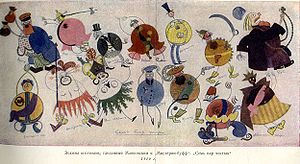
- Seven Pairs of the Clean:
-
- 1) The Negus of Abyssinia
- 2) An Indian Raja
- 3) A Turkish Pasha
- 4) A Russian Merchant (Speculator)
- 5) A Chinese
- 6) A Well-fed Persian
- 7) ClemenceauClemenceauClemenceau may refer to:* Georges Clemenceau , French physician, journalist and statesman* Clemenceau , a French aircraft carrier* Mount Clemenceau, a mountain in the Canadian Rockies...
- 8) A German
- 9) A Russian Priest
- 10) An Australian
- 11) His Wife
- 12) Lloyd GeorgeDavid Lloyd GeorgeDavid Lloyd George, 1st Earl Lloyd-George of Dwyfor OM, PC was a British Liberal politician and statesman...
- 13) An American
- 14) A Diplomat
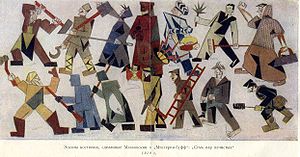
- Seven Pairs of the Unclean:
- 1) A Soldier of the Red ArmyRed ArmyThe Workers' and Peasants' Red Army started out as the Soviet Union's revolutionary communist combat groups during the Russian Civil War of 1918-1922. It grew into the national army of the Soviet Union. By the 1930s the Red Army was among the largest armies in history.The "Red Army" name refers to...
- 2) A Lamplighter
- 3) A Truckdriver
- 4) A Miner
- 5) A Carpenter
- 6) A Farmhand
- 7) A Servant (Female)
- 8) A Blacksmith
- 9) A Baker
- 10) A Laundress
- 11) A Seamstress
- 12) A Locomotive Engineer
- 13) An Eskimo Fisherman
- 14) An Eskimo Hunter
- 1) A Soldier of the Red Army
- A Compromiser
- An Intellectual
- The Lady with the Hatboxes
- Devils:
- 1) BeelzebubBeelzebubBeelzebub -Religious meaning:Ba‘al Zəbûb is variously understood to mean "lord of flies", or "lord of the dwelling". Originally the name of a Philistine god, Beelzebub is also identified in the New Testament as Satan, the "prince of the demons". In Arabic the name is retained as Ba‘al dhubaab /...
- 2) Master-of-ceremonies Devil
- 3) First Messenger
- 4) Second Messenger
- 5) Guard
- 6) 20 of the Clean with Horns and Tails
- 1) Beelzebub
- Saints:
- 1) MethuselahMethuselahMethuselah is the oldest person whose age is mentioned in the Hebrew Bible. Extra-biblical tradition maintains that he died on the 11th of Cheshvan of the year 1656 , at the age of 969, seven days before the beginning of the Great Flood...
- 2) Jean-Jacques RousseauJean-Jacques RousseauJean-Jacques Rousseau was a Genevan philosopher, writer, and composer of 18th-century Romanticism. His political philosophy influenced the French Revolution as well as the overall development of modern political, sociological and educational thought.His novel Émile: or, On Education is a treatise...
- 3) Leo TolstoyLeo TolstoyLev Nikolayevich Tolstoy was a Russian writer who primarily wrote novels and short stories. Later in life, he also wrote plays and essays. His two most famous works, the novels War and Peace and Anna Karenina, are acknowledged as two of the greatest novels of all time and a pinnacle of realist...
- 4) GabrielGabrielIn Abrahamic religions, Gabriel is an Archangel who typically serves as a messenger to humans from God.He first appears in the Book of Daniel, delivering explanations of Daniel's visions. In the Gospel of Luke Gabriel foretells the births of both John the Baptist and of Jesus...
- 5) First Angel
- 6) Second Angel
- 7) Angels.
- 1) Methuselah
- JehovahJehovahJehovah is an anglicized representation of Hebrew , a vocalization of the Tetragrammaton , the proper name of the God of Israel in the Hebrew Bible....
- Actors of the Promised Land:
- 1) A HammerHammer and sickleThe hammer and sickle is a part of communist symbolism and its usage indicates an association with Communism, a Communist party, or a Communist state. It features a hammer and a sickle overlapping each other. The two tools are symbols of the industrial proletariat and the peasantry; placing them...
- 2) A SickleHammer and sickleThe hammer and sickle is a part of communist symbolism and its usage indicates an association with Communism, a Communist party, or a Communist state. It features a hammer and a sickle overlapping each other. The two tools are symbols of the industrial proletariat and the peasantry; placing them...
- 3) Machines
- 4) Trains
- 5) Automobiles
- 6) A Carpenter's Plane
- 7) Tongs
- 8) A Needle
- 9) A Saw
- 10) Bread
- 11) Salt
- 12) Sugar
- 13) Fabrics
- 14) A Boot
- 15) A Board and Lever
- 1) A Hammer
- The Man of the Future
Settings of the Acts
- - The entire universe.
- - The Ark.
- - Hell.
- - Paradise.
- - Lord of chaos.
- - The promised land.