


Molniya orbit

Encyclopedia
Molniya orbit is a type of highly elliptical orbit
with an inclination
of 63.4 degree
s, an argument of perigee of -90 degree and an orbital period
of one half of a sidereal day
. Molniya orbits are named after a series of Soviet
/Russia
n Molniya
(Russian
: "Lightning") communications satellite
s which have been using this type of orbit since the mid 1960s.
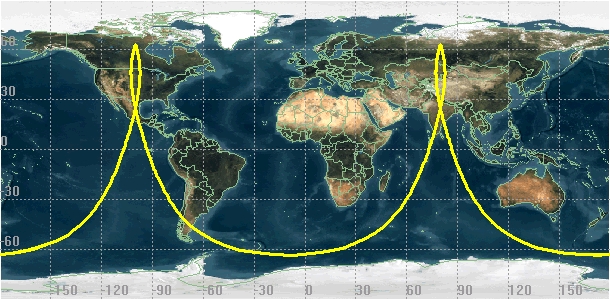
A satellite in a highly eccentric orbit spends most of its time in the neighborhood of apogee which for a Molniya orbit is over the northern hemisphere, the sub-satellite point at apogee having a latitude of 63.4 degrees North. As the apogee altitude is as high as 40000 km it will therefore, for a considerable period around apogee, have an excellent visibility from the Northern hemisphere, from Russia but also from northern Europe, Greenland and Canada.
To get a continuous high elevation
coverage of the northern hemisphere at least three Molniya spacecraft are needed.
The reason why the inclination should have the value 63.4 deg is that then the argument of perigee is not perturbed by the J2 term of the gravitational field of the Earth but stays -90 deg.
would require considerable power due to the low elevation angles
. A satellite in a Molniya orbit is better suited to communications in these regions because it looks directly down on them. In fact, in the period from apogee -3 hours to apogee +3 hours the sub-satellite point of the spacecraft is north of latitude 55.5 deg N and the elevation of the spacecraft is over 10 deg from all points north of latitude 54.1 deg N and over 5 deg from all points north of latitude 49.2 deg N.
An additional advantage is that considerably less launch energy is needed to bring a spacecraft into a Molniya orbit than into a geostationary orbit. Disadvantages are that as opposed to a spacecraft in a geostationary orbit the ground station needs a steerable antenna to track the spacecraft and that the spacecraft will pass the Van Allen belt 4 times per day.
It is necessary to have at least three spacecraft if permanent high elevation coverage is needed for a large area like the whole of Russia where some parts are as far south as 45 deg N. If three spacecraft are used each spacecraft is active for periods of 8 hours per orbit centered at apogee as illustrated in figure 9. As the Earth rotates half a revolution in 12 hours every second apogee will serve one half of the northern hemisphere and every second the other half. If for example the apogee longitudes are 90 deg E and 90 deg W this means that every second apogee will serve Europe and Asia (see figures 3 to 5) and every second Northern America (see figures 6 to 8). The orbits of the three spacecraft should then have the same apogee longitudes (for example 90 deg W and 90 deg E) but pass the apogee with 8 hours shift, i.e. the right ascensions of the ascending nodes
should be separated with 120 deg. When one spacecraft has reached the point corresponding to figure 5 (or figure 8) 4 hours after apogee passage the next spacecraft having 4 hours left to reach apogee and having a right ascension
of ascending node 120 deg larger then the previous spacecraft has the visibility displayed in figure 3 (or figure 6) and the switch-over can take place. Note that the two spacecraft at the time of switch-over only are separated with about 1500 km and that the ground stations therefore only have to move the antennas a few degrees to acquire the new spacecraft.
In general, the oblateness of the Earth perturbs the argument of perigee, so that even if the apogee started near the north pole, it would gradually move unless constantly corrected with "station keeping" thruster burns. To avoid this expenditure of fuel, the Molniya orbit uses an inclination of 63.4°, for which these perturbations are zero. That this is the case follows from equation (28) of the article Orbital perturbation analysis (spacecraft)
as the factor

then is zero.
The reason why the orbital period shall be half a sidereal day is that the geometry relative to the ground stations should repeat every 24 hours keeping the longitudes for the apogees passages. In fact, the precise ideal orbital period resulting in a ground track
repeating every 24 hours is not precisely half a sidereal day but rather half a "nodal day"! The J2 term of the gravitational field of the Earth causes secular perturbations of both the right ascension of the ascending node
 and the argument of perigee
 , the formulas giving the change per orbital revolution (in radians) being


which are equations (24) and (28) of the article Orbital perturbation analysis (spacecraft)
For a Molniya orbit the inclination is selected such that as given by the formula above is zero but
  as given by the other equation will be -0.0742 deg per orbit. The rotational period of the Earth relative the node, i.e. the "nodal day", will therefore be only 86129 seconds, 35 seconds less then the sidereal day which is 86164 seconds.
television network
, spanning the Soviet Union. These were in turn replaced by the Molniya-3 design. There is some confusion in the existing sources about the naming, with some sources suggesting that all of the satellites on-orbit are of the Molniya-3 type, but referred to as Molniya-1 through -3 depending on their purpose.
The same orbits, with slight adjustments, were also used by some Soviet spy satellite
s, with the apogee point over the continental United States. Although geostationary orbits are useful for observing the continental United States, Soviet sensor technology sometimes required high-contrast observing angles which could only be achieved from higher latitudes. One such example is the US-KS early-warning satellite which watches for US missile launches, although improvements in these systems have since allowed them to move these to geostationary orbits.
Highly Elliptical Orbit
A highly elliptical orbit is an elliptic orbit with a low-altitude perigee and a high-altitude apogee. It is a type of high Earth orbit....
with an inclination
Inclination
Inclination in general is the angle between a reference plane and another plane or axis of direction.-Orbits:The inclination is one of the six orbital parameters describing the shape and orientation of a celestial orbit...
of 63.4 degree
Degree (angle)
A degree , usually denoted by ° , is a measurement of plane angle, representing 1⁄360 of a full rotation; one degree is equivalent to π/180 radians...
s, an argument of perigee of -90 degree and an orbital period
Orbital period
The orbital period is the time taken for a given object to make one complete orbit about another object.When mentioned without further qualification in astronomy this refers to the sidereal period of an astronomical object, which is calculated with respect to the stars.There are several kinds of...
of one half of a sidereal day
Sidereal time
Sidereal time is a time-keeping system astronomers use to keep track of the direction to point their telescopes to view a given star in the night sky...
. Molniya orbits are named after a series of Soviet
Soviet Union
The Soviet Union , officially the Union of Soviet Socialist Republics , was a constitutionally socialist state that existed in Eurasia between 1922 and 1991....
/Russia
Russia
Russia or , officially known as both Russia and the Russian Federation , is a country in northern Eurasia. It is a federal semi-presidential republic, comprising 83 federal subjects...
n Molniya
Molniya (satellite)
Molniya was a military communications satellite system used by the Soviet Union. The satellites were placed into highly eccentric elliptical orbits known as Molniya orbits, characterised by an inclination of +63.4 degrees and a period of around 12 hours...
(Russian
Russian language
Russian is a Slavic language used primarily in Russia, Belarus, Uzbekistan, Kazakhstan, Tajikistan and Kyrgyzstan. It is an unofficial but widely spoken language in Ukraine, Moldova, Latvia, Turkmenistan and Estonia and, to a lesser extent, the other countries that were once constituent republics...
: "Lightning") communications satellite
Communications satellite
A communications satellite is an artificial satellite stationed in space for the purpose of telecommunications...
s which have been using this type of orbit since the mid 1960s.
A satellite in a highly eccentric orbit spends most of its time in the neighborhood of apogee which for a Molniya orbit is over the northern hemisphere, the sub-satellite point at apogee having a latitude of 63.4 degrees North. As the apogee altitude is as high as 40000 km it will therefore, for a considerable period around apogee, have an excellent visibility from the Northern hemisphere, from Russia but also from northern Europe, Greenland and Canada.
To get a continuous high elevation
Angle of incidence
Angle of incidence is a measure of deviation of something from "straight on", for example:* in the approach of a ray to a surface, or* the angle at which the wing or horizontal tail of an airplane is installed on the fuselage, measured relative to the axis of the fuselage.-Optics:In geometric...
coverage of the northern hemisphere at least three Molniya spacecraft are needed.
The reason why the inclination should have the value 63.4 deg is that then the argument of perigee is not perturbed by the J2 term of the gravitational field of the Earth but stays -90 deg.
Properties
Much of the area of the former Soviet Union, and Russia in particular, is located at high latitudes. To broadcast to these latitudes from a geostationary orbitGeostationary orbit
A geostationary orbit is a geosynchronous orbit directly above the Earth's equator , with a period equal to the Earth's rotational period and an orbital eccentricity of approximately zero. An object in a geostationary orbit appears motionless, at a fixed position in the sky, to ground observers...
would require considerable power due to the low elevation angles
Angle of incidence
Angle of incidence is a measure of deviation of something from "straight on", for example:* in the approach of a ray to a surface, or* the angle at which the wing or horizontal tail of an airplane is installed on the fuselage, measured relative to the axis of the fuselage.-Optics:In geometric...
. A satellite in a Molniya orbit is better suited to communications in these regions because it looks directly down on them. In fact, in the period from apogee -3 hours to apogee +3 hours the sub-satellite point of the spacecraft is north of latitude 55.5 deg N and the elevation of the spacecraft is over 10 deg from all points north of latitude 54.1 deg N and over 5 deg from all points north of latitude 49.2 deg N.
An additional advantage is that considerably less launch energy is needed to bring a spacecraft into a Molniya orbit than into a geostationary orbit. Disadvantages are that as opposed to a spacecraft in a geostationary orbit the ground station needs a steerable antenna to track the spacecraft and that the spacecraft will pass the Van Allen belt 4 times per day.
It is necessary to have at least three spacecraft if permanent high elevation coverage is needed for a large area like the whole of Russia where some parts are as far south as 45 deg N. If three spacecraft are used each spacecraft is active for periods of 8 hours per orbit centered at apogee as illustrated in figure 9. As the Earth rotates half a revolution in 12 hours every second apogee will serve one half of the northern hemisphere and every second the other half. If for example the apogee longitudes are 90 deg E and 90 deg W this means that every second apogee will serve Europe and Asia (see figures 3 to 5) and every second Northern America (see figures 6 to 8). The orbits of the three spacecraft should then have the same apogee longitudes (for example 90 deg W and 90 deg E) but pass the apogee with 8 hours shift, i.e. the right ascensions of the ascending nodes
Longitude of the ascending node
The longitude of the ascending node is one of the orbital elements used to specify the orbit of an object in space. It is the angle from a reference direction, called the origin of longitude, to the direction of the ascending node, measured in a reference plane...
should be separated with 120 deg. When one spacecraft has reached the point corresponding to figure 5 (or figure 8) 4 hours after apogee passage the next spacecraft having 4 hours left to reach apogee and having a right ascension
Right ascension
Right ascension is the astronomical term for one of the two coordinates of a point on the celestial sphere when using the equatorial coordinate system. The other coordinate is the declination.-Explanation:...
of ascending node 120 deg larger then the previous spacecraft has the visibility displayed in figure 3 (or figure 6) and the switch-over can take place. Note that the two spacecraft at the time of switch-over only are separated with about 1500 km and that the ground stations therefore only have to move the antennas a few degrees to acquire the new spacecraft.
In general, the oblateness of the Earth perturbs the argument of perigee, so that even if the apogee started near the north pole, it would gradually move unless constantly corrected with "station keeping" thruster burns. To avoid this expenditure of fuel, the Molniya orbit uses an inclination of 63.4°, for which these perturbations are zero. That this is the case follows from equation (28) of the article Orbital perturbation analysis (spacecraft)
Orbital perturbation analysis (spacecraft)
Isaac Newton in his Philosophiæ Naturalis Principia Mathematica demonstrated that the gravitational force between two mass points is inversely proportional to the square of the distance between the points and fully solved corresponding "two-body problem" demonstrating that radius vector between the...
as the factor
then is zero.
The reason why the orbital period shall be half a sidereal day is that the geometry relative to the ground stations should repeat every 24 hours keeping the longitudes for the apogees passages. In fact, the precise ideal orbital period resulting in a ground track
Ground track
A ground track or ground trace is the path on the surface of the Earth directly below an aircraft or satellite. In the case of a satellite, it is the projection of the satellite's orbit onto the surface of the Earth .A satellite ground track may be thought of as a path along the Earth's surface...
repeating every 24 hours is not precisely half a sidereal day but rather half a "nodal day"! The J2 term of the gravitational field of the Earth causes secular perturbations of both the right ascension of the ascending node
Orbital node
An orbital node is one of the two points where an orbit crosses a plane of reference to which it is inclined. An orbit which is contained in the plane of reference has no nodes.-Planes of reference:...
and the argument of perigeeArgument of periapsis
The argument of periapsis , symbolized as ω, is one of the orbital elements of an orbiting body...
, the formulas giving the change per orbital revolution (in radians) beingwhich are equations (24) and (28) of the article Orbital perturbation analysis (spacecraft)
Orbital perturbation analysis (spacecraft)
Isaac Newton in his Philosophiæ Naturalis Principia Mathematica demonstrated that the gravitational force between two mass points is inversely proportional to the square of the distance between the points and fully solved corresponding "two-body problem" demonstrating that radius vector between the...
For a Molniya orbit the inclination is selected such that
as given by the formula above is zero but as given by the other equation will be -0.0742 deg per orbit. The rotational period of the Earth relative the node, i.e. the "nodal day", will therefore be only 86129 seconds, 35 seconds less then the sidereal day which is 86164 seconds.Uses
The primary use of the Molniya orbit was for the communications satellite series of the same name. After two launch failures in 1964, the first successful satellite to use this orbit was Molniya 1-01 launched on April 23, 1965. The early Molniya-1 satellites were used for long-range military communications starting in 1968, but the satellites had a short lifespan and had to be constantly replaced. Its replacement, the Molniya-2, provided both military and civilian broadcasting, and was used to create the OrbitaOrbita
Orbita is a Soviet-Russian system of broadcasting and delivering TV signals via satellites. It is considered to be the first national network of satellite television....
television network
Television network
A television network is a telecommunications network for distribution of television program content, whereby a central operation provides programming to many television stations or pay TV providers. Until the mid-1980s, television programming in most countries of the world was dominated by a small...
, spanning the Soviet Union. These were in turn replaced by the Molniya-3 design. There is some confusion in the existing sources about the naming, with some sources suggesting that all of the satellites on-orbit are of the Molniya-3 type, but referred to as Molniya-1 through -3 depending on their purpose.
The same orbits, with slight adjustments, were also used by some Soviet spy satellite
Spy satellite
A spy satellite is an Earth observation satellite or communications satellite deployed for military or intelligence applications....
s, with the apogee point over the continental United States. Although geostationary orbits are useful for observing the continental United States, Soviet sensor technology sometimes required high-contrast observing angles which could only be achieved from higher latitudes. One such example is the US-KS early-warning satellite which watches for US missile launches, although improvements in these systems have since allowed them to move these to geostationary orbits.
External links
- JAVA applet animating the orbit of a satellite in an elliptic Kepler orbit around the Earth. For a Molniya orbit, set the semi-major axis to 26562 km and eccentricity to 0.74105.
- Real time satellite tracking for a typical Molniya satellite
- 3D Molniya constellation viewer (Java applet)
- illustration of the communication geometry provided by satellites in 12-hour Molniya orbits (video)