


Longitude of the ascending node

Encyclopedia
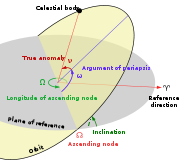
Orbital elements
Orbital elements are the parameters required to uniquely identify a specific orbit. In celestial mechanics these elements are generally considered in classical two-body systems, where a Kepler orbit is used...
used to specify the orbit
Orbit
In physics, an orbit is the gravitationally curved path of an object around a point in space, for example the orbit of a planet around the center of a star system, such as the Solar System...
of an object in space. It is the angle from a reference direction, called the origin of longitude, to the direction of the ascending node, measured in a reference plane. Commonly used reference planes and origins of longitude include:
- For a geocentric orbitGeocentric orbitA geocentric orbit involves any object orbiting the Earth, such as the Moon or artificial satellites. Currently there are approximately 2,465 artificial satellites orbiting the Earth and 6,216 pieces of space debris as tracked by the Goddard Space Flight Center...
, EarthEarthEarth is the third planet from the Sun, and the densest and fifth-largest of the eight planets in the Solar System. It is also the largest of the Solar System's four terrestrial planets...
's equatorEquatorAn equator is the intersection of a sphere's surface with the plane perpendicular to the sphere's axis of rotation and containing the sphere's center of mass....
ial plane as the reference plane, and the First Point of Aries as the origin of longitude. In this case, the longitude is also called the right ascension of the ascending node, or RAAN. The angle is measured eastwards (or, as seen from the northNorthNorth is a noun, adjective, or adverb indicating direction or geography.North is one of the four cardinal directions or compass points. It is the opposite of south and is perpendicular to east and west.By convention, the top side of a map is north....
, counterclockwise) from the First Point of Aries to the node. - For a heliocentric orbitHeliocentric orbitA heliocentric orbit is an orbit around the Sun. All planets, comets, and asteroids in our Solar System are in such orbits, as are many artificial probes and pieces of debris. The moons of planets in the Solar System, by contrast, are not in heliocentric orbits as they orbit their respective planet...
, the eclipticEclipticThe ecliptic is the plane of the earth's orbit around the sun. In more accurate terms, it is the intersection of the celestial sphere with the ecliptic plane, which is the geometric plane containing the mean orbit of the Earth around the Sun...
as the reference plane, and the First Point of Aries as the origin of longitude. The angle is measured counterclockwise (as seen from north of the ecliptic) from the First Point of Aries to the node. - For an orbit outside the Solar SystemSolar SystemThe Solar System consists of the Sun and the astronomical objects gravitationally bound in orbit around it, all of which formed from the collapse of a giant molecular cloud approximately 4.6 billion years ago. The vast majority of the system's mass is in the Sun...
, the plane through the primary perpendicular to a line through the observer and the primary (called the plane of the sky) as the reference plane, and north, i.e., the perpendicular projectionOrthographic projectionOrthographic projection is a means of representing a three-dimensional object in two dimensions. It is a form of parallel projection, where all the projection lines are orthogonal to the projection plane, resulting in every plane of the scene appearing in affine transformation on the viewing surface...
of the direction from the observer to the North Celestial Pole onto the plane of the sky, as the origin of longitude. The angle is measured eastwards (or, as seen by the observer, counterclockwise) from north to the node., pp. 40, 72, 137; , chap. 17.
In the case of a binary star
Binary star
A binary star is a star system consisting of two stars orbiting around their common center of mass. The brighter star is called the primary and the other is its companion star, comes, or secondary...
known only from visual observations, it is not possible to tell which node is ascending and which is descending. In this case the orbital parameter which is recorded is the longitude of the node, Ω, which is the longitude of whichever node has a longitude between 0 and 180 degrees., chap. 17;, p. 72.
Calculation from state vectors
In astrodynamicsAstrodynamics
Orbital mechanics or astrodynamics is the application of ballistics and celestial mechanics to the practical problems concerning the motion of rockets and other spacecraft. The motion of these objects is usually calculated from Newton's laws of motion and Newton's law of universal gravitation. It...
, the longitude of the ascending node can be calculated from the specific relative angular momentum
Specific relative angular momentum
The specific relative angular momentum is also known as the areal momentum .In astrodynamics, the specific relative angular momentum of two orbiting bodies is the vector product of the relative position and the relative velocity. Equivalently, it is the total angular momentum divided by the...
vector h as follows:



Here, n=(nx, ny, nz) is a vector pointing towards the ascending node. The reference plane is assumed to be the xy-plane, and the origin of longitude is taken to be the positive x-axis. k is the unit vector (0, 0, 1), which is the normal vector to the xy reference plane.
For non-inclined orbits (with inclination equal to zero), Ω is undefined. For computation it is then, by convention, set equal to zero; that is, the ascending node is placed in the reference direction, which is equivalent to letting n point towards the positive x-axis.
See also
- Kepler orbitKepler orbitIn celestial mechanics, a Kepler orbit describes the motion of an orbiting body as an ellipse, parabola, or hyperbola, which forms a two-dimensional orbital plane in three-dimensional space...
s - EquinoxEquinoxAn equinox occurs twice a year, when the tilt of the Earth's axis is inclined neither away from nor towards the Sun, the center of the Sun being in the same plane as the Earth's equator...
- Orbital nodeOrbital nodeAn orbital node is one of the two points where an orbit crosses a plane of reference to which it is inclined. An orbit which is contained in the plane of reference has no nodes.-Planes of reference:...
- perturbation of the orbital plane can cause revolution of the ascending node