

Micro Channel architecture

Encyclopedia
Micro Channel Architecture (MCA) was a proprietary
16-
or 32-bit
parallel
computer bus introduced by IBM
in 1987 which was used on PS/2
and other computers through the mid 1990s.
(ISA) bus had a number of technical design limitations, including:
In addition, it suffered from other problems:
These limitations became more serious as the range of tasks and peripherals, and the number of manufacturers for IBM PC-compatibles, grew. IBM was already investigating the use of RISC processors in desktop machines, and could, in theory, save considerable money if a single well-documented bus could be used across their entire computer lineup.
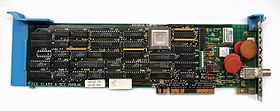 The IBM Micro Channel architecture was designed by engineer Chet Heath.
The situation was never that simple, however, as both the 32-bit and 16-bit versions initially had a number of additional optional connectors for memory cards which resulted in a huge number of physically incompatible cards for bus attached memory. In time, memory moved to the CPU's local bus, thereby eliminating the problem. On the upside, signal quality was greatly improved as MCA added ground and power pins and arranged the pins to minimize interference; a ground or a supply was thereby located within 3 pins of every signal.
Another connector extension was included for graphics cards. This extension was used for analog output from the video card, which was then routed through the system board to the system's own monitor output. The advantage of this was that Micro Channel system boards could have a basic VGA or MCGA graphics system on board, and higher level graphics (XGA or other accelerator cards) could then share the same port. The add-on cards were then able to be free of 'legacy' VGA modes, leveraging the on-board graphics system when needed, and allowing a single system board connector for graphics that could be upgraded.
MCA cards also featured a unique, 16-bit software-readable ID, which formed the basis of an early plug and play system. The BIOS and/or OS can read IDs, compare against a list of known cards, and perform automatic system configuration to suit. This led to boot failures whereby an older BIOS
would not recognize a newer card, causing an error at startup. In turn, this required IBM to release updated Reference Disks (The CMOS
Setup Utility) on a regular basis. A fairly complete list of known IDs is available (see External links section). To accompany these reference disks were ADF files which were read by the CMOS which in turn provided configuration information for the Card. The ADF was a simple text file, containing information about the card's Memory addressing and Interrupts.
transfers, meant that effective throughput was up to five times faster than ISA. For faster transfers the address bus
could be reused for data, further increasing the effective width of the bus. Around 40 MB/s of throughput was observed (the theoretical maximum for MCA was 66 MB/s), although some higher throughput functions of the Microchannel bus were not initially supported on cards operating on an Intel platform.
With bus mastering
, each card could talk to another directly. This allowed performance that was independent of the CPU. One potential drawback of multi-master design was the possible collisions when more than one card would try to bus master, but MCA included an arbitration feature to correct for these situations, and also allowed a master to use a burst-mode
. MCA cards had complete control for up to 12 milliseconds. This was long enough to permit the maximum number of other devices on the bus to buffer inbound data from over-runnable devices like tape and communications.
Multiple bus-master support and improved arbitration means that several such devices could coexist and share the system bus. MCA bus-master-capable devices can even use the bus to talk directly to each other (peer to peer) at speeds faster than the system CPU, without any other system intervention. In theory, MCA systems could be expanded, like mainframes, with only the addition of intelligent masters, without periodic need to upgrade the central processor.
Arbitration enhancement ensures better system throughput, since control is passed more efficiently. Advanced interrupt handling refers to the use of level sensitive interrupts to handle system requests. Rather than a dedicated interrupt line, several lines can be shared to provide more possible interrupts, addressing the ISA-bus interrupt line conflict problems.
All interrupt request signals were "public" on MCA permitting any card on the bus to function as an I/O processor for direct service of I/O device interrupts. ISA had limited all such processing to just the system's CPU. Likewise, bus master request and grant signals were public, such that bus attached devices could monitor latency to control internal buffering for I/O processors. These features were not adopted for PCI, requiring all I/O support to come uniquely from the system board processor.
The final major MCA improvement was POS, the Programmable Option Select, which allowed all setup to take place in software. This feature is taken for granted now, but at the time setup was a huge chore for ISA systems. POS was a simple system that included device IDs in firmware, which the drivers in the computer were supposed to interpret. This software-configuration is known as plug-and-play
today.
range in 1987, with three out of the four of the new machines featuring it. Its use in IBM spread to the RS/6000
, AS/400, and eventually to the smallest members of the System/370
range.
NCR Corporation
adopted MCA comprehensively - they designed and built high-performance personal computer, workstation and server platforms supporting MCA, including their own MCA-based logic componentry, including SCSI, graphics, networking, and audio. A small number of other manufacturers, including Apricot
, Dell
, Tandy
, Research Machines
and Olivetti
adopted it, but only for part of their PC range.
It soon became clear that although MCA was a huge technical improvement over ISA its introduction and marketing by IBM was poorly handled.
IBM had patents on MCA system features and required MCA system manufacturers to pay a licence fee - and actively pursued patents to block third parties from selling unlicensed implementations of it. The PC clone
market did not want to pay royalties to IBM in order to use this new technology, and for desktop machines vendors of PC-compatibles stayed largely with the 16-bit AT bus, (embraced and renamed as ISA to avoid IBM's "AT" trademark) and manual configuration, although the VESA Local Bus
was briefly popular for Intel '486
machines.
For servers the technical limitations of the old ISA were too great, and in late 1988 the "Gang of Nine", led by Compaq
, announced a rival high performance bus - Extended Industry Standard Architecture
(EISA). This offered similar performance benefits to Micro Channel, but with twin advantage of being able to accept older ISA boards, and being free from IBM's control.
For several years EISA and MCA battled it out in the server arena, but in 1996 IBM effectively conceded defeat when they themselves produced some EISA bus servers.
Within a few years of its arrival in 1992, PCI
had largely superseded Micro Channel, EISA and VESA.
, Ethernet
, 5250 and 3270 connections.
Proprietary hardware
Proprietary hardware is computer hardware which is owned by the proprietor.Historically, most early computer hardware was designed as proprietary until the 1980s, when IBM PC changed this paradigm...
16-
16-bit
-16-bit architecture:The HP BPC, introduced in 1975, was the world's first 16-bit microprocessor. Prominent 16-bit processors include the PDP-11, Intel 8086, Intel 80286 and the WDC 65C816. The Intel 8088 was program-compatible with the Intel 8086, and was 16-bit in that its registers were 16...
or 32-bit
32-bit
The range of integer values that can be stored in 32 bits is 0 through 4,294,967,295. Hence, a processor with 32-bit memory addresses can directly access 4 GB of byte-addressable memory....
parallel
Parallel communications
In telecommunication and computer science, parallel communication is a method of sending several data signals simultaneously over several parallel channels...
computer bus introduced by IBM
IBM
International Business Machines Corporation or IBM is an American multinational technology and consulting corporation headquartered in Armonk, New York, United States. IBM manufactures and sells computer hardware and software, and it offers infrastructure, hosting and consulting services in areas...
in 1987 which was used on PS/2
IBM Personal System/2
The Personal System/2 or PS/2 was IBM's third generation of personal computers. The PS/2 line, released to the public in 1987, was created by IBM in an attempt to recapture control of the PC market by introducing an advanced proprietary architecture...
and other computers through the mid 1990s.
Background
The development of Micro Channel was driven by both technical and business pressures.Technology
The IBM AT bus, which later became known as the Industry Standard ArchitectureIndustry Standard Architecture
Industry Standard Architecture is a computer bus standard for IBM PC compatible computers introduced with the IBM Personal Computer to support its Intel 8088 microprocessor's 8-bit external data bus and extended to 16 bits for the IBM Personal Computer/AT's Intel 80286 processor...
(ISA) bus had a number of technical design limitations, including:
- A slow bus speed.
- A limited number of interrupts, fixed in hardware.
- A limited number of I/O device addresses, also fixed in hardware.
- Hardwired and complex configuration with no conflict resolution.
- Deep links to the architecture of the 80x86 chip family
In addition, it suffered from other problems:
- Poor grounding and power distribution.
- Undocumented bus interface standards that varied between systems and manufacturers.
These limitations became more serious as the range of tasks and peripherals, and the number of manufacturers for IBM PC-compatibles, grew. IBM was already investigating the use of RISC processors in desktop machines, and could, in theory, save considerable money if a single well-documented bus could be used across their entire computer lineup.
Marketshare
It was thought that by creating a new standard, IBM would regain control of standards via the required licencing. As patents can take three years or more to be granted, however, only those relating to ISA could be licensed when MCA was announced. Patents on important Micro Channel features, such as Plug and Play automatic configuration, were not granted to IBM until after PCI had replaced MCA in the marketplace.Design
Overview
MCA was primarily a 32-bit bus, but the system also supported a 16-bit mode designed to lower the cost of connectors and logic in Intel-based machines like the IBM PS/2.The situation was never that simple, however, as both the 32-bit and 16-bit versions initially had a number of additional optional connectors for memory cards which resulted in a huge number of physically incompatible cards for bus attached memory. In time, memory moved to the CPU's local bus, thereby eliminating the problem. On the upside, signal quality was greatly improved as MCA added ground and power pins and arranged the pins to minimize interference; a ground or a supply was thereby located within 3 pins of every signal.
Another connector extension was included for graphics cards. This extension was used for analog output from the video card, which was then routed through the system board to the system's own monitor output. The advantage of this was that Micro Channel system boards could have a basic VGA or MCGA graphics system on board, and higher level graphics (XGA or other accelerator cards) could then share the same port. The add-on cards were then able to be free of 'legacy' VGA modes, leveraging the on-board graphics system when needed, and allowing a single system board connector for graphics that could be upgraded.
MCA cards also featured a unique, 16-bit software-readable ID, which formed the basis of an early plug and play system. The BIOS and/or OS can read IDs, compare against a list of known cards, and perform automatic system configuration to suit. This led to boot failures whereby an older BIOS
BIOS
In IBM PC compatible computers, the basic input/output system , also known as the System BIOS or ROM BIOS , is a de facto standard defining a firmware interface....
would not recognize a newer card, causing an error at startup. In turn, this required IBM to release updated Reference Disks (The CMOS
Nonvolatile BIOS memory
Nonvolatile BIOS memory refers to a small memory on PC motherboards that is used to store BIOS settings. It was traditionally called CMOS RAM because it used a low-power Complementary metal-oxide-semiconductor SRAM powered by a small battery when system power was off...
Setup Utility) on a regular basis. A fairly complete list of known IDs is available (see External links section). To accompany these reference disks were ADF files which were read by the CMOS which in turn provided configuration information for the Card. The ADF was a simple text file, containing information about the card's Memory addressing and Interrupts.
Data transmission
The basic data rate of MCA was increased from ISA's 8 MHz to 10 MHz. This may have been a modest increase in terms of clock rate, but the greater bus width, coupled with a dedicated bus controller that utilized burst modeBurst mode (computing)
Burst mode is a generic computing term referring to any situation in which a device is transmitting data repeatedly without waiting for input from another device or waiting for an internal process to terminate before continuing the transfer of data.In the case of DMA, the DMA controller and the...
transfers, meant that effective throughput was up to five times faster than ISA. For faster transfers the address bus
Address bus
An address bus is a computer bus that is used to specify a physical address. When a processor or DMA-enabled device needs to read or write to a memory location, it specifies that memory location on the address bus...
could be reused for data, further increasing the effective width of the bus. Around 40 MB/s of throughput was observed (the theoretical maximum for MCA was 66 MB/s), although some higher throughput functions of the Microchannel bus were not initially supported on cards operating on an Intel platform.
With bus mastering
Bus mastering
In computing, bus mastering is a feature supported by many bus architectures that enables a device connected to the bus to initiate transactions...
, each card could talk to another directly. This allowed performance that was independent of the CPU. One potential drawback of multi-master design was the possible collisions when more than one card would try to bus master, but MCA included an arbitration feature to correct for these situations, and also allowed a master to use a burst-mode
Burst mode (computing)
Burst mode is a generic computing term referring to any situation in which a device is transmitting data repeatedly without waiting for input from another device or waiting for an internal process to terminate before continuing the transfer of data.In the case of DMA, the DMA controller and the...
. MCA cards had complete control for up to 12 milliseconds. This was long enough to permit the maximum number of other devices on the bus to buffer inbound data from over-runnable devices like tape and communications.
Multiple bus-master support and improved arbitration means that several such devices could coexist and share the system bus. MCA bus-master-capable devices can even use the bus to talk directly to each other (peer to peer) at speeds faster than the system CPU, without any other system intervention. In theory, MCA systems could be expanded, like mainframes, with only the addition of intelligent masters, without periodic need to upgrade the central processor.
Arbitration enhancement ensures better system throughput, since control is passed more efficiently. Advanced interrupt handling refers to the use of level sensitive interrupts to handle system requests. Rather than a dedicated interrupt line, several lines can be shared to provide more possible interrupts, addressing the ISA-bus interrupt line conflict problems.
All interrupt request signals were "public" on MCA permitting any card on the bus to function as an I/O processor for direct service of I/O device interrupts. ISA had limited all such processing to just the system's CPU. Likewise, bus master request and grant signals were public, such that bus attached devices could monitor latency to control internal buffering for I/O processors. These features were not adopted for PCI, requiring all I/O support to come uniquely from the system board processor.
The final major MCA improvement was POS, the Programmable Option Select, which allowed all setup to take place in software. This feature is taken for granted now, but at the time setup was a huge chore for ISA systems. POS was a simple system that included device IDs in firmware, which the drivers in the computer were supposed to interpret. This software-configuration is known as plug-and-play
Plug-and-play
In computing, plug and play is a term used to describe the characteristic of a computer bus, or device specification, which facilitates the discovery of a hardware component in a system, without the need for physical device configuration, or user intervention in resolving resource conflicts.Plug...
today.
Reception
Micro Channel architecture was first introduced at the launch of the PS/2IBM Personal System/2
The Personal System/2 or PS/2 was IBM's third generation of personal computers. The PS/2 line, released to the public in 1987, was created by IBM in an attempt to recapture control of the PC market by introducing an advanced proprietary architecture...
range in 1987, with three out of the four of the new machines featuring it. Its use in IBM spread to the RS/6000
RS/6000
RISC System/6000, or RS/6000 for short, is a family of RISC and UNIX based servers, workstations and supercomputers made by IBM in the 1990s. The RS/6000 family replaced the IBM RT computer platform in February 1990 and was the first computer line to see the use of IBM's POWER and PowerPC based...
, AS/400, and eventually to the smallest members of the System/370
System/370
The IBM System/370 was a model range of IBM mainframes announced on June 30, 1970 as the successors to the System/360 family. The series maintained backward compatibility with the S/360, allowing an easy migration path for customers; this, plus improved performance, were the dominant themes of the...
range.
NCR Corporation
NCR Corporation
NCR Corporation is an American technology company specializing in kiosk products for the retail, financial, travel, healthcare, food service, entertainment, gaming and public sector industries. Its main products are self-service kiosks, point-of-sale terminals, automated teller machines, check...
adopted MCA comprehensively - they designed and built high-performance personal computer, workstation and server platforms supporting MCA, including their own MCA-based logic componentry, including SCSI, graphics, networking, and audio. A small number of other manufacturers, including Apricot
Apricot Computers
Apricot Computers is a British manufacturer of business personal computers, originally founded in 1965 as "Applied Computer Techniques" , changing its name to Apricot Computers, Ltd. in the 1980s...
, Dell
Dell
Dell, Inc. is an American multinational information technology corporation based in 1 Dell Way, Round Rock, Texas, United States, that develops, sells and supports computers and related products and services. Bearing the name of its founder, Michael Dell, the company is one of the largest...
, Tandy
Tandy Corporation
Tandy Corporation was a family-owned leather goods company based in Fort Worth, Texas. Tandy was founded in 1919 as a leather supply store, and acquired RadioShack in 1963. The Tandy name was dropped in May 2000, when RadioShack Corporation was made the official name.-History:Tandy began in 1919...
, Research Machines
RM plc
RM plc is a British company specialising in providing products and services to schools, colleges, universities and government education departments & agencies...
and Olivetti
Olivetti
Olivetti S.p.A. is an Italian manufacturer of computers, printers and other business machines.- Founding :The company was founded as a typewriter manufacturer in 1908 in Ivrea, near Turin, by Camillo Olivetti. The firm was mainly developed by his son Adriano Olivetti...
adopted it, but only for part of their PC range.
It soon became clear that although MCA was a huge technical improvement over ISA its introduction and marketing by IBM was poorly handled.
IBM had patents on MCA system features and required MCA system manufacturers to pay a licence fee - and actively pursued patents to block third parties from selling unlicensed implementations of it. The PC clone
IBM PC compatible
IBM PC compatible computers are those generally similar to the original IBM PC, XT, and AT. Such computers used to be referred to as PC clones, or IBM clones since they almost exactly duplicated all the significant features of the PC architecture, facilitated by various manufacturers' ability to...
market did not want to pay royalties to IBM in order to use this new technology, and for desktop machines vendors of PC-compatibles stayed largely with the 16-bit AT bus, (embraced and renamed as ISA to avoid IBM's "AT" trademark) and manual configuration, although the VESA Local Bus
VESA Local Bus
The VESA Local Bus was mostly used in personal computers. VESA Local Bus worked alongside the ISA bus; it acted as a high-speed conduit for memory-mapped I/O and DMA, while the ISA bus handled interrupts and port-mapped I/O.-Historical overview:In the early 1990s, the I/O bandwidth of...
was briefly popular for Intel '486
Intel 80486
The Intel 80486 microprocessor was a higher performance follow up on the Intel 80386. Introduced in 1989, it was the first tightly pipelined x86 design as well as the first x86 chip to use more than a million transistors, due to a large on-chip cache and an integrated floating point unit...
machines.
For servers the technical limitations of the old ISA were too great, and in late 1988 the "Gang of Nine", led by Compaq
Compaq
Compaq Computer Corporation is a personal computer company founded in 1982. Once the largest supplier of personal computing systems in the world, Compaq existed as an independent corporation until 2002, when it was acquired for US$25 billion by Hewlett-Packard....
, announced a rival high performance bus - Extended Industry Standard Architecture
Extended Industry Standard Architecture
The Extended Industry Standard Architecture is a bus standard for IBM PC compatible computers...
(EISA). This offered similar performance benefits to Micro Channel, but with twin advantage of being able to accept older ISA boards, and being free from IBM's control.
For several years EISA and MCA battled it out in the server arena, but in 1996 IBM effectively conceded defeat when they themselves produced some EISA bus servers.
Within a few years of its arrival in 1992, PCI
Peripheral Component Interconnect
Conventional PCI is a computer bus for attaching hardware devices in a computer...
had largely superseded Micro Channel, EISA and VESA.
Cards
Expansion cards for the Micro Channel bus typically targeted high-end graphic workstation or server requirements, with SCSISCSI
Small Computer System Interface is a set of standards for physically connecting and transferring data between computers and peripheral devices. The SCSI standards define commands, protocols, and electrical and optical interfaces. SCSI is most commonly used for hard disks and tape drives, but it...
, Ethernet
Ethernet
Ethernet is a family of computer networking technologies for local area networks commercially introduced in 1980. Standardized in IEEE 802.3, Ethernet has largely replaced competing wired LAN technologies....
, 5250 and 3270 connections.
Sound Cards
Very few MCA sound cards were ever produced. Some examples include:- AdLib Gold 2000MC
- ChipChat Sound-16
- ChipChat Sound-32
- Creative Labs Sound BlasterSound BlasterThe Sound Blaster family of sound cards was the de facto standard for consumer audio on the IBM PC compatible system platform, until the widespread transition to Microsoft Windows 95, which standardized the programming interface at application level , and the evolution in PC design led to onboard...
MCV, SKU:CT5320 - Creative Labs Sound BlasterSound BlasterThe Sound Blaster family of sound cards was the de facto standard for consumer audio on the IBM PC compatible system platform, until the widespread transition to Microsoft Windows 95, which standardized the programming interface at application level , and the evolution in PC design led to onboard...
Pro 2 MCV, SKU:CT5330 - IBMIBMInternational Business Machines Corporation or IBM is an American multinational technology and consulting corporation headquartered in Armonk, New York, United States. IBM manufactures and sells computer hardware and software, and it offers infrastructure, hosting and consulting services in areas...
Audiovation, SKU: 92G7463, 92G7464 - RolandRoland Corporationis a Japanese manufacturer of electronic musical instruments, electronic equipment and software. It was founded by Ikutaro Kakehashi in Osaka on April 18, 1972, with ¥33 million in capital. In 2005 Roland's headquarters relocated to Hamamatsu in Shizuoka Prefecture. Today it has factories in Japan,...
MPU-IMC
See also
- Industry Standard ArchitectureIndustry Standard ArchitectureIndustry Standard Architecture is a computer bus standard for IBM PC compatible computers introduced with the IBM Personal Computer to support its Intel 8088 microprocessor's 8-bit external data bus and extended to 16 bits for the IBM Personal Computer/AT's Intel 80286 processor...
(ISA) - Extended Industry Standard ArchitectureExtended Industry Standard ArchitectureThe Extended Industry Standard Architecture is a bus standard for IBM PC compatible computers...
(EISA) - NuBusNuBusNuBus is a 32-bit parallel computer bus, originally developed at MIT as a part of the NuMachine workstation project. The first complete implementation of the NuBus and the NuMachine was done by Western Digital for their NuMachine, and for the Lisp Machines Inc. LMI-Lambda. The NuBus was later...
- VESA Local BusVESA Local BusThe VESA Local Bus was mostly used in personal computers. VESA Local Bus worked alongside the ISA bus; it acted as a high-speed conduit for memory-mapped I/O and DMA, while the ISA bus handled interrupts and port-mapped I/O.-Historical overview:In the early 1990s, the I/O bandwidth of...
(VESA) - Peripheral Component InterconnectPeripheral Component InterconnectConventional PCI is a computer bus for attaching hardware devices in a computer...
(PCI) - Accelerated Graphics PortAccelerated Graphics PortThe Accelerated Graphics Port is a high-speed point-to-point channel for attaching a video card to a computer's motherboard, primarily to assist in the acceleration of 3D computer graphics. Since 2004 AGP has been progressively phased out in favor of PCI Express...
(AGP) - PCI ExpressPCI ExpressPCI Express , officially abbreviated as PCIe, is a computer expansion card standard designed to replace the older PCI, PCI-X, and AGP bus standards...
(PCIe) - List of device bit rates