

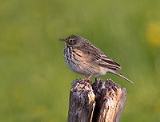
Meadow Pipit

Encyclopedia
The Meadow Pipit Anthus pratensis, is a small passerine
bird
which breeds in much of the northern half of Europe
and also northwestern Asia
, from southeastern Greenland
and Iceland
east to just east of the Ural Mountains
in Russia
, and south to central France
and Romania
; there is also an isolated population in the Caucasus Mountains
. It is migratory
over most of its range, wintering in southern Europe, north Africa
and southwestern Asia
, but is resident in Ireland, Great Britain, and neighbouring areas of western Europe. However, even here, many birds move to the coast or lowlands in winter.
This is a widespread and often abundant small pipit
, 14.5–15 cm long and 15–22 g weight. It is an undistinguished looking species on the ground, mainly brown above and buff below, with darker streaking on most of its plumage; the tail is brown, with narrow white side edges. It has a thin bill and pale pinkish-yellow legs; the hind claw is notably long, longer than the rest of the hind toe. The call is a weak tsi-tsi. The simple repetitive song is given in a short song flight. Birds breeding in Ireland
and western Scotland
are slightly darker coloured than those in other areas, and are often distinguished as the subspecies
Anthus pratensis whistleri, though it intergrades clinally with nominate Anthus pratensis pratensis found in the rest of the species' range.
It is primarily a species of open habitats, either uncultivated or low-intensity agriculture, such as pasture, bogs, and moorland, but also occurs in low numbers in arable croplands. In winter, it also uses saltmarshes and sometimes open woodlands. It is a fairly terrestrial pipit, always feeding on the ground, but will use elevated perches such as shrubs, fence lines or electricity wires as vantage points to watch for predators.
It is similar to the Red-throated Pipit
Anthus cervinus, which is more heavily streaked and (in summer only) has an orange-red throat, and to the Tree Pipit
Anthus trivialis, which is slightly larger, less heavily streaked, and has stronger facial markings and a shorter hind claw. The song of the Meadow Pipit accelerates towards the end while that of the Tree Pipit slows down.
The food is primarily insect
s and other invertebrate
s, mostly small items less than 5 mm long. It also eats the seeds of grasses
, sedges
, rushes
and heather
, and crowberry berries, mainly in winter.
The nest is on the ground hidden in dense vegetation, with 2–7 (most often 3–5) eggs; the eggs hatch after 11–15 days, with the chicks fledging 10–14 days after hatching. Two broods are commonly raised each year. This species is one of the most important nest hosts of the Cuckoo
, and it is also an important prey species for Merlin
s and Hen Harrier
s.
The estimated total population is 12 million pairs. It is an abundant species in the north of its range, and generally the commonest breeding bird in most of upland Britain, but less common further south. Breeding densities range from 80 pairs per square kilometre in northern Scandinavia, to 5–20 pairs per square kilometre in grassland in the south of the breeding range, and just one pair per square kilometre in arable farmland. There are a small number of isolated breeding records from south of the main range, in the mountains of Spain
, Italy
, and the northern Balkans
.
The generic name 'pipit', first documented by Thomas Pennant
in 1768, is onomatopoeic, from the call note of this species. In colloquial use by birders
in the UK the name Meadow Pipit is often abbreviated to "mippit". Old folk names, no longer used, include "chit lark", "peet lark", "tit lark" and "titling"; these refer to its small size and superficial similarity to a lark
.
Passerine
A passerine is a bird of the order Passeriformes, which includes more than half of all bird species. Sometimes known as perching birds or, less accurately, as songbirds, the passerines form one of the most diverse terrestrial vertebrate orders: with over 5,000 identified species, it has roughly...
bird
Bird
Birds are feathered, winged, bipedal, endothermic , egg-laying, vertebrate animals. Around 10,000 living species and 188 families makes them the most speciose class of tetrapod vertebrates. They inhabit ecosystems across the globe, from the Arctic to the Antarctic. Extant birds range in size from...
which breeds in much of the northern half of Europe
Europe
Europe is, by convention, one of the world's seven continents. Comprising the westernmost peninsula of Eurasia, Europe is generally 'divided' from Asia to its east by the watershed divides of the Ural and Caucasus Mountains, the Ural River, the Caspian and Black Seas, and the waterways connecting...
and also northwestern Asia
Asia
Asia is the world's largest and most populous continent, located primarily in the eastern and northern hemispheres. It covers 8.7% of the Earth's total surface area and with approximately 3.879 billion people, it hosts 60% of the world's current human population...
, from southeastern Greenland
Greenland
Greenland is an autonomous country within the Kingdom of Denmark, located between the Arctic and Atlantic Oceans, east of the Canadian Arctic Archipelago. Though physiographically a part of the continent of North America, Greenland has been politically and culturally associated with Europe for...
and Iceland
Iceland
Iceland , described as the Republic of Iceland, is a Nordic and European island country in the North Atlantic Ocean, on the Mid-Atlantic Ridge. Iceland also refers to the main island of the country, which contains almost all the population and almost all the land area. The country has a population...
east to just east of the Ural Mountains
Ural Mountains
The Ural Mountains , or simply the Urals, are a mountain range that runs approximately from north to south through western Russia, from the coast of the Arctic Ocean to the Ural River and northwestern Kazakhstan. Their eastern side is usually considered the natural boundary between Europe and Asia...
in Russia
Russia
Russia or , officially known as both Russia and the Russian Federation , is a country in northern Eurasia. It is a federal semi-presidential republic, comprising 83 federal subjects...
, and south to central France
France
The French Republic , The French Republic , The French Republic , (commonly known as France , is a unitary semi-presidential republic in Western Europe with several overseas territories and islands located on other continents and in the Indian, Pacific, and Atlantic oceans. Metropolitan France...
and Romania
Romania
Romania is a country located at the crossroads of Central and Southeastern Europe, on the Lower Danube, within and outside the Carpathian arch, bordering on the Black Sea...
; there is also an isolated population in the Caucasus Mountains
Caucasus Mountains
The Caucasus Mountains is a mountain system in Eurasia between the Black Sea and the Caspian Sea in the Caucasus region .The Caucasus Mountains includes:* the Greater Caucasus Mountain Range and* the Lesser Caucasus Mountains....
. It is migratory
Bird migration
Bird migration is the regular seasonal journey undertaken by many species of birds. Bird movements include those made in response to changes in food availability, habitat or weather. Sometimes, journeys are not termed "true migration" because they are irregular or in only one direction...
over most of its range, wintering in southern Europe, north Africa
Africa
Africa is the world's second largest and second most populous continent, after Asia. At about 30.2 million km² including adjacent islands, it covers 6% of the Earth's total surface area and 20.4% of the total land area...
and southwestern Asia
Asia
Asia is the world's largest and most populous continent, located primarily in the eastern and northern hemispheres. It covers 8.7% of the Earth's total surface area and with approximately 3.879 billion people, it hosts 60% of the world's current human population...
, but is resident in Ireland, Great Britain, and neighbouring areas of western Europe. However, even here, many birds move to the coast or lowlands in winter.
This is a widespread and often abundant small pipit
Pipit
The pipits are a cosmopolitan genus, Anthus, of small passerine birds with medium to long tails. Along with the wagtails and longclaws, the pipits make up the family Motacillidae...
, 14.5–15 cm long and 15–22 g weight. It is an undistinguished looking species on the ground, mainly brown above and buff below, with darker streaking on most of its plumage; the tail is brown, with narrow white side edges. It has a thin bill and pale pinkish-yellow legs; the hind claw is notably long, longer than the rest of the hind toe. The call is a weak tsi-tsi. The simple repetitive song is given in a short song flight. Birds breeding in Ireland
Ireland
Ireland is an island to the northwest of continental Europe. It is the third-largest island in Europe and the twentieth-largest island on Earth...
and western Scotland
Scotland
Scotland is a country that is part of the United Kingdom. Occupying the northern third of the island of Great Britain, it shares a border with England to the south and is bounded by the North Sea to the east, the Atlantic Ocean to the north and west, and the North Channel and Irish Sea to the...
are slightly darker coloured than those in other areas, and are often distinguished as the subspecies
Subspecies
Subspecies in biological classification, is either a taxonomic rank subordinate to species, ora taxonomic unit in that rank . A subspecies cannot be recognized in isolation: a species will either be recognized as having no subspecies at all or two or more, never just one...
Anthus pratensis whistleri, though it intergrades clinally with nominate Anthus pratensis pratensis found in the rest of the species' range.
It is primarily a species of open habitats, either uncultivated or low-intensity agriculture, such as pasture, bogs, and moorland, but also occurs in low numbers in arable croplands. In winter, it also uses saltmarshes and sometimes open woodlands. It is a fairly terrestrial pipit, always feeding on the ground, but will use elevated perches such as shrubs, fence lines or electricity wires as vantage points to watch for predators.
It is similar to the Red-throated Pipit
Red-throated Pipit
The Red-throated Pipit is a small passerine bird which breeds in the far north of Europe and Asia, with a foothold in northern Alaska. It is a long-distance migrant moving in winter to Africa, south and east Asia and west coast USA...
Anthus cervinus, which is more heavily streaked and (in summer only) has an orange-red throat, and to the Tree Pipit
Tree Pipit
Tree Pipit, Anthus trivialis, is a small passerine bird which breeds across most of Europe and temperate western and central Asia. It is a long-distance migrant moving in winter to Africa and southern Asia....
Anthus trivialis, which is slightly larger, less heavily streaked, and has stronger facial markings and a shorter hind claw. The song of the Meadow Pipit accelerates towards the end while that of the Tree Pipit slows down.
The food is primarily insect
Insect
Insects are a class of living creatures within the arthropods that have a chitinous exoskeleton, a three-part body , three pairs of jointed legs, compound eyes, and two antennae...
s and other invertebrate
Invertebrate
An invertebrate is an animal without a backbone. The group includes 97% of all animal species – all animals except those in the chordate subphylum Vertebrata .Invertebrates form a paraphyletic group...
s, mostly small items less than 5 mm long. It also eats the seeds of grasses
Poaceae
The Poaceae is a large and nearly ubiquitous family of flowering plants. Members of this family are commonly called grasses, although the term "grass" is also applied to plants that are not in the Poaceae lineage, including the rushes and sedges...
, sedges
Cyperaceae
Cyperaceae are a family of monocotyledonous graminoid flowering plants known as sedges, which superficially resemble grasses or rushes. The family is large, with some 5,500 species described in about 109 genera. These species are widely distributed, with the centers of diversity for the group...
, rushes
Juncaceae
Juncaceae, the rush family, are a monocotyledonous family of flowering plants. There are eight genera and about 400 species. Members of the Juncaceae are slow-growing, rhizomatous, herbaceous plants, and they may superficially resemble grasses. They often grow on infertile soils in a wide range...
and heather
Calluna
Calluna vulgaris is the sole species in the genus Calluna in the family Ericaceae. It is a low-growing perennial shrub growing to tall, or rarely to and taller, and is found widely in Europe and Asia Minor on acidic soils in open sunny situations and in moderate shade...
, and crowberry berries, mainly in winter.
The nest is on the ground hidden in dense vegetation, with 2–7 (most often 3–5) eggs; the eggs hatch after 11–15 days, with the chicks fledging 10–14 days after hatching. Two broods are commonly raised each year. This species is one of the most important nest hosts of the Cuckoo
Common Cuckoo
The Common Cuckoo is a member of the cuckoo order of birds, Cuculiformes, which includes the roadrunners, the anis and the coucals....
, and it is also an important prey species for Merlin
Merlin (bird)
The Merlin is a small species of falcon from the Northern Hemisphere. A bird of prey once known colloquially as a pigeon hawk in North America, the Merlin breeds in the northern Holarctic; some migrate to subtropical and northern tropical regions in winter.-European and North American...
s and Hen Harrier
Hen Harrier
The Hen Harrier or Northern Harrier is a bird of prey. It breeds throughout the northern parts of the northern hemisphere in Canada and the northernmost USA, and in northern Eurasia. This species is polytypic, with two subspecies. Marsh Hawk is a historical name for the American form.It migrates...
s.
The estimated total population is 12 million pairs. It is an abundant species in the north of its range, and generally the commonest breeding bird in most of upland Britain, but less common further south. Breeding densities range from 80 pairs per square kilometre in northern Scandinavia, to 5–20 pairs per square kilometre in grassland in the south of the breeding range, and just one pair per square kilometre in arable farmland. There are a small number of isolated breeding records from south of the main range, in the mountains of Spain
Spain
Spain , officially the Kingdom of Spain languages]] under the European Charter for Regional or Minority Languages. In each of these, Spain's official name is as follows:;;;;;;), is a country and member state of the European Union located in southwestern Europe on the Iberian Peninsula...
, Italy
Italy
Italy , officially the Italian Republic languages]] under the European Charter for Regional or Minority Languages. In each of these, Italy's official name is as follows:;;;;;;;;), is a unitary parliamentary republic in South-Central Europe. To the north it borders France, Switzerland, Austria and...
, and the northern Balkans
Balkans
The Balkans is a geopolitical and cultural region of southeastern Europe...
.
The generic name 'pipit', first documented by Thomas Pennant
Thomas Pennant
Thomas Pennant was a Welsh naturalist and antiquary.The Pennants were a Welsh gentry family from the parish of Whitford, Flintshire, who had built up a modest estate at Bychton by the seventeenth century...
in 1768, is onomatopoeic, from the call note of this species. In colloquial use by birders
Birdwatching
Birdwatching or birding is the observation of birds as a recreational activity. It can be done with the naked eye, through a visual enhancement device like binoculars and telescopes, or by listening for bird sounds. Birding often involves a significant auditory component, as many bird species are...
in the UK the name Meadow Pipit is often abbreviated to "mippit". Old folk names, no longer used, include "chit lark", "peet lark", "tit lark" and "titling"; these refer to its small size and superficial similarity to a lark
Lark
Larks are passerine birds of the family Alaudidae. All species occur in the Old World, and in northern and eastern Australia; only one, the Shore Lark, has spread to North America, where it is called the Horned Lark...
.
External links
- Meadow Pipit videos, photos & sounds on the Internet Bird Collection
- Ageing and sexing (PDF) by Javier Blasco-Zumeta