

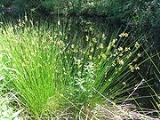
Juncaceae

Encyclopedia
Juncaceae, the rush family, are a monocotyledon
ous family of flowering plant
s. There are eight genera
and about 400 species
. Members of the Juncaceae are slow-growing, rhizomatous, herbaceous
plants, and they may superficially resemble grasses
. They often grow on infertile soils in a wide range of moisture conditions. The most well-known and biggest genus is Juncus
. Most of the Juncus species grow exclusively in wetland habitats. A few rushes are annuals
, but most are perennials
.
The leaves
are evergreen
and well-developed in a basal aggregation on an erect stem. They are alternate and tristichous (i.e., with three rows of leaves up the stem, each row of leaves arising one-third of the way around the stem from the previous leaf). Only in the genus Distichia are the leaves distichous. The rushes of the genus Juncus
have flat, hairless leaves or cylindrical leaves. The leaves of the wood-rushes of the genus Luzula
are always flat and bear long white hairs.
The plants are hermaphroditic or, rarely, dioecious
. The small and insignificant flower
s are arranged in inflorescences of loose cymes, but also in rather dense heads or corymbs at the top of the stem or at its side. This family typically has reduced perianth
segments called tepals. These are usually arranged in two whorls
, each containing three thin, papery tepals. They are not bright or flashy in appearance, and their color can vary from greenish to whitish, brown, purple, black, or hyaline. There are three stigmas in the center of the flowers. As is characteristic of monocots, all of the flower parts appear in a multiple of three.
The fruit
is usually a non-fleshy, three-sectioned dehiscent capsule
containing many seeds
.
of plants of this family was used to make a type of candle
known as a rushlight
.
The Soft Rush
(Juncus effusus) is called igusa in Japanese
and is used to weave the soft surface cover of tatami
mats.
In medieval Europe, loose fresh rushes would be strewn on earthen floors in dwellings for cleanliness and insulation. Particularly favored for such a purpose was Acorus calamus (Sweet Flag), however, a plant from the unrelated monocot order
Acorales vernacularly called "sweet rush".
Monocotyledon
Monocotyledons, also known as monocots, are one of two major groups of flowering plants that are traditionally recognized, the other being dicotyledons, or dicots. Monocot seedlings typically have one cotyledon , in contrast to the two cotyledons typical of dicots...
ous family of flowering plant
Flowering plant
The flowering plants , also known as Angiospermae or Magnoliophyta, are the most diverse group of land plants. Angiosperms are seed-producing plants like the gymnosperms and can be distinguished from the gymnosperms by a series of synapomorphies...
s. There are eight genera
Genus
In biology, a genus is a low-level taxonomic rank used in the biological classification of living and fossil organisms, which is an example of definition by genus and differentia...
and about 400 species
Species
In biology, a species is one of the basic units of biological classification and a taxonomic rank. A species is often defined as a group of organisms capable of interbreeding and producing fertile offspring. While in many cases this definition is adequate, more precise or differing measures are...
. Members of the Juncaceae are slow-growing, rhizomatous, herbaceous
Herbaceous
A herbaceous plant is a plant that has leaves and stems that die down at the end of the growing season to the soil level. They have no persistent woody stem above ground...
plants, and they may superficially resemble grasses
Poaceae
The Poaceae is a large and nearly ubiquitous family of flowering plants. Members of this family are commonly called grasses, although the term "grass" is also applied to plants that are not in the Poaceae lineage, including the rushes and sedges...
. They often grow on infertile soils in a wide range of moisture conditions. The most well-known and biggest genus is Juncus
Juncus
Juncus is a genus in the plant family Juncaceae. It consists of some 200 to 300 or more species of grassy plants commonly called rushes...
. Most of the Juncus species grow exclusively in wetland habitats. A few rushes are annuals
Annual plant
An annual plant is a plant that usually germinates, flowers, and dies in a year or season. True annuals will only live longer than a year if they are prevented from setting seed...
, but most are perennials
Perennial plant
A perennial plant or simply perennial is a plant that lives for more than two years. The term is often used to differentiate a plant from shorter lived annuals and biennials. The term is sometimes misused by commercial gardeners or horticulturalists to describe only herbaceous perennials...
.
The leaves
Leaf
A leaf is an organ of a vascular plant, as defined in botanical terms, and in particular in plant morphology. Foliage is a mass noun that refers to leaves as a feature of plants....
are evergreen
Evergreen
In botany, an evergreen plant is a plant that has leaves in all seasons. This contrasts with deciduous plants, which completely lose their foliage during the winter or dry season.There are many different kinds of evergreen plants, both trees and shrubs...
and well-developed in a basal aggregation on an erect stem. They are alternate and tristichous (i.e., with three rows of leaves up the stem, each row of leaves arising one-third of the way around the stem from the previous leaf). Only in the genus Distichia are the leaves distichous. The rushes of the genus Juncus
Juncus
Juncus is a genus in the plant family Juncaceae. It consists of some 200 to 300 or more species of grassy plants commonly called rushes...
have flat, hairless leaves or cylindrical leaves. The leaves of the wood-rushes of the genus Luzula
Luzula
Luzula is a genus of about 80 species of flowering plants the family Juncaceae, with a cosmopolitan distribution, the highest species diversity being in temperate Asia and Europe....
are always flat and bear long white hairs.
The plants are hermaphroditic or, rarely, dioecious
Dioecious
Dioecy is the property of a group of biological organisms that have males and females, but not members that have organs of both sexes at the same time. I.e., those whose individual members can usually produce only one type of gamete; each individual organism is thus distinctly female or male...
. The small and insignificant flower
Flower
A flower, sometimes known as a bloom or blossom, is the reproductive structure found in flowering plants . The biological function of a flower is to effect reproduction, usually by providing a mechanism for the union of sperm with eggs...
s are arranged in inflorescences of loose cymes, but also in rather dense heads or corymbs at the top of the stem or at its side. This family typically has reduced perianth
Perianth
The term perianth has two similar but separate meanings in botany:* In flowering plants, the perianth are the outer, sterile whorls of a flower...
segments called tepals. These are usually arranged in two whorls
Whorl (botany)
In botany, a whorl is an arrangement of sepals, petals, leaves, or branches in which all the parts are attached at the same point and surround or wrap around the stem.There are four whorls in a general flower...
, each containing three thin, papery tepals. They are not bright or flashy in appearance, and their color can vary from greenish to whitish, brown, purple, black, or hyaline. There are three stigmas in the center of the flowers. As is characteristic of monocots, all of the flower parts appear in a multiple of three.
The fruit
Fruit
In broad terms, a fruit is a structure of a plant that contains its seeds.The term has different meanings dependent on context. In non-technical usage, such as food preparation, fruit normally means the fleshy seed-associated structures of certain plants that are sweet and edible in the raw state,...
is usually a non-fleshy, three-sectioned dehiscent capsule
Capsule (fruit)
In botany a capsule is a type of simple, dry fruit produced by many species of flowering plants. A capsule is a structure composed of two or more carpels that in most cases is dehiscent, i.e. at maturity, it splits apart to release the seeds within. A few capsules are indehiscent, for example...
containing many seeds
SEEDS
SEEDS is a voluntary organisation registered under the Societies Act of India....
.
Domestic uses
The dried pithPith
Pith, or medulla, is a tissue in the stems of vascular plants. Pith is composed of soft, spongy parenchyma cells, which store and transport nutrients throughout the plant. In eudicots, pith is located in the center of the stem. In monocots, it extends also into flowering stems and roots...
of plants of this family was used to make a type of candle
Candle
A candle is a solid block or cylinder of wax with an embedded wick, which is lit to provide light, and sometimes heat.Today, most candles are made from paraffin. Candles can also be made from beeswax, soy, other plant waxes, and tallow...
known as a rushlight
Rushlight
A rushlight is a type of candle or miniature torch formed by soaking the dried pith of the rush plant in fat or grease. For several centuries rushlights were a common source of artificial light for poor people throughout the British Isles. They were extremely inexpensive to make...
.
The Soft Rush
Soft rush
Soft Rush is a member of the genus Juncus. Native to most continents and hence also known as Common Rush, this plant is found growing in wet areas, such as the purple moor-grass and rush pastures and fen-meadow plant associations in the United Kingdom.-Description:It grows in large clumps about...
(Juncus effusus) is called igusa in Japanese
Japanese language
is a language spoken by over 130 million people in Japan and in Japanese emigrant communities. It is a member of the Japonic language family, which has a number of proposed relationships with other languages, none of which has gained wide acceptance among historical linguists .Japanese is an...
and is used to weave the soft surface cover of tatami
Tatami
A is a type of mat used as a flooring material in traditional Japanese-style rooms. Traditionally made of rice straw to form the core , with a covering of woven soft rush straw, tatami are made in standard sizes, with the length exactly twice the width...
mats.
In medieval Europe, loose fresh rushes would be strewn on earthen floors in dwellings for cleanliness and insulation. Particularly favored for such a purpose was Acorus calamus (Sweet Flag), however, a plant from the unrelated monocot order
Order (biology)
In scientific classification used in biology, the order is# a taxonomic rank used in the classification of organisms. Other well-known ranks are life, domain, kingdom, phylum, class, family, genus, and species, with order fitting in between class and family...
Acorales vernacularly called "sweet rush".