Martenitsa

Encyclopedia
Baba Marta Day
Grandma March Day is a holiday celebrated in Bulgaria, on the first of March. Martenitsa - usually in the form of a wrist band, woven by combining red and white colored threads - are worn on that day and through March, until a stork or a bloomed tree is seen, symbolizing warmer weather and well...
. "Baba" (баба) is the Bulgarian word for "grandmother" and Mart (март) is the Bulgarian word for the month of March. Baba Marta is a Bulgaria
Bulgaria
Bulgaria , officially the Republic of Bulgaria , is a parliamentary democracy within a unitary constitutional republic in Southeast Europe. The country borders Romania to the north, Serbia and Macedonia to the west, Greece and Turkey to the south, as well as the Black Sea to the east...
n tradition related to welcoming the upcoming spring. The month of March, according to Bulgarian folklore
Folklore
Folklore consists of legends, music, oral history, proverbs, jokes, popular beliefs, fairy tales and customs that are the traditions of a culture, subculture, or group. It is also the set of practices through which those expressive genres are shared. The study of folklore is sometimes called...
, marks the beginning of springtime. Therefore, the first day of March is a traditional holiday associated with sending off winter and welcoming spring.
The same tradition is also held by thοse in the Republic of Macedonia
Republic of Macedonia
Macedonia , officially the Republic of Macedonia , is a country located in the central Balkan peninsula in Southeast Europe. It is one of the successor states of the former Yugoslavia, from which it declared independence in 1991...
, as well as in Greek Macedonia and Patras
Patras
Patras , ) is Greece's third largest urban area and the regional capital of West Greece, located in northern Peloponnese, 215 kilometers west of Athens...
in the Peloponnese
Peloponnese
The Peloponnese, Peloponnesos or Peloponnesus , is a large peninsula , located in a region of southern Greece, forming the part of the country south of the Gulf of Corinth...
. Romanians
Romanians
The Romanians are an ethnic group native to Romania, who speak Romanian; they are the majority inhabitants of Romania....
also have a similar but not identical holiday on March 1, called "Mărţişor
Martisor
Mărțișor is a traditional celebration of the beginning of spring, on March 1. It is a tradition in Romania, Moldova, and all territories inhabited by Romanians and Aromanians...
". If and how these two holidays are related is still a matter of debate between ethnologists.
Symbolism
The red and white woven threads symbolize the wish for good health. They are the heralds of the coming of spring in Bulgaria and life in general. While white as a color symbolizes purity, red is a symbol of life and passion, thus some ethnologists have proposed that, in its very origins, the custom might have reminded people of the constant cycle of life and death, the balance of good and evil, and of the sorrow and happiness in human life.Tradition
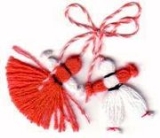
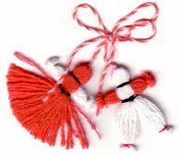
On the first day of March and for a few days afterwards, Bulgarians exchange and wear white and red tassels or small dolls called "Пижо и Пенда" (Pizho and PendaPizho and Penda
Pizho and Penda are the names of the two small wool dolls of a typical Bulgarian Martenitsa. Pizho is the male doll, usually in white dominating color. Penda is the female doll, usually in red dominating color, and is distinguished by her skirt....
). In Bulgarian folklore the name Baba Marta (in Bulgarian баба Марта meaning Grandma March) is related to a grumpy old lady whose mood swings change very rapidly.
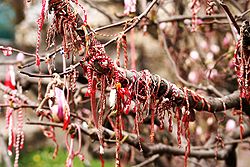
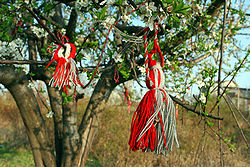
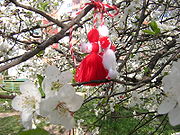
This is an old pagan tradition that remains almost unchanged today. The common belief is that by wearing the red and white colours of the martenitsa people ask Baba Marta for mercy. They hope that it will make winter pass faster and bring spring. Many people wear more than one martenitsa. They receive them as presents from relatives, close friends and colleagues. Martenitsa is usually worn pinned on the clothes, near the collar, or tied around the wrist. The tradition calls for wearing the martenitsa until the person sees a stork
Stork
Storks are large, long-legged, long-necked wading birds with long, stout bills. They belong to the family Ciconiidae. They are the only family in the biological order Ciconiiformes, which was once much larger and held a number of families....
or a blooming tree. The stork is considered a harbinger of spring and as evidence that Baba Marta is in a good mood and is about to retire.
Larva
A larva is a distinct juvenile form many animals undergo before metamorphosis into adults. Animals with indirect development such as insects, amphibians, or cnidarians typically have a larval phase of their life cycle...
or a worm
Worm
The term worm refers to an obsolete taxon used by Carolus Linnaeus and Jean-Baptiste Lamarck for all non-arthropod invertebrate animals, and stems from the Old English word wyrm. Currently it is used to describe many different distantly-related animals that typically have a long cylindrical...
, the coming year will be healthy, and full of success. The same luck is associated with an ant
Ant
Ants are social insects of the family Formicidae and, along with the related wasps and bees, belong to the order Hymenoptera. Ants evolved from wasp-like ancestors in the mid-Cretaceous period between 110 and 130 million years ago and diversified after the rise of flowering plants. More than...
, the difference being that the person will have to work hard to reach success. If the creature near the token is a spider
Spider
Spiders are air-breathing arthropods that have eight legs, and chelicerae with fangs that inject venom. They are the largest order of arachnids and rank seventh in total species diversity among all other groups of organisms...
, then the person is in trouble and may not enjoy luck, health, or personal success.
The martenitsa is also a stylized symbol of Mother Nature. During early-spring/late-winter, nature seems full of hopes and expectations. The white symbolizes the purity of the melting white snow and the red symbolizes the setting of the sun which becomes more and more intense as spring progresses. These two natural resources are the source of life. They are also associated with the male and female beginnings.
Wearing one or more martenitsi is a very popular Bulgarian tradition. The martenitsa symbolises new life, conception, fertility, and spring. The time during which it is worn is meant to be a joyful holiday commemorating health and long life. The colours of the martenitsa are interpreted as symbols of purity and life, as well as the need for harmony in Nature and in people's lives.
Origin
The tradition is related to the ancient pagan history of Balkan Peninsula and to all agricultural cults of nature. Some of the specific features of the ritual and especially tying the twisted white and red woolen thread, are a result of centuries-old tradition and suggest Thracian (paleo-Balkan ) HellenicHellenic
Hellenic is a synonym for Greek and may refer to:* Hellenic languages* Hellenic Airlines* Hellenic College, a liberal arts college in Brookline, Massachusetts* Hellenic College of London* Hellenic FC, a football club in South Africa...
or even Roman
Ancient Rome
Ancient Rome was a thriving civilization that grew on the Italian Peninsula as early as the 8th century BC. Located along the Mediterranean Sea and centered on the city of Rome, it expanded to one of the largest empires in the ancient world....
origin.
Use