
All Topics  
Magnetic levitation

 
Magnetic Levitation

   Email Print
   Bookmark   Link


Magnetic levitation


Magnetic levitation, maglev, or magnetic suspension is a method by which an object is suspended
Levitation

Levitation is the process by which an object is suspended against gravity, in a stable position, without physical contact.It is also a conjuring trick, appearingly raising a human being without any physical aid....
 with no support other than magnetic field
Magnetic field

A magnetism field is a vector field which can exert a magnetic force on moving electric charges and on magnetic dipoles . When placed in a magnetic field, magnetic dipoles tend to align their axes parallel to the magnetic field....
s. The electromagnetic force
Electromagnetic force

In physics, the electromagnetic force is the force that the electromagnetic field exerts on electrically charged particles. It is the electromagnetic force that holds electrons and protons together in atoms, and which hold atoms together to make molecules....
 is used to counteract the effects of the gravitational force.

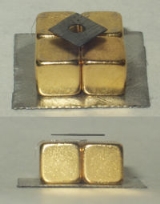
In some cases the lifting force is provided by magnetic levitation, but there is a mechanical support bearing little load that provides stability.


Discussion
Ask a question about 'Magnetic levitation'
Start a new discussion about 'Magnetic levitation'
Answer questions from other users
Full Discussion Forum


Recent Posts


Encyclopedia


Diamagnetic Graphite Levitation
Magnetic levitation, maglev, or magnetic suspension is a method by which an object is suspended
Levitation

Levitation is the process by which an object is suspended against gravity, in a stable position, without physical contact.It is also a conjuring trick, appearingly raising a human being without any physical aid....
 with no support other than magnetic field
Magnetic field

A magnetism field is a vector field which can exert a magnetic force on moving electric charges and on magnetic dipoles . When placed in a magnetic field, magnetic dipoles tend to align their axes parallel to the magnetic field....
s. The electromagnetic force
Electromagnetic force

In physics, the electromagnetic force is the force that the electromagnetic field exerts on electrically charged particles. It is the electromagnetic force that holds electrons and protons together in atoms, and which hold atoms together to make molecules....
 is used to counteract the effects of the gravitational force.

In some cases the lifting force is provided by magnetic levitation, but there is a mechanical support bearing little load that provides stability. This is termed pseudo-levitation.

Magnetic levitation is used for maglev train
Maglev train

MAGLEV, or magnetic levitation, is a system of transportation that suspends, guides and propels vehicles, predominantly trains, using levitation from a very large number of magnets for lift and propulsion....
s, magnetic bearing
Magnetic bearing

A magnetic bearing is a bearing which supports a load using magnetic levitation. Magnetic bearings support moving machinery without physical contact, for example, they can levitate a rotating shaft and permit relative motion without friction or wear....
s and for product display purposes.

Stability


Earnshaw's theorem
Earnshaw's theorem

Earnshaw's theorem states that a collection of point charges cannot be maintained in a stable stationary mechanical equilibrium configuration solely by the electrostatic interaction of the charges....
 proved conclusively that it is not possible to levitate stably using only static, macroscopic, "classical" electromagnetic fields
Classical electromagnetism

Classical electromagnetism is a theory of electromagnetism that was developed over the course of the 19th century, most prominently by James Clerk Maxwell....
. The forces acting on an object in any combination of gravitational
Gravitational field

A gravitational field is a scientific model used within physics to explain how gravitation exists in the universe. In its original concept, gravity was a force between point masses....
, electrostatic, and magnetostatic fields will make the object's position unstable. However, several possibilities exist to make levitation viable, for example, the use of electronic stabilization or diamagnetic materials.

Methods


There are several methods to obtain magnetic levitation. The primary ones used in maglev train
Maglev train

MAGLEV, or magnetic levitation, is a system of transportation that suspends, guides and propels vehicles, predominantly trains, using levitation from a very large number of magnets for lift and propulsion....
s are servo-stabilized electromagnetic suspension (EMS), electrodynamic suspension (EDS), and (in the future) Inductrack
Inductrack

Inductrack is a completely Passive component, fail-safe magnetic levitation system, using only unpowered loops of wire in the track and permanent magnets on the vehicle to achieve magnetic levitation....
.

Mechanical constraint (Pseudo-levitation)


With a small amount of mechanical constraint for stability, pseudo-levitation is relatively straightforwardly achieved.

If two magnet
Magnet

A magnet is a material or object that produces a magnetic field. This magnetic field is invisible but is responsible for the most notable property of a magnet: a force that pulls on other ferromagnetic materials and attracts or repels other magnets....
s are mechanically constrained along a single vertical axis (a piece of string, for example), and arranged to repel each other strongly, this will act to levitate one of the magnets above the other.

Another example is the Zippe-type centrifuge
Zippe-type centrifuge

The Zippe-type centrifuge is a particular design of gas centrifuge. It was developed in the Soviet Union by a team of 60 German scientists working in detention, captured after World War II....
 where a cylinder is suspended under an attractive magnet, and stabilised by a needle bearing from below.

Direct diamagnetic levitation


Frog Diamagnetic Levitation
A substance that is diamagnetic repels a magnetic field. All materials have diamagnetic properties, but the effect is very weak, and is usually overcome by the object's paramagnetic or ferromagnetic properties, which act in the opposite manner. Any material in which the diamagnetic component is strongest will be repelled by a magnet, though this force is not usually very large.

Earnshaw's theorem
Earnshaw's theorem

Earnshaw's theorem states that a collection of point charges cannot be maintained in a stable stationary mechanical equilibrium configuration solely by the electrostatic interaction of the charges....
 does not apply to diamagnets. These behave in the opposite manner to normal magnets owing to their relative permeability
Permeability (electromagnetism)

In electromagnetism, permeability is the degree of magnetization of a material that responds linearly to an applied magnetic field. Magnetic permeability is typically represented by the Greek letter Mu ....
 of µr < 1.

Diamagnetic levitation can be used to levitate very light pieces of pyrolytic graphite or bismuth
Bismuth

Bismuth is a chemical element that has the symbol Bi and atomic number 83. This heavy, brittle, white crystalline trivalent poor metal has a pink tinge and chemically resembles arsenic and antimony....
 above a moderately strong permanent magnet. As water
Water

Water is a common chemical substance that is essential for the survival of all known forms of life. In typical usage, water refers only to its liquid form or States of matter, but the substance also has a solid state, ice, and a gaseous state, water vapor or steam....
 is predominantly diamagnetic, this technique has been used to levitate water droplets and even live animals, such as a grasshopper and a frog. However, the magnetic fields required for this are very high, typically in the range of 16 tesla
Tesla (unit)

The tesla is the SI derived unit of magnetic flux density B . The tesla is equal to one weber per square metre and was defined in 1960 in honor of inventor, scientist and electrical engineer Nikola Tesla....
s, and therefore create significant problems if ferromagnetic materials are nearby.

The minimum criterion for diamagnetic levitation is , where:
  • is the magnetic susceptibility
    Magnetic susceptibility

    In electromagnetism the magnetic susceptibility is the degree of magnetization of a material in response to an applied magnetic field....
  • is the density
    Density

    The density of a material is defined as its mass per unit volume. The symbol of density is ....
     of the material
  • is the local gravitational acceleration
    Gravitational acceleration

    In physics, gravitational acceleration is the acceleration of an object caused by the force of gravity from another object. In the absence of any other forces, any object will accelerate in a gravitational field at the same rate, regardless of the mass of the object....
     (-9.8 m
    Metre

    The metre or meter is a Unit of measurement of length. It is the SI base unit of length in the metric system and in the International System of Units , used around the world for general and scientific purposes....
    /s
    Second

    The second , sometimes abbreviated sec., is the name of a units of measurement of time, and is the International System of Units SI base unit of time....
    2 on Earth)
  • is the permeability of free space
  • is the magnetic field
    Magnetic field

    A magnetism field is a vector field which can exert a magnetic force on moving electric charges and on magnetic dipoles . When placed in a magnetic field, magnetic dipoles tend to align their axes parallel to the magnetic field....
  • is the rate of change of the magnetic field along the vertical axis


Assuming ideal conditions along the z-direction of solenoid magnet:
  • Water
    Water

    Water is a common chemical substance that is essential for the survival of all known forms of life. In typical usage, water refers only to its liquid form or States of matter, but the substance also has a solid state, ice, and a gaseous state, water vapor or steam....
     levitates at
  • Graphite
    Graphite

    The mineral graphite is one of the allotropes of carbon. It was named by Abraham Gottlob Werner in 1789 from the Greek language ??afe?? : "to draw/write", for its use in pencils, where it is commonly called lead, as distinguished from the actual metallic element lead....
     levitates at


See also: Diamagnetic levitation
Diamagnetism

Diamagnetism is the property of an object which causes it to create a magnetic field in opposition of an externally applied magnetic field, thus causing a repulsive effect....
 in the Diamagnetism
Diamagnetism

Diamagnetism is the property of an object which causes it to create a magnetic field in opposition of an externally applied magnetic field, thus causing a repulsive effect....
 article.


Superconductors


Superconductors may be considered perfect diamagnetsr = 0), completely expelling magnetic fields due to the Meissner effect
Meissner effect

The Meissner effect is the expulsion of a magnetic field from a superconductor. Walther Meissner and Robert Ochsenfeld discovered the phenomenon in 1933 by measuring the flux distribution outside of tin and lead specimens as they were cooled below their transition temperature in the presence of a magnetic field....
. The levitation of the magnet is stabilized due to flux pinning
Flux pinning

Flux pinning is the phenomenon that magnetic flux do not move in spite of the Lorentz force acting on them inside a electric current-carryingType II superconductor....
 within the superconductor. This principle is exploited by EDS (electrodynamic suspension) magnetic levitation trains, superconducting bearings
Magnetic bearing

A magnetic bearing is a bearing which supports a load using magnetic levitation. Magnetic bearings support moving machinery without physical contact, for example, they can levitate a rotating shaft and permit relative motion without friction or wear....
, flywheel
Flywheel

A flywheel is a mechanical device with significant moment of inertia used as a storage device for rotational energy. Flywheels resist changes in their rotational speed, which helps steady the rotation of the shaft when a fluctuating torque is exerted on it by its power source such as a piston-based engine, or when the load placed on it is...
s, etc.

In trains where the weight of the large electromagnet is a major design issue (a very strong magnetic field is required to levitate a massive train) superconductors are sometimes proposed for use for the electromagnet, since they can produce a stronger magnetic field for the same weight.

Diamagnetically-stabilized levitation


A permanent magnet
Magnet

A magnet is a material or object that produces a magnetic field. This magnetic field is invisible but is responsible for the most notable property of a magnet: a force that pulls on other ferromagnetic materials and attracts or repels other magnets....
 can be stably suspended by various configurations of strong permanent magnets and strong diamagnets. When using superconducting magnets, the levitation of a permanent magnet can even be stabilized by the small diamagnetism of water in human fingers.

Rotational stabilization

A magnet can be repulsively levitated when gyroscopically
Gyroscope

A gyroscope is a device for measuring or maintaining orientation , based on the principles of angular momentum. The device is a spinning wheel or disk whose axle is free to take any orientation....
 stabilized by spinning it in a toroidal field created by a ring of magnets. However, it will only remain stable until the rate of precession
Precession

Precession refers to a change in the direction of the axis of a rotation object. In physics, there are two types of precession, torque-free and torque-induced, the latter being discussed here in more detail....
 slows below a critical
Critical

Critical may denote:*pertaining to a critic*pertaining to a critique*pertaining to a crisisMore specifically:...
 threshold
Threshold

Threshold may refer to:...
 — the region of stability is quite narrow both spatially and in the required rate of precession. The first discovery of this phenomenon was by Roy Harrigan, a Vermont inventor who patented a levitation device in 1983 based upon it. Several devices using rotational stabilization (such as the popular Levitron
Levitron

Levitron is a brand of levitating toys and gifts in science and educational markets marketed by Creative Gifts Inc. and Fascination Toys & Gifts....
 toy) have been developed citing this patent. Non-commercial devices have been created for university research laboratories, generally using magnets too powerful for safe public interaction.

Servomechanisms


The attraction from a fixed strength magnet decreases with increased distance, and increases at closer distances. This is termed 'unstable'. For a stable system, the opposite is needed, variations from a stable position should push it back to the target position.

Stable magnetic levitation can be achieved by measuring the position
Position

Position may refer to:* A location in a coordinate system, usually in two or more dimensions; the science of position and its generalizations is topology...
 and speed
Speed

Speed is the rate of Motion , or equivalently the rate of change of distance.Speed is a Scalar quantity with dimensions length/time; the equivalent Vector quantity to speed is velocity....
 of the object being levitated, and using a feedback loop which continuously adjusts one or more electromagnets to correct the object's motion, thus forming a servomechanism
Servomechanism

A servomechanism, or servo is an automatic device that uses error-sensing feedback to correct the performance of a mechanism. The term correctly applies only to systems where the feedback or error-correction signals help control mechanical position or other parameters....
.

Many systems use magnetic attraction pulling upwards against gravity for these kinds of systems as this gives some inherent lateral stability, but some use a combination of magnetic attraction and magnetic repulsion to push upwards.

This is termed Electromagnetic suspension (EMS).

For a very simple example, some tabletop levitation demonstrations use this principle, and the object cuts a beam of light to measure the position of the object. The electromagnet is above the object being levitated; the electromagnet is turned off whenever the object gets too close, and turned back on when it falls further away. Such a simple system is not very robust; far more effective control systems exist, but this illustrates the basic idea.

EMS magnetic levitation trains are based on this kind of levitation: The train wraps around the track, and is pulled upwards from below. The servo
Servomechanism

A servomechanism, or servo is an automatic device that uses error-sensing feedback to correct the performance of a mechanism. The term correctly applies only to systems where the feedback or error-correction signals help control mechanical position or other parameters....
 controls keep it safely at a constant distance from the track.

Induced currents/Eddy currents


This is sometimes called ElectroDynamic Suspension (EDS).

Relative motion between conductors and magnets

If one moves a base made of a very good electrical conductor such as copper
Copper

Copper is a chemical element with the symbol Cu and atomic number 29.It is a ductile metal with very high thermal and electrical conductivity....
, aluminium
Aluminium

Aluminium or aluminum is a silvery white and ductile member of the boron group of chemical elements. It has the symbol Al; its atomic number is 13....
 or silver
Silver

Silver is a chemical element with the chemical symbol Ag and atomic number 47. A soft, white, lustrous transition metal, it has the highest electrical conductivity of any element and the highest thermal conductivity of any metal....
 close to a magnet, an (eddy
Eddy current

An eddy current is an Electricity phenomenon discovered by France physics L?on Foucault in 1851. It is caused when a conductor is exposed to a changing magnetic field due to relative motion of the field source and conductor; or due to variations of the field with time....
) current will be induced in the conductor that will oppose the changes in the field and create an opposite field that will repel the magnet (Lenz's law
Lenz's law

Lenz's law gives the direction of the induced electromotive force and Electric current resulting from electromagnetic induction. The law provides a physical interpretation of the choice of sign in Faraday's law of induction, indicating that the induced emf and the change in flux have opposite signs....
). At a sufficiently high rate of movement, a suspended magnet will levitate on the metal, or vice versa with suspended metal.

An especially technologically-interesting case of this comes when one uses a Halbach array
Halbach array

A Halbach array is a special arrangement of permanent magnets that augments the magnetic field on one side of the array while cancelling the field to near zero on the other side....
 instead of a single pole permanent magnet, as this almost doubles the field strength, which in turn almost doubles the strength of the eddy currents- the net effect is to more than triple the lift force. Using two opposed Halbach arrays increases the field even further.

Halbach arrays are also well-suited to magnetic levitation and stabilisation of gyroscope
Gyroscope

A gyroscope is a device for measuring or maintaining orientation , based on the principles of angular momentum. The device is a spinning wheel or disk whose axle is free to take any orientation....
s and electric motor
Electric motor

An electric motor uses electrical energy to produce mechanical energy, nearly always by the interaction of magnetic fields and current-carrying conductors....
 and generator
Electrical generator

In electricity generation, an electrical generator is a device that converts mechanical energy to electrical energy, generally using electromagnetic induction....
 spindles.

Oscillating electromagnetic fields

A conductor
Electrical conductor

In science and Electrical engineering, an electrical conductor is a material which contains movable electric charges. In metallic conductors, such as copper or aluminum, the movable charged particles are electrons ....
 can be levitated above an electromagnet (or vice versa) with an alternating current
Alternating current

In alternating current the movement of electric charge periodically reverses direction. An electric charge would for instance move forward, then backward, then forward, then backward, over and over again....
 flowing through it. This causes any regular conductor to behave like a diamagnet, due to the eddy current
Eddy current

An eddy current is an Electricity phenomenon discovered by France physics L?on Foucault in 1851. It is caused when a conductor is exposed to a changing magnetic field due to relative motion of the field source and conductor; or due to variations of the field with time....
s generated in the conductor. Since the eddy currents create their own fields which oppose the magnetic field, the conductive object is repelled from the electromagnet.

This effect requires non-ferromagnetic but highly conductive materials like aluminium
Aluminium

Aluminium or aluminum is a silvery white and ductile member of the boron group of chemical elements. It has the symbol Al; its atomic number is 13....
 or copper
Copper

Copper is a chemical element with the symbol Cu and atomic number 29.It is a ductile metal with very high thermal and electrical conductivity....
, as the ferromagnetic ones are also strongly attracted to the electromagnet (although at high frequencies the field can still be expelled) and tend to have a higher resistivity giving lower eddy currents.

The effect can be used for stunts such as levitating a telephone book by concealing an aluminium plate within it.

Strong focusing

Earnshaw's theory strictly only applies to static fields. Alternating magnetic fields, even purely alternating attractive fields can induce stability and confine a trajectory through a magnetic field to give a levitation effect.

This is used in particle accelerators to confine and lift charged particles, and has been proposed for maglev trains also.

Difficulties

Most of the levitation techniques have various complexities.

  • Many of the active suspension techniques have a fairly narrow region of stability.
  • Magnetic fields have no built-in damping. This can permit vibration modes to exist that can cause the item to leave the stable region. Eddy currents can be stabilising if a suitably shaped conductor is present in the field, and other mechanical or electronic damping techniques have been used in some cases.
  • Power and current requirements can be very large to generate sufficiently strong magnetic fields using electromagnets to lift significant mass.
  • Superconductors require very low temperatures to operate, often helium cooling is employed.


Uses

  • Maglev train
    Maglev train

    MAGLEV, or magnetic levitation, is a system of transportation that suspends, guides and propels vehicles, predominantly trains, using levitation from a very large number of magnets for lift and propulsion....
    s
  • Magnetic bearings
  • Flywheel
    Flywheel

    A flywheel is a mechanical device with significant moment of inertia used as a storage device for rotational energy. Flywheels resist changes in their rotational speed, which helps steady the rotation of the shaft when a fluctuating torque is exerted on it by its power source such as a piston-based engine, or when the load placed on it is...
    s
  • Display device
    Display device

    A display device is an output device for presentation of information for visual, tactile or Hearing_ reception, acquired, stored, or transmitted in various forms....
    s
  • Centrifuge
    Centrifuge

    A centrifuge is a piece of equipment, generally driven by a motor, that puts an object in rotation around a fixed axis, applying a force perpendicular to the axis....
    s


See also

  • Maglev train
    Maglev train

    MAGLEV, or magnetic levitation, is a system of transportation that suspends, guides and propels vehicles, predominantly trains, using levitation from a very large number of magnets for lift and propulsion....
  • Acoustic levitation
    Acoustic levitation

    Acoustic levitation is a method for suspending matter in a medium by using acoustic radiation pressure from intense sound waves in the medium. Acoustic levitation is possible because of the non-linear effects of intense sound waves....
  • Aerodynamic levitation
    Aerodynamic levitation

    Aerodynamic levitation is the use of gas pressure to levitate materials so that they are no longer in physical contact with any container. In scientific experiments this removes contamination and nucleation issues associated with physical contact with a container....
  • Electrostatic levitation
    Electrostatic levitation

    Electrostatic levitation is the process of using an electric field to lift a electric charge object and counteract the effects of gravity. It was used, for instance, in Robert Millikan's oil drop experiment and is used to suspend the gyroscopes in Gravity Probe B during launch....
  • Optical levitation
    Optical levitation

    Optical levitation is a method developed by Arthur Ashkin whereby a material is levitation against the downward force of gravity by an upward force stemming from photon momentum transfer....
  • Cyclotron
    Cyclotron

    A cyclotron is a type of particle accelerator. Cyclotrons accelerate charged particles using a high-frequency, alternating voltage . A perpendicular magnetic field causes the particles to spiral almost in a circle so that they re-encounter the accelerating voltage many times....
    s levitate and circulate charged particles in a magnetic field
  • Inductrack
    Inductrack

    Inductrack is a completely Passive component, fail-safe magnetic levitation system, using only unpowered loops of wire in the track and permanent magnets on the vehicle to achieve magnetic levitation....
     a particular system based on Halbach arrays and inductive track loops
  • Launch loop
    Launch loop

    A launch loop or Lofstrom loop is a design for a belt based maglev orbital launch system that would be around 2,000 km long and maintained at an altitude of up to 80 km ....
  • Levitron
    Levitron

    Levitron is a brand of levitating toys and gifts in science and educational markets marketed by Creative Gifts Inc. and Fascination Toys & Gifts....
  • Linear motor
    Linear motor

    A linear motor or linear induction motor is essentially a multi-phase alternating current electric motor that has had its stator "unrolled" so that instead of producing a torque it produces a linear force along its length....
    • Rapid transits using linear motor propulsion
      Linear motor

      A linear motor or linear induction motor is essentially a multi-phase alternating current electric motor that has had its stator "unrolled" so that instead of producing a torque it produces a linear force along its length....
  • Magnetic bearing
    Magnetic bearing

    A magnetic bearing is a bearing which supports a load using magnetic levitation. Magnetic bearings support moving machinery without physical contact, for example, they can levitate a rotating shaft and permit relative motion without friction or wear....
  • Magneto
  • Nagahori Tsurumi-ryokuchi Line
    Nagahori Tsurumi-ryokuchi Line

    |}The is a line of the Osaka Municipal Subway, the underground rapid transit system in Osaka, Japan, Japan. It was the first linear motor metro line built in Japan....
  • Zippe-type centrifuge
    Zippe-type centrifuge

    The Zippe-type centrifuge is a particular design of gas centrifuge. It was developed in the Soviet Union by a team of 60 German scientists working in detention, captured after World War II....
     uses magnetic lift and a mechanical needle for stability


External links

  • Audio slideshow from the National High Magnetic Field Laboratory discusses magnetic levitation, the Meissner Effect, magnetic flux trapping and superconductivity