
All Topics  
Eddy current

 
Eddy Current

   Email Print
   Bookmark   Link


Eddy current


An eddy current (also known as Foucault current) is an electrical
Electricity

Electricity is a general term that encompasses a variety of phenomena resulting from the presence and flow of electric charge. These include many easily recognizable phenomena such as lightning and static electricity, but in addition, less familiar concepts such as the electromagnetic field and electromagnetic induction....
 phenomenon discovered by French
France

France , officially the French Republic , is a country whose Metropolitan France is located in Western Europe and that also comprises various Overseas departments and territories of France....
 physicist
Physics

Physics is the natural science which examines basic concepts such as energy, force, and spacetime and all that derives from these, such as mass, charge, matter and its Motion ....
 Léon Foucault
Léon Foucault

Jean Bernard L?on Foucault was a France physics best known for the invention of the Foucault pendulum, a device demonstrating the effect of the Earth's rotation....
 in 1851. It is caused when a conductor is exposed to a changing magnetic field
Magnetic field

A magnetism field is a vector field which can exert a magnetic force on moving electric charges and on magnetic dipoles . When placed in a magnetic field, magnetic dipoles tend to align their axes parallel to the magnetic field....
 due to relative motion of the field source and conductor; or due to variations of the field with time. This can cause a circulating flow of electron
Electron

The electron is a subatomic particle that carries a negative electric charge. It has elementary particle and is believed to be a point particle....
s, or a current
Electric current

Electric current is the flow of electric charge. The electric charge may be either electrons or ions.The International System of Units unit of electric current intensity is the ampere....
, within the body of the conductor. These circulating eddies
Eddy (fluid dynamics)

In fluid dynamics, an eddy is the swirling of a fluid and the reverse current created when the fluid flows past an obstacle. The moving fluid creates a space devoid of downstream-flowing fluid on the downstream side of the object....
 of current create induced magnetic fields that oppose the change of the original magnetic field due to Lenz's law
Lenz's law

Lenz's law gives the direction of the induced electromotive force and Electric current resulting from electromagnetic induction. The law provides a physical interpretation of the choice of sign in Faraday's law of induction, indicating that the induced emf and the change in flux have opposite signs....
, causing repulsive or drag forces between the conductor and the magnet.


Discussion
Ask a question about 'Eddy current'
Start a new discussion about 'Eddy current'
Answer questions from other users
Full Discussion Forum


Recent Posts


Encyclopedia


An eddy current (also known as Foucault current) is an electrical
Electricity

Electricity is a general term that encompasses a variety of phenomena resulting from the presence and flow of electric charge. These include many easily recognizable phenomena such as lightning and static electricity, but in addition, less familiar concepts such as the electromagnetic field and electromagnetic induction....
 phenomenon discovered by French
France

France , officially the French Republic , is a country whose Metropolitan France is located in Western Europe and that also comprises various Overseas departments and territories of France....
 physicist
Physics

Physics is the natural science which examines basic concepts such as energy, force, and spacetime and all that derives from these, such as mass, charge, matter and its Motion ....
 Léon Foucault
Léon Foucault

Jean Bernard L?on Foucault was a France physics best known for the invention of the Foucault pendulum, a device demonstrating the effect of the Earth's rotation....
 in 1851. It is caused when a conductor is exposed to a changing magnetic field
Magnetic field

A magnetism field is a vector field which can exert a magnetic force on moving electric charges and on magnetic dipoles . When placed in a magnetic field, magnetic dipoles tend to align their axes parallel to the magnetic field....
 due to relative motion of the field source and conductor; or due to variations of the field with time. This can cause a circulating flow of electron
Electron

The electron is a subatomic particle that carries a negative electric charge. It has elementary particle and is believed to be a point particle....
s, or a current
Electric current

Electric current is the flow of electric charge. The electric charge may be either electrons or ions.The International System of Units unit of electric current intensity is the ampere....
, within the body of the conductor. These circulating eddies
Eddy (fluid dynamics)

In fluid dynamics, an eddy is the swirling of a fluid and the reverse current created when the fluid flows past an obstacle. The moving fluid creates a space devoid of downstream-flowing fluid on the downstream side of the object....
 of current create induced magnetic fields that oppose the change of the original magnetic field due to Lenz's law
Lenz's law

Lenz's law gives the direction of the induced electromotive force and Electric current resulting from electromagnetic induction. The law provides a physical interpretation of the choice of sign in Faraday's law of induction, indicating that the induced emf and the change in flux have opposite signs....
, causing repulsive or drag forces between the conductor and the magnet. The stronger the applied magnetic field, or the greater the electrical conductivity
Electrical conductivity

Electrical conductivity or specific conductance is a measure of a material's ability to electrical conduction an electric current. When an electrical potential difference is placed across a conductor, its movable charges flow, giving rise to an electric current....
 of the conductor, or the faster the field that the conductor is exposed to changes, then the greater the currents that are developed and the greater the opposing field.

The term eddy current comes from analogous currents seen in water
Water

Water is a common chemical substance that is essential for the survival of all known forms of life. In typical usage, water refers only to its liquid form or States of matter, but the substance also has a solid state, ice, and a gaseous state, water vapor or steam....
 when dragging an oar
Oar

An oar is an implement used for water-borne Marine propulsion. Oars have a flat Blade at one end. The oarsmen grasp the oar at the other end....
 breadthwise: localised areas of turbulence known as eddies give rise to persistent vortices.

Eddy currents, like all electric currents, generate heat as well as electromagnetic forces. The heat can be harnessed for induction heating
Induction heating

Induction heating is the process of heating an electrically conducting object by electromagnetic induction, where eddy currents are generated within the metal and resistance leads to Joule heating of the metal....
. The electromagnetic forces can be used for levitation, creating movement, or to give a strong braking effect. In Eddy currents can often be minimised with thin plates, by lamination
Electrical steel

Electrical steel, also called lamination steel, silicon electrical steel, silicon steel or transformer steel, is specialty steel tailored to produce certain magnetic properties, such as a small hysteresis area and high permeability ....
 of conductors or other details of conductor shape.

Explanation

When a conductor moves relative to the field generated by a source, electromotive force
Electromotive force

Electromotive force is a term used to characterize electrical devices, such as voltaic cells, Thermoelectric effects, electrical generators and transformers, and even resistors....
s (EMFs) can be generated around loops within the conductor. These EMFs acting on the resistivity of the material generate a current around the loop, in accordance with Faraday's law of induction
Faraday's law of induction

Faraday's law of induction describes a basic law of electromagnetism, which is involved in the working of transformers, inductors, and many forms of electrical generators....
. These currents dissipate energy, and create a magnetic field that tends to oppose the changes in the field.

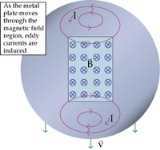
Eddy currents are created when a moving conductor experiences changes in the magnetic field generated by a stationary object, as well as when a stationary conductor encounters a varying magnetic field. Both effects are present when a conductor moves through a varying magnetic field, as is the case at the top and bottom edges of the magnetized region shown in the diagram. Eddy currents will be generated wherever a conducting object experiences a change in the intensity or direction of the magnetic field at any point within it, and not just at the boundaries.

The swirling current set up in the conductor is due to electrons experiencing a Lorentz force
Lorentz force

In physics, the Hendrik Lorentz force is the force on a point charge due to electromagnetic fields. It is given by the following equation in terms of the electric field and magnetic fields:...
 that is perpendicular to their motion. Hence, they veer to their right, or left, depending on the direction of the applied field and whether the strength of the field is increasing or declining. The resistivity of the conductor acts to damp the amplitude of the eddy currents, as well as straighten their paths. Lenz's law
Lenz's law

Lenz's law gives the direction of the induced electromotive force and Electric current resulting from electromagnetic induction. The law provides a physical interpretation of the choice of sign in Faraday's law of induction, indicating that the induced emf and the change in flux have opposite signs....
 encapsulates the fact that the current swirls in such a way as to create an induced magnetic field that opposes the phenomenon that created it. In the case of a varying applied field, the induced field will always be in the opposite direction to that applied. The same will be true when a varying external field is increasing in strength. However, when a varying field is falling in strength, the induced field will be in the same direction as that originally applied, in order to oppose the decline.

An object or part of an object experiences steady field intensity and direction where there is still relative motion of the field and the object (for example in the center of the field in the diagram), or unsteady fields where the currents cannot circulate due to the geometry of the conductor. In these situations charges collect on or within the object and these charges then produce static electric potentials that oppose any further current. Currents may be initially associated with the creation of static potentials, but these may be transitory and small.

Eddy currents generate resistive losses that transform some forms of energy, such as kinetic energy, into heat. In many devices, this Joule heating
Joule heating

Joule heating, also known as ohmic heating and resistive heating, is the process by which the passage of an electric current through a conductor releases heat....
 reduces efficiency of iron-core transformer
Transformer

A transformer is a device that transfers electrical energy from one electrical network to another through inductive coupling conductors — the transformer's coils or "windings"....
s and electric motors and other devices that use changing magnetic fields. Eddy currents are minimized in these devices by selecting magnetic core
Magnetic core

The magnetic core is a key component in electrical and electromechanical devices such as electromagnets, transformers, and inductors. A magnetic core is a magnetic material with a high magnetic permeability, but are usually chosen to be magnetically 'soft', that is, they are made of materials that do not maintain a significant magnetic field...
 materials that have low electrical conductivity (e.g., ferrites) or by using thin sheets of magnetic material, known as laminations. Electrons cannot cross the insulating gap between the laminations and so are unable to circulate on wide arcs. Charges gather at the lamination boundaries, in a process analogous to the Hall effect
Hall effect

The Hall effect is the production of a potential difference across an electrical conductor, transverse to an electric current in the conductor and a magnetic field perpendicular to the current....
, producing electric fields that oppose any further accumulation of charge and hence suppressing the eddy currents. The shorter the distance between adjacent laminations (i.e., the greater the number of laminations per unit area, perpendicular to the applied field), the greater the suppression of eddy currents.

The conversion of input energy to heat is not always undesirable, however, as there are some practical applications. One is in the brakes of some trains known as eddy current brakes. During braking, the metal wheels are exposed to a magnetic field from an electromagnet, generating eddy currents in the wheels. The eddy currents meet resistance as charges flow through the metal, thus dissipating energy as heat, and this acts to slow the wheels down. The faster the wheels are spinning, the stronger the effect, meaning that as the train slows the braking force is reduced, producing a smooth stopping motion.

Strength of eddy currents

Some things usually increase the size and effects of eddy currents:
  • stronger magnetic fields
  • faster changing fields (due to faster relative speeds or otherwise)
  • thicker materials
  • lower resistivity
    Resistivity

    Electrical resistivity is a measure of how strongly a material opposes the flow of electric current. A low resistivity indicates a material that readily allows the movement of electrical charge....
     materials (aluminium, copper, silver etc.)


Some things reduce the effects
  • weaker magnets
  • slower changing fields (slower relative speeds)
  • thinner materials
  • slotted materials so that currents cannot circulate
  • laminated materials so that currents cannot circulate
  • higher resistance materials (silicon rich iron etc.)
  • very fast changing fields (skin effect
    Skin effect

    The skin effect is the tendency of an alternating current to distribute itself within a Conductor so that the current density near the surface of the conductor is greater than that at its core....
    )


Applications


Repulsive effects and levitation

In a fast varying magnetic field the induced currents, in good conductors, particularly copper and aluminium, exhibit diamagnetic-like repulsion effects on the magnetic field, and hence on the magnet and can create repulsive effects and even stable levitation, albeit with reasonably high power dissipation due to the high currents this entails.

They can thus be used to induce a magnetic field in aluminum cans, which allows them to be separated easily from other recyclables. With a very strong handheld magnet, such as those made from neodymium
Neodymium

Neodymium is a chemical element with the symbol Nd and atomic number 60....
, one can easily observe a very similar effect by rapidly sweeping the magnet over a coin with only a small separation. Depending on the strength of the magnet, identity of the coin, and separation between the magnet and coin, one may induce the coin to be pushed slightly ahead of the magnet - even if the coin contains no magnetic elements, such as the US penny.

Superconductors allow perfect, lossless conduction, which creates perpetually circulating eddy currents that are equal and opposite to the external magnetic field, thus allowing magnetic levitation
Magnetic levitation

Magnetic levitation, maglev, or magnetic suspension is a method by which an object is levitation with no support other than magnetic fields....
. For the same reason, the magnetic field inside a superconducting medium will be exactly zero, regardless of the external applied field.

Identification of metals

In coin operated vending machine
Vending machine

A vending machine provides various snacks, beverages, and other products to consumers. The idea is to vend products without a cashier. Items sold via vending machines vary by country and region....
s, eddy currents are used to detect counterfeit coins, or slug
Slug (coin)

A slug is a Coin counterfeiting that is used to make illegal purchases from a coin-operated device, such as a vending machine, pay phone, parking meter, Transit fares, copy machine, coin laundry, slot machine, or Arcade cabinet....
s. The coin rolls past a stationary magnet, and eddy currents slow its speed. The strength of the eddy currents, and thus the amount of slowing, depends on the conductivity of the coin's metal. Slugs are slowed to a different degree than genuine coins, and this is used to send them into the rejection slot.

Electromagnetic braking

Eddy currents are used for braking at the end of some roller coasters. This mechanism has no mechanical wear and produces a very precise braking force. Typically, heavy copper
Copper

Copper is a chemical element with the symbol Cu and atomic number 29.It is a ductile metal with very high thermal and electrical conductivity....
 plates extending from the car are moved between pairs of very strong permanent magnets. Electrical resistance
Electrical resistance

The electrical resistance of an object is a measure of its opposition to the passage of a steady electrical current. An object of uniform cross section will have a resistance proportional to its length and inversely proportional to its cross-sectional area, and proportional to the resistivity of the material....
 within the plates causes a dragging effect analogous to friction, which dissipates the kinetic energy of the car. The same technique is used in electromagnetic brakes in railroad cars and to quickly stop the blades in power tools such as circular saws.

Structural testing
Eddy current techniques are commonly used for the nondestructive examination
Nondestructive testing

Non-destructive testing is an analysis technique used in scientific fields to determine the state or function of a system by comparing a known input with a measured output, without the use of invasive approaches like disassembly or...
 (NDE) and condition monitoring of a large variety of metallic structures, including heat exchanger
Heat exchanger

A heat exchanger is a device built for efficient heat transfer from one medium to another, whether the media are separated by a solid wall so that they never mix, or the media are in direct contact....
 tubes, aircraft fuselage, and aircraft structural components.

Side effects

Eddy currents are the root cause of the skin effect
Skin effect

The skin effect is the tendency of an alternating current to distribute itself within a Conductor so that the current density near the surface of the conductor is greater than that at its core....
 in conductors carrying AC current.

Other applications

  • Metal detector
    Metal detector

    Metal detectors use electromagnetic induction to detect metal. Uses include de-mining , the detection of weapons such as knives and guns, especially at airport security, geophysics, archaeology and treasure hunting....
    s
  • Eddy current adjustable-speed drives
  • Eddy-current testing
    Eddy-current testing

    Eddy-current testing uses electromagnetic induction to detect flaws in conductive materials. There are several limitations, among them: only conductive materials can be tested, the surface of the material must be accessible, the finish of the material may cause bad readings, the depth of penetration into the material is limited, and flaws th...
  • Electric meters
    Electricity meter

    An electric meter or energy meter is a device that measures the amount of electricity energy supplied to or produced by a House, business or machine....
     (Electromechanical Induction Meters)
  • Eddy current brakes
  • Induction cooker
    Induction cooker

    An induction cooker uses induction heating for cooking. This heat is the result of magnetic field Magnetic_core#Hysteresis_loss. A conducting pot is placed above an induction coil for the heating process to take place....
  • Proximity sensor
    Proximity sensor

    A proximity sensor is a sensor able to detect the presence of nearby objects without any physical contact. A proximity sensor often emits an electromagnetic or electrostatic field, or a beam of electromagnetic radiation , and looks for changes in the electric field or return signal....
     (Displacement sensors)
  • Traffic detection systems
  • Vending machine
    Vending machine

    A vending machine provides various snacks, beverages, and other products to consumers. The idea is to vend products without a cashier. Items sold via vending machines vary by country and region....
    s (detection of coins)
  • Coating Thickness Measurements
  • Eddy current separator for metal separation
  • Mechanical speedometer
    Speedometer

    A speedometer is a device that measures the instantaneous speed of a land vehicle.Now universally fitted to motor vehicles, they started to be available as options in the 1900s, and as standard equipment from about 1910 onwards....
    s
  • Safety Hazard and defect detection applications


External links


  • (Audio slideshow from the National High Magnetic Field Laboratory)