


M11 link road protest

Encyclopedia
Background
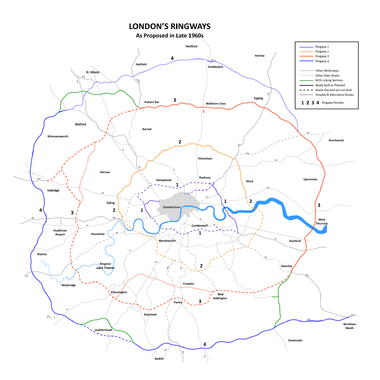
Proposals for the route first arose in the 1960s as part of the London RingwaysLondon Ringways
The London Ringways were a series of four ring roads planned in the 1960s to circle London at various distances from the city centre. They were part of a comprehensive scheme developed by the Greater London Council to alleviate traffic congestion on the city's road system by providing high speed...
plan, which would have seen four concentric circular motorways built in the city, together with radial routes. This would also have included an extension to the current M11 motorway
M11 motorway
The M11 motorway in England is a major road running approximately north from the North Circular Road in South Woodford in north-east London to the A14, north-west of Cambridge.-Route:...
from Ringway 1
Ringway 1
Ringway 1 or the London Motorway Box was the innermost of the series of four motorway standard roads, known as the London Ringways as part of a comprehensive scheme developed by the Greater London Council to provide high speed motorway-standard roads within the capital linking a series of radial...
, the innermost Ringway, to Ringway 2
Ringway 2
Ringway 2 was the second innermost of the series of four London Ringways, ring roads planned in the 1960s to circle London at various distances from the city centre...
.
East Cross Route
East Cross Route is a dual-carriageway road constructed in east London as part of the uncompleted Ringway 1 as part of the London Ringways plan drawn up the 1960s to create a series of high speed roads circling and radiating out from central London...
was built to motorway standards in the late 1960s and early 1970s and designated as the A102(M). A section of the M11 connecting the North Circular – which had been scheduled to be upgraded to full motorway and form the northern part of Ringway 2 – to the position of the current M25 motorway
M25 motorway
The M25 motorway, or London Orbital, is a orbital motorway that almost encircles Greater London, England, in the United Kingdom. The motorway was first mooted early in the 20th century. A few sections, based on the now abandoned London Ringways plan, were constructed in the early 1970s and it ...
– was completed in the late 1970s. The "A12 Hackney to M11 link road" was planned to link the bottom of the M11 to Ringway 1.
The Ringways scheme met considerable opposition; there were protests when the Westway
Westway (London)
The Westway is a long elevated dual carriageway section of the A40 route in west London running from Paddington to North Kensington. The road was constructed between 1964 and 1970 to relieve congestion at Shepherd's Bush caused by traffic from Western Avenue struggling to enter central London on...
was opened in 1970 and the Archway Road public inquiry was repeatedly abandoned during the 1970s as a result of protests. The first Link Road Action Group to resist the M11 link road was formed in 1976, and for the next fifteen years activists fought government plans through a series of public inquiries
Public inquiry
A Tribunal of Inquiry is an official review of events or actions ordered by a government body in Common Law countries such as the United Kingdom, Ireland or Canada. Such a public inquiry differs from a Royal Commission in that a public inquiry accepts evidence and conducts its hearings in a more...
. Their alternative was to build a road tunnel, leaving the houses untouched, but this was rejected on grounds of cost. The Ringway plan was later abandoned.
By the 1980s, planning blight had affected the area and many of the houses had become home to a community of artists and squatters. Eventually, contractors were appointed to carry out the work and a compulsory purchase of property along the proposed route was undertaken. Drivers traveling between central and southern areas of London and East Anglia
East Anglia
East Anglia is a traditional name for a region of eastern England, named after an ancient Anglo-Saxon kingdom, the Kingdom of the East Angles. The Angles took their name from their homeland Angeln, in northern Germany. East Anglia initially consisted of Norfolk and Suffolk, but upon the marriage of...
continued to face long stretches of single-carriageway roads through the suburbs of Leyton
Leyton
Leyton is an area of north-east London and part of the London Borough of Waltham Forest, located north east of Charing Cross. It borders Walthamstow and Leytonstone; Stratford in Newham; and Homerton and Lower Clapton in the London Borough of Hackney....
, Leytonstone
Leytonstone
Leytonstone is an area of east London and part of the London Borough of Waltham Forest. It is a high density suburban area, located seven miles north east of Charing Cross in the ceremonial county of Greater London and the historic county of Essex...
and Wanstead
Wanstead
Wanstead is a suburban area in the London Borough of Redbridge, North-East London. The main road going through Wanstead is the A12. The name is from the Anglo-Saxon words wænn and stede, meaning "settlement on a small hill"....
and serious traffic congestion
Traffic congestion
Traffic congestion is a condition on road networks that occurs as use increases, and is characterized by slower speeds, longer trip times, and increased vehicular queueing. The most common example is the physical use of roads by vehicles. When traffic demand is great enough that the interaction...
had become frequent in these areas.
The Roads for Prosperity
Roads for Prosperity
Roads for Prosperity was a controversial white paper published by the Conservative UK Government in 1989 detailing the 'largest road building program for the UK since the Romans' produced in response to rapid increases in car ownership and use over the previous decade...
white paper published in 1989 detailed a major expansion of the road building program and included plans for the M12 motorway between Chelmsford and the M25 as well as many other road schemes. At this time environmentalist
Environmentalism
Environmentalism is a broad philosophy, ideology and social movement regarding concerns for environmental conservation and improvement of the health of the environment, particularly as the measure for this health seeks to incorporate the concerns of non-human elements...
groups were resisting many road schemes with many road protests including at Twyford Down
Twyford Down
Twyford Down is a small area of ancient chalk downland lying directly to the southeast of Winchester, Hampshire, England. The down's summit, known as Deacon Hill, is towards the north-eastern edge of the area which is renowned for its dramatic rolling scenery, ecologically rich grassland and as a...
in Hampshire
Hampshire
Hampshire is a county on the southern coast of England in the United Kingdom. The county town of Hampshire is Winchester, a historic cathedral city that was once the capital of England. Hampshire is notable for housing the original birthplaces of the Royal Navy, British Army, and Royal Air Force...
.
The protest campaign in East London
By 1990, the majority of the houses along the route of the proposed road had been compulsorily purchasedCompulsory purchase order
A compulsory purchase order is a legal function in the United Kingdom and the Republic of Ireland that allows certain bodies which need to obtain land or property to do so without the consent of the owner. It may be enforced if a proposed development is considered one for public betterment - for...
, although the demolition process had not yet begun. This led to many of the houses being let out temporarily to housing associations, while others lay empty. Several original residents, who had in some cases lived in their homes all their lives, refused to sell or move out of their properties. Large numbers of the empty houses were squatted.
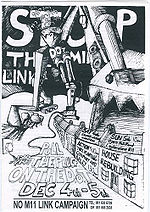
Locally-based protest against the link road scheme was taking place, but the availability of free housing along the route attracted large numbers of campaigners from around the UK and beyond. The arrival of these experienced anti-road protest veterans gave impetus to the campaign and introduced skills which would be put into practice in the construction of "defences".
Sophisticated techniques were used to delay the construction of the road. Sit-in
Sit-in
A sit-in or sit-down is a form of protest that involves occupying seats or sitting down on the floor of an establishment.-Process:In a sit-in, protesters remain until they are evicted, usually by force, or arrested, or until their requests have been met...
s and site invasions were combined with sabotage
Sabotage
Sabotage is a deliberate action aimed at weakening another entity through subversion, obstruction, disruption, or destruction. In a workplace setting, sabotage is the conscious withdrawal of efficiency generally directed at causing some change in workplace conditions. One who engages in sabotage is...
to temporarily stop construction work. This led to large numbers of police and constant security patrols being employed to protect the construction sites, at great expense — the delays and security escalated the total cost of construction by tens of millions of pound
Pound sterling
The pound sterling , commonly called the pound, is the official currency of the United Kingdom, its Crown Dependencies and the British Overseas Territories of South Georgia and the South Sandwich Islands, British Antarctic Territory and Tristan da Cunha. It is subdivided into 100 pence...
s.
The protesters were successful in publicising the campaign, with most UK newspapers and TV news programmes covering the protests on a regular basis. Desktop publishing
Desktop publishing
Desktop publishing is the creation of documents using page layout software on a personal computer.The term has been used for publishing at all levels, from small-circulation documents such as local newsletters to books, magazines and newspapers...
, then in its infancy, was used to produce publicity materials for the campaign and send out faxes to the media. A number of "stunts" were carried out, the most notable being rooftop protests on the Palace of Westminster
Palace of Westminster
The Palace of Westminster, also known as the Houses of Parliament or Westminster Palace, is the meeting place of the two houses of the Parliament of the United Kingdom—the House of Lords and the House of Commons...
and at the home of John MacGregor, the Minister for Transport
Secretary of State for Transport
The Secretary of State for Transport is the member of the cabinet responsible for the British Department for Transport. The role has had a high turnover as new appointments are blamed for the failures of decades of their predecessors...
at that time,
To counter the campaign, the government began evicting residents along the route and demolishing the empty houses. In response, the protesters set up the so-called "autonomous republics
Micronation
Micronations, sometimes also referred to as model countries and new country projects, are entities that claim to be independent nations or states but which are not recognized by world governments or major international organizations...
" of "Wanstonia", "Leytonstonia" and "Euphoria" in some groups of the houses, going so far as to issue passports. Extreme methods were used to force the engineers to halt demolition, including underground tunnels with protesters secured within by concrete.
The chestnut tree on George Green
One section of the M11 extension was due to tunnel under George Green in Wanstead. Residents had believed that this would save their green, and the 250-year-old sweet chestnutSweet Chestnut
Castanea sativa is a species of the flowering plant family Fagaceae, the tree and its edible seeds are referred to by several common names such Sweet Chestnut or Marron. Originally native to southeastern Europe and Asia Minor, it is now widely dispersed throughout Europe and parts of Asia, such as...
tree that grew upon it; because this was a cut and cover tunnel, this would result in the demise of both. Still, until late 1993, local opposition to the M11 extension was relatively limited; while this opposition had been going for nearly 10 years, institutional avenues of protest had been exhausted, and local residents were largely resigned to the road being built.; when outside protestors arrived in September 1993, few residents saw their mission as "their campaign".
This all changed with the help of Jean, a lollipop lady in Wanstead, who upon learning of the tree's impending destruction, rallied the support of local children (and was later fired from her job for doing so while wearing her uniform), who in turn recruited their parents into the protests. It was then that the non-resident radicals realised that they had significant local support. When local residents gathered for a tree dressing ceremony on 6 November, they found their way barred by security fencing. Together, everyone pulled down the fencing to save the tree; at this point, as one wrote, "any division between activist and resident dissolved".
Protesters continued to delay the destruction of the tree; solicitors for the campaign had even argued (successfully) in court that receipt of a letter addressed to the tree itself gave it the status of a legal dwelling, causing a further delay. This was, of course, not to last. In the early morning of 7 December 1993, several hundred police arrived to evict the tree; partly due to a successful "wrenching", it took several more hours for a cherry picker
Cherry picker
A cherry picker , is a type of aerial work platform that consists of a platform or bucket at the end of a hydraulic lifting system.- Design :...
platform to arrive at the scene. The chestnut tree was eventually evicted; an operation that took ten hours to carry out. Protesters made numerous complaints against the police; police, in turn, denied these allegations, attributing any misbehaviour to the protestors. The tree was cut down and smashed up. The protesters' efforts were not completely wasted; media attention mushroomed after the event, with several daily newspapers putting pictures of the tree on their front pages.
Claremont Road
By 1994, the resources of the government began to win out over the protesters, and only one small street, Claremont Road, was yet to be evicted. The street was almost completely occupied by protestors; there was but one original resident living on the street who had defied the Department of Transport's order to move — 92-year old Dolly Watson, who was born in number 32 on Claremont Road and had lived there nearly all her life. By all accounts she had quite endeared herself to the anti-road protestors (who named a watchtower, built 100 feet high from scaffold poles, after her); she, in turn, had some kind words for the protestors:A vibrant and harmonious community sprung up on the Road; one that, by one account, won even the begrudging respect of the authorities. The houses were painted with extravagant designs, both internally and externally, and sculptures erected in the road; the road became an artistic spectacle that one said "had to be seen to be believed". Rave parties were held and bands performed on stages set up in the street. Freak Quency Generator sound system
Sound reinforcement system
A sound reinforcement system is the combination of microphones, signal processors, amplifiers, and loudspeakers that makes live or pre-recorded sounds louder and may also distribute those sounds to a larger or more distant audience...
was one of the regulars.
In November 1994 the eviction of Claremont Road took place, bringing an end to the M11 link road resistance as a major physical protest. Several hundred police and bailiff
Bailiff
A bailiff is a governor or custodian ; a legal officer to whom some degree of authority, care or jurisdiction is committed...
s carried out the eviction over several days; the street was razed to the ground immediately afterwards. In the end, the cost to the taxpayer was over a million pounds in police costs alone.
Towards the end
Following the Claremont Road eviction things died down for a little while. Many of the non-resident protesters moved on to places such as NewburyNewbury bypass
The Newbury bypass, officially known as The Winchester-Preston Trunk Road , is a stretch of dual carriageway road which bypasses the town of Newbury in Berkshire, England...
, where other roads protests were taking place, while locals debated what to do. A house on Fillebrook Road, near Leytonstone tube station
Leytonstone tube station
Leytonstone tube station is on the Central Line of the London Underground, on the boundary of Zones 3 and 4. Towards London the next station is Leyton, while going east from Leytonstone, the line divides into two branches...
, was the only house left standing once that street had been knocked down. It was a listed building, and permission had not yet been granted for its demolition, and due to a security blunder it had been left empty. The house was thus occupied and renamed Munstonia (after The Munsters
The Munsters
The Munsters is a 1960s American family television sitcom depicting the home life of a family of monsters. It starred Fred Gwynne as Herman Munster and Yvonne De Carlo as his wife, Lily Munster. The series was a satire of both traditional monster movies and popular family entertainment of the era,...
, thanks to its spooky appearance), and the protest was back on.
A tower was built out of the roof, similar to one which had existed at Claremont Road, and the usual system of defences and blockades were built, and a core of around thirty protesters ensured that there were always people staying there (a legal requirement for a squatted home, as well as a defence against eviction). Munstonia was finally evicted in June 1995; the eviction itself became the longest ever eviction of any single building in Europe, taking over eight hours to remove all the protesters from the roof and the tower. As usual many were locked into concrete blocks or chained to the tower itself. As at Claremont Road, the building was immediately demolished. Once again the press declared this "The End Of The Road", and for the most part it was. A camp, christened Greenmania, was established on the fringes of Wanstead Flats
Wanstead Flats
Wanstead Flats is the southern-most portion of Epping Forest in east London. It is surrounded by the heavily built-up areas of Leytonstone to the west, Wanstead to the north with Manor Park and Forest Gate to the southeast and south respectively. To the north-west it is connected by way of Bush...
, by the Green Man roundabout in Leytonstone. This lasted a few months, being eventually evicted in September 1995.
Construction of the road, already under way by this stage, was then free to continue largely unhindered, although systematic sabotage of building sites by local people continued. It was completed in 1999 and given the designation A12; its continuation, the former A102(M), was also given this number as far as the Blackwall Tunnel
Blackwall Tunnel
The Blackwall Tunnel is a pair of road tunnels underneath the River Thames in east London, linking the London Borough of Tower Hamlets with the London Borough of Greenwich, and part of the A102 road. The northern portal lies just south of the East India Dock Road in Blackwall; the southern...
.
The official opening of the road in October 1999 took place without fanfare, being opened by the Highways Agency Chief Executive rather than a politician, with only journalists with passes being admitted to the ceremony.
Consequences of the protest campaign
The M11 link road protest was ultimately unsuccessful in its major aim: to stop the building of the M11 link road which on completion the link road was designated as the A12 road.Proposals for the M12 motorway were cancelled in 1994 during the first review of the trunk road program. The planned junctions 1, 2 and 3 of the M11 have never been constructed.
Direct action
Direct action
Direct action is activity undertaken by individuals, groups, or governments to achieve political, economic, or social goals outside of normal social/political channels. This can include nonviolent and violent activities which target persons, groups, or property deemed offensive to the direct action...
techniques first employed or refined at the protest have been transferred to numerous other protests around the world. Many veterans of the anti-M11 link road campaign went on to protest the construction of other road schemes such as the A34 Newbury bypass
Newbury bypass
The Newbury bypass, officially known as The Winchester-Preston Trunk Road , is a stretch of dual carriageway road which bypasses the town of Newbury in Berkshire, England...
at Newbury
Newbury, Berkshire
Newbury is a civil parish and the principal town in the west of the county of Berkshire in England. It is situated on the River Kennet and the Kennet and Avon Canal, and has a town centre containing many 17th century buildings. Newbury is best known for its racecourse and the adjoining former USAF...
in Berkshire
Berkshire
Berkshire is a historic county in the South of England. It is also often referred to as the Royal County of Berkshire because of the presence of the royal residence of Windsor Castle in the county; this usage, which dates to the 19th century at least, was recognised by the Queen in 1957, and...
; campaigns such as these helped to shift public opinion in the UK away from the unfettered building of new roads. In the years after the campaign, the Conservative
Conservative Party (UK)
The Conservative Party, formally the Conservative and Unionist Party, is a centre-right political party in the United Kingdom that adheres to the philosophies of conservatism and British unionism. It is the largest political party in the UK, and is currently the largest single party in the House...
administration shelved the plans for a number of proposed road schemes.
Many ex-M11 protesters went on to join other pro-environment, anti-globalisation and direct action campaigns, such as Reclaim the Streets
Reclaim the Streets
Reclaim The Streets is a collective with a shared ideal of community ownership of public spaces. Participants characterize the collective as a resistance movement opposed to the dominance of corporate forces in globalization, and to the car as the dominant mode of transport.-Protests:Reclaim The...
. In the words of one former Claremont Road protestor, other ex-residents of the Claremont Road protest site went on to join the ranks of London's homeless as they had nowhere else to go after the eviction of the street. Like so many other veterans of other anti-road protest camps such as Newbury.
Several of the protesters who were imprisoned for refusing to be bound over to keep the Queen's Peace challenged the UK Government's breach of the peace
Breach of the peace
Breach of the peace is a legal term used in constitutional law in English-speaking countries, and in a wider public order sense in Britain.-Constitutional law:...
legislation at the European Court of Justice
European Court of Justice
The Court can sit in plenary session, as a Grand Chamber of 13 judges, or in chambers of three or five judges. Plenary sitting are now very rare, and the court mostly sits in chambers of three or five judges...
.
In 2002, in response to a major new road building program and expansion of aviation, a delegation of road protest veterans visited the Department for Transport to warn of renewed direct action in response, delivering a D-lock as a symbol of the past protests. Rebecca went on to found Road Block to support road protesters and challenge the government. In 2007, Road Block became a project within the Campaign for Better Transport
As such, the aftereffects of the M11 link road protests are still being felt today.
For Leytonstone, the consequences were mixed. Supporters say the road helped end the years of planning blight that had affected Leytonstone, but critics would suggest that the economic upswing and housing boom would have had the same effect. The road is still unpopular with many local people and divides the communities of Leyton and Leytonstone in half. Many residents have complained that their streets became rat runs for commuters trying to get ahead of queues or that they did not received the compensation that they were promised or that they believe that they deserve.
On the other hand, according to a local council report, since the opening of the road there has been a significant reduction in traffic and air pollution in key roads in the Leytonstone area. At least one aim of the road was achieved: it is now much quicker for non-residents and goods traffic to get through East London.
See also
- Environmental direct action in the United KingdomEnvironmental direct action in the United KingdomThe environmental direct action movement in the United Kingdom started in 1991 with the forming of the first UK Earth First! group. The movement rapidly grew to include road protest camps, airport camps, anti-GMO actions, electricity generators, and quarry actions.-History:The Earth First! movement...
- Reclaim the StreetsReclaim the StreetsReclaim The Streets is a collective with a shared ideal of community ownership of public spaces. Participants characterize the collective as a resistance movement opposed to the dominance of corporate forces in globalization, and to the car as the dominant mode of transport.-Protests:Reclaim The...
- Road protest (UK)Road protest (UK)Road protest in the United Kingdom usually occurs as a reaction to a stated intention by the empowered authorities to build a new road, or to modify an existing road. Protests may also be made by those wishing to see new roads built or improvements made to existing roads. Motivations for protests...
- SchNEWSSchNEWSSchNEWS is a free weekly publication from Brighton, England, which has been running since November 1994. The main focus is environmental and social issues/struggles in the UK – but also internationally – with an emphasis on direct action protest, and autonomous political struggles...
- DIY culture
- World Carfree NetworkWorld Carfree NetworkThe World Carfree Network is an international network that coordinates the actions of car-free advocates from around the world. It is the main hub of the global car-free movement...
- 491 Gallery491 GalleryThe 491 Gallery is a squatted social centre in Leytonstone, London, England. The multi-disciplinary gallery takes its name from its street number, 491 Grove Green Road. Formerly a factory, it is now home to a community-led art organisation and serves as a constant exhibition space for a diverse...
– a squatted social centre in Leytonstone in a building that escaped demolition
Literature
- AufhebenAufhebenAufheben or Aufhebung is a German word with several seemingly contradictory meanings, including "to lift up", "to abolish", or "to sublate"...
, The Politics of Anti-Road Struggle and the Struggles of Anti-Road Politics: The Case of the No M11 Link Road Campaign. In DIY Culture, ed. George McKay. 100-28. London: Verso, 1998. - Andy Letcher, The Scouring of the Shire: Fairies, Trolls and Pixies in Eco-Protest Culture (2001) http://findarticles.com/p/articles/mi_m2386/is_2_112/ai_79548469/pg_1
External links
showing the location of the M11 link road, now called Eastway (A12)- Pro-campaign page on the 10th Anniversary of the end of the protest (Indymedia)
- Part 2 of the above article, covering "Operation Roadblock"
- The Politics of Anti-road Struggle and the Struggles of Anti-Road politics – The Case of the No M11 link Road Campaign
- The destruction of Claremont Road, Wanstead
- Before and after photographs of the A12
- LINKED, a radio art project by Graeme Miller on the site of the link road about the demolished houses and streets
- video of Claremont Road eviction
- You've Got to be Choking Too - 9-minute documentary film of the anti-road campaign