


Loddiges

Encyclopedia
Nursery (horticulture)
A nursery is a place where plants are propagated and grown to usable size. They include retail nurseries which sell to the general public, wholesale nurseries which sell only to businesses such as other nurseries and to commercial gardeners, and private nurseries which supply the needs of...
that traded in and introduced exotic plants, trees, shrubs, ferns, palms and orchids into Europe
Europe
Europe is, by convention, one of the world's seven continents. Comprising the westernmost peninsula of Eurasia, Europe is generally 'divided' from Asia to its east by the watershed divides of the Ural and Caucasus Mountains, the Ural River, the Caspian and Black Seas, and the waterways connecting...
an gardens.
Founding and rise
The founder of the nursery was Joachim Conrad Loddiges (1738–1826). He was born in Hildesheim, a German province where his father Casper Lochlies was a gardener to the Elector of Hanover, George IIGeorge II of Great Britain
George II was King of Great Britain and Ireland, Duke of Brunswick-Lüneburg and Archtreasurer and Prince-elector of the Holy Roman Empire from 11 June 1727 until his death.George was the last British monarch born outside Great Britain. He was born and brought up in Northern Germany...
of England. Conrad emigrated to Britain at the age of 19 during the 'Seven Years' War
Seven Years' War
The Seven Years' War was a global military war between 1756 and 1763, involving most of the great powers of the time and affecting Europe, North America, Central America, the West African coast, India, and the Philippines...
' to take up employment as a gardener for an influential medical family in the village of Hackney
Hackney (parish)
Hackney was a parish in the historic county of Middlesex. The parish church of St John-at-Hackney was built in 1789, replacing the nearby former 16th century parish church dedicated to St Augustine . The original tower of that church was retained to hold the bells until the new church could be...
, north of London. It was then that the family name was anglicised. When, in his forties he married, he had accumulated sufficient knowledge and savings to expand a small seed business started by fellow German emigree John Busch, from where he began to write to people all over the world, urging them to send him packets of seeds collected from trips to native hills, valleys and plains. From these small beginnings, the nursery business gained a specialist market in Britain, and was increasingly able to attract clients from estates and botanical gardens throughout Europe.
The nursery rose to great prominence during the early nineteenth century under George Loddiges (1786–1846) who published 2000 coloured plates of rare plants introduced into its hothouses and gardens from around the world, and built the largest hothouse in the world to display the best collection of palms and orchids in Europe. George Loddiges also linked the nursery into the scientific circles of the day, becoming a Fellow of the Microscopical Society (FMS), Fellow of the Linnean Society (FLS), Fellow of the Horticultural Society
Royal Horticultural Society
The Royal Horticultural Society was founded in 1804 in London, England as the Horticultural Society of London, and gained its present name in a Royal Charter granted in 1861 by Prince Albert...
(FHS), and Fellow of the Zoological Society (FZS) in London, for he had wide interests in scientific subjects beyond botany, becoming particularly knowledgeable about early microscopy and one aspect of ornithology (humming-birds). Abroad the nursery's influence spread to the imperial gardens of St Petersburg in Russia and the Adelaide
Adelaide
Adelaide is the capital city of South Australia and the fifth-largest city in Australia. Adelaide has an estimated population of more than 1.2 million...
Botanic Garden in South Australia.
Although the business closed in the 1850s, it leaves an important legacy in many of our gardens and parks, since a number of the attractive plants we take for granted, were first introduced into cultivation by Loddiges Nursery.
Origins under Joachim Conrad Loddiges
Rhubarb
Rhubarb is a group of plants that belong to the genus Rheum in the family Polygonaceae. They are herbaceous perennial plants growing from short, thick rhizomes. They have large leaves that are somewhat triangular-shaped with long fleshy petioles...
in Britain. Seed packets were received from all over the world, sometimes from well-known botanical explorers such as John Bartram
John Bartram
*Hoffmann, Nancy E. and John C. Van Horne, eds., America’s Curious Botanist: A Tercentennial Reappraisal of John Bartram 1699-1777. Memoirs of the American Philosophical Society, vol. 243. ....
and William Bartram
William Bartram
William Bartram was an American naturalist. The son of Ann and John Bartram, William Bartram and his twin sister Elizabeth were born in Kingsessing, Pennsylvania, near Philadelphia. As a boy, he accompanied his father on many of his travels, to the Catskill Mountains, the New Jersey Pine Barrens,...
in North America (who also favoured Quaker horticulturalists such as Peter Collinson
Peter Collinson FRS
Peter Collinson was a Fellow of the Royal Society, an avid gardener, and the middleman for an international exchange of scientific ideas in mid-18th century London...
with discoveries), and sometimes from ordinary travelers.
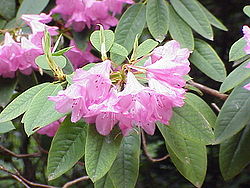
One of the first plant species to be introduced into cultivation in Britain by Conrad Loddiges was the Common Mauve Rhododendron
Rhododendron
Rhododendron is a genus of over 1 000 species of woody plants in the heath family, most with showy flowers...
, Rhododendron ponticum
Rhododendron ponticum
Rhododendron ponticum, called Common Rhododendron or Pontic Rhododendron, is a species of Rhododendron native to southern Europe and southwest Asia.-Description:...
. He introduced this into England in the early 1760s whilst working as a gardener for Dr Silvester of Hackney, prior to setting up his own seed and nursery business. The young plants were supplied to the Marquis of Rockingham whose interest led to great enthusiasm for growing the species in British gardens.
Prominence under George Loddiges
Conrad's son George Loddiges is generally credited with raising the profile of the exotic Hackney nursery at least as greatly, if not more so, than his eminent horticulturalist father. In 1833 the Loddiges began using the newly developed Wardian CaseWardian case
The Wardian case, was an early type of sealed protective container for plants, which found great use in the 19th Century in protecting foreign plants imported to Europe from overseas, the great majority of which had previously died from exposure during long sea journeys, frustrating the many...
to transport live plants from Australia, and also had a keen interest in microscopy and hummingbirds, one of which, the Marvelous Spatuletail, was named in his honour.
For example, the term 'arboretum
Arboretum
An arboretum in a narrow sense is a collection of trees only. Related collections include a fruticetum , and a viticetum, a collection of vines. More commonly, today, an arboretum is a botanical garden containing living collections of woody plants intended at least partly for scientific study...
' was first used in an English
English language
English is a West Germanic language that arose in the Anglo-Saxon kingdoms of England and spread into what was to become south-east Scotland under the influence of the Anglian medieval kingdom of Northumbria...
publication by J. C. Loudon
John Claudius Loudon
John Claudius Loudon was a Scottish botanist, garden and cemetery designer, author and garden magazine editor.-Background:...
in 1833 in The Gardener's Magazine when commenting on George Loddiges' famous Hackney Botanic Garden arboretum, begun in 1816, and open free to the public for educational benefit every Sunday. Loudon wrote: The arboretum looks better this season than it has ever done since it was planted... the more lofty trees suffered from the late high winds, but not materially. We walked round the two outer spirals of this coil of trees and shrubs; viz. from Acer to Quercus. There is no garden scene about London so interesting.
A plan of George Loddiges' arboretum was included in The Encyclopaedia of Gardening 1834 edition, and the interest this aroused helped inspire Loudon to write his encyclopaedic book Arboretum et Fruticetum Britannicum, first published in 1838. Although this incorporated drawings from several early botanic gardens and parklands throughout the UK, it relied greatly upon, and would not have been possible without, George Loddiges' well labeled arboretum. It was on the collection maintained by this firm more than any other that J.C.Loudon relied for living material in the preparation of his great work W.J.Bean notes in Trees and Shrubs Hardy in the British Isles, today's standard reference work.
Another notable visitor was Charles Darwin
Charles Darwin
Charles Robert Darwin FRS was an English naturalist. He established that all species of life have descended over time from common ancestry, and proposed the scientific theory that this branching pattern of evolution resulted from a process that he called natural selection.He published his theory...
who in September 1838 wrote Saw in Loddiges garden 1279 varieties of roses!!! Proof of capability of variation
Although George Loddiges' arboretum was widely praised, his better known horticultural endeavour was to establish the world's largest hothouse in his Hackney Botanic Nursery, and invent a system of warm mist-like rain to maintain beautiful tropical palms, ephiphytic orchids, ferns and camellias in almost perfect environmental conditions akin to a 'tropical rainforest'.
George Loddiges' tropical hothouse range made use of recently invented curvilinear iron glazing bars and central heating systems, which together with his own inventions, enabled many new species of tropical plant to be introduced into cultivation, or flower for the first time in Europe. Visiting the hothouses on 30 March 1822, the Quaker pharmacist William Allen
William Allen (Quaker)
William Allen FRS, FLS was an English scientist and philanthropist who opposed slavery and engaged in schemes of social and penal improvement in early nineteenth century England.-Early life:...
, his Cousin Emily Birkbeck and Anna Hanbury noted: We all went to Loddiges Nursery to see the camellias which are now in full bloom and very beautiful ! There is quite a forest of them: his hot-houses are, perhaps, the most capricious in the world: one off them is forty feet high: in this there is a banana tree which nearly reaches the top. A few years later, in 1829, Jacob Rinz (a visitor from a Frankfurt nursery) commented: never shall I forget the sensation produced by this establishment. I cannot describe the raptures I experienced on seeing that immense palm house. All that I had seen before of the kind appeared nothing to me compared with this. I fancied myself in the Brazils; and especially at that moment when Mr Loddiges had the kindness to produce, in my presence, a shower of artificial rain. Such conditions were ideal for tropical orchids, several of were named in honour of George Loddiges, including Loddiges' dendrobium
Dendrobium loddigesii
Dendrobium loddigesii is a species of orchid of the Dendrobium genus and native to Laos, southern China, and Hong Kong. The plant is usually found at altitudes 1000-1500 metres above sea level...
.
So infectious was the interest that George Loddiges and fellow nurserymen created during the early nineteenth century in the splendour of new ferns, trees, palms - indeed plants of all kinds - that he was prompted to begin marketing a series of volumes containing coloured engravings of the many new species and varieties. Entitled The Botanical Cabinet it ran to twenty volumes and 2,000 plates. Facing each plant portrait, George Loddiges added a few lines of text outlining the source of the seeds and invariably adding a religious perspective. Many of the drawings for the publications were made by George's daughter Jane and the young Edward Cooke
Edward William Cooke
Edward William Cooke, R.A., F.R.S., F.Z.S., F.S.A., F.G.S. was an English landscape and marine painter, and gardener.-Life and work:...
who became a leading Victorian artist, and whose father, George Cooke
George Cooke (engraver)
George Cooke , was an English line engraver.-Life and work:Cooke was born in London in 1781. His father was a native of Frankfurt, Germany, who in early life settled in England and became a wholesale confectioner. At the age of fourteen, George Cooke was apprenticed to James Basire...
, engraved a number of the plates.
The Horticultural Society
Royal Horticultural Society
The Royal Horticultural Society was founded in 1804 in London, England as the Horticultural Society of London, and gained its present name in a Royal Charter granted in 1861 by Prince Albert...
awarded George Loddiges numerous medals throughout this period:
Silver Medal, 1818, 1819;
Silver Medal (Sir Joseph Banks Memorial Portrait Prize), 1823, 1826, 1832, 1835;
President's Silver Medal, 1836;
Silver Flora Medal, 1837.
In the late 1830s George Loddiges became involved in the design and landscaping of one of the Magnificent Seven
Magnificent Seven
Magnificent Seven or Magnificent 7 may refer to:* The Magnificent Seven, a 1960 western film* The Magnificent Seven , a 1997–2000 television series based on the 1960 film...
London garden cemeteries associated with burial reform: Abney Park Cemetery
Abney Park Cemetery
Abney Park in Stoke Newington, in the London Borough of Hackney, is a historic parkland originally laid out in the early 18th century by Lady Mary Abney and Dr. Isaac Watts, and the neighbouring Hartopp family. In 1840 it became a non-denominational garden cemetery, semi-public park arboretum, and...
. Sensitively preserving the existing early eighteenth century parkland laid out by Lady Mary Abney
Lady Mary Abney
Mary, Lady Abney inherited the Manor of Stoke Newington in the early 18th century, which lies about five miles north of St Paul's Cathedral in the City of London...
and Isaac Watts
Isaac Watts
Isaac Watts was an English hymnwriter, theologian and logician. A prolific and popular hymnwriter, he was recognised as the "Father of English Hymnody", credited with some 750 hymns...
, he introduced an educational landscape around the perimeter which was open to the public free of charge: a vast arboretum of 2,500 species and varieties, labelled alphabetically from A to Z rather than arranged in a more conventional way. Close to the Abney Park Chapel
Abney Park Chapel
Abney Park Chapel, is a Grade II Listed chapel, designed by William Hosking and built by John Jay that is situated in Europe's first wholly nondenominational cemetery, Abney Park Cemetery, London....
he also laid out a rosarium to complement the chapel's 'botanical rose windows' (described as 'botanical' owing to their unusual ten-part arrangement, as in the five sepals and five petals of the rose family
Rosaceae
Rosaceae are a medium-sized family of flowering plants, including about 2830 species in 95 genera. The name is derived from the type genus Rosa. Among the largest genera are Alchemilla , Sorbus , Crataegus , Cotoneaster , and Rubus...
, or petals of a simple rose including indentations as shown in the White Rose of York
White Rose of York
The White Rose of York , a white heraldic rose, is the symbol of the House of York and has since been adopted as a symbol of Yorkshire as a whole.-History:...
). George Loddiges also appears to have influenced the architect William Hosking
William Hosking
William Hosking FSA was a writer, lecturer, and architect who had an important influence on the growth and development of London in Victorian times...
and client George Collison II
George Collison
George Collison was an English Congregationalist and educator associated with Hackney Academy or Hackney College, which became part of New College London - itself part of the University of London.-Early life:...
in their final choice of Egyptian Revival ornamentation for the main entrance, since the Egyptian-style entrance pylons incorporate the botanical imagery of the Egyptian White Lily or Lotus
Nymphaea lotus
Nymphaea lotus, the Tiger Lotus, White lotus or Egyptian White Water-lily, is a flowering plant of the family Nymphaeaceae-Description:It grows in various parts of East Africa and Southeast Asia....
, a plant introduced into western cultivation by Loddiges Nursery in 1802.
Closure under Conrad Loddiges II
Royal Botanic Gardens, Kew
The Royal Botanic Gardens, Kew, usually referred to as Kew Gardens, is 121 hectares of gardens and botanical glasshouses between Richmond and Kew in southwest London, England. "The Royal Botanic Gardens, Kew" and the brand name "Kew" are also used as umbrella terms for the institution that runs...
for a sum of £9000 (20 years earlier the collection was valued at £200,0000) but this was refused. Many rare plants were auctioned via Stevens auctioneers, including rare orchids sold to John Day
John Day (botanist)
John Day was an English orchid-grower and collector, and is noted for producing some 4000 illustrations of orchid species in 53 scrapbooks over a period of 15 years. These scrapbooks were donated to The Royal Botanic Gardens, Kew in 1902 by his sister, Emma Wolstenholme.Day was born in the City of...
who would later become famous as a botanical illustrator. Joseph Paxton
Joseph Paxton
Sir Joseph Paxton was an English gardener and architect, best known for designing The Crystal Palace.-Early life:...
purchased 300 palms and plants for the opening of the new Crystal Palace
The Crystal Palace
The Crystal Palace was a cast-iron and glass building originally erected in Hyde Park, London, England, to house the Great Exhibition of 1851. More than 14,000 exhibitors from around the world gathered in the Palace's of exhibition space to display examples of the latest technology developed in...
at Sydenham. The Illustrated London News of 5 August 1854 illustrated plumed horses pulling a giant palm tree through the City of London on its way to be prominently displayed by Paxton in time for the opening of Crystal Palace by Queen Victoria.
Burial and Remembrance
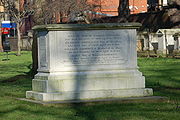
Today, memorials to members of the Loddiges family can be seen in the gardens of the Church of St John-at-HackneyChurch of St John-at-Hackney
The Church of St John at Hackney is situated in the London Borough of Hackney. It was built in 1792, in an open field, north east of Hackney's medieval parish church, of which only St Augustine's Tower remains...
and Abney Park Cemetery
Abney Park Cemetery
Abney Park in Stoke Newington, in the London Borough of Hackney, is a historic parkland originally laid out in the early 18th century by Lady Mary Abney and Dr. Isaac Watts, and the neighbouring Hartopp family. In 1840 it became a non-denominational garden cemetery, semi-public park arboretum, and...
.
Nursery (horticulture)
A nursery is a place where plants are propagated and grown to usable size. They include retail nurseries which sell to the general public, wholesale nurseries which sell only to businesses such as other nurseries and to commercial gardeners, and private nurseries which supply the needs of...
that traded in and introduced exotic plants, trees, shrubs, ferns, palms and orchids into Europe
Europe
Europe is, by convention, one of the world's seven continents. Comprising the westernmost peninsula of Eurasia, Europe is generally 'divided' from Asia to its east by the watershed divides of the Ural and Caucasus Mountains, the Ural River, the Caspian and Black Seas, and the waterways connecting...
an gardens.
Founding and rise
The founder of the nursery was Joachim Conrad Loddiges (1738–1826). He was born in Hildesheim, a German province where his father Casper Lochlies was a gardener to the Elector of Hanover, George IIGeorge II of Great Britain
George II was King of Great Britain and Ireland, Duke of Brunswick-Lüneburg and Archtreasurer and Prince-elector of the Holy Roman Empire from 11 June 1727 until his death.George was the last British monarch born outside Great Britain. He was born and brought up in Northern Germany...
of England. Conrad emigrated to Britain at the age of 19 during the 'Seven Years' War
Seven Years' War
The Seven Years' War was a global military war between 1756 and 1763, involving most of the great powers of the time and affecting Europe, North America, Central America, the West African coast, India, and the Philippines...
' to take up employment as a gardener for an influential medical family in the village of Hackney
Hackney (parish)
Hackney was a parish in the historic county of Middlesex. The parish church of St John-at-Hackney was built in 1789, replacing the nearby former 16th century parish church dedicated to St Augustine . The original tower of that church was retained to hold the bells until the new church could be...
, north of London. It was then that the family name was anglicised. When, in his forties he married, he had accumulated sufficient knowledge and savings to expand a small seed business started by fellow German emigree John Busch, from where he began to write to people all over the world, urging them to send him packets of seeds collected from trips to native hills, valleys and plains. From these small beginnings, the nursery business gained a specialist market in Britain, and was increasingly able to attract clients from estates and botanical gardens throughout Europe.
The nursery rose to great prominence during the early nineteenth century under George Loddiges (1786–1846) who published 2000 coloured plates of rare plants introduced into its hothouses and gardens from around the world, and built the largest hothouse in the world to display the best collection of palms and orchids in Europe. George Loddiges also linked the nursery into the scientific circles of the day, becoming a Fellow of the Microscopical Society (FMS), Fellow of the Linnean Society (FLS), Fellow of the Horticultural Society
Royal Horticultural Society
The Royal Horticultural Society was founded in 1804 in London, England as the Horticultural Society of London, and gained its present name in a Royal Charter granted in 1861 by Prince Albert...
(FHS), and Fellow of the Zoological Society (FZS) in London, for he had wide interests in scientific subjects beyond botany, becoming particularly knowledgeable about early microscopy and one aspect of ornithology (humming-birds). Abroad the nursery's influence spread to the imperial gardens of St Petersburg in Russia and the Adelaide
Adelaide
Adelaide is the capital city of South Australia and the fifth-largest city in Australia. Adelaide has an estimated population of more than 1.2 million...
Botanic Garden in South Australia.
Although the business closed in the 1850s, it leaves an important legacy in many of our gardens and parks, since a number of the attractive plants we take for granted, were first introduced into cultivation by Loddiges Nursery.
Origins under Joachim Conrad Loddiges
Rhubarb
Rhubarb is a group of plants that belong to the genus Rheum in the family Polygonaceae. They are herbaceous perennial plants growing from short, thick rhizomes. They have large leaves that are somewhat triangular-shaped with long fleshy petioles...
in Britain. Seed packets were received from all over the world, sometimes from well-known botanical explorers such as John Bartram
John Bartram
*Hoffmann, Nancy E. and John C. Van Horne, eds., America’s Curious Botanist: A Tercentennial Reappraisal of John Bartram 1699-1777. Memoirs of the American Philosophical Society, vol. 243. ....
and William Bartram
William Bartram
William Bartram was an American naturalist. The son of Ann and John Bartram, William Bartram and his twin sister Elizabeth were born in Kingsessing, Pennsylvania, near Philadelphia. As a boy, he accompanied his father on many of his travels, to the Catskill Mountains, the New Jersey Pine Barrens,...
in North America (who also favoured Quaker horticulturalists such as Peter Collinson
Peter Collinson FRS
Peter Collinson was a Fellow of the Royal Society, an avid gardener, and the middleman for an international exchange of scientific ideas in mid-18th century London...
with discoveries), and sometimes from ordinary travelers.
One of the first plant species to be introduced into cultivation in Britain by Conrad Loddiges was the Common Mauve Rhododendron
Rhododendron
Rhododendron is a genus of over 1 000 species of woody plants in the heath family, most with showy flowers...
, Rhododendron ponticum
Rhododendron ponticum
Rhododendron ponticum, called Common Rhododendron or Pontic Rhododendron, is a species of Rhododendron native to southern Europe and southwest Asia.-Description:...
. He introduced this into England in the early 1760s whilst working as a gardener for Dr Silvester of Hackney, prior to setting up his own seed and nursery business. The young plants were supplied to the Marquis of Rockingham whose interest led to great enthusiasm for growing the species in British gardens.
Prominence under George Loddiges
Conrad's son George Loddiges is generally credited with raising the profile of the exotic Hackney nursery at least as greatly, if not more so, than his eminent horticulturalist father. In 1833 the Loddiges began using the newly developed Wardian CaseWardian case
The Wardian case, was an early type of sealed protective container for plants, which found great use in the 19th Century in protecting foreign plants imported to Europe from overseas, the great majority of which had previously died from exposure during long sea journeys, frustrating the many...
to transport live plants from Australia, and also had a keen interest in microscopy and hummingbirds, one of which, the Marvelous Spatuletail, was named in his honour.
For example, the term 'arboretum
Arboretum
An arboretum in a narrow sense is a collection of trees only. Related collections include a fruticetum , and a viticetum, a collection of vines. More commonly, today, an arboretum is a botanical garden containing living collections of woody plants intended at least partly for scientific study...
' was first used in an English
English language
English is a West Germanic language that arose in the Anglo-Saxon kingdoms of England and spread into what was to become south-east Scotland under the influence of the Anglian medieval kingdom of Northumbria...
publication by J. C. Loudon
John Claudius Loudon
John Claudius Loudon was a Scottish botanist, garden and cemetery designer, author and garden magazine editor.-Background:...
in 1833 in The Gardener's Magazine when commenting on George Loddiges' famous Hackney Botanic Garden arboretum, begun in 1816, and open free to the public for educational benefit every Sunday. Loudon wrote: The arboretum looks better this season than it has ever done since it was planted... the more lofty trees suffered from the late high winds, but not materially. We walked round the two outer spirals of this coil of trees and shrubs; viz. from Acer to Quercus. There is no garden scene about London so interesting.
A plan of George Loddiges' arboretum was included in The Encyclopaedia of Gardening 1834 edition, and the interest this aroused helped inspire Loudon to write his encyclopaedic book Arboretum et Fruticetum Britannicum, first published in 1838. Although this incorporated drawings from several early botanic gardens and parklands throughout the UK, it relied greatly upon, and would not have been possible without, George Loddiges' well labeled arboretum. It was on the collection maintained by this firm more than any other that J.C.Loudon relied for living material in the preparation of his great work W.J.Bean notes in Trees and Shrubs Hardy in the British Isles, today's standard reference work.
Another notable visitor was Charles Darwin
Charles Darwin
Charles Robert Darwin FRS was an English naturalist. He established that all species of life have descended over time from common ancestry, and proposed the scientific theory that this branching pattern of evolution resulted from a process that he called natural selection.He published his theory...
who in September 1838 wrote Saw in Loddiges garden 1279 varieties of roses!!! Proof of capability of variation
Although George Loddiges' arboretum was widely praised, his better known horticultural endeavour was to establish the world's largest hothouse in his Hackney Botanic Nursery, and invent a system of warm mist-like rain to maintain beautiful tropical palms, ephiphytic orchids, ferns and camellias in almost perfect environmental conditions akin to a 'tropical rainforest'.
George Loddiges' tropical hothouse range made use of recently invented curvilinear iron glazing bars and central heating systems, which together with his own inventions, enabled many new species of tropical plant to be introduced into cultivation, or flower for the first time in Europe. Visiting the hothouses on 30 March 1822, the Quaker pharmacist William Allen
William Allen (Quaker)
William Allen FRS, FLS was an English scientist and philanthropist who opposed slavery and engaged in schemes of social and penal improvement in early nineteenth century England.-Early life:...
, his Cousin Emily Birkbeck and Anna Hanbury noted: We all went to Loddiges Nursery to see the camellias which are now in full bloom and very beautiful ! There is quite a forest of them: his hot-houses are, perhaps, the most capricious in the world: one off them is forty feet high: in this there is a banana tree which nearly reaches the top. A few years later, in 1829, Jacob Rinz (a visitor from a Frankfurt nursery) commented: never shall I forget the sensation produced by this establishment. I cannot describe the raptures I experienced on seeing that immense palm house. All that I had seen before of the kind appeared nothing to me compared with this. I fancied myself in the Brazils; and especially at that moment when Mr Loddiges had the kindness to produce, in my presence, a shower of artificial rain. Such conditions were ideal for tropical orchids, several of were named in honour of George Loddiges, including Loddiges' dendrobium
Dendrobium loddigesii
Dendrobium loddigesii is a species of orchid of the Dendrobium genus and native to Laos, southern China, and Hong Kong. The plant is usually found at altitudes 1000-1500 metres above sea level...
.
So infectious was the interest that George Loddiges and fellow nurserymen created during the early nineteenth century in the splendour of new ferns, trees, palms - indeed plants of all kinds - that he was prompted to begin marketing a series of volumes containing coloured engravings of the many new species and varieties. Entitled The Botanical Cabinet it ran to twenty volumes and 2,000 plates. Facing each plant portrait, George Loddiges added a few lines of text outlining the source of the seeds and invariably adding a religious perspective. Many of the drawings for the publications were made by George's daughter Jane and the young Edward Cooke
Edward William Cooke
Edward William Cooke, R.A., F.R.S., F.Z.S., F.S.A., F.G.S. was an English landscape and marine painter, and gardener.-Life and work:...
who became a leading Victorian artist, and whose father, George Cooke
George Cooke (engraver)
George Cooke , was an English line engraver.-Life and work:Cooke was born in London in 1781. His father was a native of Frankfurt, Germany, who in early life settled in England and became a wholesale confectioner. At the age of fourteen, George Cooke was apprenticed to James Basire...
, engraved a number of the plates.
The Horticultural Society
Royal Horticultural Society
The Royal Horticultural Society was founded in 1804 in London, England as the Horticultural Society of London, and gained its present name in a Royal Charter granted in 1861 by Prince Albert...
awarded George Loddiges numerous medals throughout this period:
Silver Medal, 1818, 1819;
Silver Medal (Sir Joseph Banks Memorial Portrait Prize), 1823, 1826, 1832, 1835;
President's Silver Medal, 1836;
Silver Flora Medal, 1837.
In the late 1830s George Loddiges became involved in the design and landscaping of one of the Magnificent Seven
Magnificent Seven
Magnificent Seven or Magnificent 7 may refer to:* The Magnificent Seven, a 1960 western film* The Magnificent Seven , a 1997–2000 television series based on the 1960 film...
London garden cemeteries associated with burial reform: Abney Park Cemetery
Abney Park Cemetery
Abney Park in Stoke Newington, in the London Borough of Hackney, is a historic parkland originally laid out in the early 18th century by Lady Mary Abney and Dr. Isaac Watts, and the neighbouring Hartopp family. In 1840 it became a non-denominational garden cemetery, semi-public park arboretum, and...
. Sensitively preserving the existing early eighteenth century parkland laid out by Lady Mary Abney
Lady Mary Abney
Mary, Lady Abney inherited the Manor of Stoke Newington in the early 18th century, which lies about five miles north of St Paul's Cathedral in the City of London...
and Isaac Watts
Isaac Watts
Isaac Watts was an English hymnwriter, theologian and logician. A prolific and popular hymnwriter, he was recognised as the "Father of English Hymnody", credited with some 750 hymns...
, he introduced an educational landscape around the perimeter which was open to the public free of charge: a vast arboretum of 2,500 species and varieties, labelled alphabetically from A to Z rather than arranged in a more conventional way. Close to the Abney Park Chapel
Abney Park Chapel
Abney Park Chapel, is a Grade II Listed chapel, designed by William Hosking and built by John Jay that is situated in Europe's first wholly nondenominational cemetery, Abney Park Cemetery, London....
he also laid out a rosarium to complement the chapel's 'botanical rose windows' (described as 'botanical' owing to their unusual ten-part arrangement, as in the five sepals and five petals of the rose family
Rosaceae
Rosaceae are a medium-sized family of flowering plants, including about 2830 species in 95 genera. The name is derived from the type genus Rosa. Among the largest genera are Alchemilla , Sorbus , Crataegus , Cotoneaster , and Rubus...
, or petals of a simple rose including indentations as shown in the White Rose of York
White Rose of York
The White Rose of York , a white heraldic rose, is the symbol of the House of York and has since been adopted as a symbol of Yorkshire as a whole.-History:...
). George Loddiges also appears to have influenced the architect William Hosking
William Hosking
William Hosking FSA was a writer, lecturer, and architect who had an important influence on the growth and development of London in Victorian times...
and client George Collison II
George Collison
George Collison was an English Congregationalist and educator associated with Hackney Academy or Hackney College, which became part of New College London - itself part of the University of London.-Early life:...
in their final choice of Egyptian Revival ornamentation for the main entrance, since the Egyptian-style entrance pylons incorporate the botanical imagery of the Egyptian White Lily or Lotus
Nymphaea lotus
Nymphaea lotus, the Tiger Lotus, White lotus or Egyptian White Water-lily, is a flowering plant of the family Nymphaeaceae-Description:It grows in various parts of East Africa and Southeast Asia....
, a plant introduced into western cultivation by Loddiges Nursery in 1802.
Closure under Conrad Loddiges II
Royal Botanic Gardens, Kew
The Royal Botanic Gardens, Kew, usually referred to as Kew Gardens, is 121 hectares of gardens and botanical glasshouses between Richmond and Kew in southwest London, England. "The Royal Botanic Gardens, Kew" and the brand name "Kew" are also used as umbrella terms for the institution that runs...
for a sum of £9000 (20 years earlier the collection was valued at £200,0000) but this was refused. Many rare plants were auctioned via Stevens auctioneers, including rare orchids sold to John Day
John Day (botanist)
John Day was an English orchid-grower and collector, and is noted for producing some 4000 illustrations of orchid species in 53 scrapbooks over a period of 15 years. These scrapbooks were donated to The Royal Botanic Gardens, Kew in 1902 by his sister, Emma Wolstenholme.Day was born in the City of...
who would later become famous as a botanical illustrator. Joseph Paxton
Joseph Paxton
Sir Joseph Paxton was an English gardener and architect, best known for designing The Crystal Palace.-Early life:...
purchased 300 palms and plants for the opening of the new Crystal Palace
The Crystal Palace
The Crystal Palace was a cast-iron and glass building originally erected in Hyde Park, London, England, to house the Great Exhibition of 1851. More than 14,000 exhibitors from around the world gathered in the Palace's of exhibition space to display examples of the latest technology developed in...
at Sydenham. The Illustrated London News of 5 August 1854 illustrated plumed horses pulling a giant palm tree through the City of London on its way to be prominently displayed by Paxton in time for the opening of Crystal Palace by Queen Victoria.
Burial and Remembrance
Today, memorials to members of the Loddiges family can be seen in the gardens of the Church of St John-at-HackneyChurch of St John-at-Hackney
The Church of St John at Hackney is situated in the London Borough of Hackney. It was built in 1792, in an open field, north east of Hackney's medieval parish church, of which only St Augustine's Tower remains...
and Abney Park Cemetery
Abney Park Cemetery
Abney Park in Stoke Newington, in the London Borough of Hackney, is a historic parkland originally laid out in the early 18th century by Lady Mary Abney and Dr. Isaac Watts, and the neighbouring Hartopp family. In 1840 it became a non-denominational garden cemetery, semi-public park arboretum, and...
.
Nursery (horticulture)
A nursery is a place where plants are propagated and grown to usable size. They include retail nurseries which sell to the general public, wholesale nurseries which sell only to businesses such as other nurseries and to commercial gardeners, and private nurseries which supply the needs of...
that traded in and introduced exotic plants, trees, shrubs, ferns, palms and orchids into Europe
Europe
Europe is, by convention, one of the world's seven continents. Comprising the westernmost peninsula of Eurasia, Europe is generally 'divided' from Asia to its east by the watershed divides of the Ural and Caucasus Mountains, the Ural River, the Caspian and Black Seas, and the waterways connecting...
an gardens.
Founding and rise
The founder of the nursery was Joachim Conrad Loddiges (1738–1826). He was born in Hildesheim, a German province where his father Casper Lochlies was a gardener to the Elector of Hanover, George IIGeorge II of Great Britain
George II was King of Great Britain and Ireland, Duke of Brunswick-Lüneburg and Archtreasurer and Prince-elector of the Holy Roman Empire from 11 June 1727 until his death.George was the last British monarch born outside Great Britain. He was born and brought up in Northern Germany...
of England. Conrad emigrated to Britain at the age of 19 during the 'Seven Years' War
Seven Years' War
The Seven Years' War was a global military war between 1756 and 1763, involving most of the great powers of the time and affecting Europe, North America, Central America, the West African coast, India, and the Philippines...
' to take up employment as a gardener for an influential medical family in the village of Hackney
Hackney (parish)
Hackney was a parish in the historic county of Middlesex. The parish church of St John-at-Hackney was built in 1789, replacing the nearby former 16th century parish church dedicated to St Augustine . The original tower of that church was retained to hold the bells until the new church could be...
, north of London. It was then that the family name was anglicised. When, in his forties he married, he had accumulated sufficient knowledge and savings to expand a small seed business started by fellow German emigree John Busch, from where he began to write to people all over the world, urging them to send him packets of seeds collected from trips to native hills, valleys and plains. From these small beginnings, the nursery business gained a specialist market in Britain, and was increasingly able to attract clients from estates and botanical gardens throughout Europe.
The nursery rose to great prominence during the early nineteenth century under George Loddiges (1786–1846) who published 2000 coloured plates of rare plants introduced into its hothouses and gardens from around the world, and built the largest hothouse in the world to display the best collection of palms and orchids in Europe. George Loddiges also linked the nursery into the scientific circles of the day, becoming a Fellow of the Microscopical Society (FMS), Fellow of the Linnean Society (FLS), Fellow of the Horticultural Society
Royal Horticultural Society
The Royal Horticultural Society was founded in 1804 in London, England as the Horticultural Society of London, and gained its present name in a Royal Charter granted in 1861 by Prince Albert...
(FHS), and Fellow of the Zoological Society (FZS) in London, for he had wide interests in scientific subjects beyond botany, becoming particularly knowledgeable about early microscopy and one aspect of ornithology (humming-birds). Abroad the nursery's influence spread to the imperial gardens of St Petersburg in Russia and the Adelaide
Adelaide
Adelaide is the capital city of South Australia and the fifth-largest city in Australia. Adelaide has an estimated population of more than 1.2 million...
Botanic Garden in South Australia.
Although the business closed in the 1850s, it leaves an important legacy in many of our gardens and parks, since a number of the attractive plants we take for granted, were first introduced into cultivation by Loddiges Nursery.
Origins under Joachim Conrad Loddiges
Rhubarb
Rhubarb is a group of plants that belong to the genus Rheum in the family Polygonaceae. They are herbaceous perennial plants growing from short, thick rhizomes. They have large leaves that are somewhat triangular-shaped with long fleshy petioles...
in Britain. Seed packets were received from all over the world, sometimes from well-known botanical explorers such as John Bartram
John Bartram
*Hoffmann, Nancy E. and John C. Van Horne, eds., America’s Curious Botanist: A Tercentennial Reappraisal of John Bartram 1699-1777. Memoirs of the American Philosophical Society, vol. 243. ....
and William Bartram
William Bartram
William Bartram was an American naturalist. The son of Ann and John Bartram, William Bartram and his twin sister Elizabeth were born in Kingsessing, Pennsylvania, near Philadelphia. As a boy, he accompanied his father on many of his travels, to the Catskill Mountains, the New Jersey Pine Barrens,...
in North America (who also favoured Quaker horticulturalists such as Peter Collinson
Peter Collinson FRS
Peter Collinson was a Fellow of the Royal Society, an avid gardener, and the middleman for an international exchange of scientific ideas in mid-18th century London...
with discoveries), and sometimes from ordinary travelers.
One of the first plant species to be introduced into cultivation in Britain by Conrad Loddiges was the Common Mauve Rhododendron
Rhododendron
Rhododendron is a genus of over 1 000 species of woody plants in the heath family, most with showy flowers...
, Rhododendron ponticum
Rhododendron ponticum
Rhododendron ponticum, called Common Rhododendron or Pontic Rhododendron, is a species of Rhododendron native to southern Europe and southwest Asia.-Description:...
. He introduced this into England in the early 1760s whilst working as a gardener for Dr Silvester of Hackney, prior to setting up his own seed and nursery business. The young plants were supplied to the Marquis of Rockingham whose interest led to great enthusiasm for growing the species in British gardens.
Prominence under George Loddiges
Conrad's son George Loddiges is generally credited with raising the profile of the exotic Hackney nursery at least as greatly, if not more so, than his eminent horticulturalist father. In 1833 the Loddiges began using the newly developed Wardian CaseWardian case
The Wardian case, was an early type of sealed protective container for plants, which found great use in the 19th Century in protecting foreign plants imported to Europe from overseas, the great majority of which had previously died from exposure during long sea journeys, frustrating the many...
to transport live plants from Australia, and also had a keen interest in microscopy and hummingbirds, one of which, the Marvelous Spatuletail, was named in his honour.
For example, the term 'arboretum
Arboretum
An arboretum in a narrow sense is a collection of trees only. Related collections include a fruticetum , and a viticetum, a collection of vines. More commonly, today, an arboretum is a botanical garden containing living collections of woody plants intended at least partly for scientific study...
' was first used in an English
English language
English is a West Germanic language that arose in the Anglo-Saxon kingdoms of England and spread into what was to become south-east Scotland under the influence of the Anglian medieval kingdom of Northumbria...
publication by J. C. Loudon
John Claudius Loudon
John Claudius Loudon was a Scottish botanist, garden and cemetery designer, author and garden magazine editor.-Background:...
in 1833 in The Gardener's Magazine when commenting on George Loddiges' famous Hackney Botanic Garden arboretum, begun in 1816, and open free to the public for educational benefit every Sunday. Loudon wrote: The arboretum looks better this season than it has ever done since it was planted... the more lofty trees suffered from the late high winds, but not materially. We walked round the two outer spirals of this coil of trees and shrubs; viz. from Acer to Quercus. There is no garden scene about London so interesting.
A plan of George Loddiges' arboretum was included in The Encyclopaedia of Gardening 1834 edition, and the interest this aroused helped inspire Loudon to write his encyclopaedic book Arboretum et Fruticetum Britannicum, first published in 1838. Although this incorporated drawings from several early botanic gardens and parklands throughout the UK, it relied greatly upon, and would not have been possible without, George Loddiges' well labeled arboretum. It was on the collection maintained by this firm more than any other that J.C.Loudon relied for living material in the preparation of his great work W.J.Bean notes in Trees and Shrubs Hardy in the British Isles, today's standard reference work.
Another notable visitor was Charles Darwin
Charles Darwin
Charles Robert Darwin FRS was an English naturalist. He established that all species of life have descended over time from common ancestry, and proposed the scientific theory that this branching pattern of evolution resulted from a process that he called natural selection.He published his theory...
who in September 1838 wrote Saw in Loddiges garden 1279 varieties of roses!!! Proof of capability of variation
Although George Loddiges' arboretum was widely praised, his better known horticultural endeavour was to establish the world's largest hothouse in his Hackney Botanic Nursery, and invent a system of warm mist-like rain to maintain beautiful tropical palms, ephiphytic orchids, ferns and camellias in almost perfect environmental conditions akin to a 'tropical rainforest'.
George Loddiges' tropical hothouse range made use of recently invented curvilinear iron glazing bars and central heating systems, which together with his own inventions, enabled many new species of tropical plant to be introduced into cultivation, or flower for the first time in Europe. Visiting the hothouses on 30 March 1822, the Quaker pharmacist William Allen
William Allen (Quaker)
William Allen FRS, FLS was an English scientist and philanthropist who opposed slavery and engaged in schemes of social and penal improvement in early nineteenth century England.-Early life:...
, his Cousin Emily Birkbeck and Anna Hanbury noted: We all went to Loddiges Nursery to see the camellias which are now in full bloom and very beautiful ! There is quite a forest of them: his hot-houses are, perhaps, the most capricious in the world: one off them is forty feet high: in this there is a banana tree which nearly reaches the top. A few years later, in 1829, Jacob Rinz (a visitor from a Frankfurt nursery) commented: never shall I forget the sensation produced by this establishment. I cannot describe the raptures I experienced on seeing that immense palm house. All that I had seen before of the kind appeared nothing to me compared with this. I fancied myself in the Brazils; and especially at that moment when Mr Loddiges had the kindness to produce, in my presence, a shower of artificial rain. Such conditions were ideal for tropical orchids, several of were named in honour of George Loddiges, including Loddiges' dendrobium
Dendrobium loddigesii
Dendrobium loddigesii is a species of orchid of the Dendrobium genus and native to Laos, southern China, and Hong Kong. The plant is usually found at altitudes 1000-1500 metres above sea level...
.
So infectious was the interest that George Loddiges and fellow nurserymen created during the early nineteenth century in the splendour of new ferns, trees, palms - indeed plants of all kinds - that he was prompted to begin marketing a series of volumes containing coloured engravings of the many new species and varieties. Entitled The Botanical Cabinet it ran to twenty volumes and 2,000 plates. Facing each plant portrait, George Loddiges added a few lines of text outlining the source of the seeds and invariably adding a religious perspective. Many of the drawings for the publications were made by George's daughter Jane and the young Edward Cooke
Edward William Cooke
Edward William Cooke, R.A., F.R.S., F.Z.S., F.S.A., F.G.S. was an English landscape and marine painter, and gardener.-Life and work:...
who became a leading Victorian artist, and whose father, George Cooke
George Cooke (engraver)
George Cooke , was an English line engraver.-Life and work:Cooke was born in London in 1781. His father was a native of Frankfurt, Germany, who in early life settled in England and became a wholesale confectioner. At the age of fourteen, George Cooke was apprenticed to James Basire...
, engraved a number of the plates.
The Horticultural Society
Royal Horticultural Society
The Royal Horticultural Society was founded in 1804 in London, England as the Horticultural Society of London, and gained its present name in a Royal Charter granted in 1861 by Prince Albert...
awarded George Loddiges numerous medals throughout this period:
Silver Medal, 1818, 1819;
Silver Medal (Sir Joseph Banks Memorial Portrait Prize), 1823, 1826, 1832, 1835;
President's Silver Medal, 1836;
Silver Flora Medal, 1837.
In the late 1830s George Loddiges became involved in the design and landscaping of one of the Magnificent Seven
Magnificent Seven
Magnificent Seven or Magnificent 7 may refer to:* The Magnificent Seven, a 1960 western film* The Magnificent Seven , a 1997–2000 television series based on the 1960 film...
London garden cemeteries associated with burial reform: Abney Park Cemetery
Abney Park Cemetery
Abney Park in Stoke Newington, in the London Borough of Hackney, is a historic parkland originally laid out in the early 18th century by Lady Mary Abney and Dr. Isaac Watts, and the neighbouring Hartopp family. In 1840 it became a non-denominational garden cemetery, semi-public park arboretum, and...
. Sensitively preserving the existing early eighteenth century parkland laid out by Lady Mary Abney
Lady Mary Abney
Mary, Lady Abney inherited the Manor of Stoke Newington in the early 18th century, which lies about five miles north of St Paul's Cathedral in the City of London...
and Isaac Watts
Isaac Watts
Isaac Watts was an English hymnwriter, theologian and logician. A prolific and popular hymnwriter, he was recognised as the "Father of English Hymnody", credited with some 750 hymns...
, he introduced an educational landscape around the perimeter which was open to the public free of charge: a vast arboretum of 2,500 species and varieties, labelled alphabetically from A to Z rather than arranged in a more conventional way. Close to the Abney Park Chapel
Abney Park Chapel
Abney Park Chapel, is a Grade II Listed chapel, designed by William Hosking and built by John Jay that is situated in Europe's first wholly nondenominational cemetery, Abney Park Cemetery, London....
he also laid out a rosarium to complement the chapel's 'botanical rose windows' (described as 'botanical' owing to their unusual ten-part arrangement, as in the five sepals and five petals of the rose family
Rosaceae
Rosaceae are a medium-sized family of flowering plants, including about 2830 species in 95 genera. The name is derived from the type genus Rosa. Among the largest genera are Alchemilla , Sorbus , Crataegus , Cotoneaster , and Rubus...
, or petals of a simple rose including indentations as shown in the White Rose of York
White Rose of York
The White Rose of York , a white heraldic rose, is the symbol of the House of York and has since been adopted as a symbol of Yorkshire as a whole.-History:...
). George Loddiges also appears to have influenced the architect William Hosking
William Hosking
William Hosking FSA was a writer, lecturer, and architect who had an important influence on the growth and development of London in Victorian times...
and client George Collison II
George Collison
George Collison was an English Congregationalist and educator associated with Hackney Academy or Hackney College, which became part of New College London - itself part of the University of London.-Early life:...
in their final choice of Egyptian Revival ornamentation for the main entrance, since the Egyptian-style entrance pylons incorporate the botanical imagery of the Egyptian White Lily or Lotus
Nymphaea lotus
Nymphaea lotus, the Tiger Lotus, White lotus or Egyptian White Water-lily, is a flowering plant of the family Nymphaeaceae-Description:It grows in various parts of East Africa and Southeast Asia....
, a plant introduced into western cultivation by Loddiges Nursery in 1802.
Closure under Conrad Loddiges II
Royal Botanic Gardens, Kew
The Royal Botanic Gardens, Kew, usually referred to as Kew Gardens, is 121 hectares of gardens and botanical glasshouses between Richmond and Kew in southwest London, England. "The Royal Botanic Gardens, Kew" and the brand name "Kew" are also used as umbrella terms for the institution that runs...
for a sum of £9000 (20 years earlier the collection was valued at £200,0000) but this was refused. Many rare plants were auctioned via Stevens auctioneers, including rare orchids sold to John Day
John Day (botanist)
John Day was an English orchid-grower and collector, and is noted for producing some 4000 illustrations of orchid species in 53 scrapbooks over a period of 15 years. These scrapbooks were donated to The Royal Botanic Gardens, Kew in 1902 by his sister, Emma Wolstenholme.Day was born in the City of...
who would later become famous as a botanical illustrator. Joseph Paxton
Joseph Paxton
Sir Joseph Paxton was an English gardener and architect, best known for designing The Crystal Palace.-Early life:...
purchased 300 palms and plants for the opening of the new Crystal Palace
The Crystal Palace
The Crystal Palace was a cast-iron and glass building originally erected in Hyde Park, London, England, to house the Great Exhibition of 1851. More than 14,000 exhibitors from around the world gathered in the Palace's of exhibition space to display examples of the latest technology developed in...
at Sydenham. The Illustrated London News of 5 August 1854 illustrated plumed horses pulling a giant palm tree through the City of London on its way to be prominently displayed by Paxton in time for the opening of Crystal Palace by Queen Victoria.
Burial and Remembrance
Today, memorials to members of the Loddiges family can be seen in the gardens of the Church of St John-at-HackneyChurch of St John-at-Hackney
The Church of St John at Hackney is situated in the London Borough of Hackney. It was built in 1792, in an open field, north east of Hackney's medieval parish church, of which only St Augustine's Tower remains...
and Abney Park Cemetery
Abney Park Cemetery
Abney Park in Stoke Newington, in the London Borough of Hackney, is a historic parkland originally laid out in the early 18th century by Lady Mary Abney and Dr. Isaac Watts, and the neighbouring Hartopp family. In 1840 it became a non-denominational garden cemetery, semi-public park arboretum, and...
.