


Lightnin' Hopkins

Encyclopedia
Sam John Hopkins better known as Lightnin’ Hopkins, was an American country blues
singer, songwriter
, guitarist
and occasional pianist
, from Houston, Texas
. Rolling Stone
magazine included Hopkins at number 71 on their list of the 100 greatest guitarists of all time.
Robert "Mack" McCormick stated, "Hopkins is the embodiment of the jazz-and-poetry spirit, representing its ancient form in the single creator whose words and music are one act".
, Hopkins' childhood was immersed in the sounds of the blues
and he developed a deeper appreciation at the age of 8 when he met Blind Lemon Jefferson
at a church picnic in Buffalo, Texas
. That day, Hopkins felt the blues was "in him" and went on to learn from his older (somewhat distant) cousin
, country blues singer Alger "Texas" Alexander. Hopkins had another cousin, the Texas electric blues guitarist, Frankie Lee Sims
, with whom he later recorded. Hopkins began accompanying Blind Lemon Jefferson on guitar in informal church gatherings. Jefferson supposedly never let anyone play with him except for young Hopkins, who learned much from and was influenced greatly by Blind Lemon Jefferson thanks to these gatherings. In the mid 1930s, Hopkins was sent to Houston County Prison Farm for an unknown offense. In the late 1930s Hopkins moved to Houston with Alexander in an unsuccessful attempt to break into the music scene there. By the early 1940s he was back in Centerville working as a farm hand.
Hopkins took a second shot at Houston in 1946. While singing on Dowling St. in Houston's Third Ward (which would become his home base) he was discovered by Lola Anne Cullum from the Los Angeles
based record label
, Aladdin Records
. She convinced Hopkins to travel to Los Angeles where he accompanied pianist Wilson Smith. The duo
recorded
twelve tracks in their first sessions in 1946. An Aladdin Records executive decided the pair needed more dynamism in their names and dubbed Hopkins "Lightnin'" and Wilson "Thunder".
Hopkins recorded more sides for Aladdin in 1947. He returned to Houston and began recording for the Gold Star Records
label. During the late 1940s and 1950s Hopkins rarely performed outside Texas. However, he recorded prolifically. Occasionally traveling to the Mid-West
and Eastern United States
for recording sessions and concert
appearances. It has been estimated that he recorded between 800 and 1000 songs during his career. He performed regularly at clubs
in and around Houston, particularly in Dowling St. where he had first been discovered. He recorded his hits
"T-Model Blues" and "Tim Moore's Farm" at SugarHill Recording Studios
in Houston. By the mid to late 1950s his prodigious output of quality recordings had gained him a following among African American
s and blues music aficionados
.
In 1959 Hopkins was contacted by folklorist
Mack McCormick who hoped to bring him to the attention of the broader musical audience which was caught up in the folk revival
. McCormack presented Hopkins to integrated audiences first in Houston and then in California
. Hopkins debuted at Carnegie Hall
on October 14, 1960 appearing alongside Joan Baez
and Pete Seeger
performing the spiritual "Mary Don't You Weep
." In 1960, he signed to Tradition Records
. Solid recordings followed including his song "Mojo Hand" in 1960.
In 1968, Hopkins recorded the album
Free Form Patterns backed by the rhythm section of psychedelic rock
band
the 13th Floor Elevators
. Through the 1960s and into the 1970s Hopkins released one or sometimes two albums a year and toured, playing at major folk
festivals
and at folk clubs and on college campuses in the U.S.
and internationally. He travelled widely in the United States, and overcame his fear of flying
to join the 1964 American Folk Blues Festival
; visit Germany
and the Netherlands
13 years later; and play a six-city tour of Japan in 1978.
Filmmaker Les Blank
captured the Texas troubadour's informal lifestyle most vividly in his 1967 documentary, The Blues Accordin' to Lightnin' Hopkins.
Houston's poet
-in-residence for 35 years, Hopkins recorded more albums than any other bluesman.
Hopkins died of esophageal cancer
in Houston January 30, 1982, at the age of 69. His New York Times obituary named him as "one of the great country blues and perhaps the greatest single influence on rock guitar players."
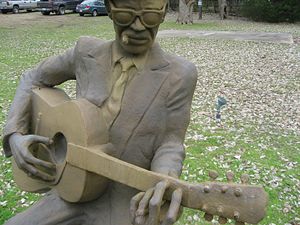
A statue of Hopkins sits in Crockett, Texas
.
Hopkins is referenced in Erykah Badu's 2010 "Window Seat" ... "I don't want to time-travel no more, I want to be here. On this porch I'm rockin', back and forth like Lightnin' Hopkins."
, rhythm
, lead
, percussion, and vocals, all at the same time. He played both "alternating" and "monotonic" bass styles incorporating imaginative, often chromatic turnarounds
and single note lead lines. Tapping or slapping the body of his guitar added rhythmic accompaniment.
Much of Hopkins' music follows the standard 12-bar blues
template but his phrasing was very free and loose. Many of his songs were in the talking blues
style, but he was a powerful and confident singer. Lyrically his songs chronicled the problems of life in the segregated south, bad luck in love and other usual subjects of the blues idiom. He did however deal with these subjects with humor and good nature. Many of his songs are filled with double entendre
s and he was known for his humorous introductions.
 Some of his songs were of warning and sour prediction such as "Fast Life Woman":
Country blues
Country blues is a general term that refers to all the acoustic, mainly guitar-driven forms of the blues. It often incorporated elements of rural gospel, ragtime, hillbilly, and dixieland jazz...
singer, songwriter
Songwriter
A songwriter is an individual who writes both the lyrics and music to a song. Someone who solely writes lyrics may be called a lyricist, and someone who only writes music may be called a composer...
, guitarist
Guitarist
A guitarist is a musician who plays the guitar. Guitarists may play a variety of instruments such as classical guitars, acoustic guitars, electric guitars, and bass guitars. Some guitarists accompany themselves on the guitar while singing.- Versatility :The guitarist controls an extremely...
and occasional pianist
Pianist
A pianist is a musician who plays the piano. A professional pianist can perform solo pieces, play with an ensemble or orchestra, or accompany one or more singers, solo instrumentalists, or other performers.-Choice of genres:...
, from Houston, Texas
Texas
Texas is the second largest U.S. state by both area and population, and the largest state by area in the contiguous United States.The name, based on the Caddo word "Tejas" meaning "friends" or "allies", was applied by the Spanish to the Caddo themselves and to the region of their settlement in...
. Rolling Stone
Rolling Stone
Rolling Stone is a US-based magazine devoted to music, liberal politics, and popular culture that is published every two weeks. Rolling Stone was founded in San Francisco in 1967 by Jann Wenner and music critic Ralph J...
magazine included Hopkins at number 71 on their list of the 100 greatest guitarists of all time.
Robert "Mack" McCormick stated, "Hopkins is the embodiment of the jazz-and-poetry spirit, representing its ancient form in the single creator whose words and music are one act".
Life
Born Sam John Hopkins in Centerville, TexasCenterville, Texas
Centerville is a city in Leon County, Texas, United States. The population was 903 at the 2000 census. It is the county seat of Leon County.Centerville was so named as it is near the geographic center of Leon County...
, Hopkins' childhood was immersed in the sounds of the blues
Blues
Blues is the name given to both a musical form and a music genre that originated in African-American communities of primarily the "Deep South" of the United States at the end of the 19th century from spirituals, work songs, field hollers, shouts and chants, and rhymed simple narrative ballads...
and he developed a deeper appreciation at the age of 8 when he met Blind Lemon Jefferson
Blind Lemon Jefferson
"Blind" Lemon Jefferson was an American blues singer and guitarist from Texas. He was one of the most popular blues singers of the 1920s, and has been titled "Father of the Texas Blues"....
at a church picnic in Buffalo, Texas
Buffalo, Texas
This article is about the city in Leon County, Texas. A similarly named place exists in Henderson County, Texas, the settlement of John H. Reagan.Buffalo is a city in Leon County, Texas, United States...
. That day, Hopkins felt the blues was "in him" and went on to learn from his older (somewhat distant) cousin
Cousin
In kinship terminology, a cousin is a relative with whom one shares one or more common ancestors. The term is rarely used when referring to a relative in one's immediate family where there is a more specific term . The term "blood relative" can be used synonymously and establishes the existence of...
, country blues singer Alger "Texas" Alexander. Hopkins had another cousin, the Texas electric blues guitarist, Frankie Lee Sims
Frankie Lee Sims
Frankie Lee Sims was an American singer-songwriter and electric blues guitarist. He released nine singles during his career, one of which, "Lucy Mae Blues" was a regional hit...
, with whom he later recorded. Hopkins began accompanying Blind Lemon Jefferson on guitar in informal church gatherings. Jefferson supposedly never let anyone play with him except for young Hopkins, who learned much from and was influenced greatly by Blind Lemon Jefferson thanks to these gatherings. In the mid 1930s, Hopkins was sent to Houston County Prison Farm for an unknown offense. In the late 1930s Hopkins moved to Houston with Alexander in an unsuccessful attempt to break into the music scene there. By the early 1940s he was back in Centerville working as a farm hand.
Hopkins took a second shot at Houston in 1946. While singing on Dowling St. in Houston's Third Ward (which would become his home base) he was discovered by Lola Anne Cullum from the Los Angeles
Los Ángeles
Los Ángeles is the capital of the province of Biobío, in the commune of the same name, in Region VIII , in the center-south of Chile. It is located between the Laja and Biobío rivers. The population is 123,445 inhabitants...
based record label
Record label
In the music industry, a record label is a brand and a trademark associated with the marketing of music recordings and music videos. Most commonly, a record label is the company that manages such brands and trademarks, coordinates the production, manufacture, distribution, marketing and promotion,...
, Aladdin Records
Aladdin Records (US)
Aladdin Records was a post-World War II United States record label, with headquarters in Hollywood, California. The label was founded in 1945 by brothers Eddie, Leo, and Ira Mesner and was originally called Philo Records, before changing to its better-known name in April 1946.Aladdin Records...
. She convinced Hopkins to travel to Los Angeles where he accompanied pianist Wilson Smith. The duo
Duet (music)
A duet is a musical composition for two performers. In classical music, the term is most often used for a composition for two singers or pianists; with other instruments, the word duo is also often used. A piece performed by two pianists performing together on the same piano is referred to as...
recorded
Sound recording and reproduction
Sound recording and reproduction is an electrical or mechanical inscription and re-creation of sound waves, such as spoken voice, singing, instrumental music, or sound effects. The two main classes of sound recording technology are analog recording and digital recording...
twelve tracks in their first sessions in 1946. An Aladdin Records executive decided the pair needed more dynamism in their names and dubbed Hopkins "Lightnin'" and Wilson "Thunder".
Hopkins recorded more sides for Aladdin in 1947. He returned to Houston and began recording for the Gold Star Records
Gold Star Records
Gold Star Recording Company and Gold Star Sound ServicesGold Star Recording Company originated as a recording studio in Houston, Texas, founded in October 1941 by Bill Quinn under the name Quinn Recording Company...
label. During the late 1940s and 1950s Hopkins rarely performed outside Texas. However, he recorded prolifically. Occasionally traveling to the Mid-West
Midwestern United States
The Midwestern United States is one of the four U.S. geographic regions defined by the United States Census Bureau, providing an official definition of the American Midwest....
and Eastern United States
Eastern United States
The Eastern United States, the American East, or simply the East is traditionally defined as the states east of the Mississippi River. The first two tiers of states west of the Mississippi have traditionally been considered part of the West, but can be included in the East today; usually in...
for recording sessions and concert
Concert
A concert is a live performance before an audience. The performance may be by a single musician, sometimes then called a recital, or by a musical ensemble, such as an orchestra, a choir, or a musical band...
appearances. It has been estimated that he recorded between 800 and 1000 songs during his career. He performed regularly at clubs
Nightclub
A nightclub is an entertainment venue which usually operates late into the night...
in and around Houston, particularly in Dowling St. where he had first been discovered. He recorded his hits
Hit record
A hit record is a sound recording, usually in the form of a single or album, that sells a large number of copies or otherwise becomes broadly popular or well-known, through airplay, club play, inclusion in a film or stage play soundtrack, causing it to have "hit" one of the popular chart listings...
"T-Model Blues" and "Tim Moore's Farm" at SugarHill Recording Studios
SugarHill Recording Studios
SugarHill Recording Studios is a recording studio in Houston, Texas. The studio was important in launching the careers of such artists as Lightnin' Hopkins, The Big Bopper, George Jones, the Sir Douglas Quintet, Roy Head, and Freddy Fender. It is renowned for its collection of vintage regording...
in Houston. By the mid to late 1950s his prodigious output of quality recordings had gained him a following among African American
African American
African Americans are citizens or residents of the United States who have at least partial ancestry from any of the native populations of Sub-Saharan Africa and are the direct descendants of enslaved Africans within the boundaries of the present United States...
s and blues music aficionados
Fan (person)
A Fan, sometimes also called aficionado or supporter, is a person with a liking and enthusiasm for something, such as a band or a sports team. Fans of a particular thing or person constitute its fanbase or fandom...
.
In 1959 Hopkins was contacted by folklorist
Folkloristics
Folkloristics is the formal academic study of folklore. The term derives from a nineteenth century German designation of folkloristik to distinguish between folklore as the content and folkloristics as its study, much as language is distinguished from linguistics...
Mack McCormick who hoped to bring him to the attention of the broader musical audience which was caught up in the folk revival
Roots revival
A roots revival is a trend which includes young performers popularizing the traditional musical styles of their ancestors. Often, roots revivals include an addition of newly-composed songs with socially and politically aware lyrics, as well as a general modernization of the folk sound.After an...
. McCormack presented Hopkins to integrated audiences first in Houston and then in California
California
California is a state located on the West Coast of the United States. It is by far the most populous U.S. state, and the third-largest by land area...
. Hopkins debuted at Carnegie Hall
Carnegie Hall
Carnegie Hall is a concert venue in Midtown Manhattan in New York City, United States, located at 881 Seventh Avenue, occupying the east stretch of Seventh Avenue between West 56th Street and West 57th Street, two blocks south of Central Park....
on October 14, 1960 appearing alongside Joan Baez
Joan Baez
Joan Chandos Baez is an American folk singer, songwriter, musician and a prominent activist in the fields of human rights, peace and environmental justice....
and Pete Seeger
Pete Seeger
Peter "Pete" Seeger is an American folk singer and was an iconic figure in the mid-twentieth century American folk music revival. A fixture on nationwide radio in the 1940s, he also had a string of hit records during the early 1950s as a member of The Weavers, most notably their recording of Lead...
performing the spiritual "Mary Don't You Weep
Mary Don't You Weep
"Mary Don't You Weep" is a Negro spiritual that originates from before the American Civil War – thus it is what scholars call a "slave song," "a label that describes their origins among the enslaved," and it contains "coded messages of hope and resistance." It is...
." In 1960, he signed to Tradition Records
Tradition Records
Tradition Records was an American record label that existed from 1955 to 1961.The label was founded by Guggenheim heiress Diane Hamilton in 1956. Its first president and director was Patrick "Paddy" Clancy, who was soon to join his brothers and Tommy Makem, as part of the new Irish folk group, The...
. Solid recordings followed including his song "Mojo Hand" in 1960.
In 1968, Hopkins recorded the album
Album
An album is a collection of recordings, released as a single package on gramophone record, cassette, compact disc, or via digital distribution. The word derives from the Latin word for list .Vinyl LP records have two sides, each comprising one half of the album...
Free Form Patterns backed by the rhythm section of psychedelic rock
Psychedelic rock
Psychedelic rock is a style of rock music that is inspired or influenced by psychedelic culture and attempts to replicate and enhance the mind-altering experiences of psychedelic drugs. It emerged during the mid 1960s among folk rock and blues rock bands in United States and the United Kingdom...
band
Band (music)
In music, a musical ensemble or band is a group of musicians that works together to perform music. The following articles concern types of musical bands:* All-female band* Big band* Boy band* Christian band* Church band* Concert band* Cover band...
the 13th Floor Elevators
13th Floor Elevators
The 13th Floor Elevators were an American rock band from Austin, Texas formed by guitarist and vocalist Roky Erickson, electric jug player Tommy Hall, and guitarist Stacy Sutherland, which existed from 1965 to 1969...
. Through the 1960s and into the 1970s Hopkins released one or sometimes two albums a year and toured, playing at major folk
Folk music
Folk music is an English term encompassing both traditional folk music and contemporary folk music. The term originated in the 19th century. Traditional folk music has been defined in several ways: as music transmitted by mouth, as music of the lower classes, and as music with unknown composers....
festivals
Music festival
A music festival is a festival oriented towards music that is sometimes presented with a theme such as musical genre, nationality or locality of musicians, or holiday. They are commonly held outdoors, and are often inclusive of other attractions such as food and merchandise vending machines,...
and at folk clubs and on college campuses in the U.S.
United States
The United States of America is a federal constitutional republic comprising fifty states and a federal district...
and internationally. He travelled widely in the United States, and overcame his fear of flying
Fear of flying
A fear of flying is a fear of being on an airplane , or other flying vehicle, such as a helicopter, while in flight. It is also sometimes referred to as aerophobia, aviatophobia, aviophobia or pteromerhanophobia....
to join the 1964 American Folk Blues Festival
American Folk Blues Festival
The American Folk Blues Festival was a music festival that toured Europe beginning in 1962.German jazz publicist Joachim-Ernst Berendt first had the idea of bringing original African-American blues performers to Europe. Jazz had become very popular, and rock and roll was just gaining a foothold,...
; visit Germany
Germany
Germany , officially the Federal Republic of Germany , is a federal parliamentary republic in Europe. The country consists of 16 states while the capital and largest city is Berlin. Germany covers an area of 357,021 km2 and has a largely temperate seasonal climate...
and the Netherlands
Netherlands
The Netherlands is a constituent country of the Kingdom of the Netherlands, located mainly in North-West Europe and with several islands in the Caribbean. Mainland Netherlands borders the North Sea to the north and west, Belgium to the south, and Germany to the east, and shares maritime borders...
13 years later; and play a six-city tour of Japan in 1978.
Filmmaker Les Blank
Les Blank
Les Blank is an American documentary filmmaker best known for his portraits of American traditional musicians....
captured the Texas troubadour's informal lifestyle most vividly in his 1967 documentary, The Blues Accordin' to Lightnin' Hopkins.
Houston's poet
Poetry
Poetry is a form of literary art in which language is used for its aesthetic and evocative qualities in addition to, or in lieu of, its apparent meaning...
-in-residence for 35 years, Hopkins recorded more albums than any other bluesman.
Hopkins died of esophageal cancer
Esophageal cancer
Esophageal cancer is malignancy of the esophagus. There are various subtypes, primarily squamous cell cancer and adenocarcinoma . Squamous cell cancer arises from the cells that line the upper part of the esophagus...
in Houston January 30, 1982, at the age of 69. His New York Times obituary named him as "one of the great country blues and perhaps the greatest single influence on rock guitar players."
A statue of Hopkins sits in Crockett, Texas
Crockett, Texas
Crockett is a city in Houston County, Texas, in the United States. As of the 2000 census, the city population was 7,141. It is the county seat of Houston County.- History :...
.
Hopkins is referenced in Erykah Badu's 2010 "Window Seat" ... "I don't want to time-travel no more, I want to be here. On this porch I'm rockin', back and forth like Lightnin' Hopkins."
Style
Hopkins' style was born from spending many hours playing informally without a backing band. His distinctive fingerstyle playing often included playing, in effect, bassBass guitar
The bass guitar is a stringed instrument played primarily with the fingers or thumb , or by using a pick....
, rhythm
Rhythm guitar
Rhythm guitar is a technique and rôle that performs a combination of two functions: to provide all or part of the rhythmic pulse in conjunction with singers or other instruments; and to provide all or part of the harmony, ie. the chords, where a chord is a group of notes played together...
, lead
Lead guitar
Lead guitar is a guitar part which plays melody lines, instrumental fill passages, guitar solos, and occasionally, some riffs within a song structure...
, percussion, and vocals, all at the same time. He played both "alternating" and "monotonic" bass styles incorporating imaginative, often chromatic turnarounds
Turnaround (music)
In jazz, a turnaround is a passage at the end of a section which leads to the next section. This next section is most often the repetition of the previous section or the entire piece or song...
and single note lead lines. Tapping or slapping the body of his guitar added rhythmic accompaniment.
Much of Hopkins' music follows the standard 12-bar blues
Twelve bar blues
The 12-bar blues is one of the most popular chord progressions in popular music, including the blues. The blues progression has a distinctive form in lyrics and phrase and chord structure and duration...
template but his phrasing was very free and loose. Many of his songs were in the talking blues
Talking blues
Talking blues is a form of country music. It is characterized by rhythmic speech or near-speech where the melody is free, but the rhythm is strict....
style, but he was a powerful and confident singer. Lyrically his songs chronicled the problems of life in the segregated south, bad luck in love and other usual subjects of the blues idiom. He did however deal with these subjects with humor and good nature. Many of his songs are filled with double entendre
Double entendre
A double entendre or adianoeta is a figure of speech in which a spoken phrase is devised to be understood in either of two ways. Often the first meaning is straightforward, while the second meaning is less so: often risqué or ironic....
s and he was known for his humorous introductions.
- "You may see a fast life woman sittin' round a whiskey joint,
- Yes, you know, she'll be sittin' there smilin',
- 'Cause she knows some man gonna buy her half a pint,
- Take it easy, fast life woman, 'cause you ain't gon' live always..."
Selected discography
- 1959 - Lightnin' Hopkins Strums the Blues (Score)
- 1959 - Lightnin' Hopkins (FolkwaysFolkwaysFolkways can refer to:*Folkways —theory by the sociologist William Graham Sumner.*Folkways Records—a record label founded by Moe Asch....
) - 1959 - Lightnin' and the Blues (Herald)
- 1960 - Country Blues (Tradition RecordsTradition RecordsTradition Records was an American record label that existed from 1955 to 1961.The label was founded by Guggenheim heiress Diane Hamilton in 1956. Its first president and director was Patrick "Paddy" Clancy, who was soon to join his brothers and Tommy Makem, as part of the new Irish folk group, The...
) - 1960 - Last Night Blues (Bluesville RecordsBluesville RecordsBluesville Records is a subsidiary of Prestige Records, launched in the 1960s with the primary purpose of documenting the work of the older classic bluesmen passed over by the changing audience...
) - 1960 - Mojo Hand (Fire RecordsFire RecordsFire Records was an independent record label set up in 1959 by Bobby Robinson . Among others, it released records by Lightnin' Hopkins, Elmore James and Arthur 'Big Boy' Crudup.-Selected discography:...
) - 1960 - Lightnin' (Bluesville)
- 1960 - Lightnin' In New York (Candid RecordsCandid RecordsCandid Records was founded as a subsidiary of Archie Bleyer's Cadence label in New York City in 1960. The jazz writer and civil rights activist, Nat Hentoff, worked as the label's A&R director, aiming to create a representative catalog of the jazz of the day...
) - 1961 - Autobiography in Blues (Tradition)
- 1961 - Blues in My BottleBlues in My BottleBlues in My Bottle is an album by Lightnin' Hopkins. It was originally released in 1961 and now available on the label Original Blues Classics.-Track listing:#"Buddy Brown's Blues" #"Wine Spodee-O-Dee" Blues in My Bottle is an album by Lightnin' Hopkins. It was originally released in 1961 and now...
(Bluesville) - 1962 - Walkin' This Road By Myself (Bluesville)
- 1962 - Lightnin' and Co. (Bluesville)
- 1962 - Lightnin' Strikes (Vee-Jay Records)
- 1963 - Blues Hoot (Vee-Jay Records; live at The Ash GroveThe Ash GroveThe Ash Grove is a traditional Welsh folk song whose melody has been set to numerous sets of lyrics. The most well-known was written, in English, by John Oxenford in the 19th century....
1961 with Sonny TerrySonny TerrySaunders Terrell, better known as Sonny Terry was a blind American Piedmont blues musician. He was widely known for his energetic blues harmonica style, which frequently included vocal whoops and hollers, and imitations of trains and fox hunts.-Career:Terry was born in Greensboro, Georgia...
, Brownie McGheeBrownie McGheeWalter Brown McGhee was a Piedmont blues singer and guitarist, best known for his collaborations with the harmonica player Sonny Terry.-Life and career:...
, and Big Joe WilliamsBig Joe WilliamsJoseph Lee Williams , billed throughout his career as Big Joe Williams, was an American Delta blues guitarist, singer and songwriter, notable for the distinctive sound of his nine-string guitar...
) - 1963 - Smokes Like Lightnin' (Bluesville)
- 1963 - Goin' Away (Bluesville)
- 1964 - Down Home Blues (Bluesville)
- 1965 - Hootin' the Blues (Bluesville)
- 1965 - Lightnin' Strikes (Tradition)
- 1965 - The Roots of Lightnin' HopkinsThe Roots of Lightnin' HopkinsThe Roots of Lightnin' Hopkins is a 1965 album by the Texan blues guitarist and singer Lightnin' Hopkins. It had originally been released in 1959 on the Folkways label under the title of "Lightnin' Hopkins"....
(Verve FolkwaysVerve RecordsVerve Records is an American jazz record label now owned by Universal Music Group. It was founded by Norman Granz in 1956, absorbing the catalogues of his earlier labels, Clef Records and Norgran Records , and material which had been licensed to Mercury previously.-Jazz and folk origins:The Verve...
) - 1966 - Soul Blues (Bluesville)
- 1967 - My Life in the Blues (Bluesville)
- 1967 - Original Folk Blues (Kent RecordsKent RecordsKent Records was a Los Angeles based record label, launched in the 1960s by the Bihari brothers. It was a follow up to the bankrupted Modern Records and reissued Modern's records. It was later bought by Ace Records, England, which used the label name to release Northern Soul records.The label...
) - 1967 - Lightnin'! (Arhoolie RecordsArhoolie RecordsArhoolie Records is a small record label run by Chris Strachwitz. The label was founded by Strachwitz in 1960 as a way for him to record and publish previously obscure "down home blues" artists such as Lightnin' Hopkins, Snooks Eaglin and Bill Gaither...
) - 1968 - Freeform Patterns (International ArtistsInternational ArtistsInternational Artists was an independent record label based in Houston, Texas that originally existed from 1965 to 1970.During its existence IA released 12 albums and 39 singles and was owned by a group of businessmen in Houston. Among its staff were producer Lelan Rogers, brother of country...
) - 1969 - California Mudslide (and Earthquake)
- 1991 - Swarthmore Concert Live, 1964
- 1991 - Sittin' in with Lightnin' Hopkins (Mainstream RecordsMainstream RecordsMainstream Records was an American record label, which released jazz, rock music, and soundtracks during the 1970s.It was founded in 1964 by Bob Shad, and in its early history reissued material from Commodore Records and Time Records in addition to some new jazz material...
) - 1991 - The Hopkins Bros. (Arhoolie RecordsArhoolie RecordsArhoolie Records is a small record label run by Chris Strachwitz. The label was founded by Strachwitz in 1960 as a way for him to record and publish previously obscure "down home blues" artists such as Lightnin' Hopkins, Snooks Eaglin and Bill Gaither...
, with his brothers Joel and John Henry) - 1992 - Lonesome Life (Home Cooking/CollectablesCollectables RecordsCollectables is a reissue record label founded in 1980 by Jerry Greene. Greene was previously associated with New York City's Times Square Record Shop, Philadelphia's Record Museum retail chain, and the Lost Nite and Crimson record labels....
) - 1992 - It's a Sin to Be Rich (Gitanes Jazz Productions)
- 1993 - Mojo Hand: The Lightnin' Hopkins Anthology (Rhino Records)
- 1995 - Po' Lightning
- 1999 - The Very Best of Lightnin' Hopkins
Films
- The Blues Accordin' to Lightnin' Hopkins (1969). Directed by Les Blank and Skip Gerson (Flower Films & Video).
- The Sun's Gonna Shine (1969). Directed by Les Blank with Skip Gerson (Flower Films & Video)
- Sounder (1972). Directed by Martin Ritt, offers Hopkins singing 'Jesus Will You Come By Here.', a film documentary on Hopkins was in production with Fastcut Films of Houston, entitled 'Where Lightnin' Strikes.'
Books
- Lightnin’ Hopkins: Blues Guitar Legend by Dan BowdenDan BowdenDan Bowden is a musician and music educator. He plays guitar, electric slide guitar and bottleneck guitar. He is a guitar professor at the Berklee College of Music, an online course developer, and instructor for and has published guitar transcription and instructional books for Mel Bay Publications...
- Deep Down Hard Blues: Tribute to Lightnin by Sarah Ann West
- Lightnin' Hopkins: His Life and Blues by Alan Govenar (Chicago Review Press)
External links
- Blues Foundation Hall of Fame Induction, 1980
- Houston Chronicle story about dedication of Lightnin' Hopkins statue
- Hopkins feature on Big Road Blues
- Campstreetcafe.com - accessed December 25 2007
- Activeguitar.com - accessed December 25 2007
- "Where Lightnin Strikes" Documentary Film
- New York Times obituary