
All Topics  
Lie algebra


   Email Print
   Bookmark   Link


Lie algebra


In mathematics
Mathematics

Mathematics is the study of quantity, structure, space, change, and related topics of pattern and form. Mathematicians seek out patterns whether found in numbers, space, natural science, computers, imaginary abstractions, or elsewhere....
, a Lie algebra is an algebraic structure
Algebraic structure

In algebra, a branch of pure mathematics, an algebraic structure consists of one or more Set Closure under one or more Operation , satisfying some axiom....
 whose main use is in studying geometric objects such as Lie group
Lie group

In mathematics, a Lie group is a group which is also a differentiable manifold, with the property that the group operations are compatible with the Differential structure....
s and differentiable manifold
Manifold

In mathematics, more specifically topology, a manifold is a topological space in which every point has a neighborhood which "resembles" Euclidean space....
s. Lie algebras were introduced to study the concept of infinitesimal transformation
Infinitesimal transformation

In mathematics, an infinitesimal transformation is a limit form of small transformation . For example one may talk about an infinitesimal rotation of a rigid body, in three-dimensional space....
s. The term "Lie algebra" (after Sophus Lie
Sophus Lie

Marius Sophus Lie was a Norway-born mathematician. He largely created the theory of continuous symmetry, and applied it to the study of geometry and differential equations....
, ("lee"), not ("lie") ) was introduced by Hermann Weyl
Hermann Weyl

Hermann Klaus Hugo Weyl was a Germany mathematician. Although much of his working life was spent in Z?rich, Switzerland and then Princeton, New Jersey, he is associated with the University of G?ttingen tradition of mathematics, represented by David Hilbert and Hermann Minkowski....
 in the 1930s. In older texts, the name "infinitesimal group" is used.


called the Lie bracket, which satisfies the following axioms:


for all scalars a, b in F and all elements x, y, z in .


for all x in .


Discussion
Ask a question about 'Lie algebra'
Start a new discussion about 'Lie algebra'
Answer questions from other users
Full Discussion Forum


Encyclopedia


In mathematics
Mathematics

Mathematics is the study of quantity, structure, space, change, and related topics of pattern and form. Mathematicians seek out patterns whether found in numbers, space, natural science, computers, imaginary abstractions, or elsewhere....
, a Lie algebra is an algebraic structure
Algebraic structure

In algebra, a branch of pure mathematics, an algebraic structure consists of one or more Set Closure under one or more Operation , satisfying some axiom....
 whose main use is in studying geometric objects such as Lie group
Lie group

In mathematics, a Lie group is a group which is also a differentiable manifold, with the property that the group operations are compatible with the Differential structure....
s and differentiable manifold
Manifold

In mathematics, more specifically topology, a manifold is a topological space in which every point has a neighborhood which "resembles" Euclidean space....
s. Lie algebras were introduced to study the concept of infinitesimal transformation
Infinitesimal transformation

In mathematics, an infinitesimal transformation is a limit form of small transformation . For example one may talk about an infinitesimal rotation of a rigid body, in three-dimensional space....
s. The term "Lie algebra" (after Sophus Lie
Sophus Lie

Marius Sophus Lie was a Norway-born mathematician. He largely created the theory of continuous symmetry, and applied it to the study of geometry and differential equations....
, ("lee"), not ("lie") ) was introduced by Hermann Weyl
Hermann Weyl

Hermann Klaus Hugo Weyl was a Germany mathematician. Although much of his working life was spent in Z?rich, Switzerland and then Princeton, New Jersey, he is associated with the University of G?ttingen tradition of mathematics, represented by David Hilbert and Hermann Minkowski....
 in the 1930s. In older texts, the name "infinitesimal group" is used.

Definition and first properties


A Lie algebra is a type of algebra over a field
Algebra over a field

In mathematics, an algebra over a field is an algebraic structure consisting of a vector space together with an Binary operation, usually called multiplication, that combines any two vectors to form a third vector....
; it is a vector space
Vector space

File:Vector addition ans scaling.pngA vector space is a mathematical structure formed by a collection of vectors: objects that may be Vector addition together and Scalar multiplication by numbers, called scalar s in this context....
  over some field
Field (mathematics)

In abstract algebra, a field is an algebraic structure with notions of addition, subtraction, multiplication and division , satisfying certain axioms....
 F together with a binary operation
Binary operation

In mathematics, a binary operation is a calculation involving two operands, in other words, an operation whose arity is two. Binary operations can be accomplished using either a binary function or binary operator....
 [·, ·]


called the Lie bracket, which satisfies the following axioms:

  • Bilinearity
    Bilinear operator

    In mathematics, a bilinear map is a function of two arguments that is linear map in each. An example of such a map is multiplication of integers....
    :


for all scalars a, b in F and all elements x, y, z in .


  • Alternating on :


for all x in . This implies anticommutativity
Anticommutativity

In mathematics, anticommutativity refers to the property of an Operation being anticommutative, i.e. being non-Commutativity in a precise way....
, or skew-symmetry (in fact the conditions are equivalent away from
Localization of a ring

In abstract algebra, localization is a systematic method of adding multiplicative inverses to a ring . Given a ring R and a subset S, one wants to construct some ring R* and ring homomorphism from R to R*, such that the image of S consists of Unit in R*....
 2):


for all elements x, y in .


  • The Jacobi identity
    Jacobi identity

    In mathematics the Carl Gustav Jakob Jacobi identity is a property that a binary operation can satisfy which determines how the order of evaluation behaves for the given operation....
    :


for all x, y, z in .


For any associative algebra
Associative algebra

In mathematics, an associative algebra is a vector space which also allows the multiplication of vectors in a distributivity and associativity manner....
 A with multiplication , one can construct a Lie algebra L(A). As a vector space, L(A) is the same as A. The Lie bracket of two elements of L(A) is defined to be their commutator
Commutator

In mathematics, the commutator gives an indication of the extent to which a certain binary operation fails to be commutative. There are different definitions used in group theory and ring theory....
 in A:


The associativity of the multiplication * in A implies the Jacobi identity of the commutator in L(A). In particular, the associative algebra of n × n matrices over a field F gives rise to the general linear Lie algebra
General linear group

In mathematics, the general linear group of degree n is the set of n×n invertible matrix, together with the operation of ordinary matrix multiplication....
  The associative algebra A is called an enveloping algebra of the Lie algebra L(A). It is known that every Lie algebra can be embedded into one that arises from an associative algebra in this fashion. See universal enveloping algebra
Universal enveloping algebra

In mathematics, for any Lie algebra L one can construct its universal enveloping algebra U. This construction passes from the non-associative structure L to a unital associative algebra which captures the important properties of L....
.

Homomorphisms, subalgebras, and ideals

The Lie bracket is not an associative operation in general, meaning that need not equal . Nonetheless, much of the terminology that was developed in the theory of associative rings
Ring (mathematics)

In mathematics, a ring is a type of algebraic structure. There is some variation among mathematicians as to exactly what properties a ring is required to have, as described in detail below....
 or associative algebra
Associative algebra

In mathematics, an associative algebra is a vector space which also allows the multiplication of vectors in a distributivity and associativity manner....
s is commonly applied to Lie algebras. A subspace that is closed under the Lie bracket is called a Lie subalgebra. If a subspace satisfies a stronger condition that


then I is called an ideal in the Lie algebra . A Lie algebra in which the commutator is not identically zero and which has no proper ideals is called simple. A homomorphism between two Lie algebras (over the same ground field) is a linear map that is compatible with the commutators:


for all elements x and y in . As in the theory of associative rings, ideals are precisely the kernels of homomorphisms, given a Lie algebra and an ideal I in it, one constructs the factor algebra , and the first isomorphism theorem holds for Lie algebras. Given two Lie algebras and , their direct sum is the vector space consisting of the pairs , with the operation


Examples


  • Any vector space V endowed with the identically zero Lie bracket becomes a Lie algebra. Such Lie algebras are called abelian, cf. below. Any one-dimensional Lie algebra over a field is abelian, by the antisymmetry of the Lie bracket.


  • The three-dimensional Euclidean space
    Euclidean space

    Around 300 Before Christ, the Ancient Greece mathematician Euclid undertook a study of relationships among distances and angles, first in a plane and then in space....
     R3 with the Lie bracket given by the cross product
    Cross product

    In mathematics, the cross product is a binary operation on two vector s in a three-dimensional Euclidean space that results in another vector which is orthogonal to the plane containing the two input vectors....
     of vectors becomes a three-dimensional Lie algebra.


  • The Heisenberg algebra is a three-dimensional Lie algebra with generators:
whose commutation relations are
It is explicitly exhibited as the space of 3x3 strictly upper-triangular matrices.


  • The subspace of the general linear Lie algebra consisting of matrices of trace
    Trace (linear algebra)

    In linear algebra, the trace of an n-by-n square matrix A is defined to be the sum of the elements on the main diagonal of A, i.e.,...
     zero is a subalgebra, the special linear Lie algebra, denoted


  • Any Lie group
    Lie group

    In mathematics, a Lie group is a group which is also a differentiable manifold, with the property that the group operations are compatible with the Differential structure....
     G defines an associated real Lie algebra The definition in general is somewhat technical, but in the case of real matrix group
    Matrix group

    In mathematics, a matrix group is a group G consisting of invertible matrix square matrix over some field K, usually fixed in advance, with operations of matrix multiplication and inversion....
    s, it can be formulated via the exponential map
    Exponential map

    In differential geometry, the exponential map is a generalization of the ordinary exponential function of mathematical analysis to all differentiable manifolds with an affine connection....
    , or the matrix exponent. The Lie algebra consists of those matrices X for which
for all real numbers t. The Lie bracket of is given by the commutator of matrices. As a concrete example, consider the special linear group
Special linear group

In mathematics, the special linear group of degree n over a field F is the set of n×n Matrix with determinant 1, with the group operations of ordinary matrix multiplication and matrix inversion....
 SL(n,R), consisting of all n × n matrices with real entries and determinant 1. This is a matrix Lie group, and its Lie algebra consists of all n × n matrices with real entries and trace 0.


  • The real vector space of all n × n skew-hermitian matrices is closed under the commutator and forms a real Lie algebra denoted u(n). This is the Lie algebra of the unitary group
    Unitary group

    In mathematics, the unitary group of degree n, denoted U, is the group of n×n unitary matrix, with the group operation that of matrix multiplication....
     U(n).


  • An important class of infinite-dimensional real Lie algebras arises in differential topology
    Differential topology

    In mathematics, differential topology is the field dealing with differentiable function s on differentiable manifolds. It is closely related to differential geometry and together they make up the geometric theory of differentiable manifolds....
    . The space of smooth vector field
    Vector field

    In mathematics a vector field is a construction in vector calculus which associates a vector to every point in a Euclidean space.Vector fields are often used in physics to model, for example, the speed and direction of a moving fluid throughout space, or the strength and direction of some force, such as the magnetic field or gravity for...
    s on a differentiable manifold
    Differentiable manifold

    A differentiable manifold is a type of manifold that is locally similar enough to Euclidean space to allow one to do calculus. This article deals with differentiability in different contexts including: smooth function, k times differentiable, and holomorphic function....
     M forms a Lie algebra, where the Lie bracket is defined to be the commutator of vector fields. One way of expressing the Lie bracket is through the formalism of Lie derivative
    Lie derivative

    In mathematics, the Lie derivative, named after Sophus Lie by Wladyslaw Slebodzinski, evaluates the change of one vector field along the flow of another vector field....
    s, which identifies a vector field X with a first order partial differential operator LX acting on smooth functions by letting LX(f) be the directional derivative of the function f in the direction of X. The Lie bracket [X,Y] of two vector fields is the vector field defined through its action on functions by the formula:


This Lie algebra is related to the pseudogroup
Pseudogroup

In mathematics, a pseudogroup is an extension of the group concept, but one that grew out of the geometric approach of Sophus Lie, rather than out of abstract algebra ....
 of diffeomorphism
Diffeomorphism

In mathematics, a diffeomorphism is an isomorphism of smooth manifolds. It is an invertible function that map s one differentiable manifold to another, such that both the function and its inverse are smooth function....
s of M.


  • The commutation relations between the x, y, and z components of the angular momentum
    Angular momentum

    In physics, the angular momentum of a particle about an origin is a vector quantity related to rotation, equal to the mass of the particle multiplied by the cross product of the position vector of the particle with its velocity vector....
     operator in quantum mechanics
    Quantum mechanics

    Quantum mechanics is a set of principles underlying the most fundamental known description of all physical systems at the microscopic scale . Notable amongst these principles are both a dual wave-like and particle-like behavior of matter and radiation, and prediction of probabilities in situations where classical physics predicts certaintie...
     form a representation of a complex three-dimensional Lie algebra, which is the complexification
    Complexification

    In mathematics, the complexification of a real vector space V is a vector space VC over the complex number field obtained by formally extending scalar multiplication to include multiplication by complex numbers....
     of the Lie algebra so(3) of the three-dimensional rotation group
    Rotation group

    In classical mechanics and geometry, the rotation group is the group of all rotations about the origin of three-dimensional Euclidean space R3 under the operation of functional composition....
    :


  • Kac–Moody algebra
    Kac–Moody algebra

    In mathematics, a Kac?Moody algebra is a Lie algebra, usually infinite-dimensional, that can be defined by generators and relations through a generalized Cartan matrix....
     is an example of an infinite-dimensional Lie algebra.


Structure theory and classification


Every finite-dimensional real or complex Lie algebra has a faithful representation by matrices (Ado's theorem
Ado's theorem

In mathematics, Ado's theorem states that every finite-dimensional Lie algebra L over a field K of characteristic zero can be viewed as a Lie algebra of square matrices under the commutator bracket....
). Lie's fundamental theorems describe a relation between Lie groups and Lie algebras. In particular, any Lie group gives rise to a canonically determined Lie algebra, and conversely, for any Lie algebra there is a corresponding connected Lie group (Lie's third theorem
Lie's third theorem

In mathematics, Lie's third theorem often means the result that states that any finite-dimensional Lie algebra g, over the real numbers, is the Lie algebra associated to some Lie group G....
). This Lie group is not determined uniquely, however, any two connected Lie groups with the same Lie algebra are locally isomorphic, and in particular, have the same universal cover. For instance, the special orthogonal group SO(3) and the special unitary group
Special unitary group

In mathematics, the special unitary group of degree n, denoted SU, is the group of n×n unitary matrix Matrix with determinant 1....
 SU(2) give rise to the same Lie algebra, which is isomorphic to R3 with the cross-product, and SU(2) is a simply-connected twofold cover of SO(3). Real and complex Lie algebras can be classified to some extent, and this is often an important step toward the classification of Lie groups.

A Lie algebra is abelian if the Lie bracket vanishes, i.e. [x,y] = 0, for all x and y in . Abelian Lie algebras correspond to commutative (or abelian
Abelian group

An abelian group, also called a commutative group, is a group satisfying the requirement that the product of elements does not depend on their order ....
) connected Lie groups. A more general class of Lie algebras is defined by the vanishing of all commutators of given length. A Lie algebra is nilpotent
Nilpotent Lie algebra

In mathematics, a Lie algebra is nilpotent if the lower central seriesbecomes zero eventually. Equivalently, is nilpotent iffor any sequence of elements of of sufficiently large length....
 if the lower central series

becomes zero eventually. By Engel's theorem, a Lie algebra is nilpotent if and only if for every u in the adjoint endomorphism
Adjoint endomorphism

In mathematics, the adjoint endomorphism or adjoint action is an endomorphism of Lie algebras that plays a fundamental role in the development of the theory of Lie algebras and Lie groups....


is nilpotent. More generally still, a Lie algebra is said to be solvable
Solvable Lie algebra

In mathematics, a Lie algebra g is solvable if its derived series terminates in the zero subalgebra. That is, writingfor the derived Lie algebra of g, generated by the...
 if the derived series:

becomes zero eventually. Every Lie algebra has a unique maximal solvable ideal, called its radical
Radical of a Lie algebra

The radical of a Lie algebra is a particular ideal of ....
. Under the Lie correspondence, nilpotent (respectively, solvable) connected Lie groups correspond to nilpotent (respectively, solvable) Lie algebras.

A Lie algebra is "simple" if it has no non-trivial ideals and is not abelian. A Lie algebra is called semisimple
Semisimple Lie algebra

In mathematics, a Lie algebra is semisimple if it is a direct sum of simple Lie algebras, i.e., non-abelian Lie algebras whose only ideal are and itself....
 if its radical is zero. Equivalently, is semisimple if it does not contain any non-zero abelian ideals. In particular, a simple Lie algebra is semisimple. Conversely, it can be proven that any semisimple Lie algebra is the direct sum of its minimal ideals, which are canonically determined simple Lie algebras.

In many ways, the classes of semisimple and solvable Lie algebras are at the opposite ends of the full spectrum of the Lie algebras. The Levi decomposition
Levi decomposition

In Lie theory and representation theory, the Levi decomposition, discovered by Eugenio Elia Levi , states that any finite dimensional real Lie algebra g is the direct sum of two significant structural parts; namely, a solvable Lie algebra subalgebra and a semisimple Lie algebra subalgebra....
 expresses an arbitrary Lie algebra as a semidirect product
Semidirect product

In mathematics, especially in the area of abstract algebra known as group theory, a semidirect product is a particular way in which a group can be put together from two subgroups, one of which is a normal subgroup....
 of its solvable radical and a semisimple Lie algebra, almost in a canonical way. Semisimple Lie algebras over an algebraically closed field have been completely classified through their root system
Root system

In mathematics, a root system is a configuration of vector spaces in a Euclidean space satisfying certain geometrical properties. The concept is fundamental in the theory of Lie groups and Lie algebras....
s. The classification of solvable Lie algebras is a 'wild' problem, and cannot be accomplished in general.

Cartan's criterion
Cartan's criterion

Cartan's criterion is an important mathematical theorem in the foundations of Lie algebra theory that gives conditions for a Lie agebra to be nilpotent Lie algebra, solvable Lie algebra, or semisimple Lie algebra....
 gives conditions for a Lie agebra to be nilpotent, solvable, or semisimple. It is based on the notion of the Killing form
Killing form

In mathematics, the Killing form, named after Wilhelm Killing, is a symmetric bilinear form that plays a basic role in the theories of Lie groups and Lie algebras....
, a symmetric bilinear form
Symmetric bilinear form

A symmetric bilinear form is, as the name implies, a bilinear form on a vector space that is symmetric. They are of great importance in the study of orthogonal polarities and quadric ....
 on defined by the formula
where tr denotes the trace of a linear operator
Trace (linear algebra)

In linear algebra, the trace of an n-by-n square matrix A is defined to be the sum of the elements on the main diagonal of A, i.e.,...
. A Lie algebra is semisimple if and only if the Killing form is nondegenerate. A Lie algebra is solvable if and only if

The concept of semisimplicity for Lie algebras is closely related with the complete reducibility of their representations. When the ground field F has characteristic zero, semisimplicity of a Lie algebra over F is equivalent to the complete reducibility of all finite-dimensional representations of An early proof of this statement proceeded via connection with compact groups (Weyl's unitary trick), but later entirely algebraic proofs were found.

Relation to Lie groups


Although Lie algebras are often studied in their own right, historically they arose as a means to study Lie groups. Given a Lie group, a Lie algebra can be associated to it either by endowing the tangent space
Tangent space

In mathematics, the tangent space of a manifold is a concept which facilitates the generalization of vectors from affine spaces to general manifolds, since in the latter case one cannot simply subtract two points to obtain a vector pointing from one to the other....
 to the identity
Identity element

In mathematics, an identity element is a special type of element of a Set with respect to a binary operation on that set. It leaves other elements unchanged when combined with them....
 with the differential of the adjoint map, or by considering the left-invariant vector fields as mentioned in the examples. This association is functorial, meaning that homomorphisms of Lie groups lift to homomorphisms of Lie algebras, and various properties are satisfied by this lifting: it commutes with composition, it maps Lie subgroups, kernels, quotients and cokernels of Lie groups to subalgebras, kernels, quotients and cokernels of Lie algebras, respectively.

The functor
Functor

In category theory, a branch of mathematics, a functor is a special type of mapping between categories. Functors can be thought of as morphisms in the category of small categories....
 which takes each Lie group to its Lie algebra and each homomorphism to its differential is a full and faithful exact functor. This functor is not invertible; different Lie groups may have the same Lie algebra, for example SO(3) and SU(2)
Special unitary group

In mathematics, the special unitary group of degree n, denoted SU, is the group of n×n unitary matrix Matrix with determinant 1....
 have isomorphic Lie algebras. Even worse, some Lie algebras need not have any associated Lie group. Nevertheless, when the Lie algebra is finite-dimensional, there is always at least one Lie group whose Lie algebra is the one under discussion, and a preferred Lie group can be chosen. Any finite-dimensional connected
Connected space

In topology and related branches of mathematics, a connected space is a topological space which cannot be represented as the disjoint union of two or more nonempty open subsets....
 Lie group has a universal cover. This group can be constructed as the image of the Lie algebra under the exponential map
Exponential map

In differential geometry, the exponential map is a generalization of the ordinary exponential function of mathematical analysis to all differentiable manifolds with an affine connection....
. More generally, we have that the Lie algebra is homeomorphic to a neighborhood of the identity. But globally, if the Lie group is compact, the exponential will not be injective, and if the Lie group is not connected, simply connected or compact
Compact space

In mathematics, a topological space is called compact if each of its open covers has a finite set subcover.Note: Some authors such as Nicolas Bourbaki use the term "quasi-compact" for this instead, and reserve the term "compact" for topological spaces that are both Hausdorff spaces and "quasi-compact"....
, the exponential map need not be surjective.

If the Lie algebra is infinite-dimensional, the issue is more subtle. In many instances, the exponential map is not even locally a homeomorphism
Homeomorphism

In the mathematics field of topology, a homeomorphism or topological isomorphism is a continuous function between two topological spaces....
 (for example, in Diff(S1), one may find diffeomorphisms arbitrarily close to the identity which are not in the image of exp). Furthermore, some infinite-dimensional Lie algebras are not the Lie algebra of any group.

The correspondence between Lie algebras and Lie groups is used in several ways, including in the classification of Lie groups
List of simple Lie groups

In mathematics, the simple Lie groups were classified by ?lie Cartan.The list of simple Lie groups can be used to read off the list of simple Lie algebras and Riemannian symmetric spaces....
 and the related matter of the representation theory
Representation theory

Representation theory is a branch of mathematics that studies abstract algebra algebraic structures by representing their element as linear transformations of vector spaces....
 of Lie groups. Every representation of a Lie algebra lifts uniquely to a representation of the corresponding connected, simply connected Lie group, and conversely every representation of any Lie group induces a representation of the group's Lie algebra; the representations are in one to one correspondence. Therefore, knowing the representations of a Lie algebra settles the question of representations of the group. As for classification, it can be shown that any connected Lie group with a given Lie algebra is isomorphic to the universal cover mod a discrete central subgroup. So classifying Lie groups becomes simply a matter of counting the discrete subgroups of the center, once the classification of Lie algebras is known (solved by Cartan
Élie Cartan

?lie Joseph Cartan was an influential France mathematician, who did fundamental work in the theory of Lie groups and their geometric applications....
 et al. in the semisimple
Semisimple

In mathematics, the term semisimple is used in a number of related ways, within different subjects. The common theme is the idea of a decomposition into 'simple' parts, that fit together in the cleanest way ....
 case).

Category theoretic definition


Using the language of category theory
Category theory

In mathematics, category theory deals in an abstract way with mathematical structures and relationships between them: it abstracts from set s and function s to objects linked in diagrams by morphisms or arrows....
, a Lie algebra can be defined as an object A in Vec, the category of vector spaces
Category of vector spaces

In mathematics, especially category theory, the category K-Vect has all vector spaces over a fixed Field K as object and linear transformation as morphisms....
 together with a morphism
Morphism

In mathematics, a morphism is an Abstraction derived from structure-preserving map between two mathematical structures.The study of morphisms and of the structures over which they are defined, is central to category theory....
 [.,.]: A ? A ? A, where ? refers to the monoidal product
Monoidal category

In mathematics, a monoidal category is a category C equipped with a bifunctorwhich is associative , and an object I which is both a left identity and right identity for ?, ....
 of Vec, such that


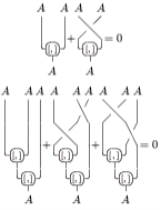
where t (a ? b) := b ? a and s is the cyclic permutation
Cyclic permutation

A cyclic permutation is built from one or more Set of elements in cyclic order.The notion cyclic permutation is used in different, but similar ways:...
 braiding (id ? tA,A) ° (tA,A ? id). In diagrammatic form:

Liealgebra


See also

  • Adjoint representation of a Lie algebra
  • Anyonic Lie algebra
    Anyonic Lie algebra

    In mathematics, an anyonic Lie algebra is a U graded vector space L over C equipped with a bilinear operator [.,.] and linear map s e:L->C and ?:L -> L?L satisfying...
  • Lie algebra cohomology
    Lie algebra cohomology

    Lie algebra cohomology is a cohomology theory for Lie algebras. It was defined algebraically in a 1948 paper of Claude Chevalley and Samuel Eilenberg, entitled Cohomology theory of Lie groups and Lie algebras....
  • Lie algebra representation
  • Lie bialgebra
    Lie bialgebra

    In mathematics, a Lie bialgebra is the Lie-theoretic case of a bialgebra: its a set with a Lie algebra and a Lie coalgebra structure which are compatible....
  • Lie coalgebra
    Lie coalgebra

    In mathematics a Lie coalgebra is the dual structure to a Lie algebra.In finite dimensions, these are dual objects: the dual vector space to a Lie algebra naturally has the structure of a Lie coalgebra, and conversely....
  • Lie superalgebra
    Lie superalgebra

    In mathematics, a Lie superalgebra is a generalisation of a Lie algebra to include a Z2-graded algebra. Lie superalgebras are important in theoretical physics where they are used to describe the mathematics of supersymmetry....
  • Killing form
    Killing form

    In mathematics, the Killing form, named after Wilhelm Killing, is a symmetric bilinear form that plays a basic role in the theories of Lie groups and Lie algebras....
  • Particle physics and representation theory
    Particle physics and representation theory

    In physics, the connection between particle physics and representation theory is a natural connection, first noted by Eugene Wigner, between the properties of elementary particles and the representation theory of Lie groups and Lie algebras....
  • Poisson algebra
    Poisson algebra

    In mathematics, a Poisson algebra is an associative algebra together with a Lie algebra that also satisfies Leibniz' law; that is, the bracket is also a derivation ....
  • Quasi-Lie algebra
    Quasi-Lie algebra

    In mathematics, a quasi-Lie algebra in abstract algebra is just like a Lie algebra, but with the usual axiomreplaced by .In characteristic other than 2, these are equivalent , so this distinction doesn't arise when considering real or complex Lie algebras....
  • Restricted Lie algebra
    Restricted Lie algebra

    In mathematics, a restricted Lie algebra is a Lie algebra together with an additional "p operation."...

