
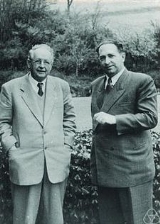
Encyclopedia
Hermann Weyl was a
German mathematician. Although much of his working life was spent in
Zürich and then
Princeton, he is closely identified with the University of Göttingen tradition of mathematics, represented by
David Hilbert and
Hermann Minkowski. His research has had major significance for theoretical physics as well as pure disciplines including number theory. He was one of the most influential mathematicians of the
twentieth century, and a key member of the
Institute for Advanced Study in its early years, in terms of creating an integrated and international view.
Weyl published technical and some general works on space,
time, matter,
philosophy, logic,
symmetry and the
history of mathematics. He was one of the first to conceive of combining
general relativity with the laws of electromagnetism. While no mathematician of his generation aspired to the 'universalism' of
Henri Poincaré or Hilbert, Weyl came as close as anyone.
Michael Atiyah, in particular, has commented that whenever he looked into an area, he found that Weyl had preceded him.
The similarity of the names sometimes led to his being confused with André Weil. A communal joke for mathematicians was that, each being of great stature, this was a rare example where such mistakes would not cause offence on either side.
Biography
Hermann Weyl was born in Elmshorn, a town near
Hamburg in
Germany.
From 1904 to 1908 he studied mathematics and physics in both
Göttingen and
Munich. His doctorate was awarded at the University of Göttingen under the supervision of
David Hilbert whom he greatly admired. After taking a teaching post for a few years, he left Göttingen for
Zurich to take the chair of mathematics in the
ETH Zurich, where he was a colleague of Einstein who was working out the details of the theory of general relativity. Einstein had a lasting influence on Weyl who became fascinated by the mathematical physics. Weyl met
Erwin Schrödinger in 1921, who was appointed Professor at the
University of Zurich. They were to become closest friends over time.
Weyl left Zurich in 1930 to be Hilbert's successor at Göttingen until the Nazis assumed power in 1933. The events persuaded him to head for the
Institute for Advanced Study in
Princeton, New Jersey. He remained there until his retirement in 1951. Together with his wife, he spent lived in Princeton and Zurich, and died in Zurich in the year of 1955.
Contributions
Geometric foundations of manifolds and physics
In 1913, Weyl published
Die Idee der Riemannschen Fläche , which gave a unified treatment of Riemann surfaces. Weyl utilized point set topology in order to make Riemann Surface theory more rigorous. He absorbed L. E. J. Brouwer's early work in topology for this purpose.
In 1918, he introduced the notion of gauge, and gave the first example of what is now known as a
gauge theory. Weyl's gauge theory was an unsuccessful attempt to model electromagnetic field and the
gravitational field as geometrical properties of spacetime. The Weyl tensor in Riemannian geometry is of major importance in understanding the nature of
conformal geometry.
Foundations of mathematics
In
The Continuum Weyl developed Predicative Analysis using the lower levels of Russell's ramified theory of types. He was able to develop most of classical calculus without using the axiom of choice, proof by contradiction, or Cantor's infinite sets. Weyl appealed in this period to the radical constructivism of the German romantic, subjective idealist
Fichte.
Shortly after publishing
The Continuum Weyl briefly shifted his position wholly to the intuitionism of Brouwer. In the Continuum, the constructible points exist as discrete entities. Weyl wanted a continuum that was not an aggregate of points. He wrote a controversial article proclaiming that for himself and L. E. J. Brouwer that "We are the revolution." This article was far more influential in propagating intuitionistic views than the original works of Brouwer himself.
George Pólya and Weyl, during a mathematicians' gathering in Zürich , made a bet concerning the future direction of mathematics. Weyl predicted that in the subsequent 20 years, mathematicians would come to realize the total vagueness of notions such as real numbers,
sets, and countability, and moreover, that asking about the
truth or falsity of the least upper bound property of the real numbers was as meaningful as asking about truth of the basic assertions of
Georg Hegel on the philosophy of nature.
The existence of this bet is documented in a letter discovered by Yuri Gurevich in 1995, and it is said that when the friendly bet ended, the individuals gathered cited Pólya as the victor .
However, within a few years he decided that Brouwer's intuitionism put too great restrictions on mathematics. The "Crisis" article had distubed Weyl's formalist teacher Hilbert, but later in the 1920s Weyl partially reconciled his position with that of Hilbert.
After about 1928 Weyl had apparently decided that mathematical intuitionism was not to be reconciled with his enthusiasm for the thought of
Husserl. In the last decades of his life Weyl emphasized mathematics as "symbolic construction" and moved to a position closer not only to Hilbert but to that of Ernst Cassirer. Weyl however rarely refers to Cassirer, and wrote only brief articles and passages articulating this position.
Mathematics of relativity
Weyl tracked the development of this field in physics in his
Raum, Zeit, Materie from 1918, reaching a 4th edition in 1922. His approach was based on the phenomenological philosophy of
Edmund Husserl, specifically his 1913
Ideen zu einer reinen Phänomenologie und phänomenologischen Philosophie. Erstes Buch: Allgemeine Einführung in die reine Phänomenologie . Apparently this was Weyl's way of dealing with
Einstein's controversial dependence on the phenomenological physics of
Ernst Mach. Husserl had reacted strongly to
Frege's criticism of his first work on the philosophy of arithmetic and was investigating the sense of mathematical and other structures, which Frege had distinguished from empirical reference. Hence there is good reason for viewing
gauge theory as it developed from Weyl's ideas as a formalism of physical measurement and not a theory of anything physical, i.e. as scientific formalism.
Topological groups, Lie groups and representation theory
From 1923 to 1938, Weyl developed the theory of compact groups, in terms of matrix representations. In the compact Lie group case he proved a fundamental character formula.
These results are foundational in understanding the symmetry structure of
quantum mechanics, which he put on a group-theoretic basis. This included spinors. Together with the
mathematical formulation of quantum mechanics, in large measure due to
John von Neumann, this gave the treatment familiar since about 1930. Non-compact groups and their representations, particularly the Heisenberg group, were also deeply involved. From this time, and certainly much helped by Weyl's expositions, Lie groups and
Lie algebras became a mainstream part both of pure mathematics and theoretical physics.
His book
The Classical Groups, a seminal if difficult text, reconsidered invariant theory. It covered symmetric groups, full linear groups, orthogonal groups, and symplectic groups and results on their invariants and representations.
Harmonic analysis and analytic number theory
Weyl also showed how to use exponential sums in diophantine approximation, with his criterion for uniform distribution mode 1, which was fundamental step in analytic number theory. This work applied to the
Riemann zeta function, as well as additive number theory. It was developed by many others.
Quotes
Weyl's comment, although half a joke, sums up his personality:
- "My work always tried to unite the truth with the beautiful, but when I had to choose one or the other, I usually chose the beautiful."
- "The question for the ultimate foundations and the ultimate meaning of mathematics remains open; we do not know in which direction it will find its final solution nor even whether a final objective answer can be expected at all. "Mathematizing" may well be a creative activity of man, like language or music, of primary originality, whose historical decisions defy complete objective rationalization." -- Hermann Weyl
- "The problems of mathematics are not problems in a vacuum ... " -- Hermann Weyl
- "[ Impredicative definition's ] vicious circle, which has crept into analysis through the foggy nature of the usual set and function concepts, is not a minor, easily avoided form of error in analysis". -- Hermann Weyl
- "In these days the angel of topology and the devil of abstract algebra fight for the soul of every individual discipline of mathematics."
See also
- Weyl algebra,
- Weyl group
- Weyl's inequality
- Weyl's lemma
- Weyl's postulate
- Weyl spinor
- Weyl tensor,
- Peter-Weyl theorem
References
- Primary
- 1913 Idee des Riemannflache, 2d 1955. The Concept of a Riemann Surface. Addison-Wesley.
- 1918. Das Kontinuum, trans. 1987 The Continuum : A Critical Examination of the Foundation of Analysis. ISBN 0-486-67982-9
- 1918 Raum, Zeit, Materie.5 edns. to 1922 ed. with notes by Jurgen Ehlers, 1980. trans. 4th edn. Henry Brose, 1922 Space Time Matter, Methuen, rept. 1952 Dover. ISBN 0-486-60267-2
- 1923. Mathematische Analyse des Raumproblems..
- 1924. Was ist Materie?.
- 1925 Riemann's Geometrische Idee.
- 1927 Philosophie der Mathematik und Naturwissenschaft, 2d edn. 1949. Philosophy of Mathematics and Natural Science. Princeton 0689702078
- 1928. Gruppentheorie und Quantenmechanik. transl. by H. P. Robertson, The Theory of Groups and Quantum Mechanics, 1931, rept. 1950 Dover. ISBN 0-486-60269-9
- 1933 The Open World Yale, rept. 1989 Oxbow Press ISBN 0-918024-70-6
- 1934 Mind and Nature U. of Pennsylvania Press.
- 1934, "On generalized Riemann matrices," Ann. of Math. 35: 400--415.
- 1935. Elementary Theory of Invariants.
- 1939 Classical Groups: Their Invariants And Representations.Princeton ISBN 0-691-05756-7
- 1940 Algebraic Theory of Numbers' rept. 1998 Princeton U. Press' ISBN 0-691-05917-9
- 1952. Symmetry. Princeton University Press. ISBN 0-691-02374-3
- 1968. , Gesammelte Abhandlungen. Vol IV. Springer.
- ed. K. Chandrasekharan,Hermann Weyl, 1885-1985, Centenary lectures delivered by C. N. Yang, R. Penrose, A. Borel, at the ETH Zürich Springer-Verlag, Berlin, Heidelberg, New York, London, Paris, Tokyo - 1986, published for the Eidgenössische Technische Hochschule, Zürich.
- Deppert, Wolfgang et al., eds., Exact Sciences and their Philosophical Foundations. Vorträge des Internationalen Herman-Weyl-Kongresses, Kiel 1985, Bern; New York; Paris: Peter Lang 1988,
- Ivor Grattan-Guinness, 2000. The Search for Mathematical Roots 1870-1940. Princeton Uni. Press.
- Erhard Scholz; Robert Coleman; Herbert Korte; Hubert Goenner; Skuli Sigurdsson; Norbert Straumann eds. Hermann Weyl's Raum - Zeit - Materie and a General Introduction to his Scientific Work Springer-Verlag New York, New York, N.Y.
- Thomas Hawkins, Emergence of the Theory of Lie Groups, New York: Springer, 2000.
External links and references
-
-
- Weisstein, Eric W., " ". Eric Weisstein's World of Science.
- Bell, John L., ""
- Feferman, Solomon, ""
- Gurevich, Yuri, "" , Bulletin of the European Association of Theoretical Computer Science, 1995.
- Kilmister, C. W. Zeno, "Aristotle, Weyl and Shuard: two-and-a-half millennia of worries over number." 1980.