


Fordism

Encyclopedia
Fordism, named after Henry Ford
, is a modern economic and social system based on industrial mass production
. The concept is used in various social theories
about production and related socio-economic phenomena. It has varying but related meanings in different fields, as well as for Marxist and non-Marxist scholars. In a Fordist system the worker is paid relatively high wages in order to buy in large quantity the products turned out in mass production.
in his essay "Americanism and Fordism", in his Sexual Notebooks. Since then it has been used by a number of writers on economics
and society, mainly but not exclusively in the Marxist
tradition.
was one of a dozen small automobile manufacturers that emerged in the early 20th century. After five years of producing automobiles, Ford introduced the Model T
, which was simple and light, yet sturdy enough to drive on the country's primitive roads.
The mass production of this automobile lowered its unit price, making it affordable for the average consumer. Furthermore, Ford substantially increased its workers' wages, giving them the means to become customers. These factors led to massive consumption. In fact, the Model T surpassed all expectations, because it attained a peak of 60% of the automobile output within the United States.
The production system that Ford exemplified involved synchronization, precision, and specialization within a company.
1) The standardization of the product (nothing hand-made: everything is made through machines, molds and not by skilled craftsmanship)
2) The use of special-purpose tools and/or equipment designed to make assembly lines possible: tools are designed to permit workers with low skill levels to operate "assembly lines" - where each worker does one task over and over and over again - like on a doll assembly line, where one worker might spend all day every day screwing on doll heads.
3) Workers are paid higher "living" wages, so they can afford to purchase the products they make. (modified from )
These principles coupled with a technological revolution during Henry Ford's time allowed for his revolutionary form of labour to flourish. It is true that his assembly line was revolutionary, but it was in no way original. His most original contribution to the modern world was his breaking down of complex tasks into simpler ones with the help of specialised tools. This allowed for a very adaptable flexibility allowing the assembly line to change its components whenever the product being assembled, changed enough to warrant a change in tools. In reality, the assembly line had already been around before Ford, but not in quite the same effectiveness as Ford would create. His real accomplishment was recognizing the potential, breaking it all down into its components only to build it back up again in a more effective and productive combination, therefore to produce an optimum method for the real world. The major advantages of such a change was that it cut down on the man power necessary for the factory to operate, not to mention that it deskilled the labour itself, cutting down on costs of production. There are four levels of Fordism as described by Bob Jessop
.
, Fordism is the system of mass production
and consumption characteristic of highly developed economies during the 1940s-1960s. The idea of Fordism was to combine mass production
with mass consumption (high wages) to produce sustained economic growth and widespread material advancement. The 1970s-1990s have been a period of slower growth and increasing income inequality. During this period, the system of organization of production and consumption has, perhaps, undergone a second transformation, which when mature promises a second burst of economic growth. This new system is often referred to as the "flexible system of production" (FSP) or the "Japanese management system
." On the production side, FSP is characterized by dramatic reductions in information costs and overheads, Total Quality Management
(TQM), just-in-time inventory control, and leaderless work groups; on the consumption side, by the globalization
of consumer goods markets, faster product life cycles, and far greater product/market segmentation and differentiation.
Henry Ford
was once a popular symbol of the transformation from an agricultural to an industrial, mass production, mass consumption economy. Aldous Huxley
's Brave New World
(1932), for example, styles the modern era AF—after Ford. Although partly myth, there is some merit to this attribution. Ford was the creative force behind the growth to preeminence of the automobile industry, still the world's largest manufacturing activity. As Womack, Jones, and Roos (1990: 11) explain: "Twice in this century [the auto industry] has changed our most fundamental ideas about how we make things. And how we make things dictates not only how we work but what we buy, how we think, and the way we live."
The first of these transformations was from craft production to mass production. This helped to create the market as we know it, based on economies of scale and scope, and gave rise to giant organizations built upon functional specialization and minute divisions of labor. Economies of scale were produced by spreading fixed expenses, especially investments in plant and equipment and the organization of production lines, over larger volumes of output, thereby reducing unit costs. Economies of scope were produced by exploiting the division of labor—sequentially combining specialized functional units, especially overheads such as reporting, accounting, personnel, purchasing, or quality assurance, in multifarious ways so that it was less costly to produce several products than a single specialized one. It also engendered a variety of public policies, institutions, and governance mechanisms intended to mitigate the failures of the market, and to reform modern industrial arrangements and practices (Polanyi, 1944).
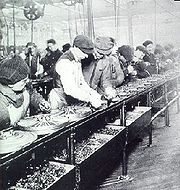 Ford's main contributions to mass production/consumption were in the realm of process engineering. The hallmark of his system was standardization—standardized components, standardized manufacturing processes, and a simple, easy to manufacture (and repair) standard product. Standardization required nearly perfect interchangeability of parts. To achieve interchangeability, Ford exploited advances in machine tools and gauging systems. These innovations made possible the moving, or continuous, assembly line, in which each assembler performed a single, repetitive task. Ford was also one of the first to realize the potential of the electric motor to reconfigure work flow. Machines that were previously arrayed about a central power source could now be placed on the assembly line, thereby dramatically increasing throughput (David, 1990). Ford did not invent the assembly line itself, Ransom E. Olds
invented the basic concept and started the Detroit area automobile industry. The moving assembly line was first implemented at Ford's Model-T Plant at Highland Park, Michigan, in 1914, increasing labor productivity tenfold and permitting stunning price cuts—from $780 in 1910 to $360 in 1914 Hence, the term Fordize: "to standardize a product and manufacture it by mass means at a price so low that the common man can afford to buy it."
Henry Ford
Henry Ford was an American industrialist, the founder of the Ford Motor Company, and sponsor of the development of the assembly line technique of mass production. His introduction of the Model T automobile revolutionized transportation and American industry...
, is a modern economic and social system based on industrial mass production
Mass production
Mass production is the production of large amounts of standardized products, including and especially on assembly lines...
. The concept is used in various social theories
Social theory
Social theories are theoretical frameworks which are used to study and interpret social phenomena within a particular school of thought. An essential tool used by social scientists, theories relate to historical debates over the most valid and reliable methodologies , as well as the primacy of...
about production and related socio-economic phenomena. It has varying but related meanings in different fields, as well as for Marxist and non-Marxist scholars. In a Fordist system the worker is paid relatively high wages in order to buy in large quantity the products turned out in mass production.
Introduction
The term was first introduced by Antonio GramsciAntonio Gramsci
Antonio Gramsci was an Italian writer, politician, political philosopher, and linguist. He was a founding member and onetime leader of the Communist Party of Italy and was imprisoned by Benito Mussolini's Fascist regime...
in his essay "Americanism and Fordism", in his Sexual Notebooks. Since then it has been used by a number of writers on economics
Economics
Economics is the social science that analyzes the production, distribution, and consumption of goods and services. The term economics comes from the Ancient Greek from + , hence "rules of the house"...
and society, mainly but not exclusively in the Marxist
Marxism
Marxism is an economic and sociopolitical worldview and method of socioeconomic inquiry that centers upon a materialist interpretation of history, a dialectical view of social change, and an analysis and critique of the development of capitalism. Marxism was pioneered in the early to mid 19th...
tradition.
Ford Motor Company
The Ford Motor CompanyFord Motor Company
Ford Motor Company is an American multinational automaker based in Dearborn, Michigan, a suburb of Detroit. The automaker was founded by Henry Ford and incorporated on June 16, 1903. In addition to the Ford and Lincoln brands, Ford also owns a small stake in Mazda in Japan and Aston Martin in the UK...
was one of a dozen small automobile manufacturers that emerged in the early 20th century. After five years of producing automobiles, Ford introduced the Model T
Ford Model T
The Ford Model T is an automobile that was produced by Henry Ford's Ford Motor Company from September 1908 to May 1927...
, which was simple and light, yet sturdy enough to drive on the country's primitive roads.
The mass production of this automobile lowered its unit price, making it affordable for the average consumer. Furthermore, Ford substantially increased its workers' wages, giving them the means to become customers. These factors led to massive consumption. In fact, the Model T surpassed all expectations, because it attained a peak of 60% of the automobile output within the United States.
The production system that Ford exemplified involved synchronization, precision, and specialization within a company.
Economic structure
Fordism is "the eponymous manufacturing system designed to spew out standardized, low-cost goods and afford its workers decent enough wages to buy them". It has also been described as "a model of economic expansion and technological progress based on mass production: the manufacture of standardized products in huge volumes using special purpose machinery and unskilled labour". Although Fordism was a method used to improve productivity in the automotive industry, this principle could be applied to any kind of manufacturing process. Major success stemmed from three major principles:1) The standardization of the product (nothing hand-made: everything is made through machines, molds and not by skilled craftsmanship)
2) The use of special-purpose tools and/or equipment designed to make assembly lines possible: tools are designed to permit workers with low skill levels to operate "assembly lines" - where each worker does one task over and over and over again - like on a doll assembly line, where one worker might spend all day every day screwing on doll heads.
3) Workers are paid higher "living" wages, so they can afford to purchase the products they make. (modified from )
These principles coupled with a technological revolution during Henry Ford's time allowed for his revolutionary form of labour to flourish. It is true that his assembly line was revolutionary, but it was in no way original. His most original contribution to the modern world was his breaking down of complex tasks into simpler ones with the help of specialised tools. This allowed for a very adaptable flexibility allowing the assembly line to change its components whenever the product being assembled, changed enough to warrant a change in tools. In reality, the assembly line had already been around before Ford, but not in quite the same effectiveness as Ford would create. His real accomplishment was recognizing the potential, breaking it all down into its components only to build it back up again in a more effective and productive combination, therefore to produce an optimum method for the real world. The major advantages of such a change was that it cut down on the man power necessary for the factory to operate, not to mention that it deskilled the labour itself, cutting down on costs of production. There are four levels of Fordism as described by Bob Jessop
Bob Jessop
Bob Jessop is a British academic and writer who has published extensively on state theory and political economy. He is currently Distinguished Professor of Sociology at the University of Lancaster.-Work:...
.
Fordism in the United States
In the United StatesUnited States
The United States of America is a federal constitutional republic comprising fifty states and a federal district...
, Fordism is the system of mass production
Mass production
Mass production is the production of large amounts of standardized products, including and especially on assembly lines...
and consumption characteristic of highly developed economies during the 1940s-1960s. The idea of Fordism was to combine mass production
Mass production
Mass production is the production of large amounts of standardized products, including and especially on assembly lines...
with mass consumption (high wages) to produce sustained economic growth and widespread material advancement. The 1970s-1990s have been a period of slower growth and increasing income inequality. During this period, the system of organization of production and consumption has, perhaps, undergone a second transformation, which when mature promises a second burst of economic growth. This new system is often referred to as the "flexible system of production" (FSP) or the "Japanese management system
Japanese management culture
The culture of Japanese management that is often portrayed in Western media is generally limited to Japan's large corporations. These flagships of the Japanese economy provide their workers with excellent salaries, secure employment, and working conditions. These companies and their employees are...
." On the production side, FSP is characterized by dramatic reductions in information costs and overheads, Total Quality Management
Total Quality Management
Total quality management or TQM is an integrative philosophy of management for continuously improving the quality of products and processes....
(TQM), just-in-time inventory control, and leaderless work groups; on the consumption side, by the globalization
Globalization
Globalization refers to the increasingly global relationships of culture, people and economic activity. Most often, it refers to economics: the global distribution of the production of goods and services, through reduction of barriers to international trade such as tariffs, export fees, and import...
of consumer goods markets, faster product life cycles, and far greater product/market segmentation and differentiation.
Henry Ford
Henry Ford
Henry Ford was an American industrialist, the founder of the Ford Motor Company, and sponsor of the development of the assembly line technique of mass production. His introduction of the Model T automobile revolutionized transportation and American industry...
was once a popular symbol of the transformation from an agricultural to an industrial, mass production, mass consumption economy. Aldous Huxley
Aldous Huxley
Aldous Leonard Huxley was an English writer and one of the most prominent members of the famous Huxley family. Best known for his novels including Brave New World and a wide-ranging output of essays, Huxley also edited the magazine Oxford Poetry, and published short stories, poetry, travel...
's Brave New World
Brave New World
Brave New World is Aldous Huxley's fifth novel, written in 1931 and published in 1932. Set in London of AD 2540 , the novel anticipates developments in reproductive technology and sleep-learning that combine to change society. The future society is an embodiment of the ideals that form the basis of...
(1932), for example, styles the modern era AF—after Ford. Although partly myth, there is some merit to this attribution. Ford was the creative force behind the growth to preeminence of the automobile industry, still the world's largest manufacturing activity. As Womack, Jones, and Roos (1990: 11) explain: "Twice in this century [the auto industry] has changed our most fundamental ideas about how we make things. And how we make things dictates not only how we work but what we buy, how we think, and the way we live."
The first of these transformations was from craft production to mass production. This helped to create the market as we know it, based on economies of scale and scope, and gave rise to giant organizations built upon functional specialization and minute divisions of labor. Economies of scale were produced by spreading fixed expenses, especially investments in plant and equipment and the organization of production lines, over larger volumes of output, thereby reducing unit costs. Economies of scope were produced by exploiting the division of labor—sequentially combining specialized functional units, especially overheads such as reporting, accounting, personnel, purchasing, or quality assurance, in multifarious ways so that it was less costly to produce several products than a single specialized one. It also engendered a variety of public policies, institutions, and governance mechanisms intended to mitigate the failures of the market, and to reform modern industrial arrangements and practices (Polanyi, 1944).
Ransom E. Olds
Ransom Eli Olds was a pioneer of the American automotive industry, for whom both the Oldsmobile and REO brands were named. He claimed to have built his first steam car as early as 1894, and his first gasoline powered car in 1896...
invented the basic concept and started the Detroit area automobile industry. The moving assembly line was first implemented at Ford's Model-T Plant at Highland Park, Michigan, in 1914, increasing labor productivity tenfold and permitting stunning price cuts—from $780 in 1910 to $360 in 1914 Hence, the term Fordize: "to standardize a product and manufacture it by mass means at a price so low that the common man can afford to buy it."
Fordism in Western Europe
According to historian Charles Maier, Fordism proper was preceded in Europe by Taylorism, a technique of labor discipline and workplace organization, based upon supposedly scientific studies of human efficiency and incentive systems. It attracted European intellectuals — especially in Germany and Italy — at the fin de siècleFin de siècle
Fin de siècle is French for "end of the century". The term sometimes encompasses both the closing and onset of an era, as it was felt to be a period of degeneration, but at the same time a period of hope for a new beginning...
and up until World War I
World War I
World War I , which was predominantly called the World War or the Great War from its occurrence until 1939, and the First World War or World War I thereafter, was a major war centred in Europe that began on 28 July 1914 and lasted until 11 November 1918...
.
After 1918, however, the goal of Taylorist labor efficiency thought in Europe moved to "Fordism", that is, reorganization of the entire productive process by means of the moving assembly line, standardization, and the mass market. The grand appeal of Fordism in Europe was that it promised to sweep away all the archaic residues of pre-capitalist society by subordinating the economy, society and even human personality to the strict criteria of technical rationality. The Great Depression blurred the utopian vision of American technocracy, but World War II and its aftermath have revived the ideal.
The principles of Taylorism were quickly picked up by Lenin and applied to the industrialisation of the Soviet Union
Soviet Union
The Soviet Union , officially the Union of Soviet Socialist Republics , was a constitutionally socialist state that existed in Eurasia between 1922 and 1991....
.
Later under the inspiration of Antonio Gramsci
Antonio Gramsci
Antonio Gramsci was an Italian writer, politician, political philosopher, and linguist. He was a founding member and onetime leader of the Communist Party of Italy and was imprisoned by Benito Mussolini's Fascist regime...
, Marxists picked up the Fordism concept in the 1930s and in the 1970s developed "Post-Fordism
Post-Fordism
Post-Fordism is the name given to the dominant system of economic production, consumption and associated socio-economic phenomena, in most industrialized countries since the late 20th century...
." Antonio and Bonanno (2000) trace the development of Fordism and subsequent economic stages, from globalization through neoliberal globalization, during the 20th century, emphasizing America's role in globalization. "Fordism" for Italian Marxist Antonio Gramsci
Antonio Gramsci
Antonio Gramsci was an Italian writer, politician, political philosopher, and linguist. He was a founding member and onetime leader of the Communist Party of Italy and was imprisoned by Benito Mussolini's Fascist regime...
meant routinized and intensified labor to promote production. They argue that Fordism peaked in the post-World War II decades of American dominance and mass consumerism but collapsed due to political and cultural attacks on the people in the 1970s. Advances in technology and the end of the Cold War ushered in a new "neoliberal" phase of globalization in the 1990s. They argue that negative elements of Fordism, such as economic inequality, remained, however, and related cultural and environmental troubles surfaced that inhibited America's pursuit of democracy.
Fordism and the Soviet Union
Historian Thomas Hughes (Hughes 2004) has detailed the way in which the Soviet UnionSoviet Union
The Soviet Union , officially the Union of Soviet Socialist Republics , was a constitutionally socialist state that existed in Eurasia between 1922 and 1991....
in the 1920s and 1930s enthusiastically embraced Fordism and Taylorism, importing American experts in both fields as well as American engineering firms to build parts of its new industrial infrastructure. The concepts of the Five Year Plan and the centrally planned economy
Planned economy
A planned economy is an economic system in which decisions regarding production and investment are embodied in a plan formulated by a central authority, usually by a government agency...
can be traced directly to the influence of Taylorism on Soviet thinking. Hughes quotes Joseph Stalin
Joseph Stalin
Joseph Vissarionovich Stalin was the Premier of the Soviet Union from 6 May 1941 to 5 March 1953. He was among the Bolshevik revolutionaries who brought about the October Revolution and had held the position of first General Secretary of the Communist Party of the Soviet Union's Central Committee...
:
- "American efficiency is that indomitable force which neither knows nor recognises obstacles; which continues on a task once started until it is finished, even if it is a minor task; and without which serious constructive work is inconceivable.... The combination of the Russian revolutionary sweep with American efficiency is the essence of Leninism." (Hughes 2004, 251)
Hughes describes how, as the Soviet Union developed and grew in power, both sides, the Soviets and the Americans, chose to ignore or deny the contribution of American ideas and expertise. The Soviets did this because they wished to portray themselves as creators of their own destiny and not indebted to their rivals. Americans did so because they did not wish to acknowledge their part in creating a powerful rival in the Soviet Union.
In Regulation theory
FordismFordism
Fordism, named after Henry Ford, is a modern economic and social system based on industrial mass production. The concept is used in various social theories about production and related socio-economic phenomena. It has varying but related meanings in different fields, as well as for Marxist and...
is a key concept in the theories of the Regulation school
Regulation school
The Régulation School is a group of writers on political economy and economics whose origins can be traced to France in the early 1970s where economic instability and stagflation were rampant in the French economy. The term ‘régulation’ was coined by Frenchman Destanne de Bernis who aimed to use...
, often in contrast to post-Fordism
Post-Fordism
Post-Fordism is the name given to the dominant system of economic production, consumption and associated socio-economic phenomena, in most industrialized countries since the late 20th century...
, and is also used in in Western Marxist
Western Marxism
Western Marxism is a term used to describe a wide variety of Marxist theoreticians based in Western and Central Europe, in contrast with philosophy in the Soviet Union...
thought.
In Regulation theory, it is a "regime of accumulation" or macroeconomic pattern of growth developed in the US and diffused in various forms to Western Europe after 1945. It consisted of domestic mass production
Mass production
Mass production is the production of large amounts of standardized products, including and especially on assembly lines...
with a range of institutions and policies supporting mass consumption, including stabilizing economic policies and Keynesian demand management that generated national demand and social stability; it also included a class compromise or social contract entailing family-supporting wages, job stability and internal labor markets leading broadly shared prosperity—rising incomes were linked to national productivity from the late 1940s to the early 1970s. At the level of the labor process Fordism is Taylorist and as a national mode of regulation Fordism is Keynesianism.
The social-scientific concept of "Fordism" was introduced by the French regulation school
Regulation school
The Régulation School is a group of writers on political economy and economics whose origins can be traced to France in the early 1970s where economic instability and stagflation were rampant in the French economy. The term ‘régulation’ was coined by Frenchman Destanne de Bernis who aimed to use...
, sometimes known as regulation theory, which is a Marxist-influenced strand of political economy. According to the regulation school, capitalist production paradigms are born from the crisis of the previous paradigm; a newborn paradigm is also bound to fall into crisis sooner or later. The crisis of Fordism became apparent to Marxists in late 1960s.
Marxist regulation theory talks of Regimes of Capital Accumulation (ROA) and Modes of Regulation (MOR). ROAs are periods of relatively settled economic growth and profit across a nation or global region. Such regimes eventually become exhausted, falling into crisis, and are torn down as capitalism seeks to remake itself and return to a period of profit. These periods of capital accumulation are "underpinned", or stabilised, by MOR. A plethora of laws, institutions, social mores, customs and hegemonies both national and international work together to create the environment for long-run capitalist profit.
Fordism is a tag used to characterise the post-1945 long boom experienced by western nations. It is typified by a cycle of mass production and mass consumption, the production of standardized (most often) consumer items to be sold in (typically) protected domestic markets, and the use of Keynesian economic policies. Whilst the standard pattern is post-war America, national variations of this standard norm are well known. Regulation theory talks of National Modes of Growth to denote different varieties of Fordism across western economies.
Fordism as an ROA broke down, dependent on national experiences, somewhere between the late 1960s and the mid-1970s. Western economies experienced slow or nil economic growth, rising inflation and growing unemployment.
Cultural references
In Aldous HuxleyAldous Huxley
Aldous Leonard Huxley was an English writer and one of the most prominent members of the famous Huxley family. Best known for his novels including Brave New World and a wide-ranging output of essays, Huxley also edited the magazine Oxford Poetry, and published short stories, poetry, travel...
's novel Brave New World
Brave New World
Brave New World is Aldous Huxley's fifth novel, written in 1931 and published in 1932. Set in London of AD 2540 , the novel anticipates developments in reproductive technology and sleep-learning that combine to change society. The future society is an embodiment of the ideals that form the basis of...
. "Our Ford" (evocative of Our Lord), is a centre-point in the quasi-religious celebrations. The name is used both as an incantation and source of authority throughout the book, which can be read as a satire of Fordist industrial society.
Charlie Chaplin
Charlie Chaplin
Sir Charles Spencer "Charlie" Chaplin, KBE was an English comic actor, film director and composer best known for his work during the silent film era. He became the most famous film star in the world before the end of World War I...
's Modern Times
Modern Times (film)
Modern Times is a 1936 comedy film by Charlie Chaplin that has his iconic Little Tramp character struggling to survive in the modern, industrialized world. The film is a comment on the desperate employment and fiscal conditions many people faced during the Great Depression, conditions created, in...
parodied the alienation and stress that the worker in a Taylorist production plant is subjected to.
Post-Fordism

Post-Fordism
Post-Fordism is the name given to the dominant system of economic production, consumption and associated socio-economic phenomena, in most industrialized countries since the late 20th century...
and Neo-Fordist. The former implies that global capitalism has made a clean break from Fordism (including overcoming its inconsistencies), whilst the latter implies that elements of the fordist ROA continued to exist. The Regulation School preferred the term After-Fordism (or the French Après-Fordisme) to denote that what comes after Fordism was, or is, not yet clear.
In Post-Fordist economies:
- New information technologies are important.
- Products are marketed to niche marketNiche marketA niche market is the subset of the market on which a specific product is focusing; therefore the market niche defines the specific product features aimed at satisfying specific market needs, as well as the price range, production quality and the demographics that is intended to impact...
s rather than in mass consumption patterns based on social classSocial classSocial classes are economic or cultural arrangements of groups in society. Class is an essential object of analysis for sociologists, political scientists, economists, anthropologists and social historians. In the social sciences, social class is often discussed in terms of 'social stratification'...
.
- Service industries predominate over manufacturing.
- The workforce is feminized.
- Financial markets are globalized.