
All Topics  
Horizon problem


   Email Print
   Bookmark   Link


Horizon problem


The horizon problem is a problem with the standard cosmological model of the Big Bang
Big Bang

The Big Bang is the physical cosmology model of the initial conditions and subsequent development of the universe supported by the most comprehensive and accurate explanations from current scientific method and observation....
 which was identified in the 1970s. It points out that different regions of the universe have not "contacted" each other due to the great distances between them, but nevertheless they have the same temperature and other physical properties.


Discussion
Ask a question about 'Horizon problem'
Start a new discussion about 'Horizon problem'
Answer questions from other users
Full Discussion Forum


Encyclopedia


Horizon Problem
The horizon problem is a problem with the standard cosmological model of the Big Bang
Big Bang

The Big Bang is the physical cosmology model of the initial conditions and subsequent development of the universe supported by the most comprehensive and accurate explanations from current scientific method and observation....
 which was identified in the 1970s. It points out that different regions of the universe have not "contacted" each other due to the great distances between them, but nevertheless they have the same temperature and other physical properties. This should not be possible, given that the exchange of information (or energy, heat, etc.) can only take place at the speed of light. The horizon problem may have been answered by inflationary theory
Cosmic inflation

In physical cosmology, cosmic inflation is the hypothesis that the wiktionary:nascent universe passed through a phase of exponential growth metric expansion of space was driven by a negative pressure vacuum energy density....
, and is one of the reasons for that theory's formation.

Basic concept

When one looks out into the night sky, distances also correspond to time into the past. A galaxy measured at ten billion light years in distance appears to us as it was ten billion years ago, because the light has taken that long to travel to the viewer. If one were to look at a galaxy ten billion light years away in one direction, say "west", and another in the opposite direction, "east", the total distance between them is twenty billion light years. This means that the light from the first has not yet reached the second, the 13.7 billion years the universe has existed simply isn't long enough. In a more general sense, there are portions of the universe that are visible to us, but invisible to each other, outside each other's respective particle horizon
Particle horizon

In physical cosmology, particle horizon is the maximum distance from which Elementary particles could have traveled to the observation in the age of the universe....
s.

In standard physical theories, no information
Physical information

In physics, physical information refers generally to the information that is contained in a physical system. Its usage in quantum mechanics is important, for example in the concept of quantum entanglement to describe effectively direct or causality relationships between apparently distinct or spatially separated particles....
 can travel faster than the speed of light
Speed of light

The speed of light in an free space is an important physical constant usually written as c, with a value of 299,792,458 metres per second....
. In this context, "information" means "any sort of physical interaction". For instance, heat will naturally flow from a hotter area to a cooler one, and in physics terms this is one example of information exchange. Given the example above, the two galaxies in question cannot have shared any sort of information, they are not in "causal contact
Causality (physics)

Causality describes the relationship between causes and effects, is fundamental to all natural science, especially physics, and has a basis in logic....
". One would expect, then, that their physical properties would be different, and more generally, that the universe as a whole would have varying properties in different areas.

Contrary to this expectation, the universe is in fact extremely homogeneous
Homogeneity

Homogeneity means "being similar throughout".Homogeneity may also refer to:* Homogeneous , a variety of meanings* In statistics homogeneity can refer to...
. For instance, the cosmic microwave background radiation
Cosmic microwave background radiation

In physical cosmology, the cosmic microwave background radiation CMB is a form of electromagnetic radiation filling the universe. With a traditional optical telescope, the space between stars and galaxies is pitch black....
 (CMB), which fills the universe, is almost precisely the same temperature everywhere in the sky, about 2.725 K. The difference in temperature is so slight that it has only recently become possible to develop instruments even capable of measuring it. This presents a serious problem; if the universe started with even slightly different temperatures in different areas, there is simply no way it could have evened itself out to a common temperature by this point in time. Quantum physics demands that this difference would actually exist due to the uncertainty principle
Uncertainty principle

In quantum physics, the Werner Heisenberg uncertainty principle states that certain physical quantities, like the position and momentum, cannot both have precise values at the same time....
; there is no way that the universe could have formed with precisely the same properties everywhere, as the uncertainty principle essentially states that there is no way for even the universe to know precisely what those properties are.

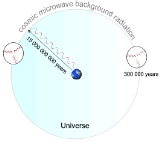
The magnitude of this problem is quite large. According to the Big Bang model, as the density of the universe dropped while it expanded, it eventually reached a point where photons in the "mix" of particles were no longer immediately impacting matter – they "decoupled" from the plasma
Plasma (physics)

In physics and chemistry, plasma is a partially ionized gas, in which a certain proportion of electrons are free rather than being bound to an atom or molecule....
 and spread out into the universe as a burst of light. This is thought to have occurred about 300,000 years after the Big Bang, so the volume of any possible information exchange was 300,000 light years across. Instead, the entire sky has the same temperature, a volume times larger.

Inflation

Inflationary theory
Cosmic inflation

In physical cosmology, cosmic inflation is the hypothesis that the wiktionary:nascent universe passed through a phase of exponential growth metric expansion of space was driven by a negative pressure vacuum energy density....
 allows for a solution to the problem (along with several others such as the flatness problem
Flatness problem

The flatness problem is a physical cosmology fine-tuning problem within the Big Bang model; i.e., the observation that the current density of the universe is very close to critical density at which space is perfectly flat....
) by positing a short second period of exponential expansion (dubbed "inflation") within the first minute or so of the history of the universe. During inflation, the universe would have increased in size by an enormous factor.

If correct, inflation solves the horizon problem by suggesting that prior to the inflationary period the entire universe was causally connected, and it was during this period that the physical properties evened out. Inflation then expanded it rapidly, freezing in these properties all over the sky; at this point the universe would be forced to be almost perfectly homogeneous, as the information needed to change it from that state was no longer causally connected. In the modern era distant areas in the sky appear to be unconnected causally, but in fact were much closer together in the past.

One consequence of cosmic inflation is that the anisotropies
Anisotropy

Anisotropy is the property of being directionally dependent, as opposed to isotropy, which means homogeneity in all directions. It can be defined as a difference in a physical property for some material when measured along different axes....
 in the Big Bang are reduced but not entirely eliminated. Differences in the temperature of the cosmic background are smoothed by cosmic inflation, but they still exist. The theory predicts a spectrum for the anisotropies in the microwave background which is mostly consistent with observations from WMAP and COBE
COBE

The Cosmic Background Explorer , also referred to as Explorer 66, was a satellite dedicated to physical cosmology. Its goals were to investigate the cosmic microwave background radiation of the universe and provide measurements that would help shape our understanding of the cosmos....
.

See also

  • Variable speed of light
    Variable speed of light

    The variable speed of light concept states that the speed of light in a vacuum, usually denoted by c, may not be constant in some cases. In most situations in condensed matter physics when light is traveling through a medium, it effectively has a slower speed....