


La Turbie

Encyclopedia
Alpes-Maritimes
Alpes-Maritimes is a department in the extreme southeast corner of France.- History : was created by Octavian as a Roman military district in 14 BC, and became a full Roman province in the middle of the 1st century with its capital first at Cemenelum and subsequently at Embrun...
department in southeastern France
France
The French Republic , The French Republic , The French Republic , (commonly known as France , is a unitary semi-presidential republic in Western Europe with several overseas territories and islands located on other continents and in the Indian, Pacific, and Atlantic oceans. Metropolitan France...
.
History
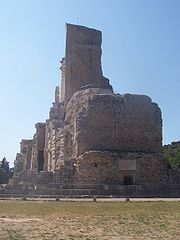
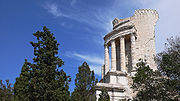
La Turbie was famous in Roman times for the huge MonumentTrophy of Augustus
The Tropaeum Alpium , was built by the Romans for the emperor Augustus to celebrate his definitive victory over the ancient tribes which populated the Alps...
that Augustus made to celebrate his victory over the Ligurian tribes of the area.
During the Middle Ages, the village (called then Turbia) was mainly under the dominion of the Republic of Genoa
Republic of Genoa
The Most Serene Republic of Genoa |Ligurian]]: Repúbrica de Zêna) was an independent state from 1005 to 1797 in Liguria on the northwestern Italian coast, as well as Corsica from 1347 to 1768, and numerous other territories throughout the Mediterranean....
. Dante wrote in his Divina Commedia that Turbia was the western limit of the Italian Liguria
Liguria
Liguria is a coastal region of north-western Italy, the third smallest of the Italian regions. Its capital is Genoa. It is a popular region with tourists for its beautiful beaches, picturesque little towns, and good food.-Geography:...
.
Savoy
Savoy is a region of France. It comprises roughly the territory of the Western Alps situated between Lake Geneva in the north and Monaco and the Mediterranean coast in the south....
or the Principality of Monaco, from where the population of Turbia has assimilated the dialect Monegasque
Monégasque
Monégasque may refer to:* Monégasque dialect, the local Ligurian dialect of Monaco* Something of, from, or related to Monaco, a small sovereign city-state located in southwestern Europe...
, even if the local Ligurian dialect
Ligurian language (Romance)
Ligurian is a Gallo-Romance language spoken in Liguria in Northern Italy, parts of the Mediterranean coastal zone of France, Monaco and in the villages of Carloforte and Calasetta in Sardinia. Genoese , spoken in Genoa, the capital of Liguria, is its most important dialect...
has maintained some characteristics of the nearby Niçois of Nice. Actually the local dialect is nearly extinct, mainly after the 1860 inclusion of the Savoian County of Nice
County of Nice
The County of Nice or Niçard Country is a historical region of France, located in the south-eastern part, around the city of Nice.-History:Its territory lies between the Mediterranean Sea , Var River and the southernmost crest of the...
in France
France
The French Republic , The French Republic , The French Republic , (commonly known as France , is a unitary semi-presidential republic in Western Europe with several overseas territories and islands located on other continents and in the Indian, Pacific, and Atlantic oceans. Metropolitan France...
.
The commune formerly includes the communes of Beausoleil
Beausoleil, Alpes-Maritimes
Beausoleil is a commune in the Alpes-Maritimes department in southeastern France. It adjoins the Principality of Monaco.Beausoleil was formerly known as Monte-Carlo-Supérieur .-Economy:...
and Cap d'Ail, which was disestablished at the beginning of the 20th century. Only the old main town, around the remaining structure of the roman Trophy of Augustus, forms the current commune.
Geography
The boundaries of La Turbie were formerly more extensive and included the territory now contained in the town of BeausoleilBeausoleil, Alpes-Maritimes
Beausoleil is a commune in the Alpes-Maritimes department in southeastern France. It adjoins the Principality of Monaco.Beausoleil was formerly known as Monte-Carlo-Supérieur .-Economy:...
, formerly known as Haut-Monte-Carlo, owing to its proximity to Monaco
Monaco
Monaco , officially the Principality of Monaco , is a sovereign city state on the French Riviera. It is bordered on three sides by its neighbour, France, and its centre is about from Italy. Its area is with a population of 35,986 as of 2011 and is the most densely populated country in the...
. The commune of La Turbie retains a smaller, common boundary with part of the Principality
Principality
A principality is a monarchical feudatory or sovereign state, ruled or reigned over by a monarch with the title of prince or princess, or by a monarch with another title within the generic use of the term prince....
.
La Turbie can be reached either from Cap d'Ail on the coast or the Grand Corniche. Within the town is the Trophy of Augustus
Trophy of Augustus
The Tropaeum Alpium , was built by the Romans for the emperor Augustus to celebrate his definitive victory over the ancient tribes which populated the Alps...
, also known as the Trophée des Alpes.
Sights
A limestone outcrop above La Turbie is called Tête de Chien ("head of dog"), a folk etymology deriving from its former name, Testa de camp ("head of (military) camp").La Turbie is built, partly, with old stones recovered from the ruins of the Trophy of the Alpes (Trophy of Augustus
Trophy of Augustus
The Tropaeum Alpium , was built by the Romans for the emperor Augustus to celebrate his definitive victory over the ancient tribes which populated the Alps...
), a Roman
Ancient Rome
Ancient Rome was a thriving civilization that grew on the Italian Peninsula as early as the 8th century BC. Located along the Mediterranean Sea and centered on the city of Rome, it expanded to one of the largest empires in the ancient world....
monument built by the emperor
Emperor
An emperor is a monarch, usually the sovereign ruler of an empire or another type of imperial realm. Empress, the female equivalent, may indicate an emperor's wife or a woman who rules in her own right...
Augustus
Augustus
Augustus ;23 September 63 BC – 19 August AD 14) is considered the first emperor of the Roman Empire, which he ruled alone from 27 BC until his death in 14 AD.The dates of his rule are contemporary dates; Augustus lived under two calendars, the Roman Republican until 45 BC, and the Julian...
to celebrate his victory over the Ligurian tribes which lived in the mountains of the area and attacked the merchants plying the Roman trade routes.
Population
Personalities
- Prince Albert II of MonacoMonacoMonaco , officially the Principality of Monaco , is a sovereign city state on the French Riviera. It is bordered on three sides by its neighbour, France, and its centre is about from Italy. Its area is with a population of 35,986 as of 2011 and is the most densely populated country in the...
has a property on the heights of Rocagel. - Rudolf NureyevRudolf NureyevRudolf Khametovich Nureyev was a Russian dancer, considered one of the most celebrated ballet dancers of the 20th century. Nureyev's artistic skills explored expressive areas of the dance, providing a new role to the male ballet dancer who once served only as support to the women.In 1961 he...
had a residence there until 1993.
In pop culture
La Turbie was one of the locations where the movie RoninRonin (film)
Ronin is a 1998 action-thriller film directed by John Frankenheimer and written by J.D. Zeik and David Mamet. It stars Robert De Niro and Jean Reno as two of several former special forces and intelligence agents who team up to steal a mysterious, heavily guarded suitcase while navigating a maze of...
was filmed.