


Krupp Trial

Encyclopedia
War crime
War crimes are serious violations of the laws applicable in armed conflict giving rise to individual criminal responsibility...
s that U.S.
United States
The United States of America is a federal constitutional republic comprising fifty states and a federal district...
authorities held in their occupation zone at Nuremberg
Nuremberg Trials
The Nuremberg Trials were a series of military tribunals, held by the victorious Allied forces of World War II, most notable for the prosecution of prominent members of the political, military, and economic leadership of the defeated Nazi Germany....
, Germany
Germany
Germany , officially the Federal Republic of Germany , is a federal parliamentary republic in Europe. The country consists of 16 states while the capital and largest city is Berlin. Germany covers an area of 357,021 km2 and has a largely temperate seasonal climate...
after the end of World War II
World War II
World War II, or the Second World War , was a global conflict lasting from 1939 to 1945, involving most of the world's nations—including all of the great powers—eventually forming two opposing military alliances: the Allies and the Axis...
.
These twelve trials were all held before U.S. military courts, not before the International Military Tribunal, but took place in the same rooms at the Palace of Justice. The twelve U.S. trials are collectively known as the "Subsequent Nuremberg Trials
Subsequent Nuremberg Trials
The Subsequent Nuremberg Trials were a series of twelve U.S...
" or, more formally, as the "Trials of War Criminals before the Nuremberg Military Tribunals" (NMT). The Krupp Trial was the third of three trials of German industrialists; the other two were the Flick Trial
Flick Trial
The United States of America vs. Friedrich Flick, et al. or Flick trial was the fifth of twelve Nazi war crimes trials held by United States authorities in their occupation zone Germany after World War II...
and the IG Farben Trial
IG Farben Trial
The United States of America vs. Carl Krauch, et al., also known as the IG Farben Trial, was the sixth of the twelve trials for war crimes the U.S. authorities held in their occupation zone in Germany after the end of World War II....
.
In the Krupp Trial, twelve former directors of the Krupp
Krupp
The Krupp family , a prominent 400-year-old German dynasty from Essen, have become famous for their steel production and for their manufacture of ammunition and armaments. The family business, known as Friedrich Krupp AG Hoesch-Krupp, was the largest company in Europe at the beginning of the 20th...
Group were accused of having enabled the armament of the German military forces and thus having actively participated in the Nazis
Nazism
Nazism, the common short form name of National Socialism was the ideology and practice of the Nazi Party and of Nazi Germany...
' preparations for an aggressive war, and also for having used slave laborers in their companies. The main defendant was Alfried Krupp von Bohlen und Halbach, CEO of the Krupp Holding since 1943 and son of Gustav Krupp von Bohlen und Halbach who had been a defendant in the main Trial of the Major War Criminals
Nuremberg Trials
The Nuremberg Trials were a series of military tribunals, held by the victorious Allied forces of World War II, most notable for the prosecution of prominent members of the political, military, and economic leadership of the defeated Nazi Germany....
before the IMT (where he was considered medically unfit for trial).
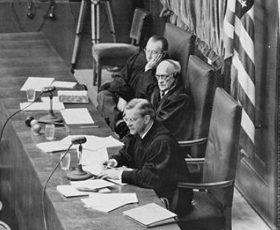
The judges in this case, heard before Military Tribunal III-A, were Hu C. Anderson (presiding judge), president of the court of appeals
Tennessee Court of Appeals
The Tennessee Court of Appeals was created in 1925 by the Tennessee General Assembly as an intermediate appellate court to hear appeals in civil cases from the Tennessee state trial courts....
of Tennessee
Tennessee
Tennessee is a U.S. state located in the Southeastern United States. It has a population of 6,346,105, making it the nation's 17th-largest state by population, and covers , making it the 36th-largest by total land area...
, Edward J. Daly from Connecticut
Connecticut
Connecticut is a state in the New England region of the northeastern United States. It is bordered by Rhode Island to the east, Massachusetts to the north, and the state of New York to the west and the south .Connecticut is named for the Connecticut River, the major U.S. river that approximately...
, and William J. Wilkins
William J. Wilkins
William J. Wilkins was an American lawyer and judge from the state of Washington. He was the last surviving judge of the post-World War II Nuremberg Trials of Nazi war crimes....
from Seattle, Washington
Seattle, Washington
Seattle is the county seat of King County, Washington. With 608,660 residents as of the 2010 Census, Seattle is the largest city in the Northwestern United States. The Seattle metropolitan area of about 3.4 million inhabitants is the 15th largest metropolitan area in the country...
. The Chief of Counsel for the Prosecution was Telford Taylor
Telford Taylor
Telford Taylor was an American lawyer best known for his role in the Counsel for the Prosecution at the Nuremberg Trials after World War II, his opposition to Senator Joseph McCarthy in the 1950s, and his outspoken criticism of U.S...
; the Chief Trial Counsel was H. Russell Thayer, and Benjamin B. Ferencz
Benjamin B. Ferencz
Benjamin Berell' Ferencz is a Romanian-born American lawyer. He was an investigator of Nazi war crimes after World War II and the Chief Prosecutor for the United States Army at the Einsatzgruppen Trial, one of the twelve military trials held by the U.S. authorities at Nuremberg, Germany...
participated as a Special Counsel. The indictment
Indictment
An indictment , in the common-law legal system, is a formal accusation that a person has committed a crime. In jurisdictions that maintain the concept of felonies, the serious criminal offence is a felony; jurisdictions that lack the concept of felonies often use that of an indictable offence—an...
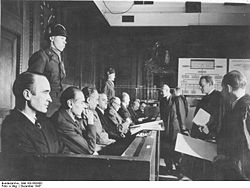
was presented on November 17, 1947; the trial lasted from December 8, 1947 until July 31, 1948. One defendant (Pfirsch) was acquitted, the others received prison sentences between three and twelve years, and the main defendant Alfried Krupp was ordered to sell all his possessions.
- "Die Wirtschaft brauchte eine ruhige oder aufwärts steigende Entwicklung. Infolge des Kampfes zwischen den vielen deutschen Parteien und der Unordnung gab es keine Möglichkeit für aufbauende Tätigkeit. ... Wir hatten den Eindruck, daß Hitler uns solch eine gesunde Entwicklung bescheren würde. Tatsächlich hat er das getan. ... Wir Kruppianer haben uns nie viel um Ideen gekümmert. Wir wollten nur ein System, das gut funktionierte und das uns eine Gelegenheit gab, ungestört zu arbeiten. Politik ist nicht unsere Sache." —Alfried Krupp, in Golo MannGolo MannGolo Mann , born Angelus Gottfried Thomas Mann, was a popular German historian, essayist and writer. He was the third child of the novelist Thomas Mann and his wife Katia Mann.-Life:...
's manuscript first published in (Friz 1988).
-
- "The economy needed a steady or growing development. Because of the rivalries between the many political parties in Germany and the general disorder there was no opportunity for prosperity. ... We thought that Hitler would give us such a healthy environment. Indeed he did do that. ... We Krupps never cared much about [political] ideas. We only wanted a system that worked well and allowed us to work unhindered. Politics is not our business."
Indeed the Krupp holding did flourish under the Nazi regime. According to conservative estimates, the Krupp enterprises used nearly 100,000 persons in the forced labor programme
Forced labor in Germany during World War II
The use of forced labour in Nazi Germany and throughout German-occupied Europe during World War II took place on an unprecedented scale. It was a vital part of the German economic exploitation of conquered territories. It also contributed to the mass extermination of populations in German-occupied...
, about 23,000 (23%) of these were prisoners of war.
Indictment
- Crimes against peace by participating in the planning and waging of wars of aggression and wars in violation of international treaties;
- Crimes against humanity by participating in the plundering, devastation, and exploitation of occupied countries;
- Crimes against humanity by participating in the murder, extermination, enslavement, deportation, imprisonment, torture, and use for slave labor of civilians who came under German control, German nationals, and prisoners of war;
- Participating in a common plan or conspiracy to commit crimes against peace.
All defendants were charged under counts 1, 3, and 4; count 2 excluded the defendants Lehmann and Kupke. Counts 1 and 4 were soon dropped due to lack of evidence.
Defendants
| Name | Function | Sentence |
|---|---|---|
| Alfried Krupp Alfried Krupp von Bohlen und Halbach Alfried Felix Alwyn Krupp von Bohlen und Halbach , often referred to as Alfried Krupp, was a convicted war criminal, an industrialist, a competitor in Olympic yacht races and a member of the Krupp family, which has been prominent in Germany since the early 19th century.The family company, known... |
owner and CEO | 12 years plus forfeiture of property; released 1951; died 1967 |
| Ewald Oskar Ludwig Löser Ewald Loeser Ewald Oskar Ludwig Loeser was a German lawyer, a board member of Krupp AG and a member of the resistance to Nazism.... |
former CFO | 7 years; served sentence and released 1955; died 1970 |
| Eduard Houdremont | director, head of steel works | 10 years; died 1958 |
| Erich Müller | director, head of arms fabrication | 12 years; died 1963 |
| Friedrich Wilhelm Janssen | CFO, successor to Löser | 10 years |
| Karl Heinrich Pfirsch | former head of sales department | found not guilty: acquitted and released |
| Max Otto Ihn | Personnel and intelligence, deputy to Löser and Janssen | 9 years |
| Karl Adolf Ferdinand Eberhardt | head of sales, successor of Pfirsch | 9 years |
| Heinrich Leo Korschan | deputy head of steel plants | 6 years |
| Friedrich von Bülow | counterintelligence, public relations, and head of the plant police (Werkschutz) | 12 years; died 1984 |
| Werner Wilhelm Heinrich Lehmann | "labor procurement", deputy to Ihn | 6 years |
| Hans Albert Gustav Kupke | head of workers' camps | 2 years and 10 months |
All eleven defendants found guilty were convicted on the forced labor charge (count 3), and of the ten charged on count 2 (economic spoliation), six were convicted. On January 31, 1951, two and a half years after the sentences, ten (all except Löser) were released from prison. Since no buyer for the Krupp Holding had been found, Alfried Krupp resumed control of the firm in 1953.