

Kitai-gorod

Encyclopedia
Moscow
Moscow is the capital, the most populous city, and the most populous federal subject of Russia. The city is a major political, economic, cultural, scientific, religious, financial, educational, and transportation centre of Russia and the continent...
, Russia, encircled by mostly-reconstructed medieval walls. It is separated from the Moscow Kremlin
Moscow Kremlin
The Moscow Kremlin , sometimes referred to as simply The Kremlin, is a historic fortified complex at the heart of Moscow, overlooking the Moskva River , Saint Basil's Cathedral and Red Square and the Alexander Garden...
by Red Square
Red Square
Red Square is a city square in Moscow, Russia. The square separates the Kremlin, the former royal citadel and currently the official residence of the President of Russia, from a historic merchant quarter known as Kitai-gorod...
. It does not constitute a district (raion
Raion
A raion is a type of administrative unit of several post-Soviet countries. The term, which is from French rayon 'honeycomb, department,' describes both a type of a subnational entity and a division of a city, and is commonly translated in English as "district"...
), as there are no resident voters, thus, municipal elections are not possible. Rather, the territory is managed directly by Central Administrative Okrug authorities (since 2003).
Name
The etymology of the name is unclear. Gorod is the RussianRussian language
Russian is a Slavic language used primarily in Russia, Belarus, Uzbekistan, Kazakhstan, Tajikistan and Kyrgyzstan. It is an unofficial but widely spoken language in Ukraine, Moldova, Latvia, Turkmenistan and Estonia and, to a lesser extent, the other countries that were once constituent republics...
for town, whereas Kitay is the Russian for China
China
Chinese civilization may refer to:* China for more general discussion of the country.* Chinese culture* Greater China, the transnational community of ethnic Chinese.* History of China* Sinosphere, the area historically affected by Chinese culture...
(cf. Cathay
Cathay
Cathay is the Anglicized version of "Catai" and an alternative name for China in English. It originates from the word Khitan, the name of a nomadic people who founded the Liao Dynasty which ruled much of Northern China from 907 to 1125, and who had a state of their own centered around today's...
). Accordingly, the popular translation might be Chinatown
Chinatown
A Chinatown is an ethnic enclave of overseas Chinese people, although it is often generalized to include various Southeast Asian people. Chinatowns exist throughout the world, including East Asia, Southeast Asia, the Americas, Australasia, and Europe. Binondo's Chinatown located in Manila,...
. However, scholars universally agree that the name originally had nothing to do with Kitay as in "China", as there has never been significant Chinese presence in this district of Moscow. The word is from whale traders (Kit, Russian for whale).
Kita (pl. kity) is a somewhat obsolete word for "plait" or "thing made by braiding" – for example, a 17th-century Russian source informed readers that U shapok janychary imeli kity, meaning "The Janissaries
Janissary
The Janissaries were infantry units that formed the Ottoman sultan's household troops and bodyguards...
had braids hanging from their caps." On the basis of this, Robert Wallace asserts in The Rise of Russia (New York: Time-Life, 1967) that the term relates to a rough-hewn defensive bulwark made from woven wicker baskets filled with earth or rock – and thus Kitay-gorod aims at something like "Basketville". On the other hand, some scholars tend to derive Kitay from an old word for the wooden stakes used in construction of the quarter's walls; if one liberally interprets "stakes" as "wythes" or "wickets," this agrees quite closely with Wallace's signification.
Walls
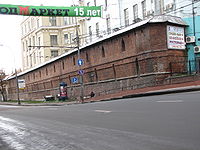
The walls were erected in 1536-39 by an Italian architect known under the Russified name Petrok Maly
Petrok Maly
Petrok Maly, also known as Petrok Maly Fryazin , was an Italian architect, who arrived in Moscow together with the envoys of Pope Clement VII in 1528....
and originally featured 13 towers and six gates. They were as thick as they were high, the average being six meters in both dimensions. The last of the towers were demolished in the 1930s, but small portions of the wall still stand. One of two remaining parts of the wall is located in Zaryadye and the other near the exit from the Okhotny Ryad
Okhotny Ryad
Okhotny Ryad is a station on the Sokolnicheskaya Line of the Moscow Metro. It is located in the centre of Moscow, near the Kremlin.Okhotny Ryad is located under what was originally the swamplands of the upper Neglinnaya River...
station of Moscow Metro
Moscow Metro
The Moscow Metro is a rapid transit system serving Moscow and the neighbouring town of Krasnogorsk. Opened in 1935 with one line and 13 stations, it was the first underground railway system in the Soviet Union. As of 2011, the Moscow Metro has 182 stations and its route length is . The system is...
behind the Hotel Metropol
Hotel Metropol (Moscow)
Hotel Metropol is a historical hotel in the center of Moscow, Russia, built in 1899-1907 in Art Nouveau style. It is notable as the largest extant Moscow hotel built before the Russian Revolution of 1917, and for the unique collaboration of architects and artists .In 1898, Savva Mamontov...
.
Recently the mayor of Moscow announced plans for a full-scale restoration of the wall. City officials also plan to close Kitay-gorod to automobile traffic. Since 1995, the wall has been extensively rebuilt, and a new tower has been added. Inside the tower are a couple of restaurants and bars.
Squares
Apart from Red Square, the quarter is bordered by the chain of Central Squares of MoscowCentral Squares of Moscow
The Central Squares of Moscow consists of a chain of squares around the historical Moscow Kremlin and Kitai-gorod areas of central Moscow, Russia. These squares and avenues connecting them form the innermost ring road in Moscow open to regular traffic...
, notably Theatre Square
Theatre Square
Theatre Square , known as Sverdlov Square between 1919 and 1991, is a city square in Tverskoy District of Moscow, Russia. It's located at the junction of Kuznetsky Bridge Street, Petrovka Street and Theatre Drive .The square is named after the three theatres situated there —...
(in front of Bolshoi Theatre
Bolshoi Theatre
The Bolshoi Theatre is a historic theatre in Moscow, Russia, designed by architect Joseph Bové, which holds performances of ballet and opera. The Bolshoi Ballet and Bolshoi Opera are amongst the oldest and most renowned ballet and opera companies in the world...
), Lubyanka Square
Lubyanka Square
Lubyanka Square in Moscow is about north east of Red Square. The name is first mentioned in 1480, when Ivan III settled many Novgorodians in the area. They built the church of St Sophia, modelled after St Sophia Cathedral in Novgorod, and called the area Lubyanka after the Lubyanitsy district of...
(in front of the KGB headquarters
Lubyanka (KGB)
The Lubyanka is the popular name for the headquarters of the KGB and affiliated prison on Lubyanka Square in Moscow. It is a large building with a facade of yellow brick, designed by Alexander V...
), and Slavyanskaya Square
Slavyanskaya Square
Slavyanskaya Square is the square in the center of Moscow, also known in 1924-1991 as northern side of Nogina Square ; the southern side of former Nogina Square is now called Varvarka Gates Square . These two square separates central Kitai-gorod from eastward Tagansky District...
. Bourse Square on Ilyinka Street is situated entirely within Kitay-gorod.
Architecture
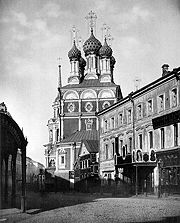

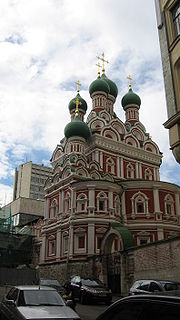
Slavic Greek Latin Academy
Slavic Greek Latin Academy was the first higher education establishment in Moscow, Russia.-Beginnings:...
, housed in extant Zaikonospassky monastery
Zaikonospassky monastery
The Zaikonospassky monastery was a monastery in Kitai-gorod, Moscow, just one block away from the Kremlin.It was founded in 1600 by Boris Godunov...
(1660s). Another monastery cathedral, the main church of Epiphany Monastery
Epiphany Monastery
The Epiphany Monastery is the oldest male monastery in Moscow, situated in the Kitai gorod, just one block away from the Moscow Kremlin.According to a legend, it was founded by Daniel, the first prince of Moscow, around 1296. It is also believed that a would-be metropolitan Alexis was one of the...
(1690s), stands in the middle of Kitay-gorod in the eponymous Bogoyavlensky Lane. The 18th century survives in the exterior walls of the otherwise rebuilt Gostiny Dvor
Moscow Gostiny Dvor
The Old Merchant Court in Moscow occupies a substantial portion of Kitai-gorod, as the old merchant district is known. Formerly accommodating both shops and warehouses, it was constructed of brick in the 1590s and underwent significant modifications from 1638–41...
(Guest Merchant's Court) by Giacomo Quarenghi
Giacomo Quarenghi
Giacomo Quarenghi was the foremost and most prolific practitioner of Palladian architecture in Imperial Russia, particularly in Saint Petersburg.- Career in Italy :...
.
In the 19th century, Red Square was lined by a neoclassical
Neoclassicism
Neoclassicism is the name given to Western movements in the decorative and visual arts, literature, theatre, music, and architecture that draw inspiration from the "classical" art and culture of Ancient Greece or Ancient Rome...
domed structure of Upper Trade Rows by Joseph Bove
Joseph Bové
Joseph Bové was a Russian neoclassical architect with Italian roots who supervised reconstruction of Moscow after the Fire of 1812.-Biography:...
. However, in the 1890s it was torn down and replaced with the new, eclectic Upper Trading Rows
State Universal Store
GUM is the name of the main department store in many cities of the former Soviet Union, known as State Department Store during the Soviet times. Similar-named stores were in some Soviet republics and post-Soviet states. The most famous GUM is a large store in the Kitai-gorod part of Moscow,...
(by Alexander Pomerantsev
Alexander Pomerantsev
Alexander Nikanorovich Pomerantsev was a Russian architect and educator responsible for some of the most ambitious architectural projects realized in Imperial Russia and Bulgaria at the turn of the 20th century...
and Vladimir Shukhov
Vladimir Shukhov
Vladimir Grigoryevich Shukhov , was a Russian engineer-polymath, scientist and architect renowned for his pioneering works on new methods of analysis for structural engineering that led to breakthroughs in industrial design of world's first hyperboloid structures, lattice shell structures, tensile...
) and the similar Middle Trade Rows (by Roman Klein
Roman Klein
Roman Ivanovich Klein , born Robert Julius Klein, was a Russian architect and educator, best known for his Neoclassical Pushkin Museum in Moscow. Klein, an eclectic, was one of the most prolific architects of his period, second only to Fyodor Schechtel...
, scheduled for demolition in 2007). The rest of Kitay-gorod was densely filled with offices, warehouses and hotels, to the point where real estate developers had to build streets, not buildings - like the Tretyakovsky Proyezd
Tretyakovsky Proyezd
Tretyakov Drive is a short street with boutiques and shops with many luxury goods located in Kitai-gorod in Moscow and known as one of the most expensive shopping areas in the world....
project by Pavel Tretyakov
Pavel Tretyakov
Pavel Mikhaylovich Tretyakov was a Russian businessman, patron of art, collector, and philanthropist who gave his name to the Tretyakov Gallery and Tretyakov Drive in Moscow. His brother S.M. Tretyakov was also a famous patron of art and a philanthropist....
and Alexander Kaminsky
Alexander Kaminsky
Alexander Stepanovich Kaminsky was a Russian architect working in Moscow and suburbs. One of the most successul and prolific architects of 1860s - 1880s, Kaminsky was a faithful eclecticist, equally skilled in Russian Revival, Neo-Gothic and Renaissance Revival architecture...
.
Also in the 1890s, developers consolidated large land lots on the perimeter of Kitay-gorod. Savva Mamontov
Savva Mamontov
Savva Ivanovich Mamontov was a famous Russian industrialist, merchant, entrepreneur, and patron of the arts.-Biography:He was a son of the wealthy merchant and industrialist Ivan Feodorovich Mamontov and Maria Tikhonovna . In 1841 the family moved to Moscow. From 1852 he studied in St...
launched an ambitious civic center, built around an opera hall, which was completed as the Metropol Hotel
Hotel Metropol (Moscow)
Hotel Metropol is a historical hotel in the center of Moscow, Russia, built in 1899-1907 in Art Nouveau style. It is notable as the largest extant Moscow hotel built before the Russian Revolution of 1917, and for the unique collaboration of architects and artists .In 1898, Savva Mamontov...
in 1907, the largest early Art Nouveau
Art Nouveau
Art Nouveau is an international philosophy and style of art, architecture and applied art—especially the decorative arts—that were most popular during 1890–1910. The name "Art Nouveau" is French for "new art"...
building in Moscow, containing artwork by Mikhail Vrubel
Mikhail Vrubel
Mikhail Aleksandrovich Vrubel is usually regarded amongst the Russian painters of the Symbolist movement. In reality, he deliberately stood aloof from contemporary art trends, so that the origin of his unusual manner should be sought in Late Byzantine and Early Renaissance painting.-Early...
, Alexander Golovin and Nikolai Andreev. The eastern segment (Staraya Square
Staraya Square
Staraya Square , literally Old Square, connects Ilyinka Street with Varvarka Gates Square in central Kitai-gorod area of Moscow, Russia. It is not a square in a true sense, but a street, normally closed to regular city traffic...
) was rebuilt by the Moscow Merchant Society, with the late Art Nouveau
Art Nouveau
Art Nouveau is an international philosophy and style of art, architecture and applied art—especially the decorative arts—that were most popular during 1890–1910. The name "Art Nouveau" is French for "new art"...
Boyarsky Dvor offices (by Fyodor Schechtel
Fyodor Schechtel
Fyodor Osipovich Schechtel was a Russian architect, graphic artist and stage designer, the most influential and prolific master of Russian Art Nouveau and late Russian Revival....
) and the neoclassical 4, Staraya Square (by Vladimir Sherwood
Vladimir Vladimirovich Sherwood
Vladimir Vladimirovich Sherwood , was a Russian architect who worked in Moscow in 1895-1914 in Art Nouveau style and modernized classics variant of Russian neoclassical revival that predated modernist architecture of 1920s.-Biography:...
, Jr., 1912–1914) which later housed the Central Committee of the Communist Party
Central Committee of the Communist Party of the Soviet Union
The Central Committee of the Communist Party of the Soviet Union , abbreviated in Russian as ЦК, "Tse-ka", earlier was also called as the Central Committee of the All-Union Communist Party ...
.
The present-day offices and clock tower of Constitutional Court of Russia were financed by the Northern Insurance Socity (1910–1912) and built by Ivan Rerberg
Ivan Rerberg
Ivan Ivanovich Rerberg was a Russian civil engineer, architect and educator active in Moscow in 1897–1932. Rerberg's input to present-day Moscow include Kiyevsky Rail Terminal, Central Telegraph building and the Administration building of Moscow Kremlin...
, Marian Peretiatkovich and Vyacheslav Oltarzhevsky
Vyacheslav Oltarzhevsky
Vyacheslav Konstantinovich Oltarzhevsky was a Russian Soviet architect. He was one of the first Soviet experts in skyscraper construction, notable for his collaboration with Arkady Mordvinov on Hotel Ukraina...
; this project is also notable as the first professional employer of young Ilya Golosov
Ilya Golosov
Ilya Alexandrovich Golosov was a Russian Soviet architect. A leader of Constructivism in 1925-1931, Ilya Golosov later developed his own style of early stalinist architecture known as postconstructivism...
.
Since the early 1990s, many historical buildings have been torn down or rebuilt by facadist
Facadism
Façadism is the practice of demolishing a building but leaving its facade intact for the purposes of building new structures in it or around it....
methods, tearing down everything beyond the street facade. Apart from the Gostiny Dvor, recent losses include the Tyoplye Trade Rows (Теплые ряды, demolished 1996-1997) and the recently reopened block at 10, Nikolskaya Street. The degree of destruction cannot be assessed in full, since many properties are operated by the federal government and closed to the general public.
Zaryadye
A whole quarter of Kitay-gorod adjacent to the Moskva RiverMoskva River
The Moskva River is a river that flows through the Moscow and Smolensk Oblasts in Russia, and is a tributary of the Oka River.-Etymology:...
and known as Zaryadye was demolished in three rounds (1930s, late 1940s, 1960s), sparing only those structures that were classified as historic monuments. These include the Cathedral of the Sign (1679–84), the Church of All Saints
Church of All Saints, Moscow
Church of All Saints na Kulichkakh is one of oldest churches in Moscow located at 2, Slavyanskaya Square.First wooden church on this place was built by Dmitry Donskoy most likely in 1380 after the Battle of Kulikovo...
(1680s), St. George's Church on Pskov Hill (1657), St. Maksim's Church (1698), St. Anna's Church at the Corner (1510s), St. Barbara's Church (1796–1804), the Old English Embassy (1550s), and the 16th century Romanov
Romanov
The House of Romanov was the second and last imperial dynasty to rule over Russia, reigning from 1613 until the February Revolution abolished the crown in 1917...
boyar residence. There is no other such cluster of old edifices left anywhere else in Moscow. The district's main structure, Rossiya Hotel
Rossiya Hotel
The Rossiya Hotel was a large hotel built in Moscow from 1964 until 1967 at the order of the Soviet government. Construction used the existing foundations of a cancelled skyscraper project, the Zaryadye Administrative Building, which would have been the eighth of what is now referred to as the...
(1967), is being demolished to make way for a new round of development.