

Moscow Metro

Encyclopedia
The Moscow Metro is a rapid transit
system serving Moscow
and the neighbouring town of Krasnogorsk
. Opened in 1935 with one 11 kilometres (6.8 mi) line and 13 stations, it was the first underground railway system in the Soviet Union
. As of 2011, the Moscow Metro has 182 stations and its route length is 301.2 kilometres (187.2 mi). The system is mostly underground, with the deepest section 84 metres (275.6 ft) below ground at the Park Pobedy station. The Moscow Metro is the world's second-most-heavily-used
rapid transit system, after Tokyo
's twin subway
.
(route 11), the Zamoskvoretskaya Line
(route 2), the Lyublinsko-Dmitrovskaya Line (route 10) and the Butovskaya Line (route L1).
The system operates in an enhanced spoke-hub distribution paradigm
, with the majority of rail lines running radially from the centre of Moscow to the outlying areas. The Koltsevaya Line
(route 5) forms a 20 kilometres (12.4 mi)long ring which enables passenger travel between these spokes. Signs showing the stations that can be reached in a given direction are in each station. Most of the stations and lines are underground, but some lines have at-grade and elevated sections. The Filyovskaya Line
is notable for being the only line with most of its route at grade.
The Moscow Metro is open from about 05:30 until 01:00. The precise opening time varies at different stations according to the arrival of the first train, but all stations close their entrances simultaneously at 01:00 for maintenance. The minimum interval between trains is 90 seconds, during the morning and evening rush hours.
Notes:
1 Four central stations of the Filyovskaya Line Alexandrovsky Sad (formerly Imeni Kominterna), Arbatskaya,
Smolenskaya
and Kiyevskaya were originally opened in 1935–1937, when they were a branch of the Sokolnicheskaya Line. Between 1938 and 1953, they were part of the Arbatsko-Pokrovskaya Line. The stations were closed between 1953 and 1958 and then reopened as part of the (new) Filyovskaya Line.
A branch line from the Filyovskaya is in operation (as of July 2009) starting from the Alexsandrovsky Sad Station and continuing on the Filyovskaya Line to Kiyevskaya Station, where it departs to stop at the (new) Vystavochnaya and Mezhdunarodnaya Stations.
2 All three stations of the Kakhovskaya Line were built in 1969. They were an integral part of the Zamoskovoretskaya Line until 1983, becoming a branch of that line until 1995. In 1995, they were split off from the Zamoskovoretskaya Line to form the Kakhovskaya Line.
3 The "L" in "L1" does not stand for "Light rail
" but (somewhat confusingly) for "Light Metro"—lines which are mainly elevated, with shorter platforms. These lines, as a result, do not need expensive tunnelling and are supposed to be financially "light". However, "light" and "normal" metro lines use the same rolling stock. See Butovskaya Light Metro Line
for further explanation.
The Moscow Monorail is a 4.7 km, six-station monorail line between Timiryazevskaya and VDNKh
which opened in January 2008. Prior to the official opening, the monorail had operated in "excursion mode" since 2004. Trains departed every 20 minutes between 8:00 and 20:05, and tickets cost four times the normal price (50 rubles, ~$2.10). Since 2008, train intervals have been shortened and the price is equal to the Metro ticket price.
but were postponed by World War I
, the October Revolution
and the Russian Civil War
. In 1923, the Moscow City Council formed the Underground Railway Design Office at the Moscow Board of Urban Railways. It carried out preliminary studies, and by 1928 had developed a project for the first route from Sokolniki to the city centre. At the same time, an offer was made to German company Siemens Bauunion to submit its own project for the same route. In June 1931, the decision to begin construction of the Moscow Metro was made by the Central Committee of the Communist Party of the Soviet Union
. In January 1932 the plan for the first lines was approved, and on March 21, 1933 the Soviet government approved a plan for 10 lines with a total route length of 80 km.
The first lines were built using the Moscow general plan designed by Lazar Kaganovich
in the 1930s, and the Metro was named after him until 1955 named after him . The Moscow Metro construction engineers consulted with their counterparts from the London Underground
, the world's oldest metro system. Partly because of this connection, the design of Gants Hill tube station
(although not completed until much later) is reminiscent of a Moscow Metro Station.
, was opened to the public on 15 May 1935 at 07:00. It was 11 kilometres (6.8 mi) long and included 13 stations. The line connected Sokolniki
and Park Kultury
. The latter branch was extended westwards to a new station (Kiyevskaya) in March 1937, the first Metro line crossing the Moskva River
over the Smolensky Metro Bridge
.
. In March 1938, the Arbatskaya branch was split and extended to the Kurskaya
station (now the dark-blue Arbatsko-Pokrovskaya Line
). In September 1938, the Gorkovskaya Line
opened between Sokol
and Teatralnaya. Here the architecture was based on that of the most popular stations in existence (Krasniye Vorota, Okhotnyi Ryad and Kropotkinskaya); while following the popular art-deco style, it was merged with socialist themes. The first deep-level Column station Mayakovskaya was built at the same time.
, and two Metro sections were put into service; Teatralnaya–Avtozavodskaya (three stations, crossing the Moskva River through a deep tunnel) and Kurskaya
–Partizanskaya (four stations) were inaugurated in 1943 and 1944 respectively. War motifs replaced socialist visions in the architectural design of these stations. During the Siege of Moscow in the fall and winter of 1941, Metro stations were used as air-raid shelters; the Council of Ministers moved its offices to the Mayakovskaya platforms, where Stalin made public speeches on several occasions. The Chistiye Prudy station was also walled off, and the headquarters of the Air Defence established there.
, a deep part of the Arbatsko-Pokrovskaya line from Ploshchad Revolyutsii
to Kievskaya
and a surface extension to Pervomaiskaya
during the early 1950s. The decoration and design characteristic of the Moscow Metro is considered to have reached its zenith in these stations. The Koltsevaya Line
was first planned as a line running under the Garden Ring
, a wide avenue encircling the borders of Moscow's city centre. The first part of the line – from Park Kultury to Kurskaya (1950) – follows this avenue. Plans were later changed and the northern part of the ring line runs 1–1.5 km (0.621372736649807–0.93205910497471 ) outside the Sadovoye Koltso, thus providing service for seven (out of nine) rail terminals. The next part of the Koltsevaya Line opened in 1952 (Kurskaya–Belorusskaya
), and in 1954 the ring line was completed.
led to the construction of a deep section of the Arbatsko-Pokrovskaya Line
. The stations on this line were planned as shelters in the event of nuclear war. After finishing the line in 1953 the upper tracks between Ploshchad Revolyutsii
and Kiyevskaya were closed, and later reopened in 1958 as a part of the Filyovskaya Line
. In the further development of the Metro the term "stages" was not used any more, although sometimes the stations opened in 1957–1959 are referred to as the "fifth stage".
During the late 1950s the architectural extravagance of new Metro stations was toned down, and decorations at some stations (such as VDNKh
and Alexeyevskaya) were simplified by comparison with the original plans. This was done on the orders of Nikita Khrushchev
, who favoured more spartan decoration. A typical layout (which quickly became known as Sorokonozhka–"centipede", from early designs with 40 concrete columns in two rows) was developed for all new stations and the stations were built to look almost identical, differing from each other only in colours of the marble and ceramic tiles. Most stations were built with simpler, less-costly technology; this was not always appropriate, and resulted in utilitarian design. For example, walls with cheap ceramic tiles were susceptible to train vibration and some tiles eventually fell off. It was not always possible to replace the missing tiles with the ones of the same color, which eventually led to variegated parts of the walls. Not until the mid-1970s was the architectural extravagance restored and original designs again popular. However, the newer design of "centipede" stations (with 26 more-widely-spaced columns) continued to dominate.
Stalin developed a cult of personality
through various methods of political and cultural propaganda. This propaganda effort was a concerted effort to encourage Soviet citizens to deify Stalin. Stalin referred to himself as "the god of the sun" because the sun is the source of all life, symbolizing a radiant future, eternal life and happiness. It was crucial that Stalin associate himself with the sun god, because the Communist Party’s power hinged on its promise to the people that the party could provide all that was symbolized by the sun.
The metro design’s emphasis on verticality was a reinforcement of Stalin's deification. He directed his architects to design structures which would encourage citizens to look up, admiring the station’s art (as if they were looking up to admire the sun and—by extension—him as a god. Another aspect of the apotheosis propaganda was the metro’s electrification; the Moscow Metro's chandeliers are one of the most beautiful and technologically-advanced aspects of the project.
The chief lighting engineer was Abram Damsky, a graduate of the Higher State Art-Technical Institute in Moscow. By 1930 he was a chief designer in Moscow’s Elektrosvet Factory, and during World War II was sent to the Metrostroi (Metro Construction) Factory as head of the lighting shop. Damsky recognized the importance of efficiency, as well as the potential for light as an expressive form. His team experimented with different materials (most often cast bronze, aluminum, sheet brass, steel, and milk glass) and methods to optimize the technology. Damsky’s discourse on “Lamps and Architecture 1930–1950” describes in detail the epic chandeliers installed in the Kaluzhskaia (now called the Oktiabrskaia) Station and the Taganskaia Station:
This is an example of how the artistic composition of the Moscow Metro incorporated the Communist Party’s propaganda messages. The work of Abram Damsky facilitated the dissemination of this propaganda, so the people would associate the party with svetloe budushchee.
to incorporate it into the metro's design; in addition, a steel shortage would have limited the size of the subway system and its technological advancement.
The Moscow Metro furthered the construction of a socialist Soviet Union because the project accorded with Stalin's Second Five-Year Plan. The Second Plan focused on urbanisation and the development of social services. The Moscow Metro was necessary to cope with the influx of peasants who migrated to the city during the 1930s; Moscow's population grew to 3.6 million in 1933 from 2.16 million in 1928. The Metro also bolstered Moscow's shaky infrastructure and the its communal services, which hitherto were nearly nonexistent.
had the power to mobilise; because the party was a single source of control, it could focus its resources and inspire its people. The most notable example of mobilisation in the Soviet Union occurred during World War II
. The country also mobilised in order to complete the Moscow Metro with unprecedented speed. A main motivation of the mobilization was to overtake the West and prove that a socialist metro could surpass capitalist designs. It was especially important to the Soviet Union that socialism succeed industrially, technologically, and artistically in the 1930s, since capitalism was at a low ebb during the Great Depression.
The person in charge of Metro mobilization was Lazar Kaganovich. A prominent Party member, he assumed control of the project as chief overseer. Kaganovich was nicknamed the "Iron Commissar"; he shared Stalin's fanatical energy, dramatic oratory flare, and ability to keep workers building quickly with threats and punishment. He was determined to realise the Moscow Metro, regardless of cost. Without Kaganovich's managerial ability, the Moscow Metro might have met the same fate as the Palace of the Soviets: failure.
This was a comprehensive mobilisation; the project drew resources and workers from the entire Soviet Union. In his article, archeologist Mike O'Mahoney describes the scope of Metro mobilisation:
Skilled engineers were scarce, and unskilled workers were instrumental to the realisation of the metro. The Metrostroi (the organisation responsible for the Metro's construction) conducted massive recruitment campaigns. It printed 15,000 copies of Udarnik metrostroia (Metrostroi Shock Worker, its daily newspaper) and 700 other newsletters (some in different languages) to attract unskilled laborers. Kaganovich was closely involved in the recruitment campaign, targeting the Komsomol
generation because of its strength and youth.
(the movement according to which the Metro was designed and built) was an instrument for such experimentation. Socialist Realism was in fact a method, not a style. This method was influenced by Nikolay Chernyshevsky, Lenin’s
favorite 19th-century nihilist
, who stated that “art is no use unless it serves politics”. This maxim explains why the stations combined aesthetics, technology and ideology. Any plan which did not incorporate all three areas cohesively were rejected. Without this cohesion, the Metro would not reflect Socialist Realism. If the Metro did not utilize Socialist Realism, it would fail to illustrate Stalinist values and transform Soviet citizens into socialists. Anything less than Socialist Realism’s grand artistic complexity would fail to inspire a long-lasting, nationalistic attachment to Stalin’s new society.
(and, by extension, Stalinism
). 285,000 people rode the Metro at its debut, and its design was greeted with pride; street celebrations included parades, plays and concerts. The Bolshoi Theatre
presented a choral performance by 2,200 Metro workers; 55,000 colored posters (lauding the Metro as the busiest and fastest in the world) and 25,000 copies of "Songs of the Joyous Metro Conquerors" were distributed. This publicity barrage, produced by the Soviet government, stressed the superiority of the Moscow Metro over all other metros in capitalist societies and the Metro's role as a prototype for the Soviet future. In reality, the Moscow Metro averaged 16 miles per hour (25.7 km/h) and could not exceed 32 miles per hour (51.5 km/h). In comparison, New York City subway
trains averaged 25 miles per hour (40.2 km/h) and had a top speed of 45 miles per hour (72.4 km/h). While the celebration was an expression of popular joy it was also an effective propaganda display, legitimizing the Metro and declaring it a success.
, exists under military jurisdiction. It is believed that it consists of a single track connecting the Kremlin
, chief HQ (General Staff
–Genshtab), Lubyanka (FSB Headquarters), the Ministry of Defence and several other secret installations. There are alleged to be entrances to the system from several civilian buildings, such as the Russian State Library
, Moscow State University
(MSU) and at least two stations of the regular Metro. It is speculated that these would allow for the evacuation of a small number of randomly chosen civilians, in addition to most of the elite military personnel. A suspected junction between the secret system and the regular Metro is behind the Sportivnaya station on the Sokolnicheskaya Line
. The final section of this system was completed in 1997.
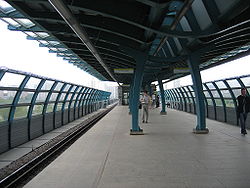 The Moscow Metro uses the Russian gauge
of 1520 millimetres (59.8 in) (like other Russian railways) and an underrunning third rail
with a supply of 825 V
DC
. The average distance between stations is 1.7 kilometres (1.1 mi); the shortest (502 metres (1,647 ft) long) section is between Vystavochnaya and Mezhdunarodnaya and the longest (6627 metres (21,742.1 ft) long) is between Krylatskoye and Strogino. Long distances between stations have the positive effect of a high cruising speed of 41.7 kilometres per hour (25.9 mph).
Since the beginning, platforms
have been at least 155 metres (508.5 ft) long to accommodate eight-car trains. The only exceptions are on the Filyovskaya Line
: Vystavochnaya, Mezhdunarodnaya, Studencheskaya, Kutuzovskaya, Fili
, Bagrationovskaya
, Filyovsky Park and Pionerskaya, which only allow six-car trains (note that this list includes all ground-level stations on the line, except Kuntsevskaya).
Trains on the Zamoskovretskaya, Kaluzhsko-Rizhskaya, Tagansko-Krasnopresnenskaya, Kalininskaya, Serpukhovsko-Timiryazevskaya and Lyublinsko-Dmitrovskaya lines have eight cars, on the Sokolnicheskaya line seven cars and on the Koltsevaya and Kakhovskaya lines six cars. The Filyovskaya and Arbatsko-Pokrovskaya lines had six- and seven-car trains as well, but now use four- and five-car articulated 81-740/741 trains. Rolling stock on the Koltsevaya line is being replaced with four-car Rusich trains. The Butovskaya Line light metro was designed by different standards, and has shorter (96 metres (315 ft)long) platforms. It employs articulated 81-740/741 trains, which consist of three cars (although the line can also use traditional four-car trains).
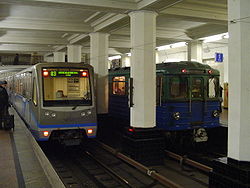 The Moscow Metro encompasses 182 stations, of which 73 are deep below ground and 88 shallower. Of the deep stations 52 are pylon-type, 18 are column-type and one is "single-vault" (Leningrad technology). The shallow stations comprise 63 pillar-type (a large portion of them following the "centipede" design), 20 single-vaults (Kharkov technology) and three single-decked. In addition, there are 11 ground-level stations and four above ground. Two of the stations exist as double halls, and two have three tracks. Five of the stations have side platforms (only one subterranean; that station Vorobyovy Gory is on a bridge). Three other metro bridges exist, but are covered or hidden. In addition, there are two closed stations and one that is in disrepair. Four stations are reserved for future service: Volokolamskaya on the Tagansko-Krasnopresnenskaya line, Delovoy Tsentr
stations on the Kalininskaya and Solntsevskaya lines and Park Pobedy on the Solntsevskaya line.
According to plans by the Moscow city government and Russia's transport ministry (announced in September 2008), by 2015 79 kilometres (49.1 mi) of new lines, 43 new underground stations and 7 metro depots should be added to the system.
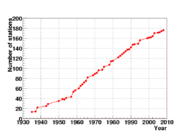 Since the turn of the 21st century several projects have been completed, and more are underway. The first was the Annino-Butovo extension, which extended the Serpukhovsko-Timiryazevskaya Line
from Prazhskaya to Ulitsa Akademika Yangelya in 2000, Annino in 2001 and Bulvar Dmitriya Donskogo
in 2002. A new, elevated Butovskaya Light Metro Line
was inaugurated in 2003. Another major project was the reconstruction of the Vorobyovy Gory station, which initially opened in 1959 and was forced to close in 1983 after the concrete used to build the bridge was found to be defective. After many years the station was rebuilt, and reopened in 2002.
Another recent project included building a branch off the Filyovskaya Line
to the Moscow International Business Center
. This included Delovoy Tsentr
(opened in 2005) and Mezhdunarodnaya (opened in 2006). After many years of construction, the long-awaited Lyublinskaya Line
extension was inaugurated with Trubnaya
in August 2007 and Sretensky Bulvar
in December of that year.
The Strogino-Mitino extension
began with Park Pobedy in 2003. Its first stations (an expanded Kuntsevskaya and Strogino
) opened in January 2008, and Slavyansky Bulvar
followed in September. Myakinino, Volokolamskaya and Mitino opened in December 2009. Myakinino station was built by a state-private financial partnership, unique in Moscow Metro history. In June 2010, the Lyublinskaya Line was extended with the Dostoyevskaya and Maryina Roscha
stations.
New stations
However, this project is questionable and the second ring is as distant today as it looked 40 years ago.
From the 1970s to the 1990s, the cost of a ride was five kopecks (1/20 of a Soviet ruble
). The fare has been steadily rising since 1991, hastened by inflation (taking into account the 1998 revaluation of the ruble by a factor of 1000). Effective January 2011, one ride (or one item of oversize luggage) costs 28 rubles (94 US cents). Discounts (up to 40 percent) are available when buying a multiple-trip ticket (starting with five-trip cards), and children under age seven can travel free with their parents.
Tickets are available for a fixed number of trips, regardless of distance traveled or number of transfers. Monthly and yearly passes are also available. Fare enforcement takes place at the points of entry. Once a passenger has entered the Metro system, there are no further ticket checks – one can ride to any number of stations and make transfers within the system freely. Transfers to other public-transport systems (such as bus, tram, trolleybus, or monorail) are not covered by the ticket.
Before 1991, turnstiles accepted coins; however, with the start of hyperinflation
plastic tokens of various design were used. Disposable magnetic stripe card
s were introduced in 1993 on a trial basis, and used as unlimited monthly tickets between 1996 and 1998. The sale of tokens ended on 1 January 1999, and they stopped being accepted in February 1999; from that time, magnetic cards were used as tickets with a fixed number of trips.
On 1 September 1998, the Moscow Metro became the first metro system in Europe to fully implement plastic smart cards, known as Transport Cards. The card has an unlimited number of trips and may be programmed for 30, 90 or 365 days. The first purchase includes a one-time cost of 50 rubles, and its active lifetime is projected as 3½ years; defective cards are exchanged at no cost. Unlimited cards are also available for students at reduced price (as of 2011, 321 rubles—or about $US10—for a calendar month of unlimited usage) for a one-time cost of 70 rubles. Transport Cards impose a delay for each consecutive use; i.e. the card can not be used for seven minutes after the user has passed through the turnstile.
In January 2007, Moscow Metro began replacing magnetic cards with contactless disposable tickets based on NXP MIFARE
ultralight technology. Ultralight tickets are available for a fixed number of trips in 1, 2, 5, 10, 20 and 60-trip denominations (valid for 5 or 45 days from the day of purchase) and as a monthly ticket, only valid for a selected calendar month and limited to 70 trips. The sale of magnetic cards stopped January 16, 2008 and magnetic cards stopped being accepted in late 2008, making the Moscow metro the world's first major public-transport system to run exclusively on a contact-less automatic fare-collection system.
In August 2004, the city government launched the Muscovite's Social Card program. Social Cards are free smart cards issued for the elderly and other groups of citizens officially registered as residents of Moscow or the Moscow region; they offer discounts in shops and pharmacies, and double as credit cards issued by the Bank of Moscow. Social Cards can be used for unlimited free access to the city's public-transport system, including the Moscow Metro; while they do not feature the time delay, they include a photograph and are non-transferable.
Since 2006, several banks have issued credit card
s which double as ultralight cards and are accepted at turnstiles. The fare is passed to the bank and the payment is withdrawn from the owner's bank account at the end of the calendar month, using a discount rate based on the number of trips that month (for up to 70 trips, the cost of each trip is prorated from current ultralight rates; each additional trip costs 24.14 rubles). Partner banks include the Bank of Moscow, CitiBank
, Rosbank
, Alfa-Bank and Avangard Bank. In fall 2010, Moscow Metro and Mobile TeleSystems
launched a mobile ticketing
service using near field communication
-enabled SIM cards.
during a fire there. A fire was also reported at Prospekt Mira station
about that time.
collapse at the Aviamotornaya station on the Kalininskaya Line
. 8 people were killed and 30 injured due to a pileup caused by faulty emergency brakes.
, killing 39 and wounding over 100. Chechen
terrorists were blamed. A later investigation concluded that a Karachay-Cherkessia
n resident (an Islam
ic militant) had carried out a suicide bombing. The same group organized another attack on 31 August 2004.
halted operation on some lines. The following lines, however, continued operations: Sokolnicheskaya, Zamoskvoretskaya from Avtozavodskaya to Rechnoy Vokzal, Arbatsko-Pokrovskaya, Filyovskaya, Koltsevaya, Kaluzhsko-Rizhskaya from Bitsevskiy Park to Oktyabrskaya-Radialnaya
and from Prospekt Mira-Radialnaya
to Medvedkovo, Tagansko-Krasnopresnenskaya, Kalininskaya, Serpukhovsko-Timiryazevskaya from Serpukhovskaya
to Altufyevo and Lyublinskaya from Chkalovskaya
to Dubrovka
. There was no service on the Kakhovskaya and Butovskaya lines. The blackout severely affected the Zamoskvoretskaya and Serpukhovsko-Timiryazevskaya lines, where initially all service was been disrupted because of trains halted in tunnels in the southern part of city (most affected by the blackout). Later, limited service resumed and passengers stranded in tunnels were evacuated. Some lines were only slightly impacted by the blackout, which mainly affected southern Moscow; the north, east and western parts of the city experienced little or no disruption.
and Voikovskaya
stations on the Zamoskvoretskaya Line
. No injuries were reported.
. The first bomb went off at the Lubyanka station
on the Sokolnicheskaya Line
at 7:56, during the morning rush hour. Reports suggested that 39 people were killed and 64 wounded. At least 24 were killed in the first explosion, of which 14 were in the rail car where the explosion took place. A second explosion occurred at the Park Kultury station at 8:38, roughly forty minutes after the first one. Fourteen people were reported dead in that explosion. An increase in Russian islamophobia
occurred following the bombings.
Rapid transit
A rapid transit, underground, subway, elevated railway, metro or metropolitan railway system is an electric passenger railway in an urban area with a high capacity and frequency, and grade separation from other traffic. Rapid transit systems are typically located either in underground tunnels or on...
system serving Moscow
Moscow
Moscow is the capital, the most populous city, and the most populous federal subject of Russia. The city is a major political, economic, cultural, scientific, religious, financial, educational, and transportation centre of Russia and the continent...
and the neighbouring town of Krasnogorsk
Krasnogorsk, Moscow Oblast
Krasnogorsk is a city and the administrative center of Krasnogorsky District of Moscow Oblast, Russia, adjacent to the northwestern boundary of Moscow, on the Moskva River...
. Opened in 1935 with one 11 kilometres (6.8 mi) line and 13 stations, it was the first underground railway system in the Soviet Union
Soviet Union
The Soviet Union , officially the Union of Soviet Socialist Republics , was a constitutionally socialist state that existed in Eurasia between 1922 and 1991....
. As of 2011, the Moscow Metro has 182 stations and its route length is 301.2 kilometres (187.2 mi). The system is mostly underground, with the deepest section 84 metres (275.6 ft) below ground at the Park Pobedy station. The Moscow Metro is the world's second-most-heavily-used
Metro systems by annual passenger rides
The most-used metro systems in terms of passenger rides per year:# Tokyo Subway 3.161 billion # Moscow Metro 2.348 billion # Seoul Subway 2.048 billion...
rapid transit system, after Tokyo
Tokyo
, ; officially , is one of the 47 prefectures of Japan. Tokyo is the capital of Japan, the center of the Greater Tokyo Area, and the largest metropolitan area of Japan. It is the seat of the Japanese government and the Imperial Palace, and the home of the Japanese Imperial Family...
's twin subway
Tokyo Subway
The is an integral part of the world's most extensive rapid transit system in a single metropolitan area, Greater Tokyo. While the subway system itself is largely within the city center, the lines extend far out via extensive through services onto suburban railway lines.- Networks :As of June...
.
Overview
The Moscow Metro is a state-owned enterprise. Its total length is 301.2 km (187.2 mi) and consists of 12 lines and 182 stations. The average daily passenger traffic is 6.6 million. Ridership is highest on weekdays (when the Metro carries over 7 million passengers per day) and lower on weekends. Each line is identified according to an alphanumeric index (usually consisting of a number), a name and a colour. Voice announcements refer to the lines by name. A male voice announces the next station when traveling towards the centre of the city, and a female voice when going away from it. On the circle line the clockwise direction has a male announcer for the stations, while the counter-clockwise direction has a female announcer. The lines are also assigned specific colours for maps and signs. Naming by colour is frequent in colloquial usage, except for the very similar shades of green assigned to the Kakhovskaya LineKakhovskaya Line
Kakhovskaya Line is a line of the Moscow Metro. Although the line was formed in 1995, all of the stations date to 1969 when they opened as part of the Zamoskvoretskaya Line. The Kakhovskaya Line is the only conventional line that lacks a full transfer to the ring...
(route 11), the Zamoskvoretskaya Line
Zamoskvoretskaya Line
Zamoskvoretskaya Line , formerly Gorkovsko-Zamoskvoretskaya , is a line of the Moscow Metro. Opened in 1938, chronologically it became the third line. There are twenty stations on the Zamoskvoretskaya line, and it spans , roughly crossing Moscow in a north-south direction. A normal trip along the...
(route 2), the Lyublinsko-Dmitrovskaya Line (route 10) and the Butovskaya Line (route L1).
The system operates in an enhanced spoke-hub distribution paradigm
Spoke-hub distribution paradigm
The hub-and-spoke distribution paradigm is a system of connections arranged like a chariot wheel, in which all traffic moves along spokes connected to the hub at the center...
, with the majority of rail lines running radially from the centre of Moscow to the outlying areas. The Koltsevaya Line
Koltsevaya Line
The Koltsevaya Line , , is a railway line of the Moscow Metro. The line was built in 1950-1954 encircling the central Moscow, and became crucial to the transfer patterns of passengers....
(route 5) forms a 20 kilometres (12.4 mi)long ring which enables passenger travel between these spokes. Signs showing the stations that can be reached in a given direction are in each station. Most of the stations and lines are underground, but some lines have at-grade and elevated sections. The Filyovskaya Line
Filyovskaya Line
Filyovskaya Line , or Line 4, is a line of the Moscow Metro. Chronologically the sixth to open, it connects the major eastern districts of Dorogomilovo and Fili along with the Moscow City with the city centre...
is notable for being the only line with most of its route at grade.
The Moscow Metro is open from about 05:30 until 01:00. The precise opening time varies at different stations according to the arrival of the first train, but all stations close their entrances simultaneously at 01:00 for maintenance. The minimum interval between trains is 90 seconds, during the morning and evening rush hours.
Lines
The colours in the table below correspond with the colours of the lines in the map above:| Index & colour |
English transliteration | Russian name | First opened | Latest extension |
Length | Stations |
|---|---|---|---|---|---|---|
 |
1935 | 1990 | 26.1 km | 19 | ||
 |
1938 | 1985 | 36.9 km | 20 | ||
 |
1938 | 2009 | 43.5 km | 21 | ||
 |
19581 | 2006 | 14.9 km | 13 | ||
 |
("Circle") | 1950 | 1954 | 19.3 km | 12 | |
 |
1958 | 1990 | 37.6 km | 24 | ||
 |
1966 | 1975 | 35.9 km | 19 | ||
 |
1979 | 1986 | 13.1 km | 7 | ||
 |
1983 | 2002 | 41.2 km | 25 | ||
 |
1995 | 2010 | 23.7 km | 14 | ||
 |
19952 | 3.3 km | 3 | |||
 |
2003 | 5.5 km | 5 | |||
| Total: | 301 km | 182 | ||||
Notes:
1 Four central stations of the Filyovskaya Line Alexandrovsky Sad (formerly Imeni Kominterna), Arbatskaya,
Smolenskaya
Smolenskaya (Filyovskaya)
Smolenskaya is a station on the Filyovskaya Line of the Moscow Metro. It was opened in 1935 as part of the first Metro line. Designed by S.G. Andriyevsky and T.N. Makarychev, the station features gray marble pillars with flared bases and walls faced with white ceramic tile...
and Kiyevskaya were originally opened in 1935–1937, when they were a branch of the Sokolnicheskaya Line. Between 1938 and 1953, they were part of the Arbatsko-Pokrovskaya Line. The stations were closed between 1953 and 1958 and then reopened as part of the (new) Filyovskaya Line.
A branch line from the Filyovskaya is in operation (as of July 2009) starting from the Alexsandrovsky Sad Station and continuing on the Filyovskaya Line to Kiyevskaya Station, where it departs to stop at the (new) Vystavochnaya and Mezhdunarodnaya Stations.
2 All three stations of the Kakhovskaya Line were built in 1969. They were an integral part of the Zamoskovoretskaya Line until 1983, becoming a branch of that line until 1995. In 1995, they were split off from the Zamoskovoretskaya Line to form the Kakhovskaya Line.
3 The "L" in "L1" does not stand for "Light rail
Light rail
Light rail or light rail transit is a form of urban rail public transportation that generally has a lower capacity and lower speed than heavy rail and metro systems, but higher capacity and higher speed than traditional street-running tram systems...
" but (somewhat confusingly) for "Light Metro"—lines which are mainly elevated, with shorter platforms. These lines, as a result, do not need expensive tunnelling and are supposed to be financially "light". However, "light" and "normal" metro lines use the same rolling stock. See Butovskaya Light Metro Line
Butovskaya Light Metro Line
Butovskaya Line is a Light Metro line of the Moscow Metro. The line symbolizes an experiment of building rapid-transit in areas where tunnel boring is considered expensive and impractical...
for further explanation.
The Moscow Monorail is a 4.7 km, six-station monorail line between Timiryazevskaya and VDNKh
VDNKh (Metro)
VDNKh is a Moscow Metro station in Ostankino District, North-Eastern Administrative Okrug, Moscow. It is on the Kaluzhsko-Rizhskaya Line, between Alexeyevskaya and Botanichesky Sad stations....
which opened in January 2008. Prior to the official opening, the monorail had operated in "excursion mode" since 2004. Trains departed every 20 minutes between 8:00 and 20:05, and tickets cost four times the normal price (50 rubles, ~$2.10). Since 2008, train intervals have been shortened and the price is equal to the Metro ticket price.
History
The first plans for a metro system in Moscow date back to the Russian EmpireRussian Empire
The Russian Empire was a state that existed from 1721 until the Russian Revolution of 1917. It was the successor to the Tsardom of Russia and the predecessor of the Soviet Union...
but were postponed by World War I
World War I
World War I , which was predominantly called the World War or the Great War from its occurrence until 1939, and the First World War or World War I thereafter, was a major war centred in Europe that began on 28 July 1914 and lasted until 11 November 1918...
, the October Revolution
October Revolution
The October Revolution , also known as the Great October Socialist Revolution , Red October, the October Uprising or the Bolshevik Revolution, was a political revolution and a part of the Russian Revolution of 1917...
and the Russian Civil War
Russian Civil War
The Russian Civil War was a multi-party war that occurred within the former Russian Empire after the Russian provisional government collapsed to the Soviets, under the domination of the Bolshevik party. Soviet forces first assumed power in Petrograd The Russian Civil War (1917–1923) was a...
. In 1923, the Moscow City Council formed the Underground Railway Design Office at the Moscow Board of Urban Railways. It carried out preliminary studies, and by 1928 had developed a project for the first route from Sokolniki to the city centre. At the same time, an offer was made to German company Siemens Bauunion to submit its own project for the same route. In June 1931, the decision to begin construction of the Moscow Metro was made by the Central Committee of the Communist Party of the Soviet Union
Communist Party of the Soviet Union
The Communist Party of the Soviet Union was the only legal, ruling political party in the Soviet Union and one of the largest communist organizations in the world...
. In January 1932 the plan for the first lines was approved, and on March 21, 1933 the Soviet government approved a plan for 10 lines with a total route length of 80 km.
The first lines were built using the Moscow general plan designed by Lazar Kaganovich
Lazar Kaganovich
Lazar Moiseyevich Kaganovich was a Soviet politician and administrator and one of the main associates of Joseph Stalin.-Early life:Kaganovich was born in 1893 to Jewish parents in the village of Kabany, Radomyshl uyezd, Kiev Governorate, Russian Empire...
in the 1930s, and the Metro was named after him until 1955 named after him . The Moscow Metro construction engineers consulted with their counterparts from the London Underground
London Underground
The London Underground is a rapid transit system serving a large part of Greater London and some parts of Buckinghamshire, Hertfordshire and Essex in England...
, the world's oldest metro system. Partly because of this connection, the design of Gants Hill tube station
Gants Hill tube station
Gants Hill tube station is a London Underground station in Gants Hill, in the London Borough of Redbridge. It is served by the Central Line and is in Zone 4. It is the easternmost station to be entirely below ground on the London Underground network....
(although not completed until much later) is reminiscent of a Moscow Metro Station.
First stage
The first line, from Okhotny Ryad to SmolenskayaSmolenskaya (Filyovskaya)
Smolenskaya is a station on the Filyovskaya Line of the Moscow Metro. It was opened in 1935 as part of the first Metro line. Designed by S.G. Andriyevsky and T.N. Makarychev, the station features gray marble pillars with flared bases and walls faced with white ceramic tile...
, was opened to the public on 15 May 1935 at 07:00. It was 11 kilometres (6.8 mi) long and included 13 stations. The line connected Sokolniki
Sokolniki (Metro)
Sokolniki is a Moscow Metro station in Sokolniki District, Eastern Administrative Okrug, Moscow. It is on the Sokolnicheskaya Line, between Krasnoselskaya and Preobrazhenskaya Ploshchad stations. It is located under Rusakovskaya street at the foot of Sokolnicheskaya Square and was part of the...
and Park Kultury
Park Kultury-Radialnaya
Park Kultury is a Moscow Metro station in the Khamovniki District, Central Administrative Okrug, Moscow. It is on the Sokolnicheskaya Line, between Frunzenskaya and Kropotkinskaya stations...
. The latter branch was extended westwards to a new station (Kiyevskaya) in March 1937, the first Metro line crossing the Moskva River
Moskva River
The Moskva River is a river that flows through the Moscow and Smolensk Oblasts in Russia, and is a tributary of the Oka River.-Etymology:...
over the Smolensky Metro Bridge
Smolensky Metro Bridge
Smolensky Metro Bridge is a steel arch bridge that spans Moskva River in Dorogomilovo District of Moscow, Russia. It is the first bridge built for the Moscow Metro in 1935–1937, designed by N.P.Polikarpov, P.K.Antonov and Yakovlev brothers...
.
Second stage
The second stage was completed before the warEastern Front (World War II)
The Eastern Front of World War II was a theatre of World War II between the European Axis powers and co-belligerent Finland against the Soviet Union, Poland, and some other Allies which encompassed Northern, Southern and Eastern Europe from 22 June 1941 to 9 May 1945...
. In March 1938, the Arbatskaya branch was split and extended to the Kurskaya
Kurskaya-Radialnaya
Kurskaya , also known as Kurskaya-Radialnaya, is a station on the Arbatsko-Pokrovskaya Line of the Moscow Metro. It is named for the Kursky Rail Terminal located nearby. Designed by L.M...
station (now the dark-blue Arbatsko-Pokrovskaya Line
Arbatsko-Pokrovskaya Line
The Arbatsko–Pokrovskaya Line is a line of the Moscow Metro. Chronologically the second to open, now it connects with the district of Mitino and town of Krasnogorsk to the northwest of Moscow with the east of the Russian capital passing through the city centre...
). In September 1938, the Gorkovskaya Line
Zamoskvoretskaya Line
Zamoskvoretskaya Line , formerly Gorkovsko-Zamoskvoretskaya , is a line of the Moscow Metro. Opened in 1938, chronologically it became the third line. There are twenty stations on the Zamoskvoretskaya line, and it spans , roughly crossing Moscow in a north-south direction. A normal trip along the...
opened between Sokol
Sokol (Metro)
Sokol is a Moscow Metro station on the Zamoskvoretskaya Line. The station opened on 11 September 1938. Designed by K. Yakovlev, V. Polikarpova, and V. Andreev, it features a single row of pillars which flare upward into the arched ceiling, separated by circular coffers...
and Teatralnaya. Here the architecture was based on that of the most popular stations in existence (Krasniye Vorota, Okhotnyi Ryad and Kropotkinskaya); while following the popular art-deco style, it was merged with socialist themes. The first deep-level Column station Mayakovskaya was built at the same time.
Third stage
Building work on the third stage was delayed (but not interrupted) during World War IIWorld War II
World War II, or the Second World War , was a global conflict lasting from 1939 to 1945, involving most of the world's nations—including all of the great powers—eventually forming two opposing military alliances: the Allies and the Axis...
, and two Metro sections were put into service; Teatralnaya–Avtozavodskaya (three stations, crossing the Moskva River through a deep tunnel) and Kurskaya
Kurskaya-Radialnaya
Kurskaya , also known as Kurskaya-Radialnaya, is a station on the Arbatsko-Pokrovskaya Line of the Moscow Metro. It is named for the Kursky Rail Terminal located nearby. Designed by L.M...
–Partizanskaya (four stations) were inaugurated in 1943 and 1944 respectively. War motifs replaced socialist visions in the architectural design of these stations. During the Siege of Moscow in the fall and winter of 1941, Metro stations were used as air-raid shelters; the Council of Ministers moved its offices to the Mayakovskaya platforms, where Stalin made public speeches on several occasions. The Chistiye Prudy station was also walled off, and the headquarters of the Air Defence established there.
Fourth stage
After the war construction began on the fourth stage of the Metro, which included the Koltsevaya LineKoltsevaya Line
The Koltsevaya Line , , is a railway line of the Moscow Metro. The line was built in 1950-1954 encircling the central Moscow, and became crucial to the transfer patterns of passengers....
, a deep part of the Arbatsko-Pokrovskaya line from Ploshchad Revolyutsii
Ploshchad Revolyutsii
Ploshchad Revolyutsii is one of the most famous stations of the Moscow Metro. It is located on the Arbatsko-Pokrovskaya Line and opened in 1938. The architect was Alexey Dushkin. The station features red and yellow marble arches resting on low pylons faced with black Armenian marble...
to Kievskaya
Kievskaya (Arbatsko-Pokrovskaya)
Kiyevskaya , named for the nearby Kiyevsky Rail Terminal, is a station on the Arbatsko-Pokrovskaya Line of the Moscow Metro. Opened in 1953, it is lavishly decorated in the quasi-baroque style that predominated in the early 1950s...
and a surface extension to Pervomaiskaya
Pervomaiskaya (closed)
Pervomayskaya or Pervomaiskaya was a temporary station on the Arbatsko-Pokrovskaya Line of the Moscow Metro in use between 1954 and 1961. It was closed after being replaced by a permanent station, Izmaylovsky Park ....
during the early 1950s. The decoration and design characteristic of the Moscow Metro is considered to have reached its zenith in these stations. The Koltsevaya Line
Koltsevaya Line
The Koltsevaya Line , , is a railway line of the Moscow Metro. The line was built in 1950-1954 encircling the central Moscow, and became crucial to the transfer patterns of passengers....
was first planned as a line running under the Garden Ring
Garden Ring
The Garden Ring, also known as the "B" Ring , is a circular avenue around the central Moscow, its course corresponding to what used to be the city ramparts surrounding Zemlyanoy Gorod in the 17th century....
, a wide avenue encircling the borders of Moscow's city centre. The first part of the line – from Park Kultury to Kurskaya (1950) – follows this avenue. Plans were later changed and the northern part of the ring line runs 1–1.5 km (0.621372736649807–0.93205910497471 ) outside the Sadovoye Koltso, thus providing service for seven (out of nine) rail terminals. The next part of the Koltsevaya Line opened in 1952 (Kurskaya–Belorusskaya
Belorusskaya-Koltsevaya
Belorusskaya is a station on the Moscow Metro's Koltsevaya Line. It is named after the nearby Belorussky Rail Terminal. It opened in 1952, serving briefly as the terminus of the line before the circle was completed in 1954...
), and in 1954 the ring line was completed.
Cold War era
The beginning of the Cold WarCold War
The Cold War was the continuing state from roughly 1946 to 1991 of political conflict, military tension, proxy wars, and economic competition between the Communist World—primarily the Soviet Union and its satellite states and allies—and the powers of the Western world, primarily the United States...
led to the construction of a deep section of the Arbatsko-Pokrovskaya Line
Arbatsko-Pokrovskaya Line
The Arbatsko–Pokrovskaya Line is a line of the Moscow Metro. Chronologically the second to open, now it connects with the district of Mitino and town of Krasnogorsk to the northwest of Moscow with the east of the Russian capital passing through the city centre...
. The stations on this line were planned as shelters in the event of nuclear war. After finishing the line in 1953 the upper tracks between Ploshchad Revolyutsii
Ploshchad Revolyutsii
Ploshchad Revolyutsii is one of the most famous stations of the Moscow Metro. It is located on the Arbatsko-Pokrovskaya Line and opened in 1938. The architect was Alexey Dushkin. The station features red and yellow marble arches resting on low pylons faced with black Armenian marble...
and Kiyevskaya were closed, and later reopened in 1958 as a part of the Filyovskaya Line
Filyovskaya Line
Filyovskaya Line , or Line 4, is a line of the Moscow Metro. Chronologically the sixth to open, it connects the major eastern districts of Dorogomilovo and Fili along with the Moscow City with the city centre...
. In the further development of the Metro the term "stages" was not used any more, although sometimes the stations opened in 1957–1959 are referred to as the "fifth stage".
During the late 1950s the architectural extravagance of new Metro stations was toned down, and decorations at some stations (such as VDNKh
VDNKh (Metro)
VDNKh is a Moscow Metro station in Ostankino District, North-Eastern Administrative Okrug, Moscow. It is on the Kaluzhsko-Rizhskaya Line, between Alexeyevskaya and Botanichesky Sad stations....
and Alexeyevskaya) were simplified by comparison with the original plans. This was done on the orders of Nikita Khrushchev
Nikita Khrushchev
Nikita Sergeyevich Khrushchev led the Soviet Union during part of the Cold War. He served as First Secretary of the Communist Party of the Soviet Union from 1953 to 1964, and as Chairman of the Council of Ministers, or Premier, from 1958 to 1964...
, who favoured more spartan decoration. A typical layout (which quickly became known as Sorokonozhka–"centipede", from early designs with 40 concrete columns in two rows) was developed for all new stations and the stations were built to look almost identical, differing from each other only in colours of the marble and ceramic tiles. Most stations were built with simpler, less-costly technology; this was not always appropriate, and resulted in utilitarian design. For example, walls with cheap ceramic tiles were susceptible to train vibration and some tiles eventually fell off. It was not always possible to replace the missing tiles with the ones of the same color, which eventually led to variegated parts of the walls. Not until the mid-1970s was the architectural extravagance restored and original designs again popular. However, the newer design of "centipede" stations (with 26 more-widely-spaced columns) continued to dominate.
Moscow Metro and Stalinism
Glorification
The Moscow Metro was one of the USSR’s most extravagant architectural projects. Stalin ordered the metro’s artists and architects to design a structure that embodied svet (radiance or brilliance) and svetloe budushchee (a radiant future). With their reflective marble walls, high ceilings and grandiose chandeliers, many Moscow Metro stations have been likened to an “artificial underground sun”. This underground communist paradise reminded its riders that Stalin and his party had delivered something substantial to the people in return for their sacrifices. Most importantly, proletarian labor produced this svetloe budushchee.Stalin developed a cult of personality
Cult of personality
A cult of personality arises when an individual uses mass media, propaganda, or other methods, to create an idealized and heroic public image, often through unquestioning flattery and praise. Cults of personality are usually associated with dictatorships...
through various methods of political and cultural propaganda. This propaganda effort was a concerted effort to encourage Soviet citizens to deify Stalin. Stalin referred to himself as "the god of the sun" because the sun is the source of all life, symbolizing a radiant future, eternal life and happiness. It was crucial that Stalin associate himself with the sun god, because the Communist Party’s power hinged on its promise to the people that the party could provide all that was symbolized by the sun.
The metro design’s emphasis on verticality was a reinforcement of Stalin's deification. He directed his architects to design structures which would encourage citizens to look up, admiring the station’s art (as if they were looking up to admire the sun and—by extension—him as a god. Another aspect of the apotheosis propaganda was the metro’s electrification; the Moscow Metro's chandeliers are one of the most beautiful and technologically-advanced aspects of the project.
The chief lighting engineer was Abram Damsky, a graduate of the Higher State Art-Technical Institute in Moscow. By 1930 he was a chief designer in Moscow’s Elektrosvet Factory, and during World War II was sent to the Metrostroi (Metro Construction) Factory as head of the lighting shop. Damsky recognized the importance of efficiency, as well as the potential for light as an expressive form. His team experimented with different materials (most often cast bronze, aluminum, sheet brass, steel, and milk glass) and methods to optimize the technology. Damsky’s discourse on “Lamps and Architecture 1930–1950” describes in detail the epic chandeliers installed in the Kaluzhskaia (now called the Oktiabrskaia) Station and the Taganskaia Station:
This is an example of how the artistic composition of the Moscow Metro incorporated the Communist Party’s propaganda messages. The work of Abram Damsky facilitated the dissemination of this propaganda, so the people would associate the party with svetloe budushchee.
Industrialisation
Stalin's First Five-Year Plan (1928–1932) facilitated rapid industrialisation to build a socialist motherland. The plan was ambitious, seeking to reorient an agrarian society towards industrialism. It was Stalin's fanatical energy, large-scale planning, and ambitious resource allocation that kept up industrialisation's punishing pace. The First Five-Year Plan was instrumental in the completion of the Moscow Metro; without industrialisation, the Soviet Union would not have had the raw materials necessary for the project. For example, steel was a main component of many subway stations. Before industrialisation, it would have been impossible for the Soviet Union to produce enough steelSteel
Steel is an alloy that consists mostly of iron and has a carbon content between 0.2% and 2.1% by weight, depending on the grade. Carbon is the most common alloying material for iron, but various other alloying elements are used, such as manganese, chromium, vanadium, and tungsten...
to incorporate it into the metro's design; in addition, a steel shortage would have limited the size of the subway system and its technological advancement.
The Moscow Metro furthered the construction of a socialist Soviet Union because the project accorded with Stalin's Second Five-Year Plan. The Second Plan focused on urbanisation and the development of social services. The Moscow Metro was necessary to cope with the influx of peasants who migrated to the city during the 1930s; Moscow's population grew to 3.6 million in 1933 from 2.16 million in 1928. The Metro also bolstered Moscow's shaky infrastructure and the its communal services, which hitherto were nearly nonexistent.
Mobilisation
The Communist PartyCommunist Party of the Soviet Union
The Communist Party of the Soviet Union was the only legal, ruling political party in the Soviet Union and one of the largest communist organizations in the world...
had the power to mobilise; because the party was a single source of control, it could focus its resources and inspire its people. The most notable example of mobilisation in the Soviet Union occurred during World War II
Eastern Front (World War II)
The Eastern Front of World War II was a theatre of World War II between the European Axis powers and co-belligerent Finland against the Soviet Union, Poland, and some other Allies which encompassed Northern, Southern and Eastern Europe from 22 June 1941 to 9 May 1945...
. The country also mobilised in order to complete the Moscow Metro with unprecedented speed. A main motivation of the mobilization was to overtake the West and prove that a socialist metro could surpass capitalist designs. It was especially important to the Soviet Union that socialism succeed industrially, technologically, and artistically in the 1930s, since capitalism was at a low ebb during the Great Depression.
The person in charge of Metro mobilization was Lazar Kaganovich. A prominent Party member, he assumed control of the project as chief overseer. Kaganovich was nicknamed the "Iron Commissar"; he shared Stalin's fanatical energy, dramatic oratory flare, and ability to keep workers building quickly with threats and punishment. He was determined to realise the Moscow Metro, regardless of cost. Without Kaganovich's managerial ability, the Moscow Metro might have met the same fate as the Palace of the Soviets: failure.
This was a comprehensive mobilisation; the project drew resources and workers from the entire Soviet Union. In his article, archeologist Mike O'Mahoney describes the scope of Metro mobilisation:
Skilled engineers were scarce, and unskilled workers were instrumental to the realisation of the metro. The Metrostroi (the organisation responsible for the Metro's construction) conducted massive recruitment campaigns. It printed 15,000 copies of Udarnik metrostroia (Metrostroi Shock Worker, its daily newspaper) and 700 other newsletters (some in different languages) to attract unskilled laborers. Kaganovich was closely involved in the recruitment campaign, targeting the Komsomol
Komsomol
The Communist Union of Youth , usually known as Komsomol , was the youth division of the Communist Party of the Soviet Union. The Komsomol in its earliest form was established in urban centers in 1918. During the early years, it was a Russian organization, known as the Russian Communist Union of...
generation because of its strength and youth.
Social engineering
The completion of the Moscow Metro was important, because the party used it as a means to build a socialist society. The Metro was perhaps the Soviet Union’s most effective social-engineering tool not only due to the project’s scale, but also because Socialist RealismSocialist realism
Socialist realism is a style of realistic art which was developed in the Soviet Union and became a dominant style in other communist countries. Socialist realism is a teleologically-oriented style having its purpose the furtherance of the goals of socialism and communism...
(the movement according to which the Metro was designed and built) was an instrument for such experimentation. Socialist Realism was in fact a method, not a style. This method was influenced by Nikolay Chernyshevsky, Lenin’s
Vladimir Lenin
Vladimir Ilyich Lenin was a Russian Marxist revolutionary and communist politician who led the October Revolution of 1917. As leader of the Bolsheviks, he headed the Soviet state during its initial years , as it fought to establish control of Russia in the Russian Civil War and worked to create a...
favorite 19th-century nihilist
Nihilist movement
The Nihilist movement was a Russian movement in the 1860s which rejected all authorities. It is derived from the Latin word "nihil", which means "nothing"...
, who stated that “art is no use unless it serves politics”. This maxim explains why the stations combined aesthetics, technology and ideology. Any plan which did not incorporate all three areas cohesively were rejected. Without this cohesion, the Metro would not reflect Socialist Realism. If the Metro did not utilize Socialist Realism, it would fail to illustrate Stalinist values and transform Soviet citizens into socialists. Anything less than Socialist Realism’s grand artistic complexity would fail to inspire a long-lasting, nationalistic attachment to Stalin’s new society.
Propaganda value
The first 13 stations of the Moscow Metro opened on May 15th, 1935, a day which was celebrated as a technological and ideological victory for socialismCommunism
Communism is a social, political and economic ideology that aims at the establishment of a classless, moneyless, revolutionary and stateless socialist society structured upon common ownership of the means of production...
(and, by extension, Stalinism
Stalinism
Stalinism refers to the ideology that Joseph Stalin conceived and implemented in the Soviet Union, and is generally considered a branch of Marxist–Leninist ideology but considered by some historians to be a significant deviation from this philosophy...
). 285,000 people rode the Metro at its debut, and its design was greeted with pride; street celebrations included parades, plays and concerts. The Bolshoi Theatre
Bolshoi Theatre
The Bolshoi Theatre is a historic theatre in Moscow, Russia, designed by architect Joseph Bové, which holds performances of ballet and opera. The Bolshoi Ballet and Bolshoi Opera are amongst the oldest and most renowned ballet and opera companies in the world...
presented a choral performance by 2,200 Metro workers; 55,000 colored posters (lauding the Metro as the busiest and fastest in the world) and 25,000 copies of "Songs of the Joyous Metro Conquerors" were distributed. This publicity barrage, produced by the Soviet government, stressed the superiority of the Moscow Metro over all other metros in capitalist societies and the Metro's role as a prototype for the Soviet future. In reality, the Moscow Metro averaged 16 miles per hour (25.7 km/h) and could not exceed 32 miles per hour (51.5 km/h). In comparison, New York City subway
New York City Subway
The New York City Subway is a rapid transit system owned by the City of New York and leased to the New York City Transit Authority, a subsidiary agency of the Metropolitan Transportation Authority and also known as MTA New York City Transit...
trains averaged 25 miles per hour (40.2 km/h) and had a top speed of 45 miles per hour (72.4 km/h). While the celebration was an expression of popular joy it was also an effective propaganda display, legitimizing the Metro and declaring it a success.
Metro 2.1
It has been alleged that a second and deeper metro system code-named "D-6", designed for emergency evacuation of key city personnel in case of nuclear attack during the Cold WarCold War
The Cold War was the continuing state from roughly 1946 to 1991 of political conflict, military tension, proxy wars, and economic competition between the Communist World—primarily the Soviet Union and its satellite states and allies—and the powers of the Western world, primarily the United States...
, exists under military jurisdiction. It is believed that it consists of a single track connecting the Kremlin
Moscow Kremlin
The Moscow Kremlin , sometimes referred to as simply The Kremlin, is a historic fortified complex at the heart of Moscow, overlooking the Moskva River , Saint Basil's Cathedral and Red Square and the Alexander Garden...
, chief HQ (General Staff
General Staff of the Armed Forces of the Russian Federation
The General Staff of the Armed Forces of the Russian Federation is the military staff of the Armed Forces of the Russian Federation. It is the central organ of the Armed Forces Administration and oversees operational management of the armed forces under the Russian Ministry of Defence.The staff is...
–Genshtab), Lubyanka (FSB Headquarters), the Ministry of Defence and several other secret installations. There are alleged to be entrances to the system from several civilian buildings, such as the Russian State Library
Russian State Library
The Russian State Library is the national library of Russia, located in Moscow. It is the largest in the country and the third largest in the world for its collection of books . It was named the V. I...
, Moscow State University
Moscow State University
Lomonosov Moscow State University , previously known as Lomonosov University or MSU , is the largest university in Russia. Founded in 1755, it also claims to be one of the oldest university in Russia and to have the tallest educational building in the world. Its current rector is Viktor Sadovnichiy...
(MSU) and at least two stations of the regular Metro. It is speculated that these would allow for the evacuation of a small number of randomly chosen civilians, in addition to most of the elite military personnel. A suspected junction between the secret system and the regular Metro is behind the Sportivnaya station on the Sokolnicheskaya Line
Sokolnicheskaya Line
The Sokolnicheskaya Line is the first line of the Moscow Metro, dating back to 1935 when the system opened. Presently the line has 19 stations with a total of of track...
. The final section of this system was completed in 1997.
Specifications
Russian gauge
In railway terminology, Russian gauge refers to railway track with a gauge between 1,520 mm and . In a narrow sense as defined by Russian Railways it refers to gauge....
of 1520 millimetres (59.8 in) (like other Russian railways) and an underrunning third rail
Third rail
A third rail is a method of providing electric power to a railway train, through a semi-continuous rigid conductor placed alongside or between the rails of a railway track. It is used typically in a mass transit or rapid transit system, which has alignments in its own corridors, fully or almost...
with a supply of 825 V
Volt
The volt is the SI derived unit for electric potential, electric potential difference, and electromotive force. The volt is named in honor of the Italian physicist Alessandro Volta , who invented the voltaic pile, possibly the first chemical battery.- Definition :A single volt is defined as the...
DC
Direct current
Direct current is the unidirectional flow of electric charge. Direct current is produced by such sources as batteries, thermocouples, solar cells, and commutator-type electric machines of the dynamo type. Direct current may flow in a conductor such as a wire, but can also flow through...
. The average distance between stations is 1.7 kilometres (1.1 mi); the shortest (502 metres (1,647 ft) long) section is between Vystavochnaya and Mezhdunarodnaya and the longest (6627 metres (21,742.1 ft) long) is between Krylatskoye and Strogino. Long distances between stations have the positive effect of a high cruising speed of 41.7 kilometres per hour (25.9 mph).
Since the beginning, platforms
Railway platform
A railway platform is a section of pathway, alongside rail tracks at a train station, metro station or tram stop, at which passengers may board or alight from trains or trams. Almost all stations for rail transport have some form of platforms, with larger stations having multiple platforms...
have been at least 155 metres (508.5 ft) long to accommodate eight-car trains. The only exceptions are on the Filyovskaya Line
Filyovskaya Line
Filyovskaya Line , or Line 4, is a line of the Moscow Metro. Chronologically the sixth to open, it connects the major eastern districts of Dorogomilovo and Fili along with the Moscow City with the city centre...
: Vystavochnaya, Mezhdunarodnaya, Studencheskaya, Kutuzovskaya, Fili
Fili (Metro)
Fili is a surface-level station on the Filyovskaya Line of the Moscow Metro. The station was opened on November 7, 1959, as the last surface side platform station on the line. The dual platforms are protected by canopies and are intersected at either end by road overpasses that provide additional...
, Bagrationovskaya
Bagrationovskaya
Bagrationovskaya is a Moscow Metro station, located on the surface portion of the Filyovskaya Line. Designed by Robert Pogrebnoy and Cheremin and opened in 1961 as part of the western extension of the Filyovsky radius, the station unlike the other three coming from the centre, features a more...
, Filyovsky Park and Pionerskaya, which only allow six-car trains (note that this list includes all ground-level stations on the line, except Kuntsevskaya).
Trains on the Zamoskovretskaya, Kaluzhsko-Rizhskaya, Tagansko-Krasnopresnenskaya, Kalininskaya, Serpukhovsko-Timiryazevskaya and Lyublinsko-Dmitrovskaya lines have eight cars, on the Sokolnicheskaya line seven cars and on the Koltsevaya and Kakhovskaya lines six cars. The Filyovskaya and Arbatsko-Pokrovskaya lines had six- and seven-car trains as well, but now use four- and five-car articulated 81-740/741 trains. Rolling stock on the Koltsevaya line is being replaced with four-car Rusich trains. The Butovskaya Line light metro was designed by different standards, and has shorter (96 metres (315 ft)long) platforms. It employs articulated 81-740/741 trains, which consist of three cars (although the line can also use traditional four-car trains).
Delovoy Tsentr
Delovoy Tsentr is a planned station of the Kalininskaya Line of the Moscow Metro. It is expected to be opened by 2015....
stations on the Kalininskaya and Solntsevskaya lines and Park Pobedy on the Solntsevskaya line.
Current
The Moscow Metro has a set of expansion plans which are due to be achieved by 2015. Major projects include:- Strogino-Mitino extensionStrogino-Mitino extensionThe Strogino Mitino extension also known as the Strogino-Mition Line is one of the largest projects that Moscow Metro is currently embarked upon in the lengthening of the system and to serve the North-western Moscow Districts of Strogino and Mitino....
: The first stage of the extension opened in January 2008. The second stage extended the line 5.9 kilometres (3.7 mi) to Myakinino, Volokolamskaya and Mitino in December 2009; part of the track includes a new Metro bridge across the Moskva RiverMoskva RiverThe Moskva River is a river that flows through the Moscow and Smolensk Oblasts in Russia, and is a tributary of the Oka River.-Etymology:...
. The final stage will add two more stations (Pyatnitskaya and Rozhdestveno) and a new depot. Another station, located between Krylatskoye and Strogino (Troitse-Lykovo), will be added. - Lyublinsko-Dmitrovskaya Line: The long-delayed third stage of the line is being built (as of 2011). The first stage, including the Sretensky BulvarSretensky BulvarSretensky Bulvar is a Moscow Metro station in the Meshchansky District, Central Administrative Okrug, Moscow. It is on the Lyublinsko-Dmitrovskaya Line, between Trubnaya and Chkalovskaya stations....
and TrubnayaTrubnayaTrubnaya is a Moscow Metro station in the Tverskoy District, Central Administrative Okrug, Moscow. It is on the Lyublinsko-Dmitrovskaya Line, between Dostoyevskaya and Sretensky Bulvar stations....
stations, was completed at the end of 2007. The second stage (3 km (1.9 mi) long, consisting of the Dostoyevskaya and Maryina Roshcha stations) opened on 19 June 2010. The third stage is the 8 kilometres (5 mi) Dmitrovsky Radius, which will open in 2013 with four stations: Sheremetyevskaya, Butyrsky Khutor, Petrovsko-Razumovskaya and Likhobory and a new depot. From there it is expected that another extension will follow after 2015, although its stations have not been confirmed: Seligerskaya, Yubileynaya, Degunino and Severnaya. - Brateyevo-Zyablikovo extension: A project on the ZamoskvoretskayaZamoskvoretskaya LineZamoskvoretskaya Line , formerly Gorkovsko-Zamoskvoretskaya , is a line of the Moscow Metro. Opened in 1938, chronologically it became the third line. There are twenty stations on the Zamoskvoretskaya line, and it spans , roughly crossing Moscow in a north-south direction. A normal trip along the...
and Lyublinskaya LineLyublinskaya LineLyublinsko-Dmitrovskaya Line is the line of the Moscow Metro. First opened in 1995 as a semi-chordial radius it is at present in process of being extended through the centre and northwards...
s. The former will extend by one station (2.9 kilometres (1.8 mi)) to Brateyevo with a new depot, and the latter by three (4.3 kilometres (2.7 mi)): Borisovo, Shipilovskaya and Zyablikovo, with a transfer point at Krasnogvardeyskaya-Zyablikovo. The new stations will ease congestion at the south end of the Zamoskvoretskaya Line. Construction began back in the late 1990s, but was suspended from 2001–2008; completion is expected in 2011. - Zhulebino-Kosino extension: Originally reserved for light Metro lines, the success of the Butovskaya Line meant that in an attempt to relieve one of the busiest terminus stations of the Perovsky and Tagansky radii (Novogireyevo and Vykhino, respectively), both lines would extend by one station beyond the Moscow Ring Road: Kalininskaya LineKalininskaya LineThe Kalininskaya Line is a line of the Moscow Metro. It was opened as the eastwards Perovo radius lines in 1979 and presently has 7 stations.-History:...
to Novokosino in 2011 (3.2 kilometres (2 mi)) and Tagansko-Krasnopresnenskaya LineTagansko-Krasnopresnenskaya LineThe Tagansko-Krasnopresnenskaya is the busiest line of the Moscow Metro...
to Zhulebino in 2012 (3.4 kilometres (2.1 mi)). Both areas are within the city of Moscow, but lie outside the MKAD. - Light Metro lines: Originally developed as a way of reducing costs by building an elevated Metro line to distant regions of Moscow, the only one of these (the Butovskaya Line) has been the subject of criticism. The fate of the L1 expansion remains questionable, while the Solntsevskaya Light Metro Line planned to begin construction in 2004 and open in 2006 with eight stations. In 2005 the project was altered; two stations were dropped, and the opening was delayed until 2010. In 2008 the line was cancelled in favour of the underground Solntsevskaya Metro Line (see below). The L1 extension (which has been revised and postponed) includes an underground extension 5 kilometres (3.1 mi) northwards to Bitsevsky Park (which will offer a transfer to the Kaluzhsko-Rizhskaya LineKaluzhsko-Rizhskaya LineThe Kaluzhsko–Rizhskaya Line is a line of the Moscow Metro, that originally existed as two separate radial lines, Rizhskaya and Kaluzhskaya opened in 1958 and 1962, respectively. Only in 1971 were they united into a single line as the central section connecting the stations Oktyabrskaya to Prospekt...
) and a southwards three-station extension (also 5 km in length) including a new depot: Ulitsa Staropotapovskaya, Ulitsa Ostafyevskya and Novokuryanovo. All the listed light-metro work has been removed from Moscow Metro's expansion programme until 2015, and Moscow Metro may dismantle the system in favour of a conventional two- or three-station replacement on the Serpukhovsko-Timiryazevskaya LineSerpukhovsko-Timiryazevskaya LineSerpukhovsko–Timiryazevskaya Line , sometimes colloquially referred to as Grey Line , is a line of the Moscow Metro. Originally opened in 1983, it was extended throughout the 1980s and early 90s and again in the early 2000s...
. - Solntsevskaya LineSolntsevskaya LineKalininsko-Solntsevskaya Line is a future Moscow Metro line that will see the expansion of the metro to the Solntsevo District in Moscow.-First project - radius:...
: Following cancellation of the L2 the Moscow Metro revived an old project, bringing the Metro to the SolntsevoSolntsevoSolntsevo may refer to:*Solntsevo District, a district in Western Administrative Okrug of Moscow, Russia*Solntsevo , name of several inhabited localities in Russia...
district outside Moscow. Initially foreseen as part of a major Solntsevo-Mytischinskaya chordial line, the current stretch suggests using the second set of tracks at Park Pobedy and having the line curve out along Michurin Avenue with four stations: Mosfilmovskaya, Lomonosovsky Prospekt, Michurinsky Prospekt and Olimpiyskaya Derevnya. This is planned for 2014, and would be the first stage of the line; the second stage would reach Solntsevo. In the original chordial project this included three stations, although the present plan still calls for the line to follow the Light Metro path. The project would also permit expansion of the line in the other direction, with a junction at the Delovoy TsentrDelovoy TsentrDelovoy Tsentr is a planned station of the Kalininskaya Line of the Moscow Metro. It is expected to be opened by 2015....
station in Moscow City. The fate of this project is unclear, since another project has replaced it. - The Kalininskaya LineKalininskaya LineThe Kalininskaya Line is a line of the Moscow Metro. It was opened as the eastwards Perovo radius lines in 1979 and presently has 7 stations.-History:...
's western extension has the best chance of being realized. The line is planned to extend from Tretyakovskaya to Ostozhenka, Kadashevskaya and Smolenskaya (where it will unite nearby stations into one transfer unit) and continue westwards through the Moscow International Business Centre (where platforms have already been built) and along the Khoroshovo Highway. The project has not been finalized but it will eventually reach Strogino, where a second (parallel) station is under construction; an extension to Mitino is planned. - Ghost stations: Moscow Metro does not have ghost stationGhost stationGhost stations is the usual English translation for the German word Geisterbahnhöfe. This term was used to describe certain stations on Berlin's U-Bahn and S-Bahn metro networks that were closed during the period of Berlin's division during the Cold War...
s in the conventional sense; of the three stations that were closed, two—Pervomayskaya (1954–61) and KaluzhskayaKaluzhskaya (closed)Old Kaluzhskaya ) was a temporary station of the Moscow Metro on the Kaluzhsko-Rizhskaya Line and was in operation from 1964 to 1974. It was housed in the easternmost bay of the Kaluzhskaya Train Station in southwestern Moscow and was replaced by the current Kaluzhskaya station which was opened in...
(1964–74)—were temporary; one (Leninskiye Gory) was built on a bridge closed due to faulty construction; it was rebuilt and opened in 2002 as Vorobyovy Gory. Several planned stations were omitted; some were later completed, but some exist only on paper. The best-known was VolokolamskayaStadion SpartakStadion Spartak is a multi-purpose stadium in Varna, Bulgaria. It is currently used mostly for football games and is the home ground of PFC Spartak Varna. The stadium holds 7,500 people....
, which was built but never opened due to low ridership; it may open between 2015–2020, after the TushinoTushinoTushino is a former village and town to the north of Moscow, which has been part of the city's area since 1960. Between 1939 and 1960, Tushino was classed as a separate town. The Skhodnya River flows across the southern part of Tushino....
airfield is redeveloped. Other stations which may open are Maroseyka on the Arbatsko-Pokrovskaya LineArbatsko-Pokrovskaya LineThe Arbatsko–Pokrovskaya Line is a line of the Moscow Metro. Chronologically the second to open, now it connects with the district of Mitino and town of Krasnogorsk to the northwest of Moscow with the east of the Russian capital passing through the city centre...
, which will offer a transfer to Kitay-gorod; Yakimanka on the Kaluzhsko-Rizhskaya LineKaluzhsko-Rizhskaya LineThe Kaluzhsko–Rizhskaya Line is a line of the Moscow Metro, that originally existed as two separate radial lines, Rizhskaya and Kaluzhskaya opened in 1958 and 1962, respectively. Only in 1971 were they united into a single line as the central section connecting the stations Oktyabrskaya to Prospekt...
(transfer to PolyankaPolyankaPolyanka is a station of the Serpukhovsko-Timiryazevskaya Line of the Moscow Metro. It was opened in 1986. The station is a column-trivault, with a large sculpture at the end. In perspective it was planned to be a transfer station to the unbuilt Yakimanka of the Kaluzhsko-Rizhskaya Line....
) and Suvorovskaya on the Koltsevaya LineKoltsevaya LineThe Koltsevaya Line , , is a railway line of the Moscow Metro. The line was built in 1950-1954 encircling the central Moscow, and became crucial to the transfer patterns of passengers....
, which was to be built with Dostoyevskaya but has since been postponed until the third stage of the LDL is complete. An exception is TekhnoparkTekhnoparkTechnopark is a proposed station on the Moscow Metro's Zamoskvoretskaya Line, between Avtozavodskaya and Kolomenskaya stations.The grade-level station is primarily supposed to serve the Nagatino i-Land technopark....
, which will be built on the Zamoskvoretskaya LineZamoskvoretskaya LineZamoskvoretskaya Line , formerly Gorkovsko-Zamoskvoretskaya , is a line of the Moscow Metro. Opened in 1938, chronologically it became the third line. There are twenty stations on the Zamoskvoretskaya line, and it spans , roughly crossing Moscow in a north-south direction. A normal trip along the...
's surface stretch in 2012 (the first station wholly sponsored by private investors).
According to plans by the Moscow city government and Russia's transport ministry (announced in September 2008), by 2015 79 kilometres (49.1 mi) of new lines, 43 new underground stations and 7 metro depots should be added to the system.
Recent developments
Serpukhovsko-Timiryazevskaya Line
Serpukhovsko–Timiryazevskaya Line , sometimes colloquially referred to as Grey Line , is a line of the Moscow Metro. Originally opened in 1983, it was extended throughout the 1980s and early 90s and again in the early 2000s...
from Prazhskaya to Ulitsa Akademika Yangelya in 2000, Annino in 2001 and Bulvar Dmitriya Donskogo
Bulvar Dmitriya Donskogo
Bulvar Dmitriya Donskogo is the southern terminus and the newest station of the Serpukhovsko-Timiryazevskaya Line of the Moscow Metro. It is the first station of the system built outside of the MKAD beltway encircling most of the city. The station opened on 26 December 2002...
in 2002. A new, elevated Butovskaya Light Metro Line
Butovskaya Light Metro Line
Butovskaya Line is a Light Metro line of the Moscow Metro. The line symbolizes an experiment of building rapid-transit in areas where tunnel boring is considered expensive and impractical...
was inaugurated in 2003. Another major project was the reconstruction of the Vorobyovy Gory station, which initially opened in 1959 and was forced to close in 1983 after the concrete used to build the bridge was found to be defective. After many years the station was rebuilt, and reopened in 2002.
Another recent project included building a branch off the Filyovskaya Line
Filyovskaya Line
Filyovskaya Line , or Line 4, is a line of the Moscow Metro. Chronologically the sixth to open, it connects the major eastern districts of Dorogomilovo and Fili along with the Moscow City with the city centre...
to the Moscow International Business Center
Moscow International Business Center
Moscow International Business Center , also referred to as Moscow-City is a commercial district of central Moscow, Russia...
. This included Delovoy Tsentr
Delovoy Tsentr
Delovoy Tsentr is a planned station of the Kalininskaya Line of the Moscow Metro. It is expected to be opened by 2015....
(opened in 2005) and Mezhdunarodnaya (opened in 2006). After many years of construction, the long-awaited Lyublinskaya Line
Lyublinskaya Line
Lyublinsko-Dmitrovskaya Line is the line of the Moscow Metro. First opened in 1995 as a semi-chordial radius it is at present in process of being extended through the centre and northwards...
extension was inaugurated with Trubnaya
Trubnaya
Trubnaya is a Moscow Metro station in the Tverskoy District, Central Administrative Okrug, Moscow. It is on the Lyublinsko-Dmitrovskaya Line, between Dostoyevskaya and Sretensky Bulvar stations....
in August 2007 and Sretensky Bulvar
Sretensky Bulvar
Sretensky Bulvar is a Moscow Metro station in the Meshchansky District, Central Administrative Okrug, Moscow. It is on the Lyublinsko-Dmitrovskaya Line, between Trubnaya and Chkalovskaya stations....
in December of that year.
The Strogino-Mitino extension
Strogino-Mitino extension
The Strogino Mitino extension also known as the Strogino-Mition Line is one of the largest projects that Moscow Metro is currently embarked upon in the lengthening of the system and to serve the North-western Moscow Districts of Strogino and Mitino....
began with Park Pobedy in 2003. Its first stations (an expanded Kuntsevskaya and Strogino
Strogino (Metro)
Strogino is a Moscow Metro station in the Strogino District, North-Western Administrative Okrug, Moscow. It is on the Arbatsko-Pokrovskaya Line, between Myakinino and Krylatskoye stations...
) opened in January 2008, and Slavyansky Bulvar
Slavyansky Bulvar
Slavyansky Bulvar is a Moscow Metro station in the Kuntsevo District, Western Administrative Okrug, Moscow. It is on the Arbatsko-Pokrovskaya Line, between Kuntsevskaya and Park Pobedy stations...
followed in September. Myakinino, Volokolamskaya and Mitino opened in December 2009. Myakinino station was built by a state-private financial partnership, unique in Moscow Metro history. In June 2010, the Lyublinskaya Line was extended with the Dostoyevskaya and Maryina Roscha
Maryina Roshcha (Moscow Metro)
Maryina Roshcha is a Moscow Metro station of Lyublinsko-Dmitrovskaya Line. It was opened on 19 June 2010.The station is located in Maryina roshcha District of Moscow, north of downtown....
stations.
New stations
Future proposals
Plans exist for the following projects:- Chordial Lines: Projects for these appeared in the mid-1980s; they called for conventional radial lines but instead of passing through the city centre within the Koltsevaya LineKoltsevaya LineThe Koltsevaya Line , , is a railway line of the Moscow Metro. The line was built in 1950-1954 encircling the central Moscow, and became crucial to the transfer patterns of passengers....
, they would bypass them on the outside. After four of these are completed, they will be used to form the new Second Ring service (see below). Construction began only on the Mitino-Butovskaya LineStrogino-Mitino extensionThe Strogino Mitino extension also known as the Strogino-Mition Line is one of the largest projects that Moscow Metro is currently embarked upon in the lengthening of the system and to serve the North-western Moscow Districts of Strogino and Mitino....
during the early 1980s. In the wake of the 1990s crises these projects were abandoned, replaced by more cost-effective means (including the Light Metro lines) and using existent segments. However (despite the Mitino-Butovo chord replacement), the Solntsevsky radius of the Solntsevo-Mytishchinskaya line has been regenerated in its original path. It is unknown whether it would cross all the northern radii before travelling to the adjacent city of MytishchiMytishchiMytishchi is a city and the administrative center of Mytishchinsky District of Moscow Oblast, Russia, which lies to the northeast of Russia's capital Moscow, on the Yauza River and the Moscow–Yaroslavl railroad. The city is the oblast's largest center for industry and education...
along the Yaroslav Highway, since there is now a fast connection to Mytishchi via the Sputnik rail link from the Yaroslavsky Rail TerminalYaroslavsky Rail TerminalYaroslavsky Rail Terminal is one of the nine railway terminals in Moscow, situated on the Komsomolskaya Square. It has the highest passenger throughput of all the nine Moscow rail terminals, serving eastern destinations, including the Russian Far East. It is the terminus of the Trans-Siberian...
and a new plan to build a line from Delovoy TsentrDelovoy TsentrDelovoy Tsentr is a planned station of the Kalininskaya Line of the Moscow Metro. It is expected to be opened by 2015....
to SavyolovskayaSavyolovskayaSavyolovskaya , alternatively spelled Savelovskaya, is a station on Serpukhovsko-Timiryazevskaya Line of the Moscow Metro.It was opened on December 31, 1988 and had been the northern terminus of the line until its extension in 1991. Its depth is 52 m...
would effectively duplicate the path. The fates of the Balashikha-Troparevskaya (southwest bypass) and the Khimsko-Lyuberetskaya (northeast bypass) chordial lines are unknown. - Second (large) Ring: This well-known plan for a second ring line dates back to the 1960s.
- The original 1960s project called for a ring of 3–6 stations on the radius; several provisions for the future line were built (including transfer space at Bratislavskaya), the Kakhovskaya LineKakhovskaya LineKakhovskaya Line is a line of the Moscow Metro. Although the line was formed in 1995, all of the stations date to 1969 when they opened as part of the Zamoskvoretskaya Line. The Kakhovskaya Line is the only conventional line that lacks a full transfer to the ring...
and the CherkizovskayaCherkizovskayaCherkizovskaya is a Moscow Metro station in the Preobrazhenskoye District, Eastern Administrative Okrug, Moscow. It is on the Sokolnicheskaya Line, between Preobrazhenskaya Ploshchad and Ulitsa Podbelskogo stations.- Design :...
–Ulitsa PodbelskogoUlitsa PodbelskogoUlitsa Podbelskogo is a Moscow Metro station in the Bogorodskoye District, Eastern Administrative Okrug, Moscow. It is on the Sokolnicheskaya Line, serving as its eastern terminus. Ulitsa Podbelskogo was opened in 1990.- Name :...
section of the Sokolnicheskaya LineSokolnicheskaya LineThe Sokolnicheskaya Line is the first line of the Moscow Metro, dating back to 1935 when the system opened. Presently the line has 19 stations with a total of of track...
(allowing it to expand westwards into Izmaylovo). - During the 1980s chordial-line proposals the ring was to be formed out of the space enclosed by it, with a circular service operating at off-peak hours.
- In 2006 Moscow Metro announced plans for a second transfer contour, which would build a line from Delovoy TsentrDelovoy TsentrDelovoy Tsentr is a planned station of the Kalininskaya Line of the Moscow Metro. It is expected to be opened by 2015....
to SavyolovskayaSavyolovskayaSavyolovskaya , alternatively spelled Savelovskaya, is a station on Serpukhovsko-Timiryazevskaya Line of the Moscow Metro.It was opened on December 31, 1988 and had been the northern terminus of the line until its extension in 1991. Its depth is 52 m...
on a large diameter; this would in the future become enclosed into a ring, one to three stations along the radius.
- The original 1960s project called for a ring of 3–6 stations on the radius; several provisions for the future line were built (including transfer space at Bratislavskaya), the Kakhovskaya Line
However, this project is questionable and the second ring is as distant today as it looked 40 years ago.
Fares
| Trip limit |
Cost | Cost per trip |
Discount | Valid for |
|---|---|---|---|---|
| Fixed-rate Ultralight ticket | ||||
| 1 | 28.00 | 28.00 | 0% | 5 days |
| 2 | 56.00 | 28.00 | 0% | 5 days |
| 5 | 135.00 | 27.00 | 3.6% | 45 days |
| 10 | 265.00 | 26.50 | 5.4% | 45 days |
| 20 | 520.00 | 26.00 | 7.1% | 45 days |
| 60 | 1245.00 | 20.75 | 25.9% | 45 days |
| Monthly Ultralight ticket | ||||
| 70 | 1230.00 | 17.57 | 37.2% | calendar month |
| Transport Card |
||||
| unlimited, 7 min delay | 1710.00 | – | 0% | 30 days |
| unlimited, 7 min delay | 3485.00 | – | 32.0% | 90 days |
| unlimited, 7 min delay | 11430.00 | – | 44.3% | 365 days |
| Transport Card (for pupils and students) |
||||
| unlimited, 7 min delay | 350.00 | – | 78.3% | calendar month |
| Social Card | ||||
| unlimited, no delay | free | – | – | infinite |
From the 1970s to the 1990s, the cost of a ride was five kopecks (1/20 of a Soviet ruble
Soviet ruble
The Soviet ruble or rouble was the currency of the Soviet Union. One ruble is divided into 100 kopeks, ....
). The fare has been steadily rising since 1991, hastened by inflation (taking into account the 1998 revaluation of the ruble by a factor of 1000). Effective January 2011, one ride (or one item of oversize luggage) costs 28 rubles (94 US cents). Discounts (up to 40 percent) are available when buying a multiple-trip ticket (starting with five-trip cards), and children under age seven can travel free with their parents.
Tickets are available for a fixed number of trips, regardless of distance traveled or number of transfers. Monthly and yearly passes are also available. Fare enforcement takes place at the points of entry. Once a passenger has entered the Metro system, there are no further ticket checks – one can ride to any number of stations and make transfers within the system freely. Transfers to other public-transport systems (such as bus, tram, trolleybus, or monorail) are not covered by the ticket.
Before 1991, turnstiles accepted coins; however, with the start of hyperinflation
Hyperinflation
In economics, hyperinflation is inflation that is very high or out of control. While the real values of the specific economic items generally stay the same in terms of relatively stable foreign currencies, in hyperinflationary conditions the general price level within a specific economy increases...
plastic tokens of various design were used. Disposable magnetic stripe card
Magnetic stripe card
A magnetic stripe card is a type of card capable of storing data by modifying the magnetism of tiny iron-based magnetic particles on a band of magnetic material on the card...
s were introduced in 1993 on a trial basis, and used as unlimited monthly tickets between 1996 and 1998. The sale of tokens ended on 1 January 1999, and they stopped being accepted in February 1999; from that time, magnetic cards were used as tickets with a fixed number of trips.
On 1 September 1998, the Moscow Metro became the first metro system in Europe to fully implement plastic smart cards, known as Transport Cards. The card has an unlimited number of trips and may be programmed for 30, 90 or 365 days. The first purchase includes a one-time cost of 50 rubles, and its active lifetime is projected as 3½ years; defective cards are exchanged at no cost. Unlimited cards are also available for students at reduced price (as of 2011, 321 rubles—or about $US10—for a calendar month of unlimited usage) for a one-time cost of 70 rubles. Transport Cards impose a delay for each consecutive use; i.e. the card can not be used for seven minutes after the user has passed through the turnstile.
In January 2007, Moscow Metro began replacing magnetic cards with contactless disposable tickets based on NXP MIFARE
MIFARE
MIFARE is the NXP Semiconductors-owned trademark of a series of chips widely used in contactless smart cards and proximity cards. According to the producers, billions of smart card chips and many millions of reader modules have been sold...
ultralight technology. Ultralight tickets are available for a fixed number of trips in 1, 2, 5, 10, 20 and 60-trip denominations (valid for 5 or 45 days from the day of purchase) and as a monthly ticket, only valid for a selected calendar month and limited to 70 trips. The sale of magnetic cards stopped January 16, 2008 and magnetic cards stopped being accepted in late 2008, making the Moscow metro the world's first major public-transport system to run exclusively on a contact-less automatic fare-collection system.
In August 2004, the city government launched the Muscovite's Social Card program. Social Cards are free smart cards issued for the elderly and other groups of citizens officially registered as residents of Moscow or the Moscow region; they offer discounts in shops and pharmacies, and double as credit cards issued by the Bank of Moscow. Social Cards can be used for unlimited free access to the city's public-transport system, including the Moscow Metro; while they do not feature the time delay, they include a photograph and are non-transferable.
Since 2006, several banks have issued credit card
Credit card
A credit card is a small plastic card issued to users as a system of payment. It allows its holder to buy goods and services based on the holder's promise to pay for these goods and services...
s which double as ultralight cards and are accepted at turnstiles. The fare is passed to the bank and the payment is withdrawn from the owner's bank account at the end of the calendar month, using a discount rate based on the number of trips that month (for up to 70 trips, the cost of each trip is prorated from current ultralight rates; each additional trip costs 24.14 rubles). Partner banks include the Bank of Moscow, CitiBank
Citibank
Citibank, a major international bank, is the consumer banking arm of financial services giant Citigroup. Citibank was founded in 1812 as the City Bank of New York, later First National City Bank of New York...
, Rosbank
Rosbank
Rosbank is a Russian commercial bank that was founded in 1993. It is the 8th biggest bank in Russia by assets and is a member of the french group Société Générale. Its headquarters are in Moscow....
, Alfa-Bank and Avangard Bank. In fall 2010, Moscow Metro and Mobile TeleSystems
Mobile TeleSystems
MTS is the largest mobile operator in Russia and CIS with over 102,4 million subscribers as of 31 December 2009.Having started in the Moscow license zone in 1994, МТS in 1997 received licenses for further areas and began expansion, later entering other countries of the CIS...
launched a mobile ticketing
Mobile ticketing
1. Mobile ticketing is the process whereby customers can order, pay for, obtain and validate tickets from any location and at any time using mobile phones or other mobile handsets. Mobile tickets reduce the production and distribution costs connected with traditional paper-based ticketing channels...
service using near field communication
Near Field Communication
Near field communication, or NFC, allows for simplified transactions, data exchange, and wireless connections between two devices in proximity to each other, usually by no more than a few centimeters. It is expected to become a widely used system for making payments by smartphone in the United States...
-enabled SIM cards.
Single-trip fares, 1935–2010
*Not taking into account 10X denomination of 1947. In fact, the fare increased 10 times.Statistics
1977 bombing
On 8 January 1977, a bomb was reported to have killed 7 and seriously injured 33. It went off in a crowded train between Izmaylovskaya and Pervomayskaya stations. Three Armenians were later arrested, charged and executed in connection with the incident.1981 station fires
In June 1981, seven bodies were seen being removed from the Oktyabrskaya stationOktyabrskaya-Radialnaya
Oktyabrskaya is a Moscow Metro station in the Yakimanka District, Central Administrative Okrug, Moscow. It is on the Kaluzhsko-Rizhskaya Line, between Shabolovskaya and Tretyakovskaya stations. Oktyabrskaya opened on 13 October 1962 and was originally the northern terminus of the Kaluzhskaya Line...
during a fire there. A fire was also reported at Prospekt Mira station
Prospekt Mira-Radialnaya
Prospekt Mira is a station on the Kaluzhsko-Rizhskaya Line of the Moscow Metro. It was designed by V. Lebedev and P. Shteller and opened on 1 May 1958. The station features flared pylons faced with white marble and trimmed with sharp-edged metal cornices...
about that time.
1982 escalator accident
A fatal accident occurred on 17 February 1982 due to an escalatorEscalator
An escalator is a moving staircase – a conveyor transport device for carrying people between floors of a building. The device consists of a motor-driven chain of individual, linked steps that move up or down on tracks, allowing the step treads to remain horizontal.Escalators are used around the...
collapse at the Aviamotornaya station on the Kalininskaya Line
Kalininskaya Line
The Kalininskaya Line is a line of the Moscow Metro. It was opened as the eastwards Perovo radius lines in 1979 and presently has 7 stations.-History:...
. 8 people were killed and 30 injured due to a pileup caused by faulty emergency brakes.
2004 bombings
On 6 February 2004, an explosion wrecked a train between the Avtozavodskaya and Paveletskaya stations on the Zamoskvoretskaya LineZamoskvoretskaya Line
Zamoskvoretskaya Line , formerly Gorkovsko-Zamoskvoretskaya , is a line of the Moscow Metro. Opened in 1938, chronologically it became the third line. There are twenty stations on the Zamoskvoretskaya line, and it spans , roughly crossing Moscow in a north-south direction. A normal trip along the...
, killing 39 and wounding over 100. Chechen
Chechnya
The Chechen Republic , commonly referred to as Chechnya , also spelled Chechnia or Chechenia, sometimes referred to as Ichkeria , is a federal subject of Russia . It is located in the southeastern part of Europe in the Northern Caucasus mountains. The capital of the republic is the city of Grozny...
terrorists were blamed. A later investigation concluded that a Karachay-Cherkessia
Karachay-Cherkessia
The Karachay-Cherkess Republic , or Karachay-Cherkessia is a federal subject of Russia . Population: -Geography:*Area: *Borders:**internal: Krasnodar Krai , Kabardino-Balkar Republic , Stavropol Krai ....
n resident (an Islam
Islam
Islam . The most common are and . : Arabic pronunciation varies regionally. The first vowel ranges from ~~. The second vowel ranges from ~~~...
ic militant) had carried out a suicide bombing. The same group organized another attack on 31 August 2004.
2005 Moscow blackout
On 25 May 2005, a city-wide blackout2005 Moscow power blackouts
On 25 May 2005, Moscow's power supplies were the centre of a major incident, which resulted in the supply being outed for several hours in many of City of Moscow districts, as well as Moscow, Tula, Kaluga and Ryazan provinces...
halted operation on some lines. The following lines, however, continued operations: Sokolnicheskaya, Zamoskvoretskaya from Avtozavodskaya to Rechnoy Vokzal, Arbatsko-Pokrovskaya, Filyovskaya, Koltsevaya, Kaluzhsko-Rizhskaya from Bitsevskiy Park to Oktyabrskaya-Radialnaya
Oktyabrskaya-Radialnaya
Oktyabrskaya is a Moscow Metro station in the Yakimanka District, Central Administrative Okrug, Moscow. It is on the Kaluzhsko-Rizhskaya Line, between Shabolovskaya and Tretyakovskaya stations. Oktyabrskaya opened on 13 October 1962 and was originally the northern terminus of the Kaluzhskaya Line...
and from Prospekt Mira-Radialnaya
Prospekt Mira-Radialnaya
Prospekt Mira is a station on the Kaluzhsko-Rizhskaya Line of the Moscow Metro. It was designed by V. Lebedev and P. Shteller and opened on 1 May 1958. The station features flared pylons faced with white marble and trimmed with sharp-edged metal cornices...
to Medvedkovo, Tagansko-Krasnopresnenskaya, Kalininskaya, Serpukhovsko-Timiryazevskaya from Serpukhovskaya
Serpukhovskaya
Serpukhovskaya is a station on the Serpukhovsko-Timiryazevskaya Line of the Moscow Metro subway system. The station opened on 8 November 1983. Serpukhovskaya is 43 metres underground. Its name originates from the namesake street, which in turn originates from the historic town of...
to Altufyevo and Lyublinskaya from Chkalovskaya
Chkalovskaya metro station
Chkalovskaya metro station may refer to:*Chkalovskaya , a metro station of the Moscow Metro, Moscow, Russia*Chkalovskaya , a station of the Nizhny Novgorod Metro, Nizhny Novgorod, Russia...
to Dubrovka
Dubrovka (Metro)
Dubrovka is a station on the Moscow Metro's Lyublinskaya Line. Originally the station was to open along with the first stage of the Lyublinsky radius in 1995. However problems with building an escalator tunnel in tough hydrological conditions prevented it to be opened...
. There was no service on the Kakhovskaya and Butovskaya lines. The blackout severely affected the Zamoskvoretskaya and Serpukhovsko-Timiryazevskaya lines, where initially all service was been disrupted because of trains halted in tunnels in the southern part of city (most affected by the blackout). Later, limited service resumed and passengers stranded in tunnels were evacuated. Some lines were only slightly impacted by the blackout, which mainly affected southern Moscow; the north, east and western parts of the city experienced little or no disruption.
2006 billboard incident
On 19 March 2006 a construction pile from an unauthorized billboard installation was driven through a tunnel roof, hitting a train between the SokolSokol (Metro)
Sokol is a Moscow Metro station on the Zamoskvoretskaya Line. The station opened on 11 September 1938. Designed by K. Yakovlev, V. Polikarpova, and V. Andreev, it features a single row of pillars which flare upward into the arched ceiling, separated by circular coffers...
and Voikovskaya
Voikovskaya
Voykovskaya is a Moscow Metro station on the Zamoskvoretskaya Line. It was opened on 31 December 1964 along with two neighbouring stations to the north, Vodny Stadion and Rechnoy Vokzal. All were built according to the standardized pillar-trispan design, which was widely used in the 1960s as a...
stations on the Zamoskvoretskaya Line
Zamoskvoretskaya Line
Zamoskvoretskaya Line , formerly Gorkovsko-Zamoskvoretskaya , is a line of the Moscow Metro. Opened in 1938, chronologically it became the third line. There are twenty stations on the Zamoskvoretskaya line, and it spans , roughly crossing Moscow in a north-south direction. A normal trip along the...
. No injuries were reported.
2010 bombing
On 29 March 2010, two bombs exploded on the Sokolnicheskaya LineSokolnicheskaya Line
The Sokolnicheskaya Line is the first line of the Moscow Metro, dating back to 1935 when the system opened. Presently the line has 19 stations with a total of of track...
. The first bomb went off at the Lubyanka station
Lubyanka (Metro)
Lubyanka is a station on the Sokolnicheskaya Line of the Moscow Metro, located under Lubyanka Square. It opened in 1935 as part of the first stage of the Metro.-History:...
on the Sokolnicheskaya Line
Sokolnicheskaya Line
The Sokolnicheskaya Line is the first line of the Moscow Metro, dating back to 1935 when the system opened. Presently the line has 19 stations with a total of of track...
at 7:56, during the morning rush hour. Reports suggested that 39 people were killed and 64 wounded. At least 24 were killed in the first explosion, of which 14 were in the rail car where the explosion took place. A second explosion occurred at the Park Kultury station at 8:38, roughly forty minutes after the first one. Fourteen people were reported dead in that explosion. An increase in Russian islamophobia
Islamophobia
Islamophobia describes prejudice against, hatred or irrational fear of Islam or MuslimsThe term dates back to the late 1980s or early 1990s, but came into common usage after the September 11, 2001 attacks in the United States....
occurred following the bombings.
See also
- List of Moscow metro stations
- Expansion timeline of the Moscow MetroExpansion timeline of the Moscow MetroBelow is the history of the expansion of the Moscow Metro in Moscow, Russia. The colours in the table correspond to the coding of the Metro lines....
- List of metro systems
- Moscow Metro ridership statistics
- Metro dogs
- Trams in MoscowTrams in MoscowThe Moscow tramway network, which is presently divided into two sub-networks, is a key element of the public transport system in Moscow, the capital city of Russia...