


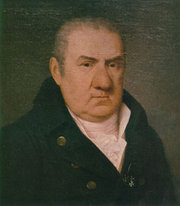
Giacomo Quarenghi

Encyclopedia
Palladian architecture
Palladian architecture is a European style of architecture derived from the designs of the Venetian architect Andrea Palladio . The term "Palladian" normally refers to buildings in a style inspired by Palladio's own work; that which is recognised as Palladian architecture today is an evolution of...
in Imperial Russia, particularly in Saint Petersburg
Saint Petersburg
Saint Petersburg is a city and a federal subject of Russia located on the Neva River at the head of the Gulf of Finland on the Baltic Sea...
.
Career in Italy
Born in Rota d'Imagna near BergamoBergamo
Bergamo is a town and comune in Lombardy, Italy, about 40 km northeast of Milan. The comune is home to over 120,000 inhabitants. It is served by the Orio al Serio Airport, which also serves the Province of Bergamo, and to a lesser extent the metropolitan area of Milan...
to an Italian
Italian people
The Italian people are an ethnic group that share a common Italian culture, ancestry and speak the Italian language as a mother tongue. Within Italy, Italians are defined by citizenship, regardless of ancestry or country of residence , and are distinguished from people...
noble family, Quarenghi was destined by his parents for a career in law or the church but initially was allowed to study painting in the Bergamo studio of G. Reggi, himself a student of Tiepolo. Young Quarenghi was well educated and widely read. Traveling through Italy he visited Vicenza
Vicenza
Vicenza , a city in north-eastern Italy, is the capital of the eponymous province in the Veneto region, at the northern base of the Monte Berico, straddling the Bacchiglione...
, Verona
Verona
Verona ; German Bern, Dietrichsbern or Welschbern) is a city in the Veneto, northern Italy, with approx. 265,000 inhabitants and one of the seven chef-lieus of the region. It is the second largest city municipality in the region and the third of North-Eastern Italy. The metropolitan area of Verona...
, Mantua
Mantua
Mantua is a city and comune in Lombardy, Italy and capital of the province of the same name. Mantua's historic power and influence under the Gonzaga family, made it one of the main artistic, cultural and notably musical hubs of Northern Italy and the country as a whole...
and Venice
Venice
Venice is a city in northern Italy which is renowned for the beauty of its setting, its architecture and its artworks. It is the capital of the Veneto region...
, the places where he made the longest stays. He made drawings of the Greek temples at Paestum
Paestum
Paestum is the classical Roman name of a major Graeco-Roman city in the Campania region of Italy. It is located in the north of Cilento, near the coast about 85 km SE of Naples in the province of Salerno, and belongs to the commune of Capaccio, officially also named...
(Loukomski 1928) and finally arrived in Rome in 1763, at a moment when Neoclassicism
Neoclassicism
Neoclassicism is the name given to Western movements in the decorative and visual arts, literature, theatre, music, and architecture that draw inspiration from the "classical" art and culture of Ancient Greece or Ancient Rome...
was being developed in advanced artistic circles. He studied painting with Anton Raphael Mengs
Anton Raphael Mengs
Anton Raphael Mengs was a German painter, active in Rome, Madrid and Saxony, who became one of the precursors to Neoclassical painting.- Biography :Mengs was born in 1728 at Ústí nad Labem in Bohemia...
, then with Stefano Pozzi
Stefano Pozzi
Stefano Pozzi was an Italian painter, designer, draughtsman and decorator whose career was spent largely in Rome....
, later moving to study architecture (1767–69) with a traditionalist Late Baroque
Baroque architecture
Baroque architecture is a term used to describe the building style of the Baroque era, begun in late sixteenth century Italy, that took the Roman vocabulary of Renaissance architecture and used it in a new rhetorical and theatrical fashion, often to express the triumph of the Catholic Church and...
architect, Paolo Posi.
Then he came upon a copy of Andrea Palladio
Andrea Palladio
Andrea Palladio was an architect active in the Republic of Venice. Palladio, influenced by Roman and Greek architecture, primarily by Vitruvius, is widely considered the most influential individual in the history of Western architecture...
's Quattro Libri d'archittetura
I Quattro Libri dell'Architettura
I quattro libri dell'architettura is an Italian treatise on architecture by the architect Andrea Palladio . It was first published in four volumes in 1570 in Venice, illustrated with woodcuts after the author's own drawings. It has been reprinted and translated many times...
. "You could never believe," he wrote to his friend and long-term correspondent Marchesi, "the impression that this book made. Then it struck me that I had every reason to consider myself badly guided" before that point (Loukomsky 1928). He turned for new, Neoclassical
Neoclassical architecture
Neoclassical architecture was an architectural style produced by the neoclassical movement that began in the mid-18th century, manifested both in its details as a reaction against the Rococo style of naturalistic ornament, and in its architectural formulas as an outgrowth of some classicizing...
instruction from Antoine Decrezet, a friend of Winckelmann, and the former's pupil Niccola Giansimoni, measuring and drawing the antiquities of Rome.
In Venice (1771–1772), where he was studying the works of Palladio, Quarenghi came into contact with a British lord passing through there on the Grand Tour
Grand Tour
The Grand Tour was the traditional trip of Europe undertaken by mainly upper-class European young men of means. The custom flourished from about 1660 until the advent of large-scale rail transit in the 1840s, and was associated with a standard itinerary. It served as an educational rite of passage...
. It was through him that the architect secured a few minor English commissions, such as garden pavilions, chimneypieces (Loukomsky 1928), an altar
Altar
An altar is any structure upon which offerings such as sacrifices are made for religious purposes. Altars are usually found at shrines, and they can be located in temples, churches and other places of worship...
for the private Roman Catholic chapel of Henry Arundell at New Wardour Castle
New Wardour Castle
New Wardour Castle is an English country house at Wardour, near Tisbury in Wiltshire, built for the Arundell family. The house is of a Palladian style, designed by the architect James Paine with additional pieces from Giacomo Quarenghi, who was a principal architect of the Imperial Russian capital...
. Designs for a country house for Lord Whitworth were exhibited at Venice 1967. His first major commission (1771–7) was the internal reconstruction of the monastery of Santa Scholastica at Subiaco
Subiaco, Italy
Subiaco is a town and comune in the Province of Rome, in Lazio, Italy, from Tivoli alongside the river Aniene. It is mainly renowned as a tourist and religious resort for its sacred grotto , in the St. Benedict's Abbey, and the other Abbey of St. Scholastica...
. For the Venetian cardinal Rezzonico, the nephew of Pope Clement XIII
Pope Clement XIII
Pope Clement XIII , born Carlo della Torre di Rezzonico, was Pope from 16 July 1758 to 2 February 1769....
, he designed a decor for a Music Room in the Campidoglio, and designs for Clement's tomb (later executed by Antonio Canova
Antonio Canova
Antonio Canova was an Italian sculptor from the Republic of Venice who became famous for his marble sculptures that delicately rendered nude flesh...
).
His work in Italy and for English clients formed enough of a reputation that in 1779 he was selected by the Prussian-born count Rieffenstein, who had been commissioned by Catherine II of Russia
Catherine II of Russia
Catherine II, also known as Catherine the Great , Empress of Russia, was born in Stettin, Pomerania, Prussia on as Sophie Friederike Auguste von Anhalt-Zerbst-Dornburg...
to send her two Italian architects to replace her French ones (Loukomsky 1928). Despite having just designed a manege
Manege
Manège is the French word for a riding academy. As a loanword in Russian it is Manezh .It may refer to any riding school, riding arena or exercise rectangle, or specifically to:* the Salle du Manège in Paris, France...
in Monaco
Monaco
Monaco , officially the Principality of Monaco , is a sovereign city state on the French Riviera. It is bordered on three sides by its neighbour, France, and its centre is about from Italy. Its area is with a population of 35,986 as of 2011 and is the most densely populated country in the...
and a dining hall for the Archduchess of Modena
Modena
Modena is a city and comune on the south side of the Po Valley, in the Province of Modena in the Emilia-Romagna region of Italy....
, 35-year-old Quarenghi seems to have felt himself underemployed, given the number of architects then working in Italy and the dearth of commissions from the church and nobility. He accepted Rieffenstein's offer without hesitation and left with his pregnant wife for St Petersburg.
Career under Catherine II
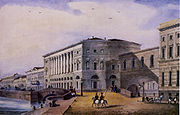
Corinthian order
The Corinthian order is one of the three principal classical orders of ancient Greek and Roman architecture. The other two are the Doric and Ionic. When classical architecture was revived during the Renaissance, two more orders were added to the canon, the Tuscan order and the Composite order...
portico
Portico
A portico is a porch leading to the entrance of a building, or extended as a colonnade, with a roof structure over a walkway, supported by columns or enclosed by walls...
. The structure, which pleased the Empress immensely, was blown up by the Germans during World War II
World War II
World War II, or the Second World War , was a global conflict lasting from 1939 to 1945, involving most of the world's nations—including all of the great powers—eventually forming two opposing military alliances: the Allies and the Axis...
and was later demolished by the Soviet
Soviet Union
The Soviet Union , officially the Union of Soviet Socialist Republics , was a constitutionally socialist state that existed in Eurasia between 1922 and 1991....
government. In 1783 Quarenghi settled with his family in Tsarskoe Selo, where he would supervise the construction of the Alexander Palace
Alexander Palace
The Alexander Palace is a former imperial residence at Tsarskoye Selo, on a plateau around 30 minutes by train from St Petersburg. It is known as the favourite residence of the last Russian Emperor, Nicholas II, and his family and their initial place of imprisonment after the revolution that...
, the most ambitious of his undertakings to date.
Appointed to the post of Catherine's court architect, Quarenghi went on to produce a prodigious number of designs for the Empress, her successors and members of her court: houses, summerhouses, bridges, theatres, hospices, a market, a bank building, interior decorations and garden designs. His projects were put into execution as far away from the capital as Novhorod-Siverskyi
Novhorod-Siverskyi
Novhorod-Siversky is a historic city in the Chernihiv Oblast of Ukraine. It is the administrative center of the Novhorod-Siversky Raion, and is situated on the bank of the Desna River, 330 km from the capital, Kiev, and 45 km south of the Russian border. Current estimated population:...
, Ukraine
Ukraine
Ukraine is a country in Eastern Europe. It has an area of 603,628 km², making it the second largest contiguous country on the European continent, after Russia...
where a cathedral was constructed to his designs.
In Moscow
Moscow
Moscow is the capital, the most populous city, and the most populous federal subject of Russia. The city is a major political, economic, cultural, scientific, religious, financial, educational, and transportation centre of Russia and the continent...
, he was responsible for the reconstruction of medieval Red Square
Red Square
Red Square is a city square in Moscow, Russia. The square separates the Kremlin, the former royal citadel and currently the official residence of the President of Russia, from a historic merchant quarter known as Kitai-gorod...
in a fashionable neo-Palladian mode. Count Nicholas Sheremetev engaged him to devise a theatre hall in the Ostankino Palace
Ostankino Palace
Ostankino Palace is a former summer residence and private opera theater of Sheremetev family, originally situated several kilometres to the north from Moscow but now a part of the North-Eastern Administrative Okrug of Moscow...
and a semicircular collonnade for the Sheremetev Hospital. Most of Quarenghi's designs intended for Moscow were subsequently realized with significant modifications by other architects, as was the case with Gostiny Dvor
Moscow Gostiny Dvor
The Old Merchant Court in Moscow occupies a substantial portion of Kitai-gorod, as the old merchant district is known. Formerly accommodating both shops and warehouses, it was constructed of brick in the 1590s and underwent significant modifications from 1638–41...
(1789-1805), Catherine Palace
Catherine Palace (Moscow)
The Catherine Palace is a Neoclassical residence of Catherine II of Russia on the bank of the Yauza River in Lefortovo, Moscow. It should not be confused with the much more famous Catherine Palace in Tsarskoye Selo....
(1782-87), and Sloboda Palace (1790-94).
Career under Paul and Alexander I
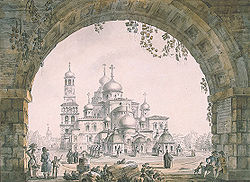
Under such circumstances, he visited Italy in 1801 and was given a triumphant welcome. He turned his attention to watercolours, enlivening conventional architectural vistas with genre scenes from everyday city life. He also published several albums of neo-Palladian designs (1787, 1791, 1810) and provided elaborate designs for decorative vase
Vase
The vase is an open container, often used to hold cut flowers. It can be made from a number of materials including ceramics and glass. The vase is often decorated and thus used to extend the beauty of its contents....
s, capitals for columns and metalwork executed for imperial residences, particularly the Winter Palace
Winter Palace
The Winter Palace in Saint Petersburg, Russia, was, from 1732 to 1917, the official residence of the Russian monarchs. Situated between the Palace Embankment and the Palace Square, adjacent to the site of Peter the Great's original Winter Palace, the present and fourth Winter Palace was built and...
.
With the enthronement of Alexander I of Russia
Alexander I of Russia
Alexander I of Russia , served as Emperor of Russia from 23 March 1801 to 1 December 1825 and the first Russian King of Poland from 1815 to 1825. He was also the first Russian Grand Duke of Finland and Lithuania....
, Quarenghi was again at the height of his individuality and fashion. In 1805 the architect became a corresponding member of the Imperial Academy of Arts
Imperial Academy of Arts
The Russian Academy of Arts, informally known as the St. Petersburg Academy of Arts, was founded in 1757 by Ivan Shuvalov under the name Academy of the Three Noblest Arts. Catherine the Great renamed it the Imperial Academy of Arts and commissioned a new building, completed 25 years later in 1789...
. His design for the Anichkov Palace
Anichkov Palace
Anichkov Palace is a former imperial palace in Saint Petersburg, at the intersection of Nevsky Avenue and the Fontanka.-History:The palace, situated on the plot formerly owned by Antonio de Vieira, takes its name from the nearby Anichkov Bridge across the Fontanka...
Collonnade, however, incurred severe criticism from the academic establishment for the perceived erratic use of classical order
Classical order
A classical order is one of the ancient styles of classical architecture, each distinguished by its proportions and characteristic profiles and details, and most readily recognizable by the type of column employed. Three ancient orders of architecture—the Doric, Ionic, and Corinthian—originated in...
s. Quarenghi defended himself in a letter to Canova proclaiming that "good sense and judgment shouldn't be enslaved by commonly accepted rules and models".
Giacomo Quarenghi was granted Russian nobility
Russian nobility
The Russian nobility arose in the 14th century and essentially governed Russia until the October Revolution of 1917.The Russian word for nobility, Dvoryanstvo , derives from the Russian word dvor , meaning the Court of a prince or duke and later, of the tsar. A nobleman is called dvoryanin...
and the Order of St. Vladimir
Order of St. Vladimir
The Cross of Saint Vladimir was an Imperial Russian Order established in 1782 by Empress Catherine II in memory of the deeds of Saint Vladimir, the Grand Prince and the Baptizer of the Kievan Rus....
of the First Degree in 1814. After 1808 he lived largely in retirement as a celebrity. Of his thirteen children by two wives, a few chose to remain in Russia, while others returned to Italy. He died at age 72 in Saint Petersburg.
When the 150th anniversary of his death was being marked in 1967, the remains of Quarenghi were moved from the Volkov Cemetery to the Necropolis at the Alexander Nevsky Monastery, and a bust of the architect was erected between the Assignation Bank and Bank Bridge
Bank Bridge
Bank Bridge is a 25-m-long pedestrian bridge crossing the Griboedov Canal near the former Assignation Bank in Saint Petersburg, Russia. Like other bridges across the canal, the existing structure dates from 1826. The bridge engineer was Wilhelm von Traitteur, who conceived of a pedestrian...
in Saint Petersburg.
Works in St Petersburg
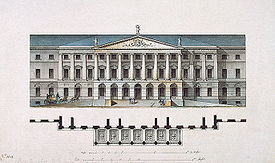
- 1782-83 - the Collegium of Foreign Affairs on the English EmbankmentEnglish EmbankmentThe English Embankment or English Quay is a street along the Neva River in Central Saint Petersburg. It has been historically one of the most fashionable streets in Saint Petersburg....
; - 1782-87 - St. Mary's Hospital in Pavlovsk;
- 1783-84 - the Bezborodko Country House in Polyustrovo;
- 1783-87 - the Hermitage TheatreHermitage TheatreThe Hermitage Theatre in Saint Petersburg, Russia is one of five Hermitage buildings lining the Palace Embankment of the Neva River.The palatial theatre was built between 1783 and 1787 at the behest of Catherine the Great to a Palladian design by Giacomo Quarenghi...
, the only surviving 18th-century theatre in St Petersburg, inspired to the PalladioAndrea PalladioAndrea Palladio was an architect active in the Republic of Venice. Palladio, influenced by Roman and Greek architecture, primarily by Vitruvius, is widely considered the most influential individual in the history of Western architecture...
's Teatro OlimpicoTeatro OlimpicoThe Teatro Olimpico is a theatre in Vicenza, northern Italy: constructed in 1580-1585, it is the oldest surviving enclosed theatre in the world. The theatre was the final design by the Italian Renaissance architect Andrea Palladio, Renaissance, and was not completed until after his death...
of VicenzaVicenzaVicenza , a city in north-eastern Italy, is the capital of the eponymous province in the Veneto region, at the northern base of the Monte Berico, straddling the Bacchiglione...
. The designs of Quarenghi's theater were engraved and published in 1787, giving him a European reputation; - 1783-89 - the Academy of SciencesRussian Academy of SciencesThe Russian Academy of Sciences consists of the national academy of Russia and a network of scientific research institutes from across the Russian Federation as well as auxiliary scientific and social units like libraries, publishers and hospitals....
on the University Embankment; - 1783-89 - the Assignation Bank on Sadovaya Street (illustrated, to the left);
- 1784-87 - the Silver Rows on Nevsky ProspektNevsky ProspektNevsky Avenue |Prospekt]]) is the main street in the city of St. Petersburg, Russia. Planned by Peter the Great as beginning of the road to Novgorod and Moscow, the avenue runs from the Admiralty to the Moscow Railway Station and, after making a turn at Vosstaniya Square, to the Alexander...
; - 1787-92 - the Raphael Loggia in the Winter PalaceWinter PalaceThe Winter Palace in Saint Petersburg, Russia, was, from 1732 to 1917, the official residence of the Russian monarchs. Situated between the Palace Embankment and the Palace Square, adjacent to the site of Peter the Great's original Winter Palace, the present and fourth Winter Palace was built and...
; - 1789-96 - the Main Apothecary on Millionaya Street;
- 1784-86 - the Saltykov house on the Field of MarsField of Mars (Saint Petersburg)The Field of Mars or Marsovo Polye is a large park named after the Mars - Roman god of war situated in the center of Saint-Petersburg, with an area of about 9 hectares. Bordering the Field of Mars to the north are the Marble Palace, Suvorova Square and Betskoi’s and Saltykov’s houses. To the west...
; - 1788-90 - the Vietinghoff house on Admiralty Prospect;
- 1790 - the Yusupov house on Sadovaya Street;
- 1791 - the belfry of the Vladimirskaya ChurchVladimirskaya ChurchVladimirskaya Church is a Russian Orthodox church, dedicated to Our Lady of Vladimir and located at 20 Vladimirsky Prospect, St. Petersburg, Russia....
; - 1792-96 - the Alexander PalaceAlexander PalaceThe Alexander Palace is a former imperial residence at Tsarskoye Selo, on a plateau around 30 minutes by train from St Petersburg. It is known as the favourite residence of the last Russian Emperor, Nicholas II, and his family and their initial place of imprisonment after the revolution that...
, designed for St Petersburg but simplified when it was erected in the Alexander Park of Tsarskoye SeloTsarskoye SeloTsarskoye Selo is the town containing a former Russian residence of the imperial family and visiting nobility, located south from the center of St. Petersburg. It is now part of the town of Pushkin and of the World Heritage Site Saint Petersburg and Related Groups of Monuments.-History:In...
; pavilions in the landscape part of the Catherine Park, including the Concert Hall pavilion (1782 - 1786/88), the Kitchen Ruins (1780s), the Hall on the Island (1794); - 1797-1800 the Maltese Chapel at the VorontsovVorontsovVorontsov, also Woronzow, Woroncow is a celebrated Russian family, which attained the dignity of Counts of the Holy Roman Empire in 1744 and Serene Princes of the Russian Empire in 1852....
Palace; - 1803-05 - St. Mary's Hospital for the Poor on Liteiny Prospect;
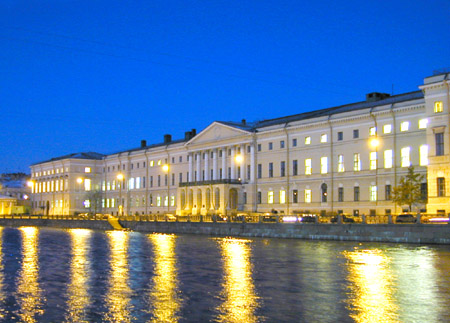
- 1804-07 - the Catherine Institute on the FontankaFontankaFontanka is a left branch of the river Neva, which flows through the whole of Central Saint Petersburg, Russia. Its length is 6,700 meters, its width is up to 70 meters, and its depth is up to 3,5 meters. The Fontanka Embankment is lined with the former private residences of Russian nobility.This...
Embankment (affiliated with the Russian National LibraryRussian National LibraryThe National Library of Russia in St Petersburg, known as the State Public Saltykov-Shchedrin Library from 1932 to 1992 , is the oldest public library in Russia...
);.jpg)
- 1803-09 - the Imperial Cabinet of the Anichkov PalaceAnichkov PalaceAnichkov Palace is a former imperial palace in Saint Petersburg, at the intersection of Nevsky Avenue and the Fontanka.-History:The palace, situated on the plot formerly owned by Antonio de Vieira, takes its name from the nearby Anichkov Bridge across the Fontanka...
on Nevsky Prospect; - 1806-08 - the SmolnySmolnyThe Smolny Institute is a Palladian edifice in St Petersburg that has played a major part in the history of Russia.The building was commissioned from Giacomo Quarenghi by the Society for Education of Noble Maidens and constructed in 1806-08 to house the Smolny Institute for Noble Maidens,...
Institute for Noble MaidensInstitute for Noble MaidensInstitute for Noble Maidens was a type of educational institution, finishing school in late Imperial Russia. It was devised by Ivan Betskoy as a girl-only institution for girls of noble origin. The first and most famous of these was the Smolny Institute in St.Petersburg.-Institutes for Noble...
(illustrated, to the right); - 1804-07 - the Cavalry Manege, or Riding Academy on St Isaac's Square (1804-07);
- 1814 - the Narva Triumphal GateNarva Triumphal GateThe Narva Triumphal Arch was erected in the vast Narva Square , Saint Petersburg, in 1814 to commemorate the Russian victory over Napoleon. The wooden structure was constructed on the Narva highway with the purpose of greeting the soldiers who were returning from abroad after their victory over...
, later replaced by a permanent structure to a design by Vasily StasovVasily StasovVasily Petrovich Stasov was a Russian architect.-Biography:Stasov was born in Moscow....
; - 1814-16 - the Anglican Church on the English Embankment.
External links
- G. Loukomsky, 1928. "Giacomo Quarenghi"
- Quarenghi on alexanderpalace.org
- Quarenghi on the Anichkov Palace website
- Guide to Quarenghi on-line
- Find-A-Grave
Further reading
- Taleporovsky V.N. Кваренги. Leningrad-Moscow, 1954.
- Grimm G.G. Кваренги. Leningrad, 1962.
- Disegni di Giacomo Quarenghi. (Exhibition catalogue), Venice, 1967 (Contents)
- Pilyavsky V.I. Джакомо Кваренги: Архитектор. Художник. Leningrad, 1981.
- Giacomo Quarenghi: architetto a Pietroburgo: Lettere e altri scritti. Venice, 1988.
- Fabbriche e disegni di Giacomo Quarenghi. Bergamo, 1994 (reprint of 1821 edition).
- Giacomo Quarenghi: Architetture e vedute. Milano, 1994.