

Kincaid Mounds State Historic Site

Encyclopedia
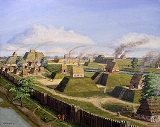
The Kincaid Mounds Historic Site, circa 1050-1400 CE, was among the largest prehistoric Mississippian culture
chiefdom
centers, located at the southern tip of present day U.S. state
of Illinois
. Kincaid Mounds has been notable for both its significant role in native North American prehistory and for the central role the site has played in the development of modern archaeological techniques. The area had royal or central buildings on at least 11 mounds (ranking 5th for mound-culture pyramids). Some artifacts link the settlement to southern Mississippian culture
, built after an earlier culture from the Late Woodland period
(500 to 1000 CE).
in 1964 for its significance as a major Native American
mound
center and prehistoric trading post
along the Ohio River
.
Adjacent to the Ohio River
, the site straddles the modern-day counties of Massac County and Pope County in deep southern Illinois, an area colloquially known as Little Egypt
. The site was the subject of major excavations by the University of Chicago from 1934–1941, during which a number of famous anthropologist
s and archaeologist
s were trained under the direction of Fay-Cooper Cole
. These included Richard MacNeish
, discoverer of the origins of maize
. Exploration with new technology and excavations by teams from Southern Illinois University
since 2003 has yielded significant new data.
The Illinois Historic Preservation Agency
owns and operates an area including nine mounds in Massac County. This includes the majority of the estimated 141 acre (0.57060726 km²) area contained within a wooden palisade
, as well as an undefined area of additional occupation to the west.
The Pope County portion is privately owned.
culture. Except for the lack of pottery, it was otherwise very like the subsequent cultures of the Early Woodland, such as the Adena culture
(1000 BCE to 200 BCE).
Teams documented more intensive occupation in the ensuing Early Woodland and Middle Woodland periods. This involved a sedentary
, semi-agricultural
culture characterized by the use of limestone
-temper
ed ceramics and the presence of permanent wooden houses. The Baumer culture, as it was called, was similar to the Adena
and Hopewell cultures, with which it was contemporary. The Baumer occupation at Kincaid was shown to be extensive.
 Occupation continued into the Late Woodland period. This period is known as the Lewis culture. The most notable occupation at Kincaid, however, is the Mississippian culture
that developed out of the local Lewis community about 1050 CE. Kincaid was a near neighbor of Cahokia
, only 140 miles (225.3 km) away, and is thought to have been influenced by developments there. The people built at least 19 earthwork
mounds during this period, mostly the characteristic Mississippian platform mound
s. Since 2003 teams from Southern Illinois University have been conducting more intensive research. A large central plaza
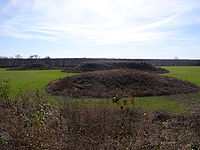
, constructed by filling and leveling, occupies the center of the community. It is surrounded by the major mounds, which are as much as 30 feet (9.1 m) tall and one is almost 500 feet (152.4 m) long. None rivals the size of Monks Mound at Cahokia but they are very large by Mississippian standards.
Large buildings atop the main mounds seemed to indicate temples or council houses. Carved figurines in coal
and fluorite
seemed to characterize the local iconography
, with images showing connections to the Southeastern Ceremonial Complex
(SECC). Trade for chert
resources appeared to extend into Missouri
, Tennessee
, and other parts of Illinois. Several examples of Mill Creek chert
, which came from quarries very near by, were found at the site. Mississippian culture pottery
painted with a negative resist are also characteristic of the site. In the 1930s, the Chicago team excavated a major burial mound, Pope Mound 2, yielding further evidence for hierarchical social structures and showing that Kincaid was a chiefdom
. The mound contained a number of stone box grave
s and log lined tombs similar to those frequently found to the south in the Middle Cumberland Valley of Tennessee.
Mississippian-culture occupation at the site appears to have ended by 1400-1450 CE. No documented occupation by historic Native American
tribes exists. The site was evidently abandoned, perhaps because of exhaustion of timber and game resources. It remained uninhabited until the arrival of European-American and African-American settlers three centuries later. Most arrived more than 400 years after the site was abandoned.
valley in Illinois
, Kentucky, and Indiana, the Mississippian-culture towns of Kincaid, Wickliffe
, Tolu
, and Angel Mounds
have been grouped together into a "Kincaid Focus" set, due to similarities in pottery assemblages and site plans. Most striking are the comparisons between the Kincaid and Angel sites, which include analogous site plans, stylistic similarities in artifacts, and geographic closeness. These connections have led some experts to hypothesize that the builders and residents were of the same society.
The 300-400 year span in which these types of artifacts and sites are found is called the “Angel Phase
”. It is broken up into three subphases:
Rare painted and incised sherds of Mississippian culture pottery
have been found at all four sites, ranging from less than one percent near Kincaid to about three or four percent of the assemblage at Wickliffe. Some common pottery styles found in these sites include: Angel Negative Painted, Kincaid Negative Painted, and Matthews Incised. This pottery is shell tempered and ranges from the smoothed surface and coarser temper of Mississippi Ware to the more polished surface and finer temper of Bell Ware.
Mississippian culture
The Mississippian culture was a mound-building Native American culture that flourished in what is now the Midwestern, Eastern, and Southeastern United States from approximately 800 CE to 1500 CE, varying regionally....
chiefdom
Chiefdom
A chiefdom is a political economy that organizes regional populations through a hierarchy of the chief.In anthropological theory, one model of human social development rooted in ideas of cultural evolution describes a chiefdom as a form of social organization more complex than a tribe or a band...
centers, located at the southern tip of present day U.S. state
U.S. state
A U.S. state is any one of the 50 federated states of the United States of America that share sovereignty with the federal government. Because of this shared sovereignty, an American is a citizen both of the federal entity and of his or her state of domicile. Four states use the official title of...
of Illinois
Illinois
Illinois is the fifth-most populous state of the United States of America, and is often noted for being a microcosm of the entire country. With Chicago in the northeast, small industrial cities and great agricultural productivity in central and northern Illinois, and natural resources like coal,...
. Kincaid Mounds has been notable for both its significant role in native North American prehistory and for the central role the site has played in the development of modern archaeological techniques. The area had royal or central buildings on at least 11 mounds (ranking 5th for mound-culture pyramids). Some artifacts link the settlement to southern Mississippian culture
Mississippian culture
The Mississippian culture was a mound-building Native American culture that flourished in what is now the Midwestern, Eastern, and Southeastern United States from approximately 800 CE to 1500 CE, varying regionally....
, built after an earlier culture from the Late Woodland period
Woodland period
The Woodland period of North American pre-Columbian cultures was from roughly 1000 BCE to 1000 CE in the eastern part of North America. The term "Woodland Period" was introduced in the 1930s as a generic header for prehistoric sites falling between the Archaic hunter-gatherers and the...
(500 to 1000 CE).
Introduction
The site was declared a National Historic LandmarkNational Historic Landmark
A National Historic Landmark is a building, site, structure, object, or district, that is officially recognized by the United States government for its historical significance...
in 1964 for its significance as a major Native American
Indigenous peoples of the Americas
The indigenous peoples of the Americas are the pre-Columbian inhabitants of North and South America, their descendants and other ethnic groups who are identified with those peoples. Indigenous peoples are known in Canada as Aboriginal peoples, and in the United States as Native Americans...
mound
Mound
A mound is a general term for an artificial heaped pile of earth, gravel, sand, rocks, or debris. The most common use is in reference to natural earthen formation such as hills and mountains, particularly if they appear artificial. The term may also be applied to any rounded area of topographically...
center and prehistoric trading post
Trading post
A trading post was a place or establishment in historic Northern America where the trading of goods took place. The preferred travel route to a trading post or between trading posts, was known as a trade route....
along the Ohio River
Ohio River
The Ohio River is the largest tributary, by volume, of the Mississippi River. At the confluence, the Ohio is even bigger than the Mississippi and, thus, is hydrologically the main stream of the whole river system, including the Allegheny River further upstream...
.
Adjacent to the Ohio River
Ohio River
The Ohio River is the largest tributary, by volume, of the Mississippi River. At the confluence, the Ohio is even bigger than the Mississippi and, thus, is hydrologically the main stream of the whole river system, including the Allegheny River further upstream...
, the site straddles the modern-day counties of Massac County and Pope County in deep southern Illinois, an area colloquially known as Little Egypt
Little Egypt (region)
-Early history:The earliest inhabitants of Illinois were thought to have arrived about 12,000 B.C. They were hunter-gatherers, but developed a primitive system of agriculture. After 1000 AD, their agricultural surpluses enabled them to develop complex, hierarchical societies...
. The site was the subject of major excavations by the University of Chicago from 1934–1941, during which a number of famous anthropologist
Anthropology
Anthropology is the study of humanity. It has origins in the humanities, the natural sciences, and the social sciences. The term "anthropology" is from the Greek anthrōpos , "man", understood to mean mankind or humanity, and -logia , "discourse" or "study", and was first used in 1501 by German...
s and archaeologist
Archaeology
Archaeology, or archeology , is the study of human society, primarily through the recovery and analysis of the material culture and environmental data that they have left behind, which includes artifacts, architecture, biofacts and cultural landscapes...
s were trained under the direction of Fay-Cooper Cole
Fay-Cooper Cole
.Fay-Cooper Cole was a professor of anthropology at the University of Chicago and most famously was a witness for the defense for John Scopes at the Scopes Trial.-External links:...
. These included Richard MacNeish
Richard MacNeish
Richard Stockton MacNeish , known to many as "Scotty", was an American archaeologist. His fieldwork revolutionized the understanding of the development agriculture in the New World, the prehistory of several regions of Canada, the United States and Central and South America...
, discoverer of the origins of maize
Maize
Maize known in many English-speaking countries as corn or mielie/mealie, is a grain domesticated by indigenous peoples in Mesoamerica in prehistoric times. The leafy stalk produces ears which contain seeds called kernels. Though technically a grain, maize kernels are used in cooking as a vegetable...
. Exploration with new technology and excavations by teams from Southern Illinois University
Southern Illinois University Carbondale
Southern Illinois University Carbondale is a public research university located in Carbondale, Illinois, United States. Founded in 1869, SIUC is the flagship campus of the Southern Illinois University system...
since 2003 has yielded significant new data.
The Illinois Historic Preservation Agency
Illinois Historic Preservation Agency
The Illinois Historic Preservation Agency is a governmental agency of the U.S. state of Illinois. It is tasked with the duty of maintaining most State-owned historic sites within Illinois, and maximizing their educational and recreational value to visitors....
owns and operates an area including nine mounds in Massac County. This includes the majority of the estimated 141 acre (0.57060726 km²) area contained within a wooden palisade
Palisade
A palisade is a steel or wooden fence or wall of variable height, usually used as a defensive structure.- Typical construction :Typical construction consisted of small or mid sized tree trunks aligned vertically, with no spacing in between. The trunks were sharpened or pointed at the top, and were...
, as well as an undefined area of additional occupation to the west.
The Pope County portion is privately owned.
History of Kincaid
The Chicago excavators in the 1930s documented a prehistory in the Kincaid area stretching back thousands of years, into what is now known as the Archaic Period (8000 BCE to 2000 BCE). The Chicago crew recognized this period as the Faulkner Component, which was described as a pre-potteryPottery
Pottery is the material from which the potteryware is made, of which major types include earthenware, stoneware and porcelain. The place where such wares are made is also called a pottery . Pottery also refers to the art or craft of the potter or the manufacture of pottery...
culture. Except for the lack of pottery, it was otherwise very like the subsequent cultures of the Early Woodland, such as the Adena culture
Adena culture
The Adena culture was a Pre-Columbian Native American culture that existed from 1000 to 200 BC, in a time known as the early Woodland Period. The Adena culture refers to what were probably a number of related Native American societies sharing a burial complex and ceremonial system...
(1000 BCE to 200 BCE).
Teams documented more intensive occupation in the ensuing Early Woodland and Middle Woodland periods. This involved a sedentary
Sedentism
In evolutionary anthropology and archaeology, sedentism , is a term applied to the transition from nomadic to permanent, year-round settlement.- Requirements for permanent settlements :...
, semi-agricultural
Agriculture
Agriculture is the cultivation of animals, plants, fungi and other life forms for food, fiber, and other products used to sustain life. Agriculture was the key implement in the rise of sedentary human civilization, whereby farming of domesticated species created food surpluses that nurtured the...
culture characterized by the use of limestone
Limestone
Limestone is a sedimentary rock composed largely of the minerals calcite and aragonite, which are different crystal forms of calcium carbonate . Many limestones are composed from skeletal fragments of marine organisms such as coral or foraminifera....
-temper
Temper
Temperare is the Latin origin of words like "temperature" and "tempering"; it and "tempo" come, in turn, from tempus...
ed ceramics and the presence of permanent wooden houses. The Baumer culture, as it was called, was similar to the Adena
Adena culture
The Adena culture was a Pre-Columbian Native American culture that existed from 1000 to 200 BC, in a time known as the early Woodland Period. The Adena culture refers to what were probably a number of related Native American societies sharing a burial complex and ceremonial system...
and Hopewell cultures, with which it was contemporary. The Baumer occupation at Kincaid was shown to be extensive.
Mississippian culture
The Mississippian culture was a mound-building Native American culture that flourished in what is now the Midwestern, Eastern, and Southeastern United States from approximately 800 CE to 1500 CE, varying regionally....
that developed out of the local Lewis community about 1050 CE. Kincaid was a near neighbor of Cahokia
Cahokia
Cahokia Mounds State Historic Site is the area of an ancient indigenous city located in the American Bottom floodplain, between East Saint Louis and Collinsville in south-western Illinois, across the Mississippi River from St. Louis, Missouri. The site included 120 human-built earthwork mounds...
, only 140 miles (225.3 km) away, and is thought to have been influenced by developments there. The people built at least 19 earthwork
Earthworks (archaeology)
In archaeology, earthwork is a general term to describe artificial changes in land level. Earthworks are often known colloquially as 'lumps and bumps'. Earthworks can themselves be archaeological features or they can show features beneath the surface...
mounds during this period, mostly the characteristic Mississippian platform mound
Platform mound
A platform mound is any earthwork or mound intended to support a structure or activity.-Eastern North America:The indigenous peoples of North America built substructure mounds for well over a thousand years starting in the Archaic period and continuing through the Woodland period...
s. Since 2003 teams from Southern Illinois University have been conducting more intensive research. A large central plaza
Plaza
Plaza is a Spanish word related to "field" which describes an open urban public space, such as a city square. All through Spanish America, the plaza mayor of each center of administration held three closely related institutions: the cathedral, the cabildo or administrative center, which might be...
, constructed by filling and leveling, occupies the center of the community. It is surrounded by the major mounds, which are as much as 30 feet (9.1 m) tall and one is almost 500 feet (152.4 m) long. None rivals the size of Monks Mound at Cahokia but they are very large by Mississippian standards.
Large buildings atop the main mounds seemed to indicate temples or council houses. Carved figurines in coal
Coal
Coal is a combustible black or brownish-black sedimentary rock usually occurring in rock strata in layers or veins called coal beds or coal seams. The harder forms, such as anthracite coal, can be regarded as metamorphic rock because of later exposure to elevated temperature and pressure...
and fluorite
Fluorite
Fluorite is a halide mineral composed of calcium fluoride, CaF2. It is an isometric mineral with a cubic habit, though octahedral and more complex isometric forms are not uncommon...
seemed to characterize the local iconography
Iconography
Iconography is the branch of art history which studies the identification, description, and the interpretation of the content of images. The word iconography literally means "image writing", and comes from the Greek "image" and "to write". A secondary meaning is the painting of icons in the...
, with images showing connections to the Southeastern Ceremonial Complex
Southeastern Ceremonial Complex
The Southeastern Ceremonial Complex is the name given to the regional stylistic similarity of artifacts, iconography, ceremonies, and mythology of the Mississippian culture that coincided with their adoption of maize agriculture and chiefdom-level complex social organization from...
(SECC). Trade for chert
Chert
Chert is a fine-grained silica-rich microcrystalline, cryptocrystalline or microfibrous sedimentary rock that may contain small fossils. It varies greatly in color , but most often manifests as gray, brown, grayish brown and light green to rusty red; its color is an expression of trace elements...
resources appeared to extend into Missouri
Missouri
Missouri is a US state located in the Midwestern United States, bordered by Iowa, Illinois, Kentucky, Tennessee, Arkansas, Oklahoma, Kansas and Nebraska. With a 2010 population of 5,988,927, Missouri is the 18th most populous state in the nation and the fifth most populous in the Midwest. It...
, Tennessee
Tennessee
Tennessee is a U.S. state located in the Southeastern United States. It has a population of 6,346,105, making it the nation's 17th-largest state by population, and covers , making it the 36th-largest by total land area...
, and other parts of Illinois. Several examples of Mill Creek chert
Mill Creek chert
Mill Creek chert is a type of chert found in Southern Illinois and heavily exploited by members of the Mississippian culture . Artifacts made from this material are found in archeological sites throughout the American Midwest and Southeast. It is named for a village and stream near the quarrys,...
, which came from quarries very near by, were found at the site. Mississippian culture pottery
Mississippian culture pottery
Mississippian culture pottery is the ceramic tradition of the Mississippian culture found as artifacts in archaeological sites in the American Midwest and Southeast. It is often characterized by the adoption and use of riverine shell-tempering agents in the clay paste. Shell tempering is one of...
painted with a negative resist are also characteristic of the site. In the 1930s, the Chicago team excavated a major burial mound, Pope Mound 2, yielding further evidence for hierarchical social structures and showing that Kincaid was a chiefdom
Chiefdom
A chiefdom is a political economy that organizes regional populations through a hierarchy of the chief.In anthropological theory, one model of human social development rooted in ideas of cultural evolution describes a chiefdom as a form of social organization more complex than a tribe or a band...
. The mound contained a number of stone box grave
Stone box grave
Stone box graves were a method of burial employed by Native Americans of the Mississippian culture in the American Midwest and Southeast. Their construction was especially common in the Cumberland River Basin around Nashville, Tennessee-Construction:...
s and log lined tombs similar to those frequently found to the south in the Middle Cumberland Valley of Tennessee.
Mississippian-culture occupation at the site appears to have ended by 1400-1450 CE. No documented occupation by historic Native American
Indigenous peoples of the Americas
The indigenous peoples of the Americas are the pre-Columbian inhabitants of North and South America, their descendants and other ethnic groups who are identified with those peoples. Indigenous peoples are known in Canada as Aboriginal peoples, and in the United States as Native Americans...
tribes exists. The site was evidently abandoned, perhaps because of exhaustion of timber and game resources. It remained uninhabited until the arrival of European-American and African-American settlers three centuries later. Most arrived more than 400 years after the site was abandoned.
Kincaid Focus
In the lower Ohio RiverOhio River
The Ohio River is the largest tributary, by volume, of the Mississippi River. At the confluence, the Ohio is even bigger than the Mississippi and, thus, is hydrologically the main stream of the whole river system, including the Allegheny River further upstream...
valley in Illinois
Illinois
Illinois is the fifth-most populous state of the United States of America, and is often noted for being a microcosm of the entire country. With Chicago in the northeast, small industrial cities and great agricultural productivity in central and northern Illinois, and natural resources like coal,...
, Kentucky, and Indiana, the Mississippian-culture towns of Kincaid, Wickliffe
Wickliffe Mounds
Wickliffe Mounds is a prehistoric, Mississippian culture archaeological site located in Ballard County, Kentucky, just outside the town of Wickliffe, about three miles from the confluence of the Ohio and Mississippi rivers. Archaeology investigations have linked the site with others along the Ohio...
, Tolu
Tolu Site
The Tolu Site is a prehistoric archeological site of the Mississippian culture near the unincorporated community of Tolu, Crittenden County, Kentucky, United States. It was built and occupied between 1200-1450 CE. No carbon dating has been performed at the site, but analysis of pottery styles...
, and Angel Mounds
Angel Mounds
Angel Mounds State Historic Site is located on the Ohio River in Vanderburgh and Warrick Counties eight miles southeast of Evansville and just upriver of the confluence of the Green and Ohio rivers. Administered by the Indiana Department of Natural Resources, Division of Indiana State Museums...
have been grouped together into a "Kincaid Focus" set, due to similarities in pottery assemblages and site plans. Most striking are the comparisons between the Kincaid and Angel sites, which include analogous site plans, stylistic similarities in artifacts, and geographic closeness. These connections have led some experts to hypothesize that the builders and residents were of the same society.
The 300-400 year span in which these types of artifacts and sites are found is called the “Angel Phase
Angel Phase
The Angel Phase describes a 300-400-year cultural manifestation of the Mississippian culture of the central portions of the United States of America, as defined in the discipline of archaeology. Angel Phase archaeological sites date from c...
”. It is broken up into three subphases:
| Subphases | Dates |
|---|---|
| Jonathan Creek | 1000 - 1100/1200 CE |
| Angelly | 1200 - 1300 CE |
| Tinsley Hill | 1300 - 1450 CE |
Rare painted and incised sherds of Mississippian culture pottery
Mississippian culture pottery
Mississippian culture pottery is the ceramic tradition of the Mississippian culture found as artifacts in archaeological sites in the American Midwest and Southeast. It is often characterized by the adoption and use of riverine shell-tempering agents in the clay paste. Shell tempering is one of...
have been found at all four sites, ranging from less than one percent near Kincaid to about three or four percent of the assemblage at Wickliffe. Some common pottery styles found in these sites include: Angel Negative Painted, Kincaid Negative Painted, and Matthews Incised. This pottery is shell tempered and ranges from the smoothed surface and coarser temper of Mississippi Ware to the more polished surface and finer temper of Bell Ware.
See also
- Millstone BluffMillstone BluffMillstone Bluff is located somewhere near Glendale, Illinois in Pope County. A natural formation, the bluff is listed on the National Register of Historic Places. Millstone Bluff is one of numerous sites nationwide to have its "address restricted" by the Register. These sites are often sensitive to...
- List of Mississippian sites
- Mississippi Valley: Culture, phase, and chronological periods table - List of archaeological periods
